Gluten-free Ramen Market Size, Share & Industry Analysis, By Product Type (Instant Ramen Noodles and Fresh Ramen Noodles), By Ingredients (Rice, Millets, Buckwheat, Legume, and Others), By Packaging (Pouch, Cup, and Others), By Flavor (Chicken, Beef, Seafood, Vegetables, and Others), By Distribution Channel (B2B and B2C), and Regional Forecast, 2026-2034
 Download Free Sample
(Offer valid till 30th Sep 2026)

Gluten-free Ramen Market Size and Future Outlook
 Listen to Audio Version
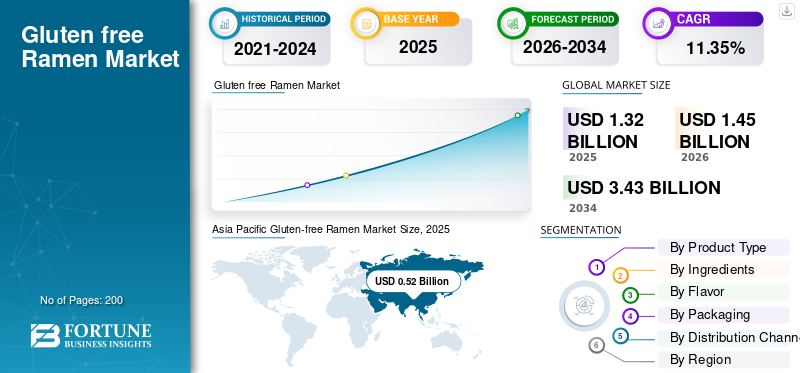
The global gluten-free ramen market size was valued at USD 1.32 billion in 2025. The market is projected to grow from USD 1.45 billion in 2026 to USD 3.43 billion by 2034, exhibiting a CAGR of 11.35% during the forecast period. Asia Pacific dominated the gluten-free ramen market with a market share of 39.39% in 2025.
Gluten-free ramen is a type of traditional Japanese noodle soup that replaces wheat-based ingredients with gluten-free alternatives. Product demand is growing as awareness of gluten intolerance, the popularity of Asian noodle products, clean-label reformulation, and the rising demand for convenient ready-to-cook meals continue to support the market growth. Additionally, increasing consumer interest in premium instant meals and alternative grain products is driving market growth. Unlike conventional ramen, which is largely made from wheat flour, the product uses ingredients such as rice, millet, buckwheat, legumes, konjac, corn, quinoa, or mixed-grain formulations to deliver wheat-free noodle textures while meeting the dietary needs of individuals with wheat allergies. The market is gaining traction across retail, e-commerce, foodservice, and meal-kit distribution channels in countries such as the U.S., U.K., Australia, South Korea, Singapore, and India.
The market is supported by manufacturers such as McCormick & Company, Inc., Lotus Foods, Inc., King Soba, Koka Noodles, Acecook, and other regional manufacturers.
Download Free sample to learn more about this report.
Gluten-free Ramen Market Trends
Changing Lifestyle Paired with Emerging Clean-Label Product Presents a Key Industry Trend
Changing lifestyles are reshaping wheat-free ramen from a purely dietary-restriction product into a convenient, better-for-you meal option. Consumers are increasingly looking for products that combine convenience with perceived health benefits, including clean labels, recognizable grains, no artificial additives, low sodium, vegan claims, non-GMO positioning, organic certification, and high-protein formulations. This trend is supporting innovation in ramen products made from rice, millet, brown rice, buckwheat, konjac, quinoa, chickpea, lentil, and mixed-grain formulations. Manufacturers are increasingly launching products that combine multiple claims in one product. Gluten-free ramen brands increasingly emphasize “wheat-free,” “organic ramen,” “vegan ramen,” “non-GMO ramen,” “whole grain,” “low sodium,” and “no additives” to target health-conscious consumers. This positioning is relevant as traditional instant ramen is often perceived as high in sodium and heavily processed.
- According to the International Food Information Council’s 2024 Food & Health Survey, which surveyed 3,000 U.S. consumers' health perceptions, food safety, ingredient transparency, and eating patterns continue to influence food-purchasing decisions.
MARKET DYNAMICS
Market Drivers
Download Free sample to learn more about this report.
Rising Gluten Intolerance among Adults to Drive Market Expansion
The market is strongly driven by the increasing awareness of celiac disease, non-celiac gluten sensitivity, wheat allergy, and broader gluten avoidance among adult consumers. Ramen is traditionally made from wheat flour, which limits consumption among gluten-intolerant consumers and creates demand for alternatives made with rice, millet, buckwheat, legumes, and other gluten-free ingredients. As diagnosis rates improve and consumers become more attentive to digestive health, gluten-free ramen is moving beyond a niche medical-diet product into a functional food category and convenient food option for consumers seeking allergen-safe, easy-to-prepare meals.
Demand is particularly strong in markets with well-established gluten-free labeling systems and higher penetration of free-from products. This has enabled gluten-free ramen to achieve a broader consumer base than many other gluten-free meal formats, especially when products are positioned as certified gluten-free, wheat-free, vegan, organic, low-sodium, or clean-label noodles. Thus, the instant ramen market is emerging in the healthy noodles category globally.
- According to the Celiac Disease Foundation, celiac disease is estimated to affect 1 in 100 people worldwide, while only about 30% are properly diagnosed. This indicates a large underserved population requiring or seeking gluten-free food products.
Market Restraints
Volatility in Raw Material Costs to Hamper Market Growth
Despite rising demand, gluten-free ramen manufacturers face cost pressure from volatile prices of rice, millet, buckwheat, corn, legumes, quinoa, starches, and packaging materials. Rice, ramen noodles, and millet-based ramen are especially exposed to agricultural price swings, export restrictions, adverse weather conditions, freight cost fluctuations, and variations in crop availability. In addition, premium gluten-free ramen products often depend on imported ingredients or finished goods, making the category sensitive to exchange-rate fluctuations and international logistics costs. These cost pressures limit affordability and constrain mass-market adoption across South Asia, Southeast Asia, Africa, Latin America, and parts of the Middle East, where conventional instant noodles are much cheaper and more widely available.
- According to the Food and Agriculture Organization, the rice price index increased by 1.9% in April compared with the previous month. Furthermore, the Cereal Price Index averaged 111.3 points in April, up 0.9 points (0.8%) from March. The monthly increase reflected higher prices across major cereal commodities.
Market Opportunities
Growing Ready-To-Eat and Convenience Food Consumption to Push Market Growth
The expansion of ready-to-eat, ready-to-cook, and convenience food consumption creates a strong growth opportunity for the market. Instant ramen is already one of the world’s most scalable convenience foods due to its affordability, long shelf life, quick preparation, and easy distribution through supermarkets, convenience stores, e-commerce, foodservice, and institutional channels. Gluten-free ramen can capture this convenience-driven demand while also addressing the needs of consumers seeking wheat-free and gluten-free alternatives. Growth opportunities are strongest in instant ramen cups, bowl formats, pouches, ramen kits, meal kits, frozen ramen bowls, and foodservice-ready gluten-free noodle portions. Rising noodle-eating habits further strengthen the market. In the U.S. and Europe, demand is additionally driven by the growing popularity of free-from foods, premium Asian cuisine, and clean-label convenience meals.
- According to the World Instant Noodles Association, 123.1 billion servings of instant noodles were consumed globally in 2024, demonstrating the scale of the convenience noodle platform that gluten-free ramen can target.
SEGMENTATION ANALYSIS
By Product Type
Instant Ramen Noodles Segment Dominated the Market Due to Wider Retail Availability and Longer Shelf Life
Based on product type, the market is segmented into instant ramen noodles and fresh ramen noodles.
The instant ramen noodles segment dominated the global market and was valued at USD 1.16 billion in 2025, owing to its strong availability across supermarkets, health-food stores, online platforms, specialty gluten-free stores, and convenience-led retail channels. Instant gluten-free ramen is widely preferred as it offers a longer shelf life, easier storage, quicker preparation, and better affordability than fresh gluten-free ramen. The segment is mainly supported by rice-, millet-, and buckwheat-based ramen cakes, and legume-based ramen cakes, sold in pouch, cup, and bowl formats. The segment also benefits from the rising demand for ready-to-cook and ready-to-eat meal solutions among consumers with gluten intolerance, wheat sensitivity, celiac disease, and clean-label food preferences.
The fresh ramen noodles segment was valued at USD 0.16 billion in 2025 and is projected to grow at the fastest CAGR of 12.48% from 2026 to 2034, supported by increasing demand for restaurant-style gluten-free meals, premium refrigerated noodles, foodservice applications, and meal-kit formats.
By Ingredients
Rice Segment Dominated the Market Due to Its Broad Usage, Mild Taste, and Strong Gluten-Free Acceptance
Based on ingredients, the market is segmented into rice, millets, buckwheat, legumes, and others.
The rice segment led the global market and was valued at USD 0.56 billion in 2025, owing to its widespread use as a primary gluten-free noodle base. Rice-based ramen is preferred as it offers a mild taste, good digestibility, broad consumer acceptance, and better compatibility with Asian-style broths, such as chicken, seafood, vegetable, miso, and shoyu. Rice is also among the most familiar gluten-free grains globally, making it easier for manufacturers to position rice-based ramen as a safe, accessible wheat-free alternative.
The legumes segment was valued at USD 0.13 billion in 2025 and is projected to grow at the fastest CAGR of 14.66% during the forecast period. Growth is driven by increased demand for high-protein gluten-free noodles made from chickpea, lentil, pea, and bean-based ingredients. Legume-based ramen appeals to health-conscious consumers seeking higher protein, greater satiety, and plant-based nutrition.
To know how our report can help streamline your business, Speak to Analyst
By Flavor
Chicken Segment Dominated the Market Due to Its Broad Consumer Acceptance
Based on flavor, the market is segmented into chicken, beef, seafood, vegetables, and others.
The chicken segment dominated the market and was valued at USD 0.41 billion in 2025, owing to its broad consumer acceptance, familiar taste profile, and strong presence in instant ramen products. Chicken flavor is among the most widely consumed ramen flavors in the U.S. and Europe. Chicken-flavored gluten-free ramen benefits from strong usage in pouch, cup, and instant noodle formats. It also shows wider compatibility with rice, millet, buckwheat, and legume-based noodle formulations. Due to its mainstream appeal, chicken flavor is often the preferred launch option for manufacturers entering the gluten-free ramen category.
The vegetable segment reached USD 0.32 billion in 2025 and is projected to grow at the fastest CAGR of 12.66% from 2026 to 2034. The segment’s growth is supported by rising demand for vegan, vegetarian, plant-based ramen, clean-label, and low-allergen food options. Vegetable-based broths are widely used in gluten-free ramen as they align with health-conscious consumer preferences and reduce dependency on animal-based flavoring systems.
By Packaging
Pouch Segment Dominated the Market Due to Its Lower Packaging Costs, Longer Shelf Life, and Strong Household Consumption
Based on packaging, the market is segmented into pouch, cup, and others.
The pouch segment dominated the market and was valued at USD 0.92 billion in 2025, owing to its lower packaging costs, longer shelf life, ease of storage, and strong suitability for household consumption. Pouch-based gluten-free ramen is commonly sold as single-serve packs, multi-packs, and ramen cake formats, making it attractive for both consumers and retailers. For manufacturers, pouch formats reduce packaging weight, improve logistics efficiency, and enable flexible product positioning across economy-, mid-range-, and premium-gluten-free ramen product lines.
The cup segment was valued at USD 0.35 billion in 2025 and is projected to grow at the fastest CAGR of 12.22% during the forecast period.
By Distribution Channel
B2C Segment Dominated the Market due to Strong Retail, E-Commerce, and Household Consumption
Based on distribution channel, the market is segmented into B2B and B2C.
The B2C segment captured the dominant global gluten-free ramen market share, valued at USD 1.07 billion in 2025. The dominance is driven by strong demand from household consumers purchasing gluten-free ramen through supermarkets, hypermarkets, health-food stores, specialty gluten-free stores, online retailers, and convenience stores. Gluten-free ramen is still largely a consumer-packaged product, with most consumption occurring at home as part of everyday meal preparation.
The B2B segment reached USD 0.25 billion in 2025 and is projected to grow at the fastest CAGR of 12.58% from 2026 to 2034.
Gluten-free Ramen Market Regional Outlook
Regionally, the market is studied across North America, Europe, Asia Pacific, South America, and the Middle East & Africa.
North America
Asia Pacific Gluten-free Ramen Market Size, 2025 (USD Billion)
To get more information on the regional analysis of this market, Download Free sample
North America was valued at USD 0.40 billion in 2025 and is projected to reach USD 1.06 billion by 2034, growing at a CAGR of 11.47% during the forecast period. Growth is driven by high awareness of gluten-free diets, strong trust in allergen labeling, premium retail availability, and increasing demand for convenient Asian-style meals. The region benefits from strong B2C sales through supermarkets, natural food retailers, and e-commerce, while foodservice and meal kits are creating new B2B opportunities. Clean-label and “free-from” purchasing behavior is also supporting demand for rice, millet, buckwheat, and legume-based ramen.
U.S. Gluten-free Ramen Market
The U.S. dominates the North American market, valued at approximately USD 0.31 billion in 2025, supported by mature gluten-free product penetration, strong online grocery access, and high consumer willingness to pay for allergen-safe convenience foods. The U.S. also has a large instant noodle market, with WINA reporting 5.151 billion instant noodle servings in 2024, creating a strong platform for premium and health-focused innovations, driving gluten-free ramen products.
Europe
Europe was valued at USD 0.30 billion in 2025 and is projected to reach USD 0.74 billion by 2034, growing at a CAGR of 10.58% during the forecast period. Market growth is supported by established gluten-free certification systems, strong coeliac awareness associations, premium retail channels, and high consumer trust in free-from labeling. Growth opportunities are strongest in vegetable, seafood, miso, and clean-label ramen formats, as consumers increasingly combine gluten-free diets with plant-based and health-conscious eating habits. AOECS states that its Crossed Grain Trademark licensing system covers gluten-free product sales in over 30 European countries, and more than 23,000 gluten-free products have been licensed under the scheme till 2025.
Germany Gluten-free Ramen Market
Germany was valued at approximately USD 0.06 billion in 2025 and is supported by a strong organic food retail network, high purchasing power, and growing demand for clean-label Asian meal solutions. Product demand is being driven by rice-, millet-, buckwheat-, and legume-based products sold in supermarkets, drugstores, organic chains, and e-commerce. Although the country has a smaller ramen consumption base than Asia, it benefits from higher value realization through premium pricing and strong consumer acceptance of free-from retail.
Asia Pacific
Asia Pacific dominated the global market, valued at USD 0.52 billion in 2025, and is projected to reach USD 1.42 billion by 2034, growing at the fastest CAGR of 11.96% during the forecast period. The region is driven by high noodle-eating habits, strong ramen culture, rising urban health awareness, and rapid growth in premium retail and e-commerce. Unlike North America and Europe, region’s advantage lies in gluten-free penetration and in the scale of noodle consumption across China, India, Japan, Indonesia, Vietnam, Korea, Thailand, and the Philippines. According to WINA’s 2025 demand statistica, global instant noodle demand reached 123.067 billion servings in 2024, with many of the highest-consuming countries.
China Gluten-free Ramen Market
China dominated the regional market, valued at approximately USD 0.15 billion in 2025. Gluten-free ramen market growth is supported by the world’s largest instant noodle consumption base and growing demand for premium, health-focused packaged foods in urban markets. WINA reported 43.802 billion instant noodle servings for China/Hong Kong in 2024, exceeding any other country and creating a substantial consumer base for gluten-free ramen adoption. Demand is concentrated in tier-1 and tier-2 cities, where consumers have better access to imported foods, specialty health products, and e-commerce platforms. Growth opportunities are strongest in rice and millet-based gluten-free ramen products.
Japan Gluten-free Ramen Market
Japan was valued at approximately USD 0.09 billion in 2025. A deep ramen culture, high product-quality expectations, and the increasing availability of wheat-free and allergen-conscious noodle alternatives support market growth. According to WINA, Japan consumed around 5.901 billion servings of instant noodles in 2024, confirming a large domestic noodle consumption base. Demand for the product is further supported by tourism, specialty noodles offerings, health-conscious consumers, and continued product innovation using ingredients such as rice, brown rice, millet, konjac, and buckwheat.
South America and the Middle East & Africa
South America was valued at USD 0.06 billion in 2025 and is projected to reach USD 0.15 billion by 2034, growing at a CAGR of 10.09% during the forecast period. Growth is led by Brazil and Argentina, where gluten-free labeling awareness, celiac-related food systems, and premium urban retail are more developed than in other regional markets. The regional opportunity is strongest in shelf-stable pouch ramen products and affordable gluten-free noodle formats, as fresh ramen remains limited by cold-chain infrastructure and distribution constraints. Brazil is especially important to regional growth, with WINA reporting 2.592 billion instant noodle servings consumed in 2024.
The Middle East & Africa market was valued at USD 0.03 billion in 2025 and is projected to reach USD 0.06 billion by 2034, growing at a CAGR of 8.28% during the forecast period. The region is driven by premium imported-food demand in Gulf countries, urban health-conscious consumers, expatriate purchasing, and increasing availability of gluten-free products in modern retail. However, growth remains uneven as the affordability and limited availability of certified gluten-free products restrict penetration in many African markets. The strongest opportunities are in the UAE, Saudi Arabia, and South Africa through premium supermarkets, hotels, airline catering, and specialty foodservice. WINA data shows Nigeria consumed 3.002 billion instant noodle servings and South Africa consumed 613 million servings in 2024, indicating a large ordinary noodle base but still a low gluten-free conversion.
Brazil Gluten-free Ramen Market
Brazil dominated the South American market, valued at approximately USD 0.04 billion in 2025. Market growth is supported by the country’s large packaged noodle base, expanding urban health-food retail, and growing consumer reliance on gluten-label visibility.
COMPETITIVE LANDSCAPE
Key Industry Players
Key Players Focus on New Product Development and Geographical Expansion to Strengthen their Market Position
The global gluten-free ramen market is fragmented in nature, with the presence of international and regional players. Key industry players such as McCormick & Company, Inc., Lotus Foods, Inc., King Soba, Koka Noodles, and Acecook hold prominent market share globally. Key players are focusing on new product development to expand their product portfolio. Furthermore, industry players are expanding their geographical reach to strengthen their consumer base and market position globally.
Key Players in the Gluten-free Ramen Market
|
Rank |
Company Name |
|
1 |
McCormick & Company, Inc. |
|
2 |
Koka Noodles |
|
3 |
Lotus Foods, Inc. |
|
4 |
King Soba |
|
5 |
Acecook |
List of Key Gluten-free Ramen Companies Profiled
- McCormick & Company, Inc. (U.S.)
- Naturally Yours (India)
- Star Anise Foods LLC (U.S.)
- Lotus Foods Inc. (U.S.)
- Kobayashi Noodle (Japan)
- King Soba (U.K.)
- Hayashi Seimen (Japan)
- Koka Noodles (Tat Hui Foods), (Singapore)
- Vifon (Vietnam)
- Acecook (Vietnam)
KEY INDUSTRY DEVELOPMENTS
- March 2025: Lotus Foods, a global processed food manufacturer, launched Organic Wide White Rice Ramen in the U.S. The new products are available in Millet & Brown Rice Ramen, Jade Pearl Rice™ Ramen, and Forbidden Rice® Ramen variants.
- November 2024: Naturally Yours, an Indian emerging instant noodles and ramen manufacturing company, launched a millet and buckwheat (Kuttu) based instant ramen. The company claims that the new product is free from artificial colors, preservatives, and MSG.
REPORT COVERAGE
The global gluten-free ramen market research provides an in-depth study of market sizes & forecast by all the market segments included in the report. The market analysis includes details on the market dynamics and market trends expected to drive the market during the forecast period. It offers information on the technological advancements, new product launches, key industry developments, and details on partnerships, mergers & acquisitions. The report also encompasses a detailed competitive landscape with information on the market segmentation, market share, and profiles of key operating players.
Request for Customization to gain extensive market insights.
Report Scope & Segmentation
| ATTRIBUTE | DETAILS |
| Study Period | 2021-2034 |
| Base Year | 2025 |
| Estimated Year | 2026 |
| Forecast Period | 2026-2034 |
| Historical Period | 2021-2024 |
| Growth Rate | CAGR of 11.35% from 2026 to 2034 |
| Unit | Value (USD Billion) |
|
Segmentation |
By Product Type
|
|
By Ingredients
|
|
|
By Flavor
|
|
|
By Packaging
|
|
|
By Distribution Channel
|
|
|
By Region
|
Frequently Asked Questions
Fortune Business Insights says that the global market was valued at USD 1.32 billion in 2025 and is anticipated to reach USD 3.43 billion by 2034.
At a CAGR of 11.35%, the global market will exhibit fast growth over the forecast period.
By ingredient, the rice segment led the market.
Asia Pacific held the largest market share in 2025.
Rising gluten intolerance among adults is a key factor driving the market.
McCormick & Company, Inc., Lotus Foods, Inc., King Soba, Koka Noodles, and Acecook are the leading players in the market.
Changing lifestyle paired with the emerging clean-label product is a key market trend.



- 2021-2034
- 2025
- 2021-2024
- 200
-
(Offer valid till 30th Sep 2026)
Get 30-60 hrs Free Customization
Expand Regional and Country Coverage, Segments Analysis, Company Profiles, Competitive Benchmarking, and End-user Insights.




















Related Reports
-
US +1 833 909 2966 ( Toll Free )
-
Get In Touch With Us