GNSS Simulator Market Size, Share & Industry Analysis, By Type (RF GNSS Simulators, Software-defined GNSS Simulators, Integrated HIL GNSS Simulation Benches), By Constellation Support (Single-Constellation & Multi-Constellation Simulators), By Application (Avionics & UAV Navigation Testing, Launch & Space Mission GNSS Testing, & Others), By Offering (Hardware, Software, & Services), By End User (Aircraft / UAV / Avionics OEMs, Spacecraft & Launch Vehicle Primes, Defense & Government (Air Forces, Space Forces, Labs), and Space Agencies, & Others), and Regional Forecast, 2026-2034
 Download Free Sample
KEY MARKET INSIGHTS
 Listen to Audio Version
The global GNSS simulator market size was valued at USD 214.50 million in 2025 and is projected to grow from USD 234.53 million in 2026 to USD 503.01 million by 2034, exhibiting a CAGR of 10.01% during the forecast period. North America dominated the global market with a share of 40.63% in 2025.
The GNSS simulator market covers hardware, software and services that generate realistic GPS/Galileo/GLONASS/BeiDou/NavIC signals in the lab to test GNSS receivers and full navigation systems. It spans classic RF rack instruments, SDR-based simulators and integrated HIL benches tied to INS, FMS and GNC rigs. These tools are used for avionics, UAVs, launch vehicles, satellites, timing systems, and resilience testing against jamming and spoofing. Key end users are aircraft and UAV OEMs, satellite and launcher primes, defense labs, space agencies, and specialist test houses.
Major players such as Spirent, Safran (Orolia/Skydel), Rohde & Schwarz, IFEN and others keep pushing SDR, automation, and mission-specific solutions.
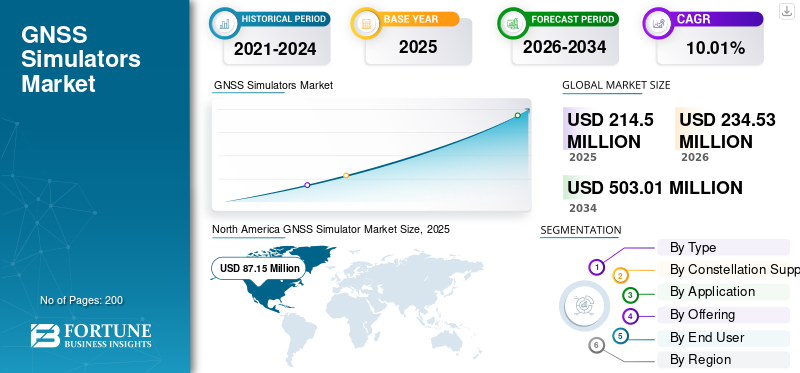
Download Free sample to learn more about this report.
GNSS Simulator Market KEY TAKEAWAYS
 Market Size & Forecast
- 2025 Market Size: USD 214.50 million
- 2026 Market Size: USD 234.53 million
- 2034 Forecast Market Size: USD 503.01 million
- CAGR: 10.01% from 2026–2034
 Market Share
- North America dominated the market with a 40.63% share in 2025.
- Software-Defined GNSS Simulators segment is projected to grow at a CAGR of 10.60%.
- Single-Constellation Simulators segment is projected to grow at a CAGR of 9.58%.
 Key Regional Highlights
North America
USD 87.15 million in 2025. Strong defense spending, aerospace testing demand, and advanced GNSS infrastructure support market leadership.
Europe
USD 47.69 million in 2026. Growth supported by aerospace innovation, military applications, and advanced navigation testing systems.
Asia Pacific
Fastest-growing region. Driven by space programs, NAVIC and BeiDou systems, and rising aerospace and defense testing demand.
U.S.
USD 58.00 million in 2026. Demand driven by military navigation, aerospace testing, and commercial GNSS applications.
Japan
USD 10.26 million in 2026. Growth supported by aerospace R&D and advanced navigation technology adoption.
Read More

MARKET DYNAMICS
MARKET DRIVERS
Rise in Multi-Constellation GNSS Standards to Drive Market Growth
The market for GNSS simulators is anticipated to expand rapidly due to the increasing use of multi-constellation GNSS systems, such as GPS, GLONASS, Galileo, and BeiDou. As industries including autonomous vehicles, aviation, defense, and precision agriculture require improved positioning accuracy and dependability, testing systems must handle data from several constellations simultaneously. Without depending on live signals, GNSS simulators allow developers to verify device performance in challenging, real-world scenarios. The market is driven by ongoing innovation as a result of the shift toward multi-constellation capabilities, which raises the demand for sophisticated simulation tools that guarantee interoperability, signal integrity, and enhanced error correction.
MARKET RESTRAINTS
High Cost and Complexity of GNSS Testing Infrastructure May Restrain Market Growth
The high cost and complexity of GNSS testing infrastructure are projected to impede market expansion. Sophisticated hardware, signal production devices, and software that can accurately simulate various constellations are necessary for the development and upkeep of sophisticated GNSS simulators. This results in high operating costs and capital expenditures, particularly for smaller businesses and research institutes. Furthermore, the intricacy of setting up, adjusting, and updating these systems necessitates the assistance of qualified experts and ongoing technical assistance. These obstacles prevent broad adoption, especially in developing nations where it is challenging to deploy sophisticated GNSS testing systems on a large scale due to financial limitations and a lack of technical resources.
MARKET OPPORTUNITIES
Growing Focus on PNT Resilience and Space-Based GNSS to Create Market Opportunities
Improvements in space-based GNSS and the increasing demand for precise Positioning, Navigation, and Timing (PNT) are anticipated to generate substantial market potential. Since accurate and continuous positioning data is essential to current systems, it is now crucial to make sure that they are resilient to jamming, spoofing, and signal disruptions. Strong testing and simulation technologies are being purchased by governments and businesses to confirm system dependability in challenging circumstances. Advanced GNSS simulators and testing solutions are becoming more necessary as a result of the growth of space-based GNSS architectures and their integration with complementary technologies such as satellite-based augmentation systems (SBAS) and low earth orbit constellations, which improve accuracy.
GNSS SIMULATOR MARKET TRENDS
Shift to Software-Defined, Automated, and Hardware-in-the-Loop (HIL) centric Simulation is the Latest Market Trend
The shift toward hardware-in-the-loop (HIL)-centric, software-defined, and automated GNSS simulation is having a big impact on market trends. With the flexibility and speed of software-defined architectures, developers can effectively evaluate changing GNSS signals and interference situations. In complex systems, automation facilitates continuous integration and validation by increasing testing speed and repeatability. The growing preference for HIL simulations mixes real hardware components with virtual GNSS environments, enhancing accuracy and performance validation for applications such as autonomous vehicles, avionics, and defense systems. Innovation in cutting-edge GNSS testing solutions and their industry acceptance are being propelled by the convergence of flexibility, automation, and realism.
MARKET CHALLENGES
Data Security and Signal Integrity Concerns is a Market Challenge
In GNSS simulators infrastructure, maintaining signal integrity and data security is a significant concern. The possibility of interference, spoofing, and illegal access rises as simulators produce and process vast amounts of satellite signal data. Strong encryption and secure signal handling procedures are necessary to defend critical defense, aerospace, and automotive test facilities against cyberattacks. Furthermore, it is essential to guarantee the precision and genuineness of simulated signals to prevent deceptive test results. Organizations using sophisticated GNSS simulation systems face obstacles due to the complexity and expense of ongoing cybersecurity improvements and signal validation technology.
Russia Ukraine War Impact
Complexity of GNSS Jamming Has Impacted the Market amid the Russia-Ukraine War
The market for GNSS simulators has been significantly impacted by the conflict between Russia and Ukraine. The frequency and complexity of GNSS jamming, spoofing, and electronic warfare have increased the demand for sophisticated simulation and testing systems. To impede military, aviation, and civilian navigation across Ukraine and the surrounding areas, Russian strategies include the tactical deployment of jamming equipment on active frontlines and urban defensive installations. This has highlighted the necessity for strong, durable PNT systems and unveiling shortcomings in vital infrastructure. Investments in GNSS simulators that can simulate interference, test resilience, and improve security for both military and civilian applications have increased as a result of the war.
Download Free sample to learn more about this report.
Segmentation Analysis
By System Type
RF GNSS Simulators Segment to Expand with Ease of Testing Under Multipath Scenarios
On the basis of segmentation by type, the market is classified into RF GNSS simulators, software-defined GNSS simulators, and integrated HIL GNSS simulation benches.
The RF GNSS simulators segment accounted for a dominant market share in 2025. Advanced RF simulators enable testing under varied interference, jamming, and multipath scenarios, ensuring that IoT devices meet stringent accuracy and resilience standards expected by sectors such as defense, automotive, and aerospace.
The software-defined GNSS simulators segment is expected to grow at the highest CAGR of 10.60% over the forecast period.
By Constellation Support
Rise in Diverse Global Navigation to Boost Multi-constellation Simulators Segment
In terms of constellation support, the market is categorized into single-constellation simulators and multi-constellation simulators.
The multi-constellation simulators segment captured the largest GNSS simulator market share in 2025. The segment is expanding due to the growing demand for accurate and dependable navigation in industries such as defense, aviation, and autonomous vehicles, which calls for testing receivers with multiple satellite systems (GPS, Galileo, GLONASS, and BeiDou) at the same time.
The single-constellation simulators segment is expected to grow at the highest CAGR of 9.58% over the forecast period.
By Application
Expansion of the UAV Sector to Propel Avionics & UAV Navigation Testing Segment Growth
Based on application, the market is segmented into avionics & UAV navigation testing, launch & space mission GNSS testing, GNSS/INS & GNC HIL integration, and others.
The avionics & UAV navigation testing segment held the dominating position in 2025. The segmental expansion is owing to the growing need for secure, dependable, and high-precision navigation systems. This is due to the proliferation of unmanned aerial vehicles (UAVs) and the aerospace industry's strict safety and regulatory standards.
The GNSS/INS & GNC HIL integration segment is set to flourish at the highest CAGR of 10.75% during the forecast period.
By Offering
Rising Demand to Test Complex Real-world Scenarios to Accelerate Hardware Segmental Growth
Based on offering, the market is segmented into hardware, software, and services.
The hardware segment held the dominating position in 2025. Growth is fueled by the surging need to test complex real-world scenarios from diverse industry verticals such as consumer electronics, automotive, and aerospace industries.
The software segment will witness the highest growth rate of 10.52% over the forecast period.
To know how our report can help streamline your business, Speak to Analyst
By End User
Tight Safety Regulations to Strengthen Aircraft / UAV / avionics OEMs Segmental Growth
Based on end user, the market is segmented into aircraft / UAV / avionics OEMs, spacecraft & launch vehicle primes, defense & government (air forces, space forces, labs), and space agencies, certification bodies & research institutes.
The aircraft / UAV / avionics OEMs segment held the dominating position in 2025. The segmental growth is driven by the need to test sophisticated autonomous systems, strict safety standards, and the requirement to guarantee robustness against dangers of signal interference.
The defense & government (air forces, space forces, labs) segment will witness the highest growth rate of 10.80% over the forecast period.
GNSS Simulator Market Regional Outlook
By geography, the market is categorized into Europe, North America, Asia Pacific, and the rest of the world.
North America
North America GNSS Simulator Market Size, 2025 (USD Million) To get more information on the regional analysis of this market, Download Free sample
North America held a dominant share in 2024, valuing at USD 80.08 million, and also took the leading share in 2025 with USD 87.15 million. Strong defense and aerospace spending, the growing need for testing in the aerospace, defense and automotive industries, supportive government initiatives, and cutting-edge GNSS technology infrastructure are the main drivers of regional growth. In the U.S., the market growth is driven by the requirement for accurate and dependable navigation in both commercial and military applications, including testing new systems. In 2026, the U.S. market is estimated to reach USD 58.00 million.
Asia Pacific and Europe
Regions such as Europe and Asia Pacific are anticipated to witness notable GNSS simulator market growth in the coming years. During the forecast period, the Asia Pacific market is projected to record the highest growth rate of 10.78%. The Asia Pacific region is the fastest-growing due to the increased government investment in space programs, the creation of several regional navigation systems (such as India's NAVIC and China's BeiDou), and the requirement for sophisticated training and testing for military and aerospace applications. Backed by these factors, China is anticipated to record a valuation of USD 22.01 million, Japan is likely to record USD 10.26 million, and India, USD 17.14 million, in 2026. Following Asia Pacific, the market in Europe is estimated to reach USD 47.69 million in 2026. In the region, the U.K. and Germany are estimated to reach USD 16.19 million and 12.72 million respectively in 2026.
Rest of the World
In the rest of the world, the Middle East and Africa and Latin America regions would witness moderate growth during the analysis period. In 2026, the Middle East and Africa market is set to record USD 16.32 million as its valuation. The Latin America market is set to attain the value of USD 10.97 million in 2026.
COMPETITIVE LANDSCAPE
KEY INDUSTRY PLAYERS
Advancements in Simulation Testing and Accuracy Define the Market Landscape
The market for GNSS simulators is fragmented, with a mix of established niche suppliers and global leaders competing for technological innovation and customization. Spirent Communications, Rohde & Schwarz, Orolia, CAST Navigation, and Accord Software & Systems are among the leading companies that control the high-precision and military-grade markets. Software-defined, affordable simulators for research and academic applications are the main focus of regional companies in Asia Pacific and Europe. Enhancing test scalability and signal authenticity in advanced positioning, navigation, and timing (PNT) systems requires strategic alliances with aircraft OEMs, satellite system integrators, and defense agencies.
LIST OF KEY GNSS SIMULATORS COMPANIES PROFILED
- Spirent Communications (U.K.)
- Safran (France)
- Rohde & Schwarz (Germany)
- IFEN GmbH (Germany)
- CAST Navigation (U.S.)
- VIAVI Solutions (U.S.)
- Syntony GNSS (France)
- RACELOGIC (U.K.)
- Hexagon (Canada)
- Jackson Labs Technologies (U.S.)
KEY INDUSTRY DEVELOPMENTS
- November 2025: A new global navigation satellite system (GNSS) simulation platform called PNT Xe, unveiled by Spirent Communications, became part of Keysight Technologies, a top supplier of test and validate solutions for next-generation networks and devices. Its purpose is to make high-performance GNSS testing available to more users throughout the development lifecycle.
- April 2025: The U.S. Navy's Naval Air Systems Command (NAVAIR) awarded TrustPoint, a pioneer in cutting-edge Positioning, Navigation, and Timing (PNT) technology, a USD 1.2 million Small Business Innovation Research (SBIR) Phase II contract. Through this historic agreement, TrustPoint and Hexagon would collaborate to develop and demonstrate the first-ever C-band GNSS service-enabled receivers to the U.S. government.
- March 2025: The Japan Aerospace Exploration Agency (JAXA) chose Spirent Communications plc to supply a cutting-edge lunar positioning, navigation, and timing (PNT) simulation solution. This ground-breaking technology would help JAXA's lunar exploration efforts and aid in the creation of vital navigational infrastructure for next lunar missions.
- February 2025: Rohde & Schwarz and u-blox, a top global supplier of GNSS modules, successfully validated u-blox's most recent automotive GNSS module using an automated R&S SMBV100B based GNSS simulator solution in compliance with the recently released Chinese GB/T test requirement for automotive on-board GNSS positioning systems. The "implementation date" for these rules, which were published on November 28, 2024, is June 2025.
- August 2024: TrustPoint announced that SpaceWERX chose it for two Direct-to-Phase II contracts totaling USD 3.8 million. The contracts have been centered on showcasing the company's GPS-independent ground control segment and an advanced position, navigation, and timing (PNT) security application to tackle the Department of the Air Force's (DAF) most urgent issues.
REPORT COVERAGE
Request for Customization to gain extensive market insights.
Report Scope & Segmentation
|
ATTRIBUTE |
DETAILS |
|
Study Period |
2021-2034 |
|
Base Year |
2025 |
|
Estimated Year |
2026 |
|
Forecast Period |
2026-2034 |
|
Historical Period |
2021-2024 |
|
Growth Rate |
CAGR of 10.01% from 2026-2034 |
|
Unit |
Value (USD Million) |
|
Segmentation |
By Type, Constellation Support, Application, Offering, End User, and Region |
|
By Type |
· RF GNSS Simulators · Software-defined GNSS Simulators · Integrated HIL GNSS Simulation Benches |
|
By Constellation Support |
· Single-Constellation Simulators · Multi-Constellation Simulators |
|
By Application |
· Avionics & UAV Navigation Testing · Launch & Space Mission GNSS Testing · GNSS/INS & GNC HIL Integration · Others |
|
By Offering |
· Hardware · Software · Services |
|
By End User |
· Aircraft / UAV / Avionics OEMs · Spacecraft & Launch Vehicle Primes · Defense & Government (Air Forces, Space Forces, Labs) · Space Agencies, Certification Bodies & Research Institutes |
|
By Geography |
· North America (By Type, Constellation Support, Application, Offering, End User and Country) o U.S. o Canada · Europe (By Type, Constellation Support, Application, Offering, End User and Country/Sub-region) o U.K. o Germany o France o Russia o Rest of Europe · Asia Pacific (By Type, Constellation Support, Application, Offering, End User and Country/Sub-region) o China o Japan o India o South Korea o Rest of the Asia Pacific · Rest of the World (By Type, Constellation Support, Application, Offering, End User and Country/Sub-region) o Middle East and Africa o Latin America |
Frequently Asked Questions
Fortune Business Insights says that the global market value stood at USD 214.50 million in 2025 and is projected to reach USD 503.01 million by 2034.
In 2025, the market value stood at USD 87.15 million.
The market is expected to exhibit a CAGR of 10.01% during the forecast period of 2026-2034.
In 2025, the hardware segment dominated the market by offering.
A rise in multi-constellation GNSS standards is a key factor anticipated to drive market growth.
Spirent Communications (U.K.), Safran (France), Rohde & Schwarz (Germany), IFEN GmbH (Germany), and CAST Navigation (U.S.) are some of the major players in the market.
North America dominated the market share in 2025.



- 2021-2034
- 2025
- 2021-2024
- 200
Get 30-60 hrs Free Customization
Expand Regional and Country Coverage, Segments Analysis, Company Profiles, Competitive Benchmarking, and End-user Insights.




















Related Reports
-
US +1 833 909 2966 ( Toll Free )
-
Get In Touch With Us