Gourmet Food Market Size, Share & Industry Analysis, By Product Type (Gourmet Bakery & Confectionery, Gourmet Packaged Foods, Gourmet Dairy & Dairy Alternatives, Gourmet Meat, Seafood & Alternatives, and Gourmet Oils, Vinegars & Seasonings), By Product Form (Shelf-Stable, Chilled, and Frozen), By Distribution Channel (Supermarkets & Hypermarkets, Specialty & Gourmet Stores, Online / D2C, and Duty-Free & Consumer Gifting), and Regional Forecast, 2026-2034
 Download Free Sample
(Offer valid till 15th Oct 2026)

Gourmet Food Market Size
 Listen to Audio Version
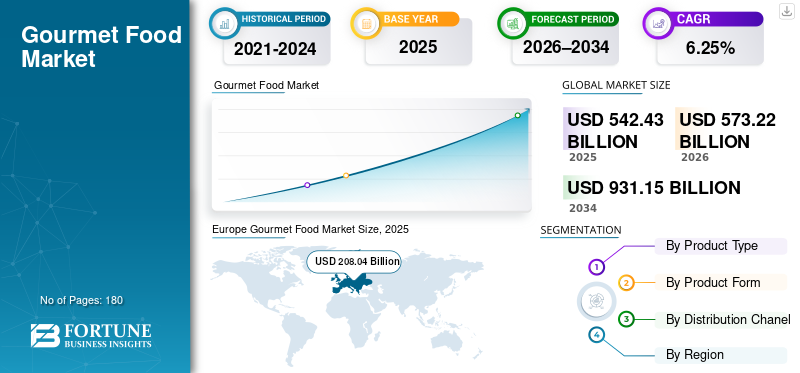
The global gourmet food market size was valued at USD 542.43 billion in 2025. The market is projected to grow from USD 573.22 billion in 2026 to USD 931.15 billion by 2034, exhibiting a CAGR of 6.25% during the forecast period. Europe dominated the gourmet food market with a market share of 38.35% in 2025.
Gourmet foods are high-end products made with high quality ingredients and great care. They stand out in terms of their taste, how they are made, and their focus on authenticity and presentation. Some of the gourmet foods include artisanal baked goods, organic food, fine chocolates, specialty cheeses, gourmet sauces, oils, and carefully selected packaged foods. These products are seen as treats, gifts, or special experiences, and are sold in high-end stores and online. With growth in disposable income, consumers look for special eating experiences at home. More shoppers are willing to pay extra for quality and unique flavors. Better delivery systems and more online shopping have made these foods easier to find, especially for city dwellers and wealthier customers which is driving the market growth.
Companies such as Ferrero Group, Lindt & Sprüngli, Godiva Chocolatier, Mondelez International, and others are some of the key players operating in this market. New product launch is the key strategy adopted to support the market growth.
Download Free sample to learn more about this report.
GOURMET FOOD MARKET KEY TAKEAWAYS
 Market Size & Forecast
- 2025 Market Size: USD 542.43 billion
- 2026 Market Size: USD 573.22 billion
- 2034 Forecast Market Size: USD 931.15 billion
- CAGR: 6.25% from 2026–2034
 Market Share
- Europe dominated the gourmet food market with a 38.35% share in 2025.
- Gourmet packaged foods remained a major product segment, supported by strong demand for premium convenience foods.
- Online/D2C was the fastest-growing distribution segment, expanding at a CAGR of 7.08% from 2026–2034.
 Key Regional Highlights
North America
North America accounted for USD 150.63 billion in 2025, supported by a mature gourmet food ecosystem and growing consumer interest in premium offerings.
Europe
Europe led the global market in 2025, generating USD 208.04 billion in revenue, driven by strong demand for premium and artisanal food products.
Asia Pacific
Asia Pacific reached USD 135.44 billion in 2025 and is among the fastest-growing regions due to rising disposable incomes and evolving food preferences.
U.S.
The market reached USD 126.11 billion in 2025, making it the largest and most competitive gourmet food market in North America.
Japan
The market was valued at USD 35.55 billion in 2025, supported by strong consumer demand for premium-quality, specialty, and imported food products.
Read More

GOURMET FOOD MARKET TRENDS
Authenticity and Sustainability to Redefine the Future of the Market
In recent times brands focus on their origins, craftsmanship, and authenticity to connect with consumers. Premium private labels and plant-based products are becoming more popular, making it harder to tell the difference between specialty and mainstream retail products. Online shopping is changing from offering just convenient food products to offering curated experiences, with personalized suggestions and exclusive products. Sustainability is now a key trend, with more attention on ethical sourcing, recyclable packaging, and cutting down on food waste. New flavors inspired by global and regional cuisines are shaping product launches, especially in sauces, snacks, and sweets.
Download Free sample to learn more about this report.
MARKET DYNAMICS
MARKET DRIVERS
Rising Premiumization and Experiential Consumption to Increase the Demand for the Product
Health conscious consumers are spending more on gourmet bakery, confectionery, sauces, and specialty foods as they look for special experiences and treats at home. Moreover, supermarkets now offer more premium private-label products, making gourmet foods available to more people while still keeping a high-quality image. There is also strong demand for gourmet foods as gifts, especially during festivals and celebrations, which helps drive high-value sales. Online and direct-to-consumer channels have made it easier for people to find and buy a wider range of imported gourmet foods, fostering gourmet food market growth across different regions.
MARKET RESTRAINTS
High Pricing, Supply Chain Complexity, and Regulatory Barriers to Constrain Market Scalability
High price sensitivity in emerging and middle-income markets limits mass adoption, restricting gourmet food products’ consumption largely to urban and affluent consumers. Several chilled and artisanal items have a shorter shelf-life and need careful temperature control. This raises costs for retailers and limits distances through which the products can be shipped. In established markets, the competition is high and there are many similar products present on store shelves. This makes it hard for brands to stand out and consequently raises marketing costs. Together, these issues make it tough for smaller brands to grow quickly.
MARKET OPPORTUNITIES
Digital Expansion and Premium Everyday Products Unlock New Growth Avenues for the Market
There are strong growth opportunities in the market as more consumers look for affordable treats in everyday food, not just luxury items. With the growth of online and cross-border shopping, as well as direct-to-consumer models, gourmet brands can now reach niche customers without relying on traditional retail stores. More people are interested in clean-label, organic, and sustainably sourced gourmet products, giving brands a chance to stand out and improve profits. New ideas like portion-controlled, shelf-stable, and gift-ready products can help people enjoy such foods outside of special occasions. Working with retailers, subscription services, and curated gourmet platforms can also help brands reach more customers and find new ways to grow.
Segmentation Analysis
By Product Type
High Purchase Frequency and Attractive Packaging Propels Gourmet Bakery & Confectionery Segment Leadership
By product type, the market is segmented into gourmet bakery & confectionery, gourmet packaged foods, gourmet dairy & dairy alternatives, gourmet meat, seafood & alternatives and gourmet oils, vinegars & seasonings.
Gourmet bakery and confectionery products was the largest segment in 2025. Artisanal breads, premium pastries, chocolates, artisanal cheese and desserts are popular because people enjoy them for special occasions, festivals, and as treats that feel special or meaningful. These products are sold at higher prices in supermarkets, specialty shops, and online stores. Attractive displays and packaging encourage people to buy these products on impulse, helping this category stay ahead in sales.
Gourmet packaged foods is another major segment which is expected to grow at a CAGR of 6.49% during the forecast period. This segment’s growth is driven by convenience, versatility, and extended shelf life. Premium sauces, condiments, ready-to-eat items, and specialty spreads cater to time-constrained consumers seeking restaurant-quality experiences at home. Continuous innovation in flavors and clean-label positioning supports sustained demand for gourmet packaged foods.
By Product Form
Shelf Stable Product Form Leads Market Due To Its Long Shelf Life And Distribution Efficiency
Based on the product form, the market includes shelf-stable, chilled, and frozen.
The shelf-stable product form accounted for the largest market share in 2025 as they last longer, are easy to store, and are simpler to distribute. Retailers can offer a wide variety of gourmet foods, such as sauces, condiments, oils, and sweets, without needing special cold storage for these products. For shoppers, shelf-stable foods are convenient, help cut down on food waste, and are good for gifts, which makes them a popular choice for product form in the premium food market.
Chilled product form is another major segment, predicted to grow at a CAGR of 5.85% during the forecast period. This is mainly because people perceive them as fresher, more authentic, and of higher quality, especially when it comes to gourmet dairy, specialty cheeses, and premium meats. Even though chilled products cost more to store and transport, customers are willing to pay extra for better taste and the appeal of artisanal products. Better cold-chain systems and improved store refrigeration have made these products more widely available, especially in developed economies.
By Distribution Channel
Wide Assortment of Products and High Visibility Drive Supermarkets and Hypermarkets’ Dominance
The market segmentation based on distribution channel includes supermarkets & hypermarkets, specialty & gourmet stores, online / D2C, and duty-free & consumer gifting.
Supermarket and hypermarket segment i held the largest gourmet food market share in 2025 as they offer a wide range of products, attract many shoppers, and have more premium private-label options. These stores give gourmet brands good visibility, build trust with shoppers, and make products available right away, all of which are important for selling premium foods. Special gourmet aisles, in-store promotions, and product samples help engage customers and encourage them to try new products.
Online / D2C is the fastest growing segment with an estimated CAGR of 7.08% from 2026 to 2034. E-commerce platforms let consumers find imported, niche, and artisanal gourmet products that are often not available in physical stores. Subscription models, curated gourmet boxes, and targeted digital marketing help brands build stronger relationships with their customers.
To know how our report can help streamline your business, Speak to Analyst
Gourmet Food Market Regional Outlook
By geography, the market is categorized into Europe, North America, Asia Pacific, South America, and the Middle East & Africa.
Europe
Europe Gourmet Food Market Size, 2025 (USD Billion)
To get more information on the regional analysis of this market, Download Free sample
The European market reached USD 208.04 billion by 2025 and it is the leading region in the global gourmet market share. The European market is influenced by strong regional traditions, widespread use of Protected Designations Of Origin (PDO), Protected Geographical Indications (PGI), and well-known reputation of artisanal producers. Unlike North America, competition focuses less on branding and more on consistent quality, origin, and skilled production. Private labels are well established and introduced in ways that respect traditional food culture. In this mature market, brands hardly change and products remain on the shelves longer.
Germany Gourmet Food Market
The market in Germany in 2025 reached around USD 38.52 billion, representing roughly 7.10% of global market revenues.
U.K. Gourmet Food Market
U.K. market reached approximately USD 33.47 billion in 2025, equivalent to around 6.17% of global market sales.
Asia Pacific
The Asia Pacific market is valued at USD 135.44 billion in 2025 and is the one of the fastest growing region. The Asia Pacific market is growing and has a diverse structure, with competition that differs greatly from one country to another. In established markets like Japan and Australia, companies compete on quality, premium packaging, and brand trust. In China and Southeast Asia, competition focuses more on the appeal of imported products, gifting traditions, and online retail. Competition is high in cities, where both global brands and high-end local companies focus on wealthy customers.
India Gourmet Food Market
The India market in 2025 was around USD 10.91 billion, accounting for roughly 2.01% of global market share.
China Gourmet Food Market
China’s market in 2025 was around USD 30.95 billion, representing roughly 5.71% of global market sales.
Japan Gourmet Food Market
The Japan market in 2025 reached around USD 35.55 billion, accounting for roughly 6.55% of global market revenues.
North America
The market in North America market reached USD 150.63 billion in 2025. The North American B2C gourmet food market is very competitive and focused on innovation. It includes large premium supermarket chains, specialty gourmet retailers, and fast-growing direct-to-consumer brands. Major retailers are investing in high-quality store brands that match specialty brands in quality but remain affordable. Consumers are looking for clean-label products, global flavors, and convenient premium options, especially in packaged foods and sweets.
U.S. Gourmet Food Market
In 2025, the U.S. market is estimated to reach USD 126.11 billion. The U.S. market is the most competitive and crowded with brands in North America. National premium retailers, regional specialty chains, and many direct-to-consumer gourmet startups drive the competition. Meanwhile, artisanal and craft brands are focusing on local ingredients, small-batch production, and authenticity. Meal kits are emerging as a premium extension of the gourmet food market, driven by consumer demand for convenience, curated ingredients, and restaurant-quality experiences at home. Now, companies are gaining competitive advantage through data-driven merchandising, effective digital marketing, and quick product updates, not just by relying on heritage or where they come from.
South America and Middle East and Africa
Over the forecast period, South America is expected to experience significant growth in this market. The South America market in 2025 recorded USD 30.18 billion as its valuation and is projected to exhibit strong growth rate in the future. The South American market is still developing and competition is uneven, with most activity focused in large cities. Imported gourmet brands, premium supermarket chains, and a few specialty retailers lead the competition. Consumers are more sensitive to price than in developed markets, so companies must find a balance between offering premium products and keeping prices affordable.
Middle East and Africa region reached USD 18.15 billion in 2025. The market in the Middle East and Africa depends a lot on imports. In the GCC, premium supermarkets, specialty gourmet shops, and high-end private labels compete closely, mainly offering imported European and global brands. Gifting traditions and duty-free shops influence which products are popular and create seasonal competition. In Africa, South Africa is the key market, where modern retail stores support these products.
South Africa Gourmet Food Market
South Africa market is set to grow at a CAGR of 4.72% during the forecast period. Sourced gourmet foods are gaining traction as consumers increasingly value ingredient origin, authenticity, and traceability, reinforcing premium positioning and willingness to pay in the B2C market. However, imported products still hold strong appeal for many consumers.
COMPETITIVE LANDSCAPE
Key Industry Players
Premiumization and Brand Differentiation Created by Prominent Players Is Reshaping the Market
The global gourmet food market includes a mix of specialty retailers, premium supermarket chains, and branded food manufacturers, making it moderately fragmented. Large supermarket chains are expanding their gourmet private-label products, closing the gap with specialty stores by offering locally sourced, high-quality products at more affordable prices. Digital-first and direct-to-consumer gourmet brands are growing by focusing on niche customers, using subscription services, and selling limited-edition or regional products. Therefore, to succeed in this market, brands need to be authentic, have reliable supply chains, and use multiple sales channels.
LIST OF KEY GOURMET FOOD COMPANIES PROFILED
- Ferrero Group (Italy)
- Lindt & Sprüngli (Switzerland)
- Godiva Chocolatier (Belgium)
- Mondelez International (U.S.)
- Nestlé S.A. (Switzerland)
- Barilla Group (Italy)
- Illycaffè S.p.A. (Italy)
- Lavazza Group (Italy)
- Danone S.A. (France)
- Bonnat Chocolatier (France)
KEY INDUSTRY DEVELOPMENTS
- November 2025: Australian gourmet snack brand Red Rock Deli launched its products in the Indian market.
- May 2025: Sigma, one of the largest charcuterie manufacturer in Europe, launched “The Mad Butcher” brand. This new brand’s product line includes gourmet authentic cured meat snacks.
- July 2023: ITC launched its gourmet bakery brand, Sunfeast Baked Creations, in Mumbai and Pune. It offers handcrafted croissants which are directly delivered to the consumers via Swiggy and Zomato.
- September 2022: LA ESPAÑOLA, a leading oil manufacturer partnered with prestigious chef Martín Berasategui and expanded its gourmet range with an extra virgin olive oil segment.
- March 2021: Mondelēz International announced its plans to acquire Gourmet Food Holdings Pty Ltd, a leading Australian food company. The company is one of the leading attractive premium biscuit and cracker category.
REPORT COVERAGE
Request for Customization to gain extensive market insights.
Report Scope & Segmentation
|
ATTRIBUTE |
DETAILS |
|
Study Period |
2021-2034 |
|
Base Year |
2025 |
|
Estimated Year |
2026 |
|
Forecast Period |
2026-2034 |
|
Historical Period |
2021-2024 |
|
Growth Rate |
CAGR of 6.25% from 2026-2034 |
|
Unit |
Value (USD Billion) |
|
Segmentation |
By Product Type , By Product Form, By Distribution Channel, and Region |
|
By Product Type |
|
|
By Product Form |
|
|
By Distribution Channel |
|
|
By Region |
|
Frequently Asked Questions
Fortune Business Insights says that the global market value stood at USD 542.43 billion in 2025 and is projected to reach USD 931.15 billion by 2034.
In 2025, the market value in Europe stood at USD 208.04 billion.
The market is expected to exhibit a CAGR of 7.60% during the forecast period.
By distribution channel, supermarkets and hypermarkets segment led the global market in 2025.
Rising premiumization and experiential consumption drive sustained demand for gourmet foods.
Ferrero Group, Lindt & Sprüngli, Godiva Chocolatier, and Mondelez International are few of the players in the market.
Europe held the largest market share in 2025.
Authenticity and sustainability redefine the future of the gourmet food market.



- 2021-2034
- 2025
- 2021-2024
- 180
-
(Offer valid till 15th Oct 2026)
Get 30-60 hrs Free Customization
Expand Regional and Country Coverage, Segments Analysis, Company Profiles, Competitive Benchmarking, and End-user Insights.




















Related Reports
-
US +1 833 909 2966 ( Toll Free )
-
Get In Touch With Us