Olive Oil Market Size, Share & Industry Analysis, By Type (Refined/Pure, Virgin, and Others), By End-user (Household/Retail, Foodservice, Food Manufacturing, and Others), By Distribution Channel (Offline and Online), and Regional Forecast, 2026-2034
 Download Free Sample
(Offer valid till 30th Sep 2026)

KEY MARKET INSIGHTS
 Listen to Audio Version
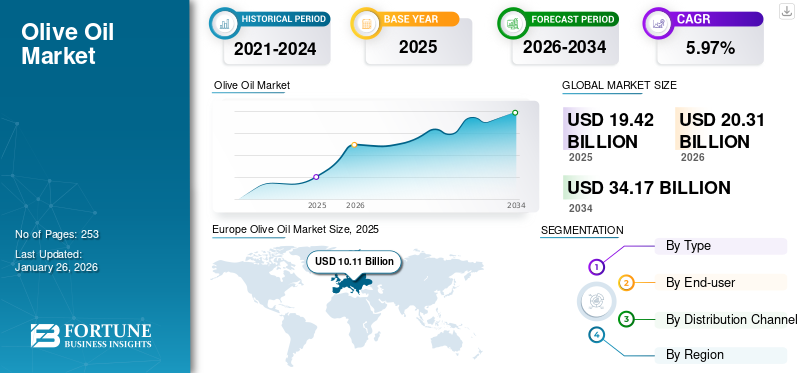
The global olive oil market size was valued at USD 19.42 billion in 2025 and is projected to grow from USD 20.31 billion in 2026 to USD 34.17 billion by 2034, exhibiting a CAGR of 5.97% during the forecast period. Europe dominated the olive oil market with a market share of 49.75% in 2025.
Olive oil is an oil extracted solely from the olive fruit, excluding oils that are extracted utilizing solvents or re-esterification procedures and any blend with oils of another type. Virgin olive oil is the oil that is pressed from the olive fruit alone by mechanical or other physical processes under conditions, especially thermal conditions, which do not cause modifications in the oil and which has not been treated with any process except washing, decantation, centrifugation, and filtration.
The edible oil sector is one of the largest industries in all parts of the globe since edible oil is used in nearly every household in some form or another. Oil palm, rapeseed, soybean, and sunflower contribute to most of the edible oils produced and used. According to the data published by FAO, during the last two decades, global edible oil consumption has increased at a compounded annual growth rate of nearly 4% and is expected to continue. In most developing nations, olive oil remains a niche product for most of the population, primarily due to the premium price segment of the product. With the supply of olives decreasing considerably, demand remained stable, which triggered oil prices to an all-time high in the last five years.
Growing emphasis on the quality of the food consumed and the rising proportion of health-conscious consumers are the major reasons attributed to the growing olive oil consumption on the global platform. Key market players include Sovena, Deoleo, S.A., and Borges International Group.
Download Free sample to learn more about this report.
Olive Oil Market Key Takeaways
 Global Market Size & Forecast
- 2025 Market Size: USD 19.42 billion
- 2026 Market Size: USD 20.31 billion
- 2034 Forecast Market Size: USD 34.17 billion
- CAGR: 5.97% from 2026–2034
 Market Share
- Europe dominated the olive oil market with a 49.75% share in 2025.
- Virgin olive oils are projected to account for 78.65% of the global market in 2026.
- Retail/household end-users are expected to hold 63.71% of the market share in 2026.
 Key Regional Highlights
North America
The market stood at USD 3.02 billion in 2025 and is expected to reach USD 3.24 billion in 2026, driven by increasing consumer preference for healthy edible oils.
Europe
The market reached USD 10.11 billion in 2025 and is projected to grow to USD 10.64 billion in 2026, supported by strong production and consumption across the region.
Asia Pacific
The market generated USD 1.96 billion in 2025 and is projected to reach USD 2.12 billion in 2026, fueled by rising health awareness and expanding retail distribution.
U.S.
The olive oil market is projected to reach USD 2.81 billion by 2026, supported by growing demand for premium and healthy cooking oils.
Japan
The market is projected to reach USD 0.67 billion by 2026, driven by increasing adoption of Mediterranean dietary habits and health-conscious consumers.
Read More

Market Dynamics
Market Drivers
Surge in Home Cooking Practices Augments Utilization of Olive Oil
Over the last few years, cooking behavior has changed drastically, and many households prefer home cooking practices more than ever. This trend is primarily escalated by the increasing awareness of conscious eating, which boosts the reliance on healthy ingredients. Today, a major chunk of consumers is highly aware of the impact of diet on their health and is keenly looking for ways to enhance it. This includes choosing safe ingredients and prioritizing organic options, such as olive oil. The high content of polyphenols, antioxidants, and monounsaturated fats makes olive oil a healthier alternative for home cooking.
Along with this, the increasing consumption of the Mediterranean diet also strengthens the usage of olive oil. The Mediterranean diet is rich in plant-centric products and healthy fats and offers numerous health advantages.
Growing Awareness of Health Advantages Bolsters Intake of Olive Oil
Olive oil is recognized as one of the most flavorful and healthier cooking raw materials in the culinary landscape. Renowned for its nutritional profile, versatility, and taste, this edible oil provides several health advantages, making it a preferred choice among consumers.
Compared to other cooking oils, such as coconut and mustard, olive oil provides high antioxidant compounds, and few antioxidants are known to offer anti-inflammatory effects. These antioxidants are helpful in disease prevention and promote overall health. Moreover, olive oil, specifically extra virgin oil, holds a strong percentage of monounsaturated fats (MUFA), commonly known as healthy fats. Via such reliance on olive oil, most consumers can minimize low-density lipoproteins, contributing to cardiovascular challenges. Along with this, in comparison to coconut oil, olive oil contains a lower percentage of saturated fats. This factor bolsters the global olive oil market growth.
Market Restraints
Climatic Variations and Pest Infestation Restrict Market Potential
One of the critical factors hampering the global market is variations in climatic conditions. Sudden fluctuations in temperature, specifically rising temperatures, can cause heat stress in olive trees and result in poor-quality oil. Moreover, water scarcity is another condition faced by edible oil producers as it affects the oil content and quality and minimizes olive tree yield. According to the Agroberichten Buitenland, a Dutch Government association, Spain witnessed a 50% drop in its production in 2023, owing to losses in olive groves, vineyards, and cereals, which is a result of severe droughts. Other than this, extreme weather events (storms/heatwaves) and changes in precipitation patterns can also collectively limit the production rate of oil globally.
Pest attack is a strong restraint in the global marketplace, which hampers the industry's momentum. In addition to weather-related concerns, oil producers face numerous pest attacks, especially olive fruit flies, which damage the olive crops. Moreover, this infestation can affect the oil's organoleptic characteristics, further making it unsafe for utilization. Along with this, the negative impact of pests can minimize the chances of profitability for oil producers, ultimately impeding growth.
Market Opportunities
Introduction of Eco-Friendly Packaging and Technological Advancements Creates Growth Opportunities
The rising consumer awareness regarding conventional packaging and technological advancements in the packaging sector unlock growth opportunities for the launch of eco-friendly packaging. In today's era, most global consumers know the hazardous effects of single-use plastics and other conventional packaging materials. To minimize its usage, individuals prioritize sustainability and are willing to pay extra for finished products with environment-friendly packaging. By seeing such advantages, the brands are responding by using sustainable packaging that can captivate health-conscious consumers and improve their market sales. For instance, in May 2024, Neoleo, a Mediterranean pioneer, reinvented its packaging and launched new eco-friendly aluminum cans of extra virgin olive oil across the Netherlands.
Adopting technology in the food industry is a substantial factor that enhances growth possibilities in the market. Food manufacturers, especially those engaged in oil production, use technologies to stay ahead of the competition. To bridge the gap between labor force availability and the actual demand, the operators are utilizing technologies to streamline their procedures and improve the quality. The companies can utilize pulsed electric fields, ultrasound technology, and other emerging techniques that can facilitate the extraction of oil. Moreover, numerous research studies are being conducted using new production technology. For instance, in November 2020, the University of Perugia stated that the use of high-vacuum-assisted extraction technologies enhances the characteristics of extra virgin oil and minimizes sensory defects.
Market Challenges
Tough Competition from Novel Oils Poses a Major Challenge for Market Growth
The stiff competition from various novel oil types is a significant challenge in the global market. Oil palm, rapeseed, soybean, and sunflower contribute to most of the edible oils produced and used. Vegetable oils per capita consumption is increasing daily, exceeding 21 kg/year in developing nations and 26 Kg/year in developed nations. Moreover, compared to olive oil, alternative edible oils such as canola oil have a solid presence in the global industry, making it challenging for olive-based oil producers to compete in the market. Thus, such robust competition impedes the market's momentum.
The surging cases of adulteration in oil limit the growth of the global industry. A few common adulterants, such as nut oils, seed oils, and recycled olive oil, are utilized to adulterate a variety of oils, such as organic oil and extra virgin olive oil (EVOO). As a result, the growing cases of adulteration/fraud can impede the olive oil industry's potential.
Olive Oil Market Trends
Increasing Trend of Flavor-Infused and Fortified Olive Oil Paves Growth Prospects
Fortified and flavor-infused oil is a rapidly growing olive oil market trend, aiming to cater to evolving consumer preferences and offer novel products. This trend is known for positively enhancing olive oil's sensory attributes and chemical composition. The industry is witnessing robust growth for infused oil due to the rising need for functional foods and consumer inclination toward premium culinary ingredients. Home cooks and chefs highly utilize flavor-infused olive oil, such as garlic-infused olive oil, rosemary-infused oil, and lemon-flavored olive oil, to elevate their food palates. Using infused oils makes the end product attractive and adds unique flavors without utilizing multiple ingredients. For instance, in May 2024, Texana Brands, a U.S. producer, launched a new flavor-infused oil, "Italian Herb Infused Olive Oil," nationwide.
Download Free sample to learn more about this report.
Impact of U.S. Tariff
The U.S. is one of the top five consumers of olive oil in the world. With American President Donald Trump announcing a reciprocal tariff system for global trade with the U.S., the international olive oil industry is expected to be hit hard if the tariffs come into the act, which is paused for 3 months as of April 2025.
The newly announced tariffs include a 20% duty on imports from all European Union countries, including Italy, Spain, Portugal, and Greece. The tariffs would make olive oil much more expensive, prompting a pullback in consumption and shifting consumers toward cheaper and less healthy seed oils. Other oil-producing countries in South America and Africa, including Algeria, Argentina, Morocco, Uruguay, Chile, and Turkey, will face the standard 10% tariff. While Tunisian exports of olive oil to the U.S. will face a 28% tariff, South African exports will attract a steep 31% tariff. The U.S. olive oil production accounts for less than five percent of U.S. domestic consumption. According to USDA (U.S. Department of Agriculture) data, in 2023, the U.S. imported USD 713 billion of olive oil from Spain. The U.S. also imported more than USD 700 billion of olive oil from Italy and more than USD 500 billion from other countries.
Due to these changing dynamics of tariffs, oil that will not reach the U.S. will be sold in other markets. More competition could follow, prompting the oil market price to decline for some months but hurting the production chain. While the tariffs are expected to come into action quickly in 3-4 months, large multinational bottlers will have to look for potential solutions regarding bottlers and packers of oil in the U.S. As the tariffs are only announced for trade with the U.S., it is the major consumer, the U.S. olive oil market size deviations will impact the global industry significantly by disrupting the overall supply chain and prices.
Segmentation Analysis
By Type
Virgin Segment Held Largest Market Share Owing to Its Higher Nutrient Content
Based on type, the market is segmented into virgin, refined/pure, and others (lampante oil and pomace oil).
The virgin olive oils segment is projected to dominate the market with a share of 78.65% in 2026 and is expected to witness a strong sales performance over the forecast period, owing to its rising popularity among consumers due to its health benefits. Omega-3 and oleic acid in virgin oil help prevent lifestyle-related disorders such as obesity and cardiovascular diseases. Emerging processing techniques and technological advancements, allowing for efficient processing of virgin oils with high nutrient content, further drive market growth.
The refined oil made from olives is projected to exhibit substantial growth due to its rising utilization in pharmaceuticals, dietary supplements, and the cosmetic industries. The rising demand for nutrient-enriched animal feed increased the requirement for olive fruit oil to manufacture high-value animal feed.
To know how our report can help streamline your business, Speak to Analyst
By End-user
Growing Use of Olive Oil in Household/Retail Segment Supported Market Growth
Based on end-user, the market is divided into household/retail, foodservice, food manufacturing, and others (animal feed, pharmaceuticals, and dietary supplements).
The retail/household end-user segment is expected to account for 63.71% of the market share in 2026. The increasing demand for olive fruit oil for household cooking fuels is driving market growth. The growing awareness of the oil's role in maintaining good health has remarkably increased the demand for various types of olive fruit oil in retail channels. The emerging minimally processed natural oils trend has surged the demand for cold-pressed virgin oils.
There has been a significant rise in demand for Olea europaea fruit oil from the food service sector due to its attributes of enhancing flavor and texture without a detrimental impact on health. Consumers' preference to enjoy their favorite meals without compromising their taste has majorly contributed to food service retailers opting for this oil over other cooking oils.
By Distribution Channel
Offline Segment Dominates Market Due to Widespread Availability of Oil Made from Olives
Based on the distribution channel, the market is divided into offline and online.
Offline distribution includes retail outlets, wholesalers, suppliers, and direct company sales to retail consumers or businesses such as food manufacturers/ service establishments.
The offline distribution channel segment dominated the global market with a market share of 90.86% in 2026 due to the widespread availability of oil made from olives through retail outlets and demand from foodservice operators and manufacturers directly from the companies.
While the offline sales channel is expected to dominate the market over the forecast period, the online sales channel is expected to grow with the highest CAGR. This growth is attributed to the expanding quick commerce industry, which caters to retail markets and drives the growth of grocery e-commerce platforms. Moreover, the emergence of online marketplaces connecting buyers and sellers of mass products is expected to boost the market positively. Expanding B2B marketplace platforms in developing countries offers numerous growth opportunities, exerting solid growth opportunities for the market.
Olive Oil Market Regional Outlook
On the basis of geography, the market is categorized into North America, Asia Pacific, Europe, South America, and the Middle East & Africa.
Europe
Europe Olive Oil Market Size, 2025 (USD Billion)
To get more information on the regional analysis of this market, Download Free sample
Europe's market value reached USD 9,706.99 billion in 2024, capturing the largest market size. The market's strong growth in Europe is mainly attributed to the highest olive tree cultivation and production in the region. Spain and Italy are the primary countries producing and supplying Olea europaea fruit oil to various countries in other regions. The growing popularity of functional foods has increased the demand for Olea europaea fruit oil across the food manufacturing industry in Europe. The UK market is projected to reach USD 0.42 billion by 2026, while the Germany market is projected to reach USD 0.77 billion by 2026. In 2025, Europe represented USD 10.11 billion, accounting for 49.75% of the worldwide market, and is projected to grow to USD 10.64 billion in 2026.
Spain produces half of the world's olive crop. However, the adverse climatic conditions have led to a decline in olive fruit harvest in Spain, affecting product availability in the global market. According to the U.S. Department of Agriculture, EU countries face a second consecutive decline in olive production in 2023-24. The decline in production is anticipated to result in a price rise, leading to limited product availability for domestic use. This leads the government to take effective initiatives to increase olive fruit production to balance the gap between production and supply of oil made from olives.
North America
The rising interest in healthy oils mainly drives market growth in North America as consumers seek to prevent lifestyle-related health conditions from hectic lifestyles. Studies to prove the beneficial effects of olive fruit oil consumption on health resulted in advancements in the region. The growing popularity of dietary supplements to maintain overall health and wellness has increased the demand for Olea europaea fruit oil for nutraceuticals and pharmaceutical sectors in the region. The U.S. market is projected to reach USD 2.81 billion by 2026. North America recorded a market size of USD 3.02 billion in 2025, capturing 14.86% of the global market share, and is projected to reach USD 3.24 billion in 2026.
Asia Pacific
Asia Pacific has immense growth potential for the olive fruit oil industry and is expected to showcase the fastest growth rate compared to the global average. The market's growth is attributed to increasing discretionary incomes and rising awareness of their health benefits, which enable consumers to spend on healthcare products that promote well-being. The rising trend of dining out and trying out Mediterranean cuisine is expected to drive further market growth. The growing popularity of functional food & beverages in the region contributes to the rising demand for omega-3 fatty acid-fortified foods. The Japan market is projected to reach USD 0.67 billion by 2026, and the China market is projected to reach USD 0.63 billion by 2026. The Asia Pacific market generated USD 1.96 billion in 2025, representing 9.67% of the global market landscape, and is expected to reach USD 2.12 billion in 2026.
South America
South America is expected to grow substantially due to rising awareness of the health benefits of oil made from olives. Virgin oils are becoming popular across retail sectors as consumers' interest in cooking with healthy oils has increased. The increasing popularity of cosmetics containing omega-3 that improve skin health is expected to surge the demand for other olive fruit oil varieties in the region. In 2025, Latin America held 5.34% of the global market, reaching a valuation of USD 1.09 billion, and is projected to grow to USD 1.16 billion in 2026.
Middle East & Africa
The Middle East & Africa is emerging as a prospective market in Olea europaea fruit oil consumption due to its wide application in various culinary preparations, coupled with manufacturers eyeing this region as a potential production hub. This is attributed to the rise in olive tree plantations supported by the regional government. According to the Turkish Ministry of Agriculture and Forestry data, the Turkish olive fruit oil production increased by 32% in 2021 compared to the previous year. Thus, such factors are expected to promote the region's growth in the years to come. Middle East & Africa accounted for USD 4.14 billion in 2025, representing 20.39% of the global market share, and is projected to reach USD 4.33 billion in 2026.
Competitive Landscape
Key Industry Players
Prominent Players Focus on Geographical Expansion to Strengthen their Market Presence
|
Rank |
Company Name |
|
1. |
Sovena |
|
2. |
Deoleo, S.A. |
|
3. |
Borges International Group |
|
4. |
Salov S.p.A. |
|
5. |
Cargill, Incorporated |
The market is fragmented due to several prominent players spread across Europe and the Middle East. These players are prominently focusing on expanding their geographical footprint to gain a larger consumer base, which, in turn, contributes to market expansion. For instance, in July 2020, Sovena Group entered the Chilean market after purchasing a 24.6% stake in a regional company, Soho, which produces olive fruit oil brands such as Olave, Huasco, and SOL de Aculeo.
Other key players, such as Borges S.A., Salov S.p.A., and Deoleo S.A., focus on strategic mergers, acquisitions, and partnerships to gain a competitive edge. The arrival of small and niche players in the market contributes to intensifying competition within the market, which positively affects the growth of the market.
LIST OF KEY OLIVE OIL COMPANIES PROFILED
- Salov S.p.A. (Italy)
- Deoleo S.A. (Spain)
- Sovena Group (Portugal)
- Del Monte Foods, Inc. (U.S.)
- Cargill, Inc. (U.S.)
- California Olive Ranch (U.S.)
- Pompeian (U.S.)
- Modi Natural Ltd. (India)
- Borges International Group (Spain)
- Catania Oils (U.S.)
KEY INDUSTRY DEVELOPMENTS
- January 2025: Borges India, a leading name in Mediterranean food products, launched "Zero Pesticide Residue (ZPR) Almonds and two Single Variety Extra Virgin Olive Oils."
- The new offerings reflect Borges' unwavering commitment to quality, health, and sustainability, offering Indian consumers innovative and nutritious options.
- July 2024: Investment fund "SMERemediumCap" and "Inspiring Earth" entered into a joint partnership to create an export-minded firm in the Greek oil sector via a triple acquisition, with a total investment of more than 10 billion USD. Both companies formed a joint company, which acquired the "Latzimas SA," "Sitia Oils-Lasitia SA," and "Olympian Green International SA."
- July 2024 – Spanish company Genosa announced the launch of oil made from olives with soluble phenol-rich hydroxytyrosol, which offers several health benefits and numerous application possibilities.
- June 2022 – Certified Origins, a European-based company specializing in fresh and authentic Extra Virgin Olive Oils (EVOOs), launched multiple carbon-neutral Italian EVOOs under its flagship brand Bellucci. The company's mission is to bring good and healthy foods to the world, and it sources this premium Italian Evoo from Tuscany, Apulia, and Sicily exclusively for international markets.
- June 2021 – Pietro Coricelli, an Umbrian olive fruit oil producer and one of the largest and most widely distributed olive fruit oil brands, announced that it would join IBM Food Trust to use blockchain technology to trace its extra-virgin olive fruit oil.
REPORT COVERAGE
The olive oil market report provides a detailed analysis of the market. It focuses on key aspects such as leading companies, types, regional market share, the growth rate for all possible market segments, the competitive landscape, and leading product end-users. Besides, the report also offers insights into the market trends and highlights key industry developments. In addition to the abovementioned factors, the report encompasses several factors that have contributed to the market's growth in recent years.
Request for Customization to gain extensive market insights.
Report Scope & Segmentation
|
ATTRIBUTE |
DETAILS |
|
Study Period |
2021–2034 |
|
Base Year |
2025 |
|
Estimated Year |
2026 |
|
Forecast Period |
2026-2034 |
|
Historical Period |
2021–2024 |
|
Growth Rate |
|
|
Unit |
Value (USD billion ) |
|
Segmentation
|
By Type
By End-User
By Distribution Channel
By Region
|
Frequently Asked Questions
Fortune Business Insights says that the global market size stood at USD 19.42 billion in 2025.
The market will exhibit a CAGR of 5.97% during the forecast period (2026-2034).
The virgin olive oil segment led the market.
The growing awareness of the health benefits of olive fruit oil is the key factor driving the market.
Deoleo S.A., Borges S.A., and Salov Group are the top players in the market.
Europe held the highest market share in 2025.
The major factors driving product adoption are the rising awareness of the health benefits of monounsaturated fatty acids and the growing popularity of exotic cuisines.



- 2021-2034
- 2025
- 2021-2024
- 253
-
(Offer valid till 30th Sep 2026)
Get 30-60 hrs Free Customization
Expand Regional and Country Coverage, Segments Analysis, Company Profiles, Competitive Benchmarking, and End-user Insights.




















Related Reports
-
US +1 833 909 2966 ( Toll Free )
-
Get In Touch With Us