Green Airport Market Size, Share, Industry Analysis, By Application (Civil & Commercial and Military), By Energy Type (Wind Power, Bioenergy, Solar Power, and Others), By Airport Class (Class A, Class B, and Class C), By Airport Type (International and Domestic), and Regional Forecast, 2026-2034
 Download Free Sample
KEY MARKET INSIGHTS
 Listen to Audio Version
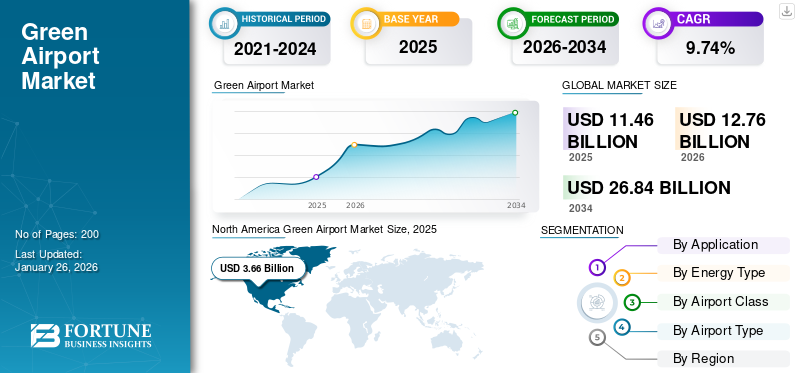
The global green airport market size was valued at USD 11.46 billion in 2025 and is projected to grow from USD 12.76 billion in 2026 to USD 26.84 billion by 2034, exhibiting a CAGR of 9.74% during the forecast period. North America dominated the green airport market with a market share of 31.92% in 2025.
Green airports have implemented sustainability principles and environmental responsibility into their operations. Their practices can include energy and water management, waste reduction strategies, air, water, or noise quality improvement. Many participate in certifications such as the Green Airport Title by Airports Council International. Examples of sustainable initiatives include Zurich Airport’s use of collected rainwater and Indira Gandhi International Airport’s, as well as geothermal energy and water recycling systems. By adopting these practices, green airports increasingly focused on reducing carbon emissions, improving air quality, and enhancing their public image. Thus, play a vital role in the aviation industry’s fight against climate change.
The green airport market is set for growth, driven by sustainability initiatives, technological advancements, and an increasing number of projects and recent developments across various regions. Key players in the market include SITA (Switzerland), Collins Aerospace (U.S.), and Honeywell International Inc. (U.S.). These companies compete in pricing and aircraft provisions.
Download Free sample to learn more about this report.
Green Airport Market Key Takeaways
 Global Market Size & Forecast
- 2025 Market Size: USD 11.46 billion
- 2026 Market Size: USD 12.76 billion
- 2034 Forecast Market Size: USD 26.84 billion
- CAGR: 9.74% from 2026–2034
 Market Share
- North America dominated the global green airport market with a 31.92% share in 2025.
- The Civil & Commercial segment is projected to account for 74.26% of the market in 2026.
- The Solar Power segment held 59.00% of the market in 2025.
 Key Regional Highlights
North America
Held 31.92% of the global market in 2025, generating USD 3.66 billion.
Europe
Accounted for 28.11% of the global market in 2025, generating USD 3.22 billion.
Asia Pacific
Generated USD 2.92 billion in 2025, representing 25.48% of the global market.
U.S
The green airport market is projected to reach USD 3.15 billion by 2026.
Japan
The green airport market is projected to reach USD 0.51 billion by 2026.
Read More

Market Dynamics
Market Driver
Sustainability In Aviation and Global Climate Change Goals To Promote Market Growth
Sustainability in the context of global climatic change refers to meeting current needs without compromising the ability of future generations to meet theirs. It focuses on economic growth, environmental protection, and social equity. A major sustainability goal in aviation is decarbonization, with the sector targeting net-zero carbon emissions by 2050 and significant reductions by 2030. This will be achieved through the use of sustainable aviation fuels, improvements in aircraft efficiencies, and enhanced operational practices. Airports are also promoting resource efficiency by minimizing waste, maximizing recycling, and implementing energy and water-saving measures.
One more important aspect is biodiversity protection. Airports are increasingly assessing their impact on local wildlife and habitats to ensure minimal ecological disruption. These efforts align with global climate commitments, particularly in the Paris Agreement, which aims to limit global warming to no more than 2 degrees above pre-industrial levels. Given the air transport industry’s commitment to achieving net-zero emissions, these targets appear attainable with sustained efforts.
The Carbon Offsetting and Reduction Scheme for International Aviation is a key initiative supporting carbon-neutral growth in international aviation from 2020 onward. It promotes sustainability through certified offset projects. Emerging technologies and practices will play a vital role in this transition– hydrogen-powered aircraft, more efficient engines, and innovations in air traffic management will significantly enhance operational efficiency. Achieving these sustainability and climate goals requires a collaborative effort from governments, the aviation industry, and research institutions. The scheme brings together authorities and the aviation industry to form an all-encompassing approach aimed at solving aviation's efficiency and reduce environmental impact while ensuring this industry's long-term sustenance and strength in a future climate.
Market Restraint
High Cost And Collaboration Needs with Market Stakeholders To Restrain Market Growth
High costs and collaboration needs severely hinder the green airport market growth. Installation of green technologies and infrastructure involves large amounts of capital expenditure, which may act as a barrier for many airports. Initial expenses that might range from hundreds of thousands to millions of dollars include solar panel installations, energy-efficient lighting, and waste management systems. Upgrading existing infrastructure or building new green buildings involves extra costs, making it difficult for airports with limited budgets to balance sustainability initiatives with other operational needs.
Additionally, achieving sustainability goals requires coordination among multiple stakeholders, including government agencies, airlines, local communities, and environmental organizations. This coordination is necessary for developing holistic strategies that balance environmental concerns with operational efficiency. However, differing priorities and perspectives among stakeholders can cause conflicts or delay decision-making. Establishing effective partnerships demands continuous communication and trust-building, which can be complex in the dynamic aviation industry. In addition, many green initiatives depend on public-private partnerships or government grants to offset high initial costs. Addressing these financial and collaborative challenges is essential to driving demand for sustainable practices within the aviation industry.
Market Opportunities
Sustainability Initiatives & Regulations to Present Major Growth Opportunity for Market Players
Airfields produce vast amounts of biodegradable waste consisting of food residues and yard trimming. Using that waste for biopower through anaerobic digestion or as fuel in an incinerator reduces the dependence on landfills while producing sustainable power for airport operations. Although the initial capital investment for bioenergy infrastructure is high, long-term operational savings can be significant. Energy derived from bioresources helps decrease energy costs, enhancing economic viability. Moreover, bioenergy plants create employment opportunities and boost local economies by sourcing biomass from regional agricultural or forestry operations.
Airports embracing bioenergy can also benefit from government incentives to encourage the use of renewable energy. Furthermore, investing in bioenergy boosts an airport's reputation as an environmentally responsible entity, attracting eco-conscious travelers and stakeholders. Overall, integrating bioenergy into airport operations offers a multifaceted opportunity to advance sustainability goals while addressing economic and environmental challenges in the aviation industry.
Market Challenge
Unavailability Of Green Initiatives For Class B And C Airports To Challenge Market Development
Class B and Class C airports face specific barriers to adopting green initiatives. High initial costs can strain their limited budgets, while a lack of resources and expertise makes it challenging to implement complex sustainability practices. Additionally, regulatory requirements can be complex, sometimes creating uncertainty about compliance. Low institutional pressure further reduces motivation to engage in environmental improvements and stakeholder resistance may arise when changes affect existing operations or relationships with airlines and vendors. Addressing these challenges would allow smaller airports to make a transition toward more sustainable practices without impacting their operational capabilities, allowing them to contribute effectively to broader environmental goals.
Green Airport Market Trends
Rising Sustainable Aviation Fuel Adoption is a Major Market Trend
Sustainable Aviation Fuel (SAF) substantially enhances green airport operations by reducing carbon emissions and promoting sustainable goals. SAF can achieve up to 80% reduction in lifecycle greenhouse gas emissions compared to traditional jet fuel, addressing Scope 3 emissions from aircraft operations, often the biggest contributor to an airport's carbon footprint. This reduction helps airports meet regulatory requirements and meet passenger expectations for environmentally friendly travel options.
Download Free sample to learn more about this report.
Moreover, SAF improves local air quality by emitting fewer harmful pollutants, which benefits communities near airports. Many airports are facilitating the adoption of SAF through incentive programs and partnerships with airlines and fuel suppliers. By integrating SAF into their operations, airports can enhance their sustainability profile, support airline partners in meeting SAF mandates, and enhance operational efficiency. Overall, SAF plays a critical role in advancing the environmental agenda of green airports while supporting the rising demand for air travel.
Impact of COVID-19
The COVID-19 pandemic had a significant impact on green airports. While reduced air traffic lowered emissions and prompted the industry to reevaluate its sustainability practices, financial constraints limited investment in the green airport market. However, some airports used this period to accelerate investments in renewable energy and explore Sustainable Aviation Fuels (SAF). Downtime gave a chance to experiment with new technologies aimed at reducing emissions. As airports recover, sustainability will play a crucial role in their long-term strategic plans, positioning climate change as a key priority for the future of green aviation.
Segmentation Analysis
By Application
Rising Digitization Efforts Propelled Civil & Commercial Segment Growth
On the basis of application, the market has been divided into civil & commercial and military.
The civil & commercial segment is projected to dominate the market with a share of 74.26% in 2026 and is expected to grow at the highest CAGR in the forecast period. Green airports engage in commercial activities such as partnerships with airlines and businesses in order to encourage sustainability. Airports are also working with technology providers to develop smart airport solutions, optimizing resource use and minimizing waste. A significant trend in this segment is the rise of green cargo operations, driven by digitization efforts aimed at enhancing efficiency and minimizing the impact on the environment. Such airports, as key hubs for commercial air travel, are leading sustainable aviation initiatives by concentrating on decreasing carbon emissions and energy consumption while maximizing operational efficiency. Many airports are increasingly integrating renewable energy sources such as solar and wind power. Additionally, sustainable building designs and electric ground transportation are becoming standard initiatives.
The military segment accounted for a significant market share in 2024. Sustainable development for infrastructure for military applications follows key principles, including the use of renewable materials, energy conservation, and climate resilience. These initiatives aim to improve community welfare by enhancing accessibility and inclusion while decreasing carbon footprints. Financial viability is a critical consideration, ensuring that projects remain sustainable without placing undue burdensome on governments or users. Aligned with the United Nations Sustainable Development Goals (SDGs), sustainable military infrastructure supports long-term economic growth while ensuring responsible environmental stewardship and balanced relationship between development and nature.
By Energy Type
Advancements In Energy Technologies Encouraged Solar Power Segment Growth
Based on energy type, the market is segmented into wind power, bioenergy, solar power, and others.
The solar power segment is projected to dominate the market with a share of 59.13% in 2026. Advancements in energy technologies, such as thin film solar energy and photovoltaic pavements, enable airports to maximize solar energy output without requiring extra land. A notable example is Cochin International Airport, which operates entirely on a solar-based system, while Delhi Airport integrates both hydro and conserve energy sources such as solar. With government incentives and an increase in green infrastructure, airports throughout the world adopt such renewable solutions for energy consumption in order to fulfill environmental needs, enhance public image, and attain net-zero emission targets. The segment is anticipated to capture 59% of the market share in 2025.
The bioenergy segment accounted for a substantial market share in 2024 and is expected to grow at the highest CAGR of 11.81% during the forecast period (2025-2032). Airports are becoming more inclined to use bioenergy to power various operations, such as heating, cooling, and electricity generation. For instance, Stockholm Airport uses a biofuel system to heat its terminals, thus demonstrating the applicability of bioenergy in airport infrastructure. Furthermore, the implementation of microgrids allows airports to optimize energy use and integrate renewable sources. Bioenergy adoption is propelling the global green airport market, which is projected to become the largest segment. It is crucial for achieving broader environmental goals and bringing the aviation industry closer to a sustainable future.
To know how our report can help streamline your business, Speak to Analyst
By Airport Class
Class A Segment Led due To is Ability to Reduce Class A Segment
Based on airport class, the market is segmented into Class A, Class B, and Class C.
The Class A segment is projected to dominate the market with a share of 67.82% in 2026 and is expected to grow at the highest CAGR during the forecast period. Class A airport green operations play a crucial role in curtailing carbon footprint and enhancing efficiency in operation while also reducing expenditures through the use of renewable energy and sustainable practices. These efforts enhance passenger experiences and attract investments, positioning Class A airports as leaders in environmental stewardship and contributors to global sustainability goals in aviation. The segment is set to dominate the market in 2025 with a share of 67%.
- In February 2024, Amsterdam's Schiphol Airport dropped its plans to build a parallel runway due to concerns over noise pollution and environmental impact. This move reflects the growing trend of airports prioritizing sustainability and carbon footprint reduction over expansion.
The Class B segment accounted for a significant market share in 2024 and is expected to record a significant CAGR of 9.44% during the forecast period. Carbon footprint reduction in Class B airports is achieved through renewable energy adoption, energy-efficient technologies, and sustainable operational practices. These initiatives significantly lower greenhouse gas emissions associated with airport activities, particularly in transportation and energy use. This contributes to global climate goals and enhances environmental sustainability within the aviation sector.
By Airport Type
International Segment Led due to Growing Adoption of Green Initiatives
Based on airport type, the market is divided into international and domestic.
The international segment is projected to dominate the market with a share of 74.38% in 2026 and is expected to record the highest CAGR during the forecast period. International airports are adopting more green initiatives to make their services more sustainable. Some of the most prominent ones include San Francisco International Airport, which uses massive recycling programs and solar panels to minimize its carbon footprint. Indianapolis International Airport boasts one of the largest solar farms, which produces considerable renewable energy. Denver International Airport boasts the largest solar power farm at a commercial airport, with efforts to reduce waste and compost. Furthermore, Los Angeles International Airport takes a leadership role in sustainable aviation fuels, substantially lowering lifecycle emissions. These efforts contribute to a more environmentally responsible future for global air travel. This segment is likely to attain 67% of the market share in 2025.
The domestic segment is expected to record a significant CAGR during the forecast period. Domestic airports are undertaking various green initiatives to achieve sustainability and minimize their impact on the environment. For example, Delhi Airport launched a green transport initiative to reduce its carbon footprint to near zero by 2030, while Hyderabad Airport set up a biodiesel fueling station to support its eco-friendly operations. Airports are also considering renewable energy sources, such as using solar power, and waste management practices to reduce landfill contribution. Other sustainability measures include commitments to eliminating single-use plastics and implementing rainwater harvesting systems for water conservation. These efforts contribute to a more sustainable aviation industry while improving operational efficiency and fostering community engagement. The segment is estimated to document a CAGR of 9.27% during the forecast period (2025-2032).
Green Airport Market Regional Outlook
North America
North America Green Airport Market Size, 2025 (USD Billion)
To get more information on the regional analysis of this market, Download Free sample
The North America region captured 31.92% of the global market in 2025, generating USD 3.66 billion in revenue, and is projected to reach USD 4.06 billion in 2026. North America led the green airport market share due to growing environmental consciousness and regulatory pressure. Airports in the region are increasingly utilizing renewable energy, including solar and wind power in order to cut carbon emissions. Some such notable examples are the Indianapolis International Airport, one of the biggest solar farms in the region with significant funding from the FAA to expand renewable energy projects. Los Angeles International Airport is now at the forefront of embracing sustainable aviation fuels, while Denver International Airport invests heavily in energy efficient technologies. These efforts align with a broader set of commitments in achieving net-zero emissions and improvement in sustainability.
Numerous developments in U.S. airports towards sustainability are expected to grow the market for the country in the forthcoming years. Boston-Logan International airport, Denver International Airport, and Dallas Fort Worth International airport are some examples of green airports in the country that are driving growth for the particular region altogether. Additionally, in November 2024, Luis Muñoz Marín Airport was recognized and awarded by the American Association of Airport Executives (AAAE) and Chicago Department of Aviation for the airport’s sustainability initiatives taken for “Airports Going Green 2024” The U.S. market is projected to reach USD 3.15 billion by 2026.
Europe
Europe maintained a strong presence in the global market, reaching USD 3.22 billion in 2025, accounting for 28.11% share, and is expected to reach USD 3.6 billion in 2026. The European market is forecasted to achieve a higher growth rate in the coming years, supported by strong regulatory frameworks and a focus on sustainability. European airports are actively pursuing renewable energy solutions such as solar and wind power alongside innovative projects such as hydrogen production for ground operations. Initiatives under the EU Green Deal include OLGA and TULIPS, aim to reduce carbon emissions and energy efficiency. The U.K. market is anticipated to stand at USD 0.6 billion in 2026.For example, Amsterdam Airport Schiphol has invested in energy-saving technologies and aims to transition all airport buildings off the gas grid by 2030. These efforts together position Europe as a leader in sustainable aviation practices and carbon neutrality. Germany is set to reach a market value of USD 0.97 billion in 2026, while France is predicted to be valued at USD 0.37 billion in the same year.
Asia Pacific
In 2025, Asia Pacific generated USD 2.92 billion, contributing 25.48% to global market revenue, and is projected to grow to USD 3.29 billion in 2026. The region is likely to showcase the highest growth rate in the coming years. The development of infrastructure and a supportive regulatory environment are critical for the growth of green airports in the Asia Pacific region. Green airport initiatives are growing in the region due to sustainability goals and environmental awareness. Among them are Hong Kong International Airport, known for implementing marine ecology measures to enhance biodiversity locally, and Indira Gandhi International Airport in India, which set up a Biodiversity Center that promotes conservation and education. The Chinese market is poised to gain USD 0.95 billion in 2026. The Mactan-Cebu International Airport of the Philippines undertook a Coastal Clean-Up project, cleaning mangrove habitats and removing 18 tons of waste. These initiatives demonstrates the region’s dedication to reduce carbon footprints while fostering ecological balance, positioning Asia Pacific as a key region in aviation practice. India is projected to reach USD 0.67 billion in 2026, while Japan is foreseen to be worth USD 0.51 billion in the same year.
Rest of the World
The rest of the world is the fourth leading region estimated to reach USD 0.99 billion in 2025. The rest of the world market is forecasted to achieve a higher growth rate in the coming years. As airports consider sustainability, the green airport initiatives in Latin America and the Middle East & Africa are progressing. VINCI Airports manages a number of airports in Latin America that are recognized as 'Green Airports' by ACI-LAC, for their environmental efforts. For example, energy efficiency projects in Brazil and Costa Rica, where Salvador Bahia Airport reduced carbon emissions by 87%. Dubai International Airport in the Middle East has put in extensive solar energy systems and water conservation measures to make its operation more sustainable. Such steps indicate a strong commitment to minimizing carbon footprints and promoting environmentally responsible airport operations in emerging regions.
Competitive Landscape
Key Market Players
Key Market Players are Developing Sustainable Solutions by Partnering with Technology Developers
The green airport market's major players, such as Honeywell, ABB Group, SITA, Siemens, and Thales, are readily integrating sustainable solutions and using clean power technologies. Collaborations and partnerships among technology developers and airport management make it easy to adopt green technologies. North America leads in this market owing to its tight environmental regulations, followed by Europe and Asia Pacific. Though investment is high in the beginning, firms are motivated by cost savings in the long term and increasing demand for sustainability. The market is driven by a combination of technology change, regulatory mandates, and customer attitude that leads to innovation and growth opportunities. Overall, the industry is booming with businesses catering to introduce green solutions that serve environmental and efficiency objectives.
List of Key Companies Profiled In The Report
- Thales Group (France)
- Collins Aerospace (U.S.)
- Siemens AG (Germany)
- Acciona (Spain)
- Schneider Electric (France)
- IBM Corporation (U.S.)
- TKH Airport Solutions (Netherlands)
- Honeywell International Inc. (U.S.)
- SITA (Switzerland)
- ABB (Switzerland)
- Sabre Corporation (U.S.)
- Indra Sistemas SA (Spain)
- Amadeus IT Groups SA (Spain)
- Cisco Systems Inc (U.S.)
Key Industry Developments
- November 2024 – The subsidiary of VINCI Airports, ANA Aeroportos de Portugal, signed a USD 251.9 million deal with a consortium of Mota-Engil, VINCI Construction Grands Projets, Alves Ribeiro and HCI. The deal, signed at a ceremony attended by Portugal's Prime Minister and Minister of Infrastructure and Housing as part of efforts to enhance the passenger experience and also operate more efficiently at Lisbon airport.
- June 2024- Investment Fund Managers, including Queensland Investment Corporation, which holds assets such as Sydney and Adelaide airports, executed a USD 467 million deal to support renewable energy initiatives. Under the multi-state power purchase agreement, the infrastructure assets would secure over 500 GWh of green power supply every year.
- August 2023- City officials and construction workers on broke ground on the USD 164 million West Gate Expansion projection project at Austin-Bergstrom International Airport. The general contractor, Hensel Phelps, based in Greeley, would oversee the Construction Dive.
- July 2023- In Canada, the first public refueling site for vehicles with hydrogen fuel cells in the province of Ontario will be marked by a hydrogen fueling station at Toronto Pearson International Airport (YYZ) for cars and trucks serving the airport. The YYZ fueling station will be financed via a Canadian dollar 1 million (USD 750,000) investment from the Canadian government.
- May 2023- The Ministry of Transportation & Telecommunications in Bahrain granted a contract worth USD 1.437 million to Netherlands Airport Consultants. Based in The Hague, the consultancy firm would undertake an initial study for Bahrain's ambitious greenfield airport project, which is estimated to cost USD 10 billion.
Report Coverage
The report analyzes the market in depth and highlights crucial aspects, such as prominent companies, market segmentation, competitive landscape, airport types, and technology adoption. Besides this, it provides regional insights into the market trends and highlights significant industry developments. In addition to the aspects mentioned earlier, the report encompasses several factors contributing to the market's growth over the years.
Request for Customization to gain extensive market insights.
Report Scope & Segmentation
|
ATTRIBUTE |
DETAILS |
|
Study Period |
2021-2034 |
|
Base Year |
2025 |
|
Estimated Year |
2026 |
|
Forecast Period |
2026-2034 |
|
Historical Period |
2021-2024 |
|
Growth Rate |
CAGR of 9.74% from 2026 to 2034 |
|
Unit |
Value (USD Billion) |
|
Segmentation |
By Application
By Energy Type
By Airport Class
By Airport Type
By Region
|
Frequently Asked Questions
The market was valued at USD 11.66 billion in 2025 and is projected to reach USD 26.84 billion by 2034.
The market is projected to record a CAGR of 9.74% during the forecast period.
The international segment captured the major market share in 2026.
Sustainability in aviation and global climate change is a key factor driving market growth.
Honeywell International Inc. (U.S.), SITA (Switzerland), ABB (Switzerland), and others are some of the leading players in the market.
U.S. dominated the global market in 2025.



- 2021-2034
- 2025
- 2021-2024
- 200
Get 30-60 hrs Free Customization
Expand Regional and Country Coverage, Segments Analysis, Company Profiles, Competitive Benchmarking, and End-user Insights.




















-
US +1 833 909 2966 ( Toll Free )
-
Get In Touch With Us