Artisanal Ice Cream Market Size, Share & Industry Analysis, By Flavor (Fruit-based Flavors, Chocolate & Cocoa-based Flavors, Nut-based Flavors, and Others), By Source (Dairy-based and Non-Dairy/Plant-based), By Packaging (Single-Serve Packs, Multi-Serve Consumer Packs, and Others), By Distribution Channel (Supermarkets/Hypermarkets, Specialty Stores, Online Retail, and Others), and Regional Forecast, 2026-2034
 Download Free Sample
(Offer valid till 15th Aug 2026)
Artisanal Ice Cream Market Size and Future Outlook
 Listen to Audio Version
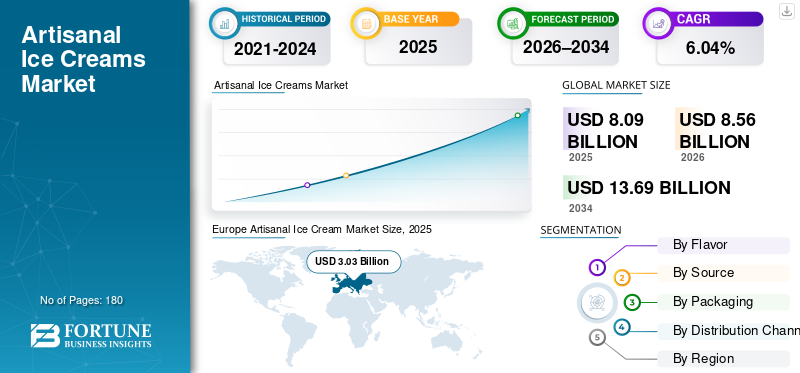
The global artisanal ice cream market size was valued at USD 8.09 billion in 2025. The market is projected to grow from USD 8.56 billion in 2026 to USD 13.69 billion by 2034, exhibiting a CAGR of 6.04% during the forecast period. Europe dominated the artisanal ice cream market with a market share of 37.45% in 2025.
Artisanal ice cream is a handcrafted, premium, and small-batch frozen dessert which emphasizes traditional methods, freshness, and high quality components over cost efficiency and mass production. Unlike regular ice cream, artisanal items focus on texture quality and flavor authenticity, often manufactured regionally or locally and sold via premium retail channels, cafes, and specialty outlets. A few popular flavors include fruit-based, nut-based, and chocolate. Moreover, with respect to target consumers, gourmet ice cream is cherished by health- and ingredient-conscious consumers, lactose-intolerant consumers, and middle- to high-income populace. Geographically, Europe and North America are the key consumers in the market.
Companies such as Unilever plc, Nestlé S.A., and Van Leeuwen Ice Cream are the key players in this market. New product launches is a pivotal strategy adopted by these players to improve their market positions.
Download Free sample to learn more about this report.
ARTISANAL ICE CREAM MARKET Key Takeaways
 Market Size & Forecast
- 2025 Market Size: USD 8.09 billion
- 2026 Market Size: USD 8.56 billion
- 2034 Forecast Market Size: USD 13.69 billion
- CAGR: 6.04% from 2026–2034
 Market Share
- Europe dominated the artisanal ice cream market with a 37.45% share in 2025.
- The chocolate & cocoa-based flavors are projected to grow at a CAGR of 5.93% over the forecast period.
- The non-dairy/plant-based segment is projected to grow at a CAGR of 7.69% over the forecast period.
 Key Regional Highlights
Europe
Europe dominates the market, reaching USD 3.03 billion by 2025, and recording a growth rate of 5.84% in the coming years. The surging demand for frozen desserts and the rising inclination towards dairy-free products bolster the region’s growth potential.
North America
North America reached USD 2.01 billion in 2025, supported by the expansion of artisanal ice cream brands, rising disposable income, and ongoing product innovation.
Asia Pacific
Asia Pacific accounted for USD 2.00 billion in 2025, driven by growing consumer preference for natural ingredients and premium frozen dessert products.
U.S.
The market was valued at approximately USD 1.67 billion in 2025, representing around 20.60% of global market revenue, supported by strong consumer demand and a well-established artisanal ice cream industry.
Japan
The market recorded approximately USD 0.40 billion in 2025, accounting for nearly 4.98% of global revenues, driven by demand for premium and innovative ice cream products.
Read More

ARTISANAL ICE CREAM MARKET TRENDS
Surging Inclination Toward Plant-Based Ice Creams is the Current Trend
The non-dairy or plant-based segment has emerged as one of the most significant trends in the market driven by consumer preferences toward sustainable products and a flexitarian diet. Initially, plant-centric gourmet ice creams are targeted mainly for the vegan population; however, demand has substantially expanded among mainstream premium buyers, flexitarians, and lactose-intolerant consumers. Today, most individuals buy dairy-free ice cream alongside dairy options for wellness benefits and variety. Moreover, due to advancements in plant-centric fat systems, cashew, oat, and almond nut blends deliver flavors and creaminess similar to those of regular gelato. As a result, such improvements have further reduced the restrictions on adoption, allowing plant-based items to compete with processed dairy items.
Download Free sample to learn more about this report.
MARKET DYNAMICS
MARKET DRIVERS
Growing Premiumization in Ice Cream Sector Propels the Market’s Growth Momentum
The surging indulgence-led or premiumization consumption is a pivotal driver in the ice cream sector, as most consumers are willing to pay for sensory satisfaction and quality. Artisanal/gourmet ice cream is mostly seen as an affordable luxury rather than a daily dessert, allowing individuals to justify their spending on ingredient authenticity and superior taste. This shift is widespread in developed markets such as North America and Europe, where most consumers are moving away from mass-market products and more toward premium options. This same trend is visible in emerging markets, where surge in experimentation and disposable income fuel the demand for premium desserts. Today, to meet consumer demand, most cafes and specialty stores are introducing artisanal ice cream variants alongside traditional options.
MARKET RESTRAINTS
High Manufacturing Cost and Limited Shelf Life to Inhibit Market’s Potential
One of the key challenges in the global artisanal ice cream market growth is high production costs. Artisanal/gourmet ice cream production majorly depends on high-quality raw materials such as fresh fruits, specialty chocolates, high-fat dairy, and nuts, which are substantially overpriced than components utilized in mass-market ice cream sector. Moreover, limited automation, small-batch production, manual processing, fuel energy costs, and labor cost per unit are also hindering the consumption of gourmet ice cream. These costs pressures restrict market penetration beyond premium segments and limit affordability, specifically in price-sensitive developing markets. Additionally, maintaining a robust cold chain infrastructure, including cold storage and blast freezers, adds as a significant variable costs.
Limited shelf life is another obstacle in the market. In comparison to traditional ice creams, artisanal products contain minimal preservatives and stabilizers, resulting in a shorter shelf life. Thus, this factor also hampers the global market growth.
MARKET OPPORTUNITIES
Technological Advancements in the Ice Cream Sector to Open Growth Opportunities
The utilization of modern technologies in the ice cream sector builds several growth opportunities globally. To enhance texture consistency, most companies are adopting batch-freezing technologies. This technique allows manufacturers to improve flavor and mouthfeel while maintaining the handcrafted attributes. Technological advancements in high-precision pasteurization systems are another technique that strengthen food safety while retaining flavor components in fruit and premium dairy ingredients. Moreover, innovation in emulsification and plant-centric fat system technologies enhances the creaminess and texture of non-dairy gourmet ice cream. Besides this, technological upgradation in clean-label texturizers and natural stabilizers improves melt resistance and shelf life in gourmet ice cream without depending on artificial additives.
Segmentation Analysis
By Flavor
Fruit-based Flavors Dominated the Market Owing to Their Broader Consumer Appeal
Based on flavor, the market is distributed into fruit-based flavors, chocolate & cocoa-based flavors, nut-based flavors, and others.
The fruit-based flavors led the global market in 2025. In comparison to other flavors, fruit-centric ice cream gains advantage in terms of health-conscious, as fruits are mostly linked with antioxidants and vitamins. Artisanal manufacturers use local and seasonal sourcing to create regionally inspired or limited-edition products. Moreover, it poses minimal allergen concerns compared to nut-based ice creams, further adding to their growth. Additionally, it offers higher refreshment value and mouthfeel, thereby directly boosting growth of the market.
The chocolate & cocoa-based flavors are projected to grow at a CAGR of 5.93% over the forecast period.
To know how our report can help streamline your business, Speak to Analyst
By Source
Dairy–Based Category Led the Market with Their Versatility in Producing a Range of Premium and Classic Flavors
Depending on the source, the market is distributed into dairy-based and non-dairy/plant-based.
In 2025, the dairy-based category led the global industry as dairy-based ice creams are known to provide a creamy and naturally rich mouthfeel owing to the presence of milk proteins and fats. This dairy formulation offers versatility for a range of premium and classic flavors, including custard-style, chocolate, and nuts. Moreover, it is price-stable and cost-effective compared to plant-based substitutes such as specialty oat bases, almonds, and cashews. Additionally, it is the preferred option, especially in specialty parlors and foodservice, where texture and taste are prioritized mainly over dietary restrictions.
The non-dairy/plant-based is projected to grow at a CAGR of 7.69% over the forecast period.
By Packaging
Single-Serve Packs Lead The Industry With Their Convenient On-The-Go Consumption
Based on packaging, the market is segmented into single-serve packs, multi-serve consumer packs, and others.
Single-serve packs led the global space in 2025. Single-serve packs (sticks and cups) are designed for on-the-go/immediate consumption, minimizing the need for portioning and storage. In comparison to multi-packs, which need planned consumption, cups and sticks mostly align with spontaneous consumption. Moreover, owing to their lower price, these packs allow more frequent repeat purchases than multi-serve packs. Additionally, producers easily experiment and introduce limited-edition flavors via single-serve packs. Thus, such instances drive the segment’s growth potential
The others segment is projected to grow at a high CAGR of 9.71% over the forecast period.
By Distribution Channel
Specialty Stores Dominated the Market Owing to Real-Time Customization Offered
Based on distribution channel, the market is divided into supermarkets/hypermarkets, specialty stores, online retail, and others.
Specialty stores leads in the global artisanal ice cream market share. These stores provide freshly produced ice creams, often created in small batches or on-site. Unlike online retail and hypermarkets, which majorly depend on extended cold chains and longer storage, these channels have a tighter control over flavor integrity and freshness. Moreover, it provides the option of real-time customization, including portion sizes, flavor combinations, and toppings, which is not feasible with packaged retail items. Also, it has minimal reliance on long-distance cold chain logistics, further bolstering the segment’s growth momentum.
The online retail segment is projected to grow at the highest CAGR of 8.86% over the forecast period.
Artisanal Ice Cream Market Regional Outlook
By geography, the market is categorized into Europe, North America, Asia Pacific, South America, and the Middle East & Africa.
Europe
Europe Artisanal Ice Cream Market Size, 2025 (USD Billion)
To get more information on the regional analysis of this market, Download Free sample
Europe dominates the market, reaching USD 3.03 billion by 2025, and recording a growth rate of 5.84% in the coming years. The surging demand for frozen desserts and the rising inclination towards dairy-free products bolster the region’s growth potential.
Germany Artisanal Ice Cream Market
The Germany market in 2025 recorded around USD 0.68 billion, representing roughly 8.37% of the global market revenues.
U.K. Artisanal Ice Cream Market
The U.K. market reached approximately USD 0.50 billion in 2025, equivalent to around 6.14% of the global market sales.
North America
The North America market reached a valuation of USD 2.01 billion in 2025 in the global market and currently holds the second position. The market in North America is expected to grow due to the expanding artisanal ice cream companies and rising disposable income. Moreover, the increased number of players and technological advancements are driving regional growth.
U.S. Artisanal Ice Cream Market:
Based on North America’s strong contribution and the U.S. dominance within the region, the U.S. market has been analytically approximated at around USD 1.67 billion in 2025, accounting for roughly 20.60% of global market sales.
Asia Pacific
Asia Pacific is reached a valuation of USD 2.00 billion in 2025. The growing demand for such ice cream and rising consumer preference for natural ingredients are key factors boosting the region’s growth potential. In the region, India and China are both recorded USD 0.32 billion and USD 0.75 billion as their valuation, respectively, in 2025.
India Artisanal Ice Cream Market
The India market in 2025 reached around USD 0.32 billion, accounting for roughly 3.95% of the global market revenues.
The surging number of local producers and the growing social media trend are major factors driving the nation’s growth potential.
China Artisanal Ice Cream Market
China's market is projected to be one of the largest globally, with revenues reaching around USD 0.75 billion in 2025, representing roughly 9.25% of the global market sales.
Japan Artisanal Ice Cream Market
Japan market in 2025 recorded around USD 0.40 billion, as its valuation accounting for approximately 4.98% of the global market revenues.
South America and the Middle East & Africa
The South America and Middle East & Africa regions are expected to witness moderate growth in this market space during the forecast period. The South America market reached the valuation of USD 0.69 billion in 2025. The surging consumer base and demand for high quality ingredients are expected to drive regional growth. The Middle East and Africa market reached the valuation of USD 0.37 billion in 2025.
South Africa Artisanal Ice Cream Market
The South Africa market reached around USD 0.11 billion in 2025, representing roughly 1.34% of global market revenues.
COMPETITIVE LANDSCAPE
Key Industry Players
New Product Launches Help the Key Market Players to Improve Their Market Positions
The artisanal ice cream market exhibits a fragmented structure, with intense competition among market players operating. In this market, the key companies are primarily adopting new product launches as their main strategy. Through this approach, players can cater to rising consumer demands and enhance their brand image.
LIST OF KEY ARTISANAL ICE CREAM COMPANIES PROFILED
- Unilever plc (U.K.)
- Little Moons (U.K.)
- Van Leeuwen Ice Cream (U.S.)
- Nancy’s Fancy (U.S.)
- Gelato Messina (Australia)
- NIC Ice Creams (India)
- Carmela Ice Cream (U.S.)
- Nestlé S.A. (Switzerland)
- Nye’s Cream Sandwiches (U.S.)
- McConnell's Fine Ice Creams (U.S.)
KEY INDUSTRY DEVELOPMENTS
- October 2025: Anand Sweets & Savouries, a premium sweets firm in South India, collaborated with Milano Ice-cream, an ice cream enterprise in India, to reveal a limited-edition gelato.
- September 2025: Indulge Creamery, an artisanal ice cream brand founded by hospitality professional Pawan Saluja, has launched in India. Its menu includes cookies, cheesecake, vegan mango sorbet, Belgian chocolate, and vegan dark chocolate.
- July 2025: Nova Artisan Gelato, an Indian ice cream shop, opened an outlet in Mumbai, Maharashtra, which serves a range of flavorful gelatos.
- April 2025: Baskin-Robbins India released a new gelato line as part of its summer offerings. The products are launched for both kids and adults across India.
- March 2023: Burma Burma, an award-winning Burmese restaurant chain, unveiled gourmet ice creams in six flavors.
REPORT COVERAGE
Request for Customization to gain extensive market insights.
Report Scope & Segmentation
| ATTRIBUTE | DETAILS |
| Study Period | 2021-2034 |
| Base Year | 2025 |
| Estimated Year | 2026 |
| Forecast Period | 2026-2034 |
| Historical Period | 2021-2024 |
| Growth Rate | CAGR of 6.04% from 2026-2034 |
| Unit | Value (USD Billion) |
| Segmentation | By Flavor, Source, Packaging, Distribution Channel, and Region |
| By Flavor |
|
| By Source |
|
| By Packaging |
|
| By Distribution Channel |
|
| By Region |
|
Frequently Asked Questions
Fortune Business Insights says that the global market value stood at USD 8.09 billion in 2025 and is projected to reach USD 13.69 billion by 2034.
In 2025, the market value in Europe is expected to touch USD 3.03 billion.
The market is expected to exhibit a CAGR of 6.04% during the global market forecast period.
By source, the dairy-based segment led the global market in 2025.
Growing premiumization consumption propels the market’s momentum.
Unilever plc, Nestle S.A., and Van Leeuwen Ice Cream are among the top players in the market.
Europe held the largest market share in 2025.
Surging inclination towards plant-based ice cream is the current trend.



- 2021-2034
- 2025
- 2021-2024
- 180
-
(Offer valid till 15th Aug 2026)
Get 30-60 hrs Free Customization
Expand Regional and Country Coverage, Segments Analysis, Company Profiles, Competitive Benchmarking, and End-user Insights.




















Related Reports
-
US +1 833 909 2966 ( Toll Free )
-
Get In Touch With Us