Health & Hygiene Packaging Market Size, Share & Industry Analysis, By Material (Plastic, Paper & Paperboard, Glass, Metal, Others), By Packaging Type (Films & Sheets, Bottles & Jars, Bags & Pouches, Boxes & Cartons, Blister Packs, Sachets, Labels, Others), By Application (Home Care & Toiletries, Personal Care & Cosmetics, Nutraceuticals & Food Supplements, Functional/Health Beverage, Pharmaceutical and OTC Formulations, Others), and Regional Forecast, 2026-2034
 Download Free Sample
(Offer valid till 15th Oct 2026)

KEY MARKET INSIGHTS
 Listen to Audio Version
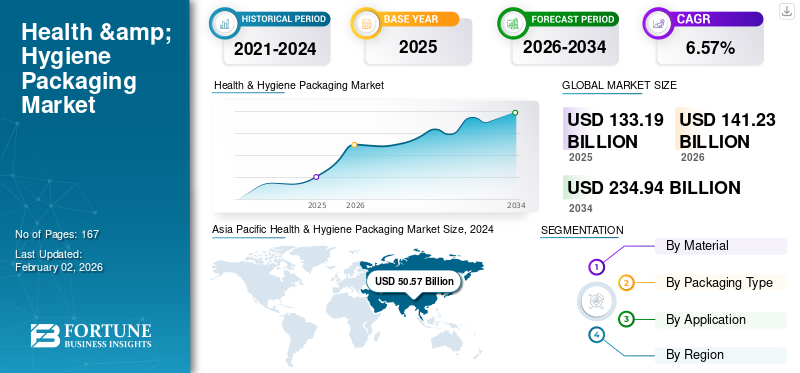
The global health & hygiene packaging market size was valued at USD 125.80 billion in 2024. The market is projected to grow from USD 133.19 billion in 2025 to USD 206.02 billion by 2032, exhibiting a CAGR of 6.43% during the forecast period. Asia Pacific dominated the health & hygiene packaging market with a market share of 40.2% in 2024.
Health & hygiene packaging includes tailored and secure packaging options for items such as pharmaceuticals, medical devices, cosmetics, and personal care products. It focuses on safeguarding product quality, avoiding contamination and tampering, and ensuring consumer safety, along with adherence to regulatory standards.
Notable trends in health and hygiene packaging involve growing demand for sustainable options such as recyclable, compostable, and reusable materials, influenced by consumer choices and regulatory demands. There is also growing interest in smart and active packaging that can track product integrity and deliver digital information. Additionally, there have been innovations in the areas of convenient, single-use, and travel-size packaging formats. All these factors contribute to the market expansion globally.
Furthermore, the market encompasses several major players such as Amcor, Berry Global, and Georgia Pacific. Broad portfolio with innovative product launch, and strong geographic presence expansion have supported the dominance of these companies in the global market.
Download Free sample to learn more about this report.
HEALTH & HYGIENE PACKAGING MARKET KEY TAKEAWAYS
 Global Market Size & Forecast
- 2024 Market Size: USD 125.80 billion
- 2025 Market Size: USD 133.19 billion
- 2032 Forecast Market Size: USD 206.02 billion
- CAGR: 6.43% from 2026–2034
 Market Share
- Asia Pacific dominated the health & hygiene packaging market with a market share of 40.2% in 2024.
- The paper and paperboard material segment is expected to grow at a CAGR of 6.32% over the forecast period.
- The bottles & jars packaging type segment is expected to grow at a CAGR of 6.89% over the forecast period.
 Key Regional Highlights
North America
e North American region is projected to record a growth rate of 6.34%,
Europe
Europe contributed 18.40% to the global market in 2025, with a valuation of USD 24.51 billion, and is projected to reach USD 25.86 billion in 2026.
Asia Pacific
Asia Pacific accounted for USD 53.98 billion in 2025, representing 40.53% of the global market share, and is projected to reach USD 57.67 billion in 2026.
U.S.
In 2025, the U.S. market is estimated to reach USD 27.11 billion.
Japan
The personal-care and healthcare sectors are extensive and established, ensuring consistent demand for sterile and regulated packaging in the region.
Read More

MARKET DYNAMICS
MARKET DRIVERS
Heightened Health & Safety Awareness Drives Market Growth
Health and safety considerations have emerged as one of the key factors influencing packaging design. Currently, consumers expect packaging to convey a sense of trust, safety, and cleanliness. This is particularly important for hygiene products such as disinfectant sprays, antibacterial wipes, sanitary pads, baby diapers, and pharmaceuticals. There is growing appreciation for packaging that includes tamper-evident seals, sterilized materials, barrier coatings, and secure closures. Hospitals, medical suppliers, and households rely on packaging that ensures sterility during transportation, storage, and use. Even in the realm of personal care, consumers are attracted to brands that highlight “hygienic packaging,” linking it to increased product safety.
MARKET RESTRAINTS
High Raw Material Costs and Price Volatility Hampers Market Development
The hygiene and health packaging sector is largely reliant on plastics derived from petrochemicals, specialized papers, and biodegradable materials. Variations in crude oil prices, interruptions in supply chains, and increasing expenses for sustainable options are few contributing factors that elevate packaging costs. For instance, recycled resins or bio-based plastics can be 30–50% pricier than traditional virgin plastics. In the case of mass-market hygiene products such as sanitary pads, diapers, or wipes, where profit margins are less, this increase in costs poses a significant barrier to the broader implementation of environmentally friendly solutions. Thus, the high raw material costs and continuous fluctuations in prices are analyzed to hinder the market expansion.
MARKET OPPORTUNITIES
Growth in Ready-to-Eat Products and Premiumization Creates Lucrative Growth Opportunities
The growth of online shopping has profoundly altered the requirements for packaging. Hygiene items, such as diapers and personal care kits, are delivered directly to consumers' doors, necessitating that packaging be robust enough to endure extensive supply chains. In contrast to conventional retail packaging, e-commerce packaging must incorporate features that are spill-proof, shock-resistant, and tamper-proof to endure various stages of handling. Additionally, packaging must still be visually appealing in online marketplaces, where product photos play a crucial role in influencing consumer choices. This combination of needs, resilience during shipping, and visual appeal online has reshaped the design of packaging. Therefore, the growing e-commerce and omnichannel retailing are offering potential health & hygiene packaging market growth opportunities.
MARKET CHALLENGES
Limited Recycling & Waste Management Infrastructure Challenges Market Growth
Even when businesses create packaging that can be recycled, many areas do not have the necessary collection and sorting infrastructure to handle it. Multi-layer sachets, packs for wet wipes, and laminated cartons frequently find their way to landfills even though they are technically suitable for recycling. Varying municipal recycling regulations lead to confusion among consumers, resulting in contamination in recycling streams and low recovery rates. This disconnect between ideal packaging design and existing recycling facilities hampers the sustainability initiatives of the industry. Thus, the limited recycling and waste management infrastructure challenges the global health & hygiene packaging market growth.
HEALTH & HYGIENE PACKAGING MARKET TRENDS
Increasing Sustainability Pressure Emerges as a Significant Market Trend
Sustainability has become essential. Brands face increasing pressure from consumers and regulators to minimize their environmental impact. Businesses are launching biodegradable plastics, compostable films, paper-based containers, and packaging made from recycled materials. Mono-material packaging is becoming more popular because it is simpler to recycle than multi-layer options. Refillable and reusable products, such as refill pouches for liquid soaps or deodorant sticks, are increasingly prevalent. However, for products that require strict hygiene standards, companies need to design sustainable options that maintain sterility. Henceforth, the growing sustainability pressure is booming as a key market trend.
Download Free sample to learn more about this report.
Segmentation Analysis
By Material
Remarkable Benefits Offered by the Plastic Material Propels Segment Growth
In terms of material, the market is categorized into plastic, paper & paperboard, glass, metal, and others.
The plastic segment captured the largest share of the market in 2024. In 2025, the segment is anticipated to dominate with a 63.88% share. Plastic materials offer considerable advantages for health and hygiene, such as maintaining sterility by creating a protective shield against contaminants. They enhance safety with shatter-resistant and leak-proof features, and prolong shelf life by safeguarding contents from air and moisture. Furthermore, the lightweight characteristic of plastic minimizes transport emissions, its affordability increases product accessibility, and its adaptability enables customized, innovative solutions for a variety of medical and food items.
The paper and paperboard material segment is expected to grow at a CAGR of 6.32% over the forecast period.
By Packaging Type
Longer Shelf Life of Product Offered by Films & Sheets Propels Segment Growth
In terms of packaging type, the market is categorized into films & sheets, bottles & jars, bags & pouches, boxes & cartons, blister packs, sachets, labels, and others.
The films & sheets segment captured the largest Health & Hygiene Packaging market share in 2024. In 2025, the segment is anticipated to dominate with a 30.27% share. Films and sheets provide advantages such as a longer shelf life by safeguarding the product against contaminants, increased product safety through barrier functions that protect against moisture, oxygen, and light, minimized waste by maintaining freshness, and an enhanced brand image due to a high-quality appearance and texture. Additionally, these films are cost-effective due to their lightweight designs and decreased material usage. They offer greater convenience with user-friendly formats, and promote sustainability through features such as recyclability and thin, compression-resistant structures.
The bottles & jars packaging type segment is expected to grow at a CAGR of 6.89% over the forecast period.
By Application
Rising Demand for Home Care & Toiletries Drives Segmental Growth
Based on application, the market is segmented into home care & toiletries, personal care & cosmetics, nutraceuticals & food supplements, functional/health beverages, pharmaceutical and OTC formulations, and others.
In 2024, the market was dominated by home care and toiletries in terms of application. Furthermore, the segment is set to hold a 35.88% share in 2025. There is a global increase in the demand for home care and toiletries, propelled by heightened health awareness, urban growth, and a preference for convenience and efficiency. Significant trends include a move toward sustainable products (utilizing natural ingredients, biodegradable packaging, and eco friendly formulations), a preference for convenient and effective formats (such as liquids and concentrates), and an increased emphasis on direct-to-consumer models and private labels. Additionally, consumers are focusing on wellness and non-toxic ingredients, resulting in a higher demand for products that have demonstrated antibacterial qualities and natural fragrances.
To know how our report can help streamline your business, Speak to Analyst
In addition, personal care and cosmetics application is projected to grow at a CAGR of 6.58% during the study period.
Health & Hygiene Packaging Market Regional Outlook
By geography, the market is categorized into Europe, North America, Asia Pacific, Latin America, and the Middle East & Africa.
Asia Pacific
Asia Pacific Health & Hygiene Packaging Market Size, 2025 (USD Billion) To get more information on the regional analysis of this market, Download Free sample
Asia Pacific accounted for USD 53.98 billion in 2025, representing 40.53% of the global market share, and is projected to reach USD 57.67 billion in 2026. The rapid urbanization, increased spending by the middle class on personal care and premium hygiene items, and significant growth in e-commerce (both cross-border and domestic) are driving up the need for convenient single-use packs, sachets, flexible pouches, and compact dispensers designed for parcel shipping.
Additionally, governments, regional organizations, and civil society are intensifying efforts to manage plastic waste and invest in circular systems, particularly in Southeast Asia, prompting brands and packaging to undergo redesigns (focusing more on mono-materials, recyclability, and refill schemes). It thus enhances the health and hygiene packaging market across the Asia Pacific region. In the region, India and China are both estimated to reach USD 13.55 billion and USD 16.18 billion, each, in 2025.
Europe
Europe contributed 18.40% to the global market in 2025, with a valuation of USD 24.51 billion, and is projected to reach USD 25.86 billion in 2026. Other regions, such as Europe and North America, are anticipated to witness a notable growth in the coming years. During the forecast period, the North American region is projected to record a growth rate of 6.34%, which is the second highest amongst all the regions, and reach valuation of USD 34.48 billion in 2025. The personal-care and healthcare sectors are extensive and established, ensuring consistent demand for sterile and regulated packaging in the region. The rise of e-commerce and subscription services drives the need for home-delivery-optimized packaging and additional protective packaging. Major consumer goods companies are increasing their prices while still achieving volume growth in hygiene sectors, thereby sustaining the demand for hygiene and health packaging solutions. In 2025, the U.S. market is estimated to reach USD 27.11 billion.
North America
The North America market generated USD 34.48 billion in 2025, representing 25.88% of the global market landscape, and is expected to reach USD 36.51 billion in 2026. Trends in health and hygiene packaging across Europe are influenced by heightened hygiene awareness, strict environmental regulations, and the expansion of e-commerce, creating a need for sustainable, tamper-proof, and intelligent packaging. Notable trends involve the use of recyclable and compostable materials, and the incorporation of smart technologies such as RFID and QR codes for tracking. The rising awareness about health and hygiene in the region also drives market expansion.
Backed by these factors, U.K. is expected to record the valuation of USD 4.69 billion, Germany to record USD 5.35 billion, and France to record USD 3.79 billion in 2025.
Latin America
Latin America contributed approximately USD 10.69 billion to the global market in 2025, accounting for 8.03% share, and is expected to reach USD 11.21 billion in 2026. There's a significant shift toward biodegradable films, paper-based laminates, and recyclable mono-material structures. The rise of patient-centric healthcare models is driving demand for personalized packaging, such as unit-dose formats for easier administration. South Africa is set to attain the value of USD 2.49 billion in 2025.
Middle East & Africa
In 2025, Middle East & Africa held 7.17% of the global market, reaching a valuation of USD 9.54 billion, and is projected to grow to USD 9.97 billion in 2026.
COMPETITIVE LANDSCAPE
Key Industry Players
Strong Distribution Network of Key Companies Supports their Leading Position
The global market shows a semi-concentrated structure with numerous small-to-mid-size companies actively operating across the globe. These players are actively involved in product innovation, strategic partnerships, and geographic expansion.
Amcor Plc, Berry Global, and Georgia Pacific are some of the dominating players in the market. A comprehensive range of health & hygiene packaging products, global presence through strong distribution channel, and collaborations with research and academic institutes are few characteristics of such players that support their dominance.
Apart from this, other prominent players in the market include Amerplast, UFlex Limited, Sonoco Product Company, and others. These companies are undertaking various strategic initiatives, such as investments in R&D and partnerships with pharmaceutical companies to enhance their market presence.
LIST OF KEY HEALTH & HYGIENE PACKAGING COMPANIES PROFILED
- Amcor (Switzerland)
- Berry Global (U.S.)
- Georgia Pacific (U.S.)
- Amerplast (Finland)
- UFlex Limited (India)
- Sonoco Product Company (U.S.)
- Mondi (U.K.)
- Glenroy (U.S.)
- Napco National (Saudi Arabia)
- Alpla Group (Austria)
- Ball Corporation (U.S.)
- Constantia Flexibles (Austria)
- DS Smith (U.K.)
- Quadpack (Spain)
- Huhtamaki (Finland)
KEY INDUSTRY DEVELOPMENTS
- November 2024: Oddy India, a prominent name in eco-friendly food packaging solutions, launched its newest collection of Food Specialty Papers, tailored specifically for the Hotel, Restaurant, and Catering (HoReCa) sector. This groundbreaking range targets the main challenges encountered by food service operations, emphasizing sustainability, cost-effectiveness, and outstanding performance to improve food handling, preparation, and packaging in busy kitchen environments.
- August 2024: Packaging and recycling expert ALPLA, along with SEA ME GmbH, the initiator of Zerooo, has created a standardized solution for cosmetics and personal care items. Starting in September, various brands will introduce shampoo, shower gel, detergent, body lotion, and dental care products in 300-millilitre PET bottles. This reusable and completely recyclable plastic packaging comes in three colors and is compatible with all types of caps. A laser-engraved 2D data matrix code provides details about the contents of each bottle and its circulation history.
- February 2024: Tata Elxsi, a company specializing in product engineering and design services, has launched an environmentally friendly packaging design for the Vatika shampoo line in the United Arab Emirates market. This new design signifies a commitment to sustainability, achieving a 15% decrease in plastic usage for each 400ml package compared to the prior design. With this updated packaging, Tata aims to minimize plastic consumption while maintaining the bottle’s usability, functionality, and structural integrity.
- August 2022: The multinational packaging firm Mondi has teamed up with health and hygiene company Essity, along with chemical company Dow, to introduce recyclable secondary packaging. This innovative packaging for Essity’s feminine care items is created from renewable resources and byproducts derived from the paper packaging manufacturing sector. It is produced from circular raw materials following the mass balance method established by the International Sustainability & Carbon Certification (ISCC).
- April 2022: Huhtamaki, a major global provider of eco-friendly packaging solutions, unveiled a pioneering sustainable innovation for the pharmaceutical and healthcare sectors. The Push Tab® blister lid, made entirely from mono-material PET and devoid of aluminum, is crafted to satisfy the stringent safety standards associated with the highly regulated pharmaceutical and healthcare packaging. This groundbreaking development offers the industry a more sustainable option compared to conventional push-through blister packaging.
REPORT COVERAGE
Request for Customization to gain extensive market insights.
Report Scope & Segmentation
|
ATTRIBUTE |
DETAILS |
|
Study Period |
2019-2032 |
|
Base Year |
2024 |
|
Estimated Year |
2025 |
|
Forecast Period |
2025-2032 |
|
Historical Period |
2019-2023 |
|
Growth Rate |
CAGR of 6.43% from 2025-2032 |
|
Unit |
Value (USD Billion) |
|
Segmentation |
By Material, Packaging Type, Application, and Region |
|
By Material |
· Plastic · Paper & Paperboard · Glass · Metal · Others |
|
By Packaging Type |
· Films & Sheets · Bottles & Jars · Bags & Pouches · Boxes & Cartons · Blister Packs · Sachets · Labels · Others |
|
By Application |
· Home Care & Toiletries · Personal Care & Cosmetics · Nutraceuticals & Food Supplements · Functional/Health Beverage · Pharmaceutical and OTC Formulations · Others |
|
By Geography |
· North America (By Material, By Packaging Type, Application, and Country) o U.S. o Canada · Europe (By Material, By Packaging Type, Application, and Country/Sub-region) o Germany o U.K. o France o Spain o Italy o Russia o Poland o Romania o Rest of Europe · Asia Pacific (By Material, By Packaging Type, Application, and Country/Sub-region) o China o Japan o India o Australia o Southeast Asia o Rest of Asia Pacific · Latin America (By Material, By Packaging Type, Application, and Country/Sub-region) o Brazil o Mexico o Argentina o Rest of Latin America · Middle East & Africa (By Material, By Packaging Type, Application, and Country/Sub-region) o Saudi Arabia o UAE o Oman o South Africa o Rest of the Middle East & Africa |
Frequently Asked Questions
Fortune Business Insights says that the global market value stood at USD 125.80 billion in 2024 and is projected to reach USD 206.02 billion by 2032.
In 2024, the market value stood at USD 50.57 billion.
The market is expected to exhibit a CAGR of 6.43% during the forecast period of 2025-2032.
The home care and toiletries segment led the market by application.
The key factors driving the market growth are the heightened health & safety awareness.
Amcor, Berry Global, Georgia Pacific, Amerplast, UFlex Limited, and Sonoco Product Company are some of the prominent players in the market.
Asia Pacific dominated the market in 2024.
Increase in demand from the home care and toiletries sectors is one of the factors that are expected to favor the product adoption.



- 2021-2034
- 2025
- 2021-2024
- 167
-
(Offer valid till 15th Oct 2026)
Get 30-60 hrs Free Customization
Expand Regional and Country Coverage, Segments Analysis, Company Profiles, Competitive Benchmarking, and End-user Insights.










Related Reports
-
US +1 833 909 2966 ( Toll Free )
-
Get In Touch With Us