Healthcare Logistics Market Size, Share & Industry Analysis By Service Type (Transportation Services, Warehousing & Storage Services, Distribution Services, and Others), By Product Type (Pharmaceutical Products, Medical Devices, Clinical Trial Materials, and Others), By Temperature Control (Cold Chain Logistics and Non-cold Chain Logistics), By Logistics Model (In-house and Outsourced), By End User (Pharmaceutical & Biotechnological Companies, Medical Device Companies, Hospitals & Clinics, and Others), and Regional Forecast, 2026-2034
 Download Free Sample
Healthcare Logistics Market Size and Future Outlook
 Listen to Audio Version
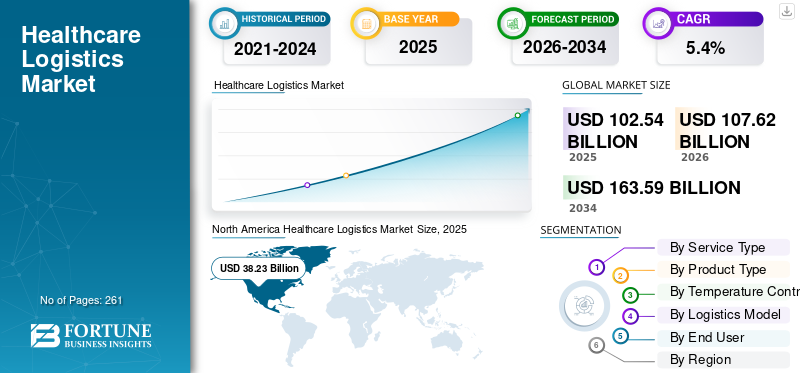
The healthcare logistics market size was valued at USD 102.54 billion in 2025 and is projected to grow from USD 107.62 billion in 2026 to USD 163.59 billion by 2034, exhibiting a CAGR of 5.4% during the forecast period. North America dominated the healthcare logistics market with a market share of 37.28% in 2025.
Healthcare logistics refers to the management of supply chain services, which includes overseeing the secure transportation, storage, and distribution of medical devices, pharmaceuticals, and biological samples. The increasing number of clinical trials, rising demand for novel pharmaceutical and specialty medicines, growing outsourcing by pharmaceutical and biotechnological firms, and the expansion of direct-to-patient delivery models are resulting in market growth. The improvement in healthcare access and others is aslo boosting the adoption of healthcare logistics.
- For instance, according to data published by the World Health Organization (WHO), approximately 35,499 clinical trials were conducted in Australia in 2025.
Furthermore, the rising emphasis on improving the service capabilities among companies, including DHL Group, United Parcel Service of America, Inc., among others, is contributing to the increased demand for these services.
Download Free sample to learn more about this report.
Healthcare Logistics Market Key Takeaways
 Global Market Size & Forecast
- 2025 Market Size: USD 102.54 billion
- 2026 Market Size: USD 107.62 billion
- 2034 Forecast Market Size: USD 163.59 billion
- CAGR: 5.4% from 2026–2034
 Market Share
- North America dominated the healthcare logistics market with a 37.28% share in 2025.
- Pharmaceutical products accounted for the largest product type segment with a 46.7% share in 2025.
- Transportation services held the largest share among service type segments in 2025.
 Key Regional Highlights
North America
North America led the market with USD 38.23 billion in 2025 and the highest regional share.
Europe
Europe is projected to reach USD 30.22 billion in 2026, supported by growing pharmaceutical distribution demand.
Asia Pacific was valued at USD 134.05 million in 2025 and is projected to grow at the fastest 8.48% CAGR through 2034.
Asia Pacific is expected to reach USD 27.61 billion in 2026, driven by temperature-controlled logistics expansion.
U.S.
The market is estimated at USD 35.28 billion in 2026, representing approximately 32.8% of global sales.
Japan
The market is estimated at USD 4.13 billion in 2026, accounting for approximately 3.8% of global revenues.
Read More

Healthcare Logistics Market Trends
Increasing Adoption of Real-Time Temperature Monitoring is an Emerging Market Trend
There is a strong shift toward real-time temperature tracking, particularly for vaccines, pharmaceuticals, biologics, cell & gene therapies, and other temperature-sensitive healthcare products. These real-time monitoring solutions enable pharmaceutical companies, logistics providers, and healthcare distributors to monitor humidity, track temperature, location, door opening, route deviations, and power status during transit and storage.
The biologics and advanced therapies often require strict temperature ranges, including 2°C to 8°C, -20°C, ultra-low temperature, or cryogenic conditions. This results in the deployment of IoT-enabled sensors, telematics, RFID devices, cloud dashboards, automated alerts, GPS tracking, and control tower platforms to ensure continuous product visibility across depots, warehouses, and among logistics providers.
- For instance, according to a 2022 report published by VaccinesWork, it was reported that real-time temperature data across the vaccine cold chain can help local, regional, and national-level decision-makers identify problems or risks in the supply chain.
Market Dynamics
Market Drivers
Download Free sample to learn more about this report.
Growing Number of Clinical Trials to Drive Market Growth
The growing number of multi-site clinical trials among biotechnology, pharmaceutical, and medical device companies to fuel pharmaceutical drug manufacturing processes is resulting in the rising demand for warehousing, transportation, distribution, and temperature-controlled handling of clinical trial materials across various regions.
- For instance, according to 2024 statistics published by the World Health Organization (WHO), approximately 197,090 clinical trials were conducted in the U.S.
This, along with the expansion of R&D investments among pharmaceutical and biotechnological companies and growing outsourcing services for drug and medical device development, is further augmenting the adoption rate of these services. Additionally, the rising focus of key companies on providing novel services, are further likely to contribute to the healthcare logistics market growth.
Market Restraints
High Cost Associated with Cold-Chain Infrastructure Challenges Market Growth
The high cost associated with cold-chain infrastructure is a major restraint for the global market, especially for logistics providers handling biologics, vaccines, insulin, specialty injectables, clinical trial materials, and other temperature-sensitive healthcare products. The healthcare cold-chain operations require temperature-zoned storage rooms, validated refrigerated warehouses, refrigerated vehicles, backup power, calibration systems, and others, resulting in a growing cost of these services.
- For instance, according to the statistics published by Clarion Construction, Inc., it was reported that the cold storage construction cost per square foot ranges from USD 130 to USD 350.
Market Opportunities
Expansion of Pharmaceutical Cold-Chain Networks to Create Lucrative Opportunities
The expansion of pharmaceutical cold-chain networks presents a lucrative opportunity for the global market, as biotechnology and pharmaceutical companies are increasingly relying on temperature-controlled infrastructure to distribute vaccines, biologics, insulin, oncology therapies, and other materials. These products require strict temperature ranges, including cryogenic conditions and others. This creates strong demand for specialized logistics providers with refrigerated transport, validated storage, active and passive packaging, and real-time monitoring capabilities. Additionally, increasing healthcare expenditure is also fueling the development of pharmaceutical cold-chain networks globally.
- According to 2025 data published by the International Trade Administration (ITA), the healthcare expenditure is about USD 135.0 billion in Brazil.
Market Challenges
Limited Clinical Trials in Developing Countries to Hinder Market Growth
There is a growing demand for novel healthcare logistics services among the patient population. However, limited healthcare access in developing economies remains a key challenge in the global market. The lack of well-developed pharmaceutical, biotechnology infrastructure and efficient logistics networks, limited service providers, and a lack of a developed clinical trial system are resulting in a limited number of clinical trials among the companies, thereby restraining the market growth.
- For instance, according to 2025 statistics published by the World Health Organization (WHO), only 55 clinical trials were conducted in Yemen.
SEGMENTATION ANALYSIS
By Service Type
Increasing Number of Diagnostic Tests Led to Transportation Services Segmental Dominance
Based on the service type, the market is classified into transportation services, warehousing & storage services, distribution services, and others.
To know how our report can help streamline your business, Speak to Analyst
The transportation services segment held the largest healthcare logistics market share in 2025. This growth is due to the increasing number of drug and medical device developments. Additionally, rising demand for routine and specialized lab tests, including clinical chemistry, hematology, and others, among the patient population also boosts segment growth. This results in growing adoption of transportation services to supply diagnostic samples, kits, and others. Moreover, the surging number of companies providing novel services, is further expected to contribute to the segment growth.
- For instance, according to 2026 statistics published by the American Clinical Laboratory Association (ACLA), approximately 7.0 billion lab tests are performed each year in the U.S.
The distribution services segment is expected to grow at a CAGR of 5.2% over the forecast period.
By Product Type
Increasing Number of Clinical Studies for Drugs or Biologics Led to Dominance of Pharmaceutical Products Segment
Based on the product type, the market is segmented into pharmaceutical products, medical devices, clinical trial materials, and others.
The pharmaceutical products segment dominated the global market in 2025 with a a share of 46.7%. The growth is due to the increasing number of clinical studies for drugs and biologics, resulting in rising adoption and demand for robust logistics services.
- For instance, according to 2026 statistics published by ClinicalTrials.gov, about 217,149 clinical studies are registered for drugs or biologics globally.
The medical devices segment is set to flourish with a CAGR of 5.6% over the forecast period.
By Temperature Control
Increasing Prescriptions for Generic Drugs Led to Non-Cold Chain Logistics Segment Dominance
Based on temperature control, the market is segmented into cold chain logistics and non-cold chain logistics.
The non-cold chain logistics segment dominated the global market in 2025. The growth is due to the rising number of prescriptions for generic drugs, which require ambient temperature, resulting in a increased demand for non-cold chain logistics.
- For instance, according to the 2022 data published by the Assistance Secretary for Planning and Evaluation (ASPE), it was estimated that 91% of all prescriptions were filled as generic drugs in the U.S.
The cold chain logistics segment is set to grow with a CAGR of 5.7% during the forecast period.
By Logistics Model
Increasing Expansion for Third Party Logistics Provider Led to Outsourced Segment Dominance
Based on the logistics model, the market is bifurcated into in-house and outsourced.
The outsourced segment dominated the market in 2025. The increasing preference toward third-party logistics providers for specialized cold-chain capabilities, reduction in fixed infrastructure costs, among others, are some of the key factors contributing to the segment’s growth. Furthermore, the segment is set to hold a 66.0% share in 2026.
- For instance, in August 2025, CEVA Logistics, an outsourcing logistics company that operates across 170 countries and has purpose-built healthcare logistics facilities in Asia Pacific certified to standards including GDP and GMP.
In addition, in-house segment is projected to grow at a 5.3% CAGR during the forecast period.
By End User
Increasing Number of Pharmaceutical & Biotechnological Companies Led to Segment’s Dominance
Based on end user, the market is segmented into pharmaceutical & biotechnological companies, medical device companies, hospitals & clinics, and others.
The pharmaceutical & biotechnological companies segment dominated the market in 2025. The increasing manufacturing of drugs, biologics, vaccines, and others, a growing number of clinical trials and a rising number of pharmaceutical and biotechnology companies, are some of the key factors contributing to segment’s growth in the market. Furthermore, the segment is set to hold a 62.6% share in 2026.
- For instance, according to 2026 data published by Cross River Therapy, there are approximately 5,000 pharmaceutical & biotechnological companies in the U.S.
In addition, medical device companies are projected to grow at a 6.3% CAGR during the forecast period.
Healthcare Logistics Market Regional Outlook
Based on region, the market has been studied across North America, Europe, Asia Pacific, Latin America, and the Middle East & Africa.
North America
North America Healthcare Logistics Market Size, 2025 (USD Billion)
To get more information on the regional analysis of this market, Download Free sample
The North America market held the dominant share in 2024, valued at USD 35.90 billion, and also took the leading share in 2025 with USD 38.23 billion. The increasing number of clinical trials, rising adoption rate of pharmaceuticals and medical devices, increasing number of hospitals and other healthcare settings, among others, are some of the major factors contributing to the regional market growth.
- For instance, according to 2025 data published by the World Health Organization (WHO), about 197,090 clinical trials were conducted in the U.S.
U.S. Healthcare Logistics Market
Based on North America’s strong contribution, the U.S. market can be analytically approximated at around USD 35.28 billion in 2026, accounting for roughly 32.8% of global sales.
Europe
Europe is projected to record a growth rate of 4.8% in the coming years, which is the second highest among all regions, and reach a valuation of USD 30.22 billion by 2026. The growing demand for pharmaceutical distribution and inventory management services is likely to support the market growth.
U.K. Healthcare Logistics Market
The U.K. market in 2026 is estimated at around USD 4.21 billion, representing roughly 3.9% of global revenues.
Germany Healthcare Logistics Market
Germany’s market is projected to reach approximately USD 6.58 billion in 2026, equivalent to around 6.1% of global sales.
Asia Pacific
Asia Pacific market is estimated to reach USD 27.61 billion in 2026 and secure the position of the third-largest region in the market. The growing demand for temperature controlled logistics and alignment with regulatory compliance are likely to support the growth of the market.
Japan Healthcare Logistics Market
The Japan market in 2026 is estimated at around USD 4.13 billion, accounting for roughly 3.8% of global revenues. Japan is expected to grow due to the expansion of healthcare logistics and improved supply chain efficiency among the key companies in the market.
China Healthcare Logistics Market
China’s market is projected to be one of the largest worldwide, with 2026 revenues estimated at around USD 10.17 billion, representing roughly 9.5% of global sales.
India Healthcare Logistics Market
The India market in 2026 is estimated at around USD 3.91 billion, accounting for roughly 3.6% of global revenues.
Latin America and Middle East & Africa
The Latin America and Middle East & Africa regions are expected to witness moderate growth in this market space during the forecast period. The Latin America market is set to reach a valuation of USD 5.44 billion in 2026. The growth is due to the growing number of decentralized and hybrid clinical trials and the rising demand for healthcare logistics services in the region. The Middle East & Africa region are also expected to grow due to the rising number of logistics service providers expanding their network in the market. In the Middle East & Africa, the GCC is set to reach a value of USD 2.26 billion in 2026.
South Africa Healthcare Logistics Market
The South Africa market is projected to reach around USD 0.68 billion in 2026, representing roughly 0.6% of global revenues.
Competitive Landscape
Key Industry Players
Expansion of Cold Chain Network Supports Key Players to Sustain their Position in the Market
A strong logistics portfolio, along with a strong focus on inorganic growth strategies globally, is one of the key factors contributing to the dominance of key players in the market. DHL GROUP and United Parcel Service of America, Inc., are major companies in the market. Furthermore, the growing focus of these firms on the expansion of cold chain logistics networks is likely to strengthen their presence, further contributing to the market expansion.
- For instance, in February 2026, DHL Group expanded its dedicated Airfreight Cold Chain Network to strengthen logistics supply for temperature-sensitive medicines, vaccines, pharmaceutical products and cell & gene therapies.
Other key players, including Kuehne+Nagel and others, are also growing in the market, primarily due to their increasing focus on collaborations among other companies to strengthen their presence in the market.
List of Key Healthcare Logistics Companies Profiled
- DHL Group (Germany)
- United Parcel Service of America, Inc. (U.S.)
- FedEx (U.S.)
- Kuehne+Nagel (Switzerland)
- DB SCHENKER (Germany)
- DSV (Denmark)
- CEVA Logistics (France)
- GEODIS (France)
- Cencora, Inc. (U.S.)
- Marken (U.S.)
KEY INDUSTRY DEVELOPMENTS
- May 2026: Kuehne+Nagel expanded its healthcare logistics footprint and opened a new temperature-controlled airfreight cross-dock facility in Hyderabad. This helped the company strengthen its presence.
- May 2026: Kuehne+Nagel signed five-year logistics agreement with MHC Group as its Official Logistics Partner with an aim to strengthen its services portfolio.
- April 2026: Kuehne+Nagel collaborated with Casaideas, aimed at enhancing logistics capabilities supporting both e-commerce fulfilment and retail store replenishment in Chile.
- April 2026: GEODIS, a global logistics provider, opened its dedicated healthcare cold chain cross-dock facility in the Americas with an aim to strengthen its presence in the market.
- April 2026: Yusen Logistics Global Management Co., Ltd. presented its global healthcare platform at LogiPharma 2026 in Vienna, showcasing the company's strengthened capabilities in delivering specialist healthcare solutions worldwide.
- March 2026: DHL Group expanded its life sciences arm, DHL Health Logistics, with the development of a pharmaceutical hub in Singapore. This investment fuels Life Sciences and Healthcare (LSHC) infrastructure.
- April 2025: CEVA Logistics announced the construction of a new warehouse in the Strasbourg-Entzheim Airport Business Park to strengthen its pharmaceutical logistics channel.
REPORT COVERAGE
The report provides a detailed healthcare logistics market analysis and focuses on key aspects such as leading companies and market segmentation, including service type, product type, temperature control, logistics model, and end user. Besides this, the global report offers insights into the market growth trends and highlights key industry developments. In addition to the aforementioned factors, the report encompasses several factors that have contributed to the growth and advancement of the market over recent years.
Request for Customization to gain extensive market insights.
Report Scope & Segmentation
| ATTRIBUTE | DETAILS |
| Study Period | 2021-2034 |
| Base Year | 2025 |
| Estimated Year | 2026 |
| Forecast Period | 2026-2034 |
| Historical Period | 2021-2024 |
| Growth Rate | CAGR of 5.4% from 2026-2034 |
| Unit | Value (USD Billion) |
| Segmentation | By Service Type, Product Type, Temperature Control, Logistics Model, End User, and Region |
| By Service Type |
|
| By Product Type |
|
| By Temperature Control |
|
| By Logistics Model |
|
| By End User |
|
| By Region |
|
Frequently Asked Questions
Fortune Business Insights says that the global market size was USD 102.54 billion in 2025 and is projected to reach USD 163.59 billion by 2034.
In 2025, the North America regional market value stood at USD 38.23 billion.
Growing at a CAGR of 5.4%, the market will exhibit steady growth over the forecast period (2026-2034).
By service type, the transportation services is the leading segment in this market.
The expansion of logistics networks is one of the major factors driving the market's growth.
DHL Group and United Parcel Service of America, Inc., are the major players in the global market.
North America held the highest share in the market.
The growing number of clinical trials, rising expansion of logistics network, growing outsourcing of drug and medical devices development services, among others, are some of the key factors expected to boost the adoption of these services.



- 2021-2034
- 2025
- 2021-2024
- 261
Get 30-60 hrs Free Customization
Expand Regional and Country Coverage, Segments Analysis, Company Profiles, Competitive Benchmarking, and End-user Insights.













.webp)






Related Reports
-
US +1 833 909 2966 ( Toll Free )
-
Get In Touch With Us