Healthy Vegetable Chips Market Size, Share & Industry Analysis, By Product Architecture (Sliced, Whole-Piece, and Reconstituted/Formed Chips), By Primary Vegetable (Root & Tuber [Sweet Potato and Cassava Chips], Leafy Vegetable [Kale and Spinach Chips], Fruiting & Pod Vegetable [Okra and Pumpkin Chips], and Mixed Vegetable Chips), By Flavor (Plain/Unsalted, Chili & Spicy, Sweet-Savory, and Barbecue & Smoky), By Nature (Conventional and Organic), By Distribution Channel (Supermarkets & Hypermarkets, Convenience & Grocery Stores, and Online Marketplaces), and Regional Forecast, 2026-2034
 Download Free Sample
(Offer valid till 30th Sep 2026)

Healthy Vegetable Chips Market Size and Future Outlook
 Listen to Audio Version
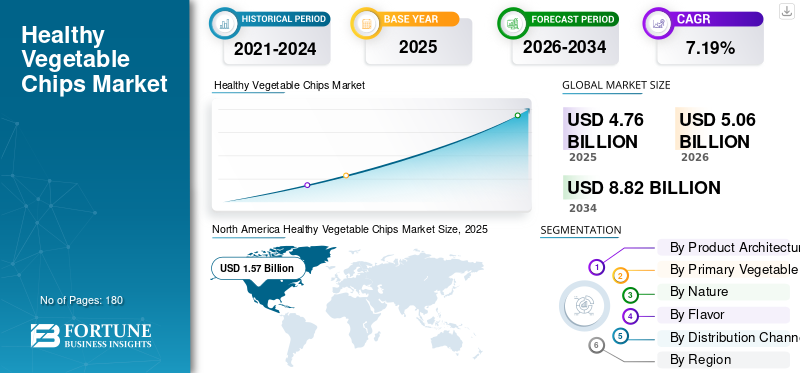
The global healthy vegetable chips market size was valued at USD 4.76 billion in 2025 and is projected to grow from USD 5.06 billion in 2026 to USD 8.82 billion by 2034, exhibiting a CAGR of 7.19% during the forecast period. North America dominated the healthy vegetable chips market with a market share of 32.98% in 2025.
The global market for healthy vegetable chips includes packaged, ready-to-eat snacks made mainly from vegetables such as sweet potato, beetroot, cassava, taro, carrot, parsnip, okra, green beans, peas, pumpkin, and kale. Products may be sliced, retained as whole pieces, or processed using baking, conventional frying, vacuum frying, air drying, or low-temperature dehydration techniques. The market is growing as more consumers seek for products suiting plant-based diets, clean label snacks that are more nutritious than traditional salty options. New products with less oil, simple ingredients, organic vegetables, smaller packs, and flavors from around the world are also supporting the increased demand for vegetable chips.
Companies such as Snackruptors Inc., PepsiCo, Inc., Jackson’s Food Company, LLC, Rhythm Superfoods, LLC, and Greenday Global Co., Ltd. are some of the key players in the market. New product launch is the key strategy which is boosting market expansion and supporting market growth.
Download Free sample to learn more about this report.
Healthy Vegetable Chips Market Key Takeaways
 Global Market Size & Forecast
- 2025 Market Size: USD 4.76 billion
- 2026 Market Size: USD 5.06 billion
- 2034 Forecast Market Size: USD 8.82 billion
- CAGR: 7.19% from 2026-2034
 Market Share
- North America dominated the healthy vegetable chips market with a market share of 32.98% in 2025.
- The root and tuber vegetables segment accounted for the largest market share in 2025.
- The conventional segment led the global market in 2025.
 Key Regional Highlights
North America
The market in North America reached a valuation of USD 1.57 billion in 2025 and is the leading region in the global market, driven by high consumer awareness of healthier snacks and a well-developed natural and organic food retail sector.
Europe
The European market reached a valuation of USD 1.36 billion in 2025 and represents the second-largest market owing to growing demand for clean-label snacks, organic food products, and minimally processed alternatives to conventional potato chips.
Asia Pacific
The Asia Pacific market was valued at USD 1.18 billion in 2025, with China, Japan, South Korea, Australia, and India witnessing growing consumer interest in vegetable-based snacks.
U.S.
In 2025, the U.S. market reached USD 1.32 billion, driven by strong consumer interest in healthier snacks, wide product availability in stores, and ongoing product innovation.
Japan
The Japan market size in 2025 reached a valuation of around USD 0.24 billion, accounting for roughly 4.96% of global market revenues.
Read More

Healthy Vegetable Chips Market Trends
Product Innovation Through Diverse Vegetable Varieties and Advanced Processing Technologies Reshapes the Healthy Snacking Landscape
Continuous innovation is becoming a defining trend within the market as manufacturers expand through both ingredient diversity and processing capabilities. Companies are introducing products made from sweet potato, beetroot, taro, cassava, carrot, parsnip, lotus root, okra, kale, mushroom, and mixed vegetable combinations to provide greater variety, vibrant natural colors, and differentiated flavor experiences. Manufacturers are reducing the use of artificial additives, making ingredient lists simpler, and using more natural herbs, spices, and vegetable seasonings to support a clean-label image. New packaging ideas, such as resealable pouches, portion-sized packs, and recyclable materials, also help these products stand out as premium options.
MARKET DYNAMICS
MARKET DRIVERS
Download Free sample to learn more about this report.
Rising Consumers’ Preference for Healthier, Plant-Based, and Nutrient-Dense Snack Alternatives Accelerates Market Growth
As people become more aware of nutrition, preventive health, and balanced eating, the demand for healthy vegetable chips is rising. Vegetable chips made from sweet potato, beetroot, carrot, cassava, parsnip, taro, kale, and other vegetables align well with the broader shift toward plant-based and minimally processed foods. Manufacturers are further strengthening this trend by introducing baked, vacuum-fried, and air-dried products with reduced oil, lower sodium, and simple ingredient declarations. The growing popularity of flexitarian diets, clean-label foods, and natural snacking options among millennials and Generation Z has expanded the consumer base beyond niche health conscious consumers. Retailers are also dedicating greater shelf space to premium vegetable snacks as demand for healthier packaged foods continues to rise. Consequently, increasing consumers’ preference for plant-based and nutrient-dense snack alternatives remains one of the strongest drivers for the global healthy vegetable chips market growth.
|
Rank |
Market Drivers |
Overall Impact Rank |
CAGR Contribution (2026-2034) |
Impact 2026-2028 |
Impact 2029-2031 |
Impact 2032-2034 |
|
1 |
Rising Consumer Preference for Healthier, Plant-Based and Nutrient-Dense Snack Alternatives |
High |
+3.10% |
High |
High |
High |
|
2 |
Product Innovation in Baked, Vacuum-Fried, Air-Dried and Whole-Piece Vegetable Chips |
High |
+2.45% |
Medium |
High |
High |
|
3 |
Expansion of Supermarkets, Specialty Retail, E-commerce and Quick-Commerce Distribution |
Medium-High |
+2.10% |
High |
High |
Medium |
|
4 |
Growing Demand for Organic, Clean-Label and Minimally Processed Vegetable Snacks |
Medium |
+1.75% |
Medium |
High |
High |
|
5 |
Increasing Commercialization of Diverse Vegetable Varieties and Private-Label Products |
Medium-Low |
+1.20% |
Medium |
Medium |
High |
|
6 |
Others |
Low |
+0.62% |
Low |
Low |
Low |
|
|
Total Positive Growth Contribution |
|
+11.22% |
|
|
|
MARKET RESTRAINTS
High Retail Prices Compared with Traditional Potato Chips and Other Mainstream Snacks Limit Mass-Market Penetration
Even though many consumers are interested in healthy veggie chips, prices of these products are relatively higher than conventional chips. Vegetable chips usually cost more in stores as their ingredients are expensive, they produce less product per batch, and they often need special cooking methods such as vacuum frying or baking, along with higher-end packaging. Many vegetables contain more water than potatoes, so they need extra processing to improve the crunch and keep their color and nutrients. Other factors include receiving organic certification, using simple ingredients, choosing natural seasonings, and making smaller batches also raise production costs. Owing to these factors, vegetable chips often cost more than regular potato chips, tortilla chips, or other common snacks.
|
Rank |
Market Restraints |
Overall Impact Rank |
Negative CAGR Contribution (2026-2034) |
Impact 2026-2028 |
Impact 2029-2031 |
Impact 2032-2034 |
|
1 |
High Retail Prices Compared with Conventional Potato Chips and Other Mainstream Snacks |
High |
-1.65% |
High |
Medium |
Medium |
|
2 |
Volatility in Vegetable Supply, Crop Quality, Processing Yields and Production Costs |
Medium |
-1.10% |
Medium |
Medium |
High |
|
3 |
Nutrition, Labeling and Health-Positioning Challenges Associated with Oil, Sodium and Processing |
Medium |
-0.83% |
Medium |
Medium |
Low |
|
4 |
Others |
Low |
-0.45% |
Low |
Low |
Low |
|
|
Total Negative Growth Impact |
|
-4.03% |
|
|
|
MARKET OPPORTUNITIES
Expansion of Functional, Clean-Label, and Protein-Enriched Vegetable Snacks Creates Significant Growth Opportunities
The market for healthy vegetable chips is growing as more people seek for snacks that are both nutritious and enjoyable to eat. Manufacturers are going beyond traditional vegetable chips by adding plant proteins, legumes, seeds, ancient grains, fiber, probiotics, and special seasonings to make their products healthier. More people are seeking snacks that are gluten-free, allergen-free, non-GMO, organic, and minimally processed to match new health trends. Premium mixes with colorful vegetables and flavors from around the world create opportunities for manufacturers to differentiate their offerings. New methods, including vacuum frying, air frying, freeze drying, and dehydration, help keep the chips’ natural color, texture, and nutrients while using less oil.
Segmentation Analysis
By Product Architecture
Consistent Crispness and Familiar Snack Format Drive the Leadership of Sliced Vegetable Chips Segment
The market is segmented by product architecture into sliced vegetable chips, whole-piece vegetable chips, and reconstituted or formed vegetable crisps.
The sliced vegetable chips segment held the largest healthy vegetable chips market share in 2025. Manufacturers use vegetables such as beetroot, sweet potato, carrot, taro, cassava, and parsnip to make even slices. Consumers find sliced chips easy to recognize and compare with regular salty snacks, making it easier for them to try vegetable-based options. Retailers favor the segment as it supports broad flavor extensions, consistent crispness, private-label development, and clear shelf positioning within healthier snack alternatives.
The whole-piece vegetable chips segment is expected to grow at a CAGR of 7.18% during the forecast period. The segment further held the second-largest market share in 2025 as they retained the recognizable shape and visual identity of the original vegetable. Products made from whole okra pods, green beans, peas, mushrooms, baby carrots, or compact vegetable pieces appeal to consumers seeking less processed and ingredient-transparent snacks.
By Primary Vegetable
High Dry-Matter Content and Strong Processing Suitability Drive the Leadership of Root and Tuber Vegetable Chips
Based on primary vegetable, the market is segmented into root and tuber vegetables, leafy vegetable chips, fruiting and pod vegetable chips, flower and stem vegetable chips, mixed vegetable chips, and others.
The root and tuber vegetables segment accounted for the largest market share in 2025. These vegetables can be sliced evenly, hold up well during frying or baking, and offer natural colors and flavors without needing much extra processing. Their dense texture gives chips a stronger crunch, helps prevent breakage, and allows seasoning to stick better compared to high-moisture vegetables.
Fruiting and pod vegetable chips held the second-largest share of the market and is expected to grow at a CAGR of 7.07% during the forecast period. These ingredients help brands stand out from typical root-vegetable snacks and offer snack assortments that appear unique. Okra and green bean chips work well as whole-piece snacks. Pumpkin and squash can be sliced or blended to make specialty snacks. This segment is growing as people want more variety in vegetables, new textures, and high-quality mixed-vegetable snack packs.
By Nature
Wider Raw Material Availability and Competitive Pricing Drive the Leadership of Conventional Vegetable Chips
The market is segmented by nature into conventional and organic.
The conventional segment led the global market in 2025. Manufacturers can source conventional sweet potatoes, cassava, beetroot, carrots, okra, and other vegetables from large agricultural networks. Conventional products are often found in private-label lines and large supermarket chains, where shoppers tend to focus on taste, texture, calories, and price rather than certification.
The organic segment is another major segment that has a CAGR of 7.69% during the forecast period. Organic vegetable chips held the second-largest share of the market in 2025. They appeal to people seeking snacks made with certified farming methods, simple ingredients, and high quality. Chips made from sweet potato, beetroot, carrot, cassava, and mixed vegetables are especially popular in natural food stores, premium supermarkets, and online platforms.
By Flavor
Broad Consumer Acceptance and Natural Vegetable Taste Drive the Leadership of Plain, Unsalted and Lightly Salted Flavors
The market is segmented by flavor into plain, unsalted and lightly salted, chili and spicy, sweet-savory, barbecue and smoky, and others.
The plain, unsalted and lightly salted segment accounted for the largest market share in 2025, as they align well with the growing focus on healthy eating. These flavors help people notice the natural sweetness, earthiness, or savory taste of vegetables such as sweet potato, beetroot, cassava, carrot, taro, and others. However, light seasoning also helps brands make lower-sodium claims.
The chili and spicy segment held the second-largest share of the market in 2025 and is expected to register a CAGR of 7.49% during the forecast period. These snacks offer the bold flavors people expect from popular savory snacks, but they still keep their vegetable-based appeal. Seasonings such as chili, paprika, jalapeño, peri-peri, masala, cayenne, and hot pepper help brands attract younger consumers while competing more effectively with flavored potato chips, tortilla chips, and other snacks. Spicy flavors are especially popular in Asia Pacific, Latin America, the Middle East, and in multicultural urban markets.
By Distribution Channel
To know how our report can help streamline your business, Speak to Analyst
Broad Assortment Visibility and In-Store Product Comparisons Drive the Leadership of Supermarkets and Hypermarkets Segment
The market is segmented by distribution channel into supermarkets and hypermarkets, convenience and traditional grocery stores, health, organic and specialty food stores, online marketplaces, and others.
The supermarkets and hypermarkets segment led the global market in 2025. They offer a wide range of branded and private-label vegetable chips, with options for different prices, types of vegetables, pack sizes, and health benefits. Stores use snack aisles, natural food sections, special displays, and in-store comparisons to help shoppers distinguish vegetable chips with potato chips, multigrain snacks, and other healthier options.
The convenience and traditional grocery stores segment is another major segment that is expected to register a CAGR of 6.66% during the forecast period. The segment also held the second-largest market share in 2025 as they attracted impulse buyers, people seeking quick snacks, and shoppers from the neighborhood. Traditional grocery stores also reach many customers in emerging markets where modern retail is not yet widespread.
Healthy Vegetable Chips Market Regional Outlook
By region, the market is categorized into Europe, North America, Asia Pacific, South America, and the Middle East & Africa.
North America
North America Healthy Vegetable Chips Market Size, 2025 (USD Billion)
To get more information on the regional analysis of this market, Download Free sample
The market in North America reached a valuation of USD 1.57 billion in 2025 and is the leading region in the global market. This is due to high consumer awareness of healthier snacks and a well-developed natural and organic food retail sector. More consumers are seeking snacks made with simple ingredients, less oil, and vegetables such as sweet potato, beetroot, cassava, and carrot. The presence of leading snack manufacturers and premium health brands is driving market growth. At the same time, retailers are giving more shelf space to healthier snack options.
U.S. Healthy Vegetable Chips Market
In 2025, the U.S. market reached USD 1.32 billion. The market is driven by strong consumer interest in healthier snacks, wide product availability in stores, and ongoing product innovation. More consumers are choosing snacks made from sweet potato, beetroot, cassava, carrots, and mixed vegetables instead of regular potato chips. These snacks are widely available at a range of prices in supermarkets, warehouse clubs, natural food stores, convenience stores, and online retail channels.
Europe
The European market reached a valuation of USD 1.36 billion in 2025. Europe represents the second-largest market owing to growing demand for clean-label snacks, organic food products, and minimally processed alternatives to conventional potato chips. Germany, the U.K., France, Italy, Spain, and the Netherlands are key markets where consumers increasingly prioritize ingredient transparency, reduced additives, and vegetable-based snacks. European manufacturers continue to introduce products with reduced sodium, organic certification, and sustainable packaging to align with evolving consumer preferences.
Germany Healthy Vegetable Chips Market
The market in Germany in 2025 reached around USD 0.26 billion, representing roughly 5.36% of global market revenues. Vegetable chips can be found in supermarkets, discount stores, organic food shops, and specialty health stores throughout Germany. Beetroot, sweet potato, carrot, and mixed root vegetable chips are especially popular due to the rising demand for minimally processed and clean-label products.
U.K. Healthy Vegetable Chips Market
The U.K. market value reached approximately USD 0.21 billion in 2025, equivalent to around 4.49% of global market sales.
Asia Pacific
The Asia Pacific market was valued at USD 1.18 billion in 2025. China, Japan, South Korea, Australia, and India are witnessing growing consumer interest in vegetable-based snacks as it is a healthier substitute for fried potato chips. Local manufacturers are introducing products using regionally preferred vegetables such as taro, sweet potato, lotus root, okra, pumpkin, and cassava alongside global vegetable varieties.
India Healthy Vegetable Chips Market
The Indian market size in 2025 was valued at around USD 0.15 billion, accounting for roughly 3.21% of global market revenues.
China Healthy Vegetable Chips Market
China’s market in 2025 was valued at around USD 0.33 billion, representing roughly 7.01% of global market share. Healthy vegetable chips are growing quickly in China as more urban consumers seek premium packaged snacks which they believe are better for them. Local companies keep launching new flavors that match Chinese tastes, while international brands are adding more premium products with claims that it is beneficial for public health. Higher incomes, greater health awareness, and more modern stores are helping the market grow over the long term.
Japan Healthy Vegetable Chips Market
The Japan market size in 2025 reached a valuation of around USD 0.24 billion, accounting for roughly 4.96% of global market revenues.
South America and Middle East & Africa
The South America market in 2025 recorded USD 0.43 billion. The market in South America is slowly growing as more people focus on their health and retailers offer more premium snacks. In countries such as Argentina, Chile, and Colombia, consumers are increasingly purchasing these snacks from supermarkets, specialty stores, and online grocery sites. Cassava, sweet potato, beetroot, and mixed vegetable chips are especially popular due to strong local farming in the region.
The Middle East & Africa region reached a valuation of USD 0.22 billion in 2025. The market is still small, but it is growing as more premium retail stores open, people become more health-conscious, and demand rises for imported healthier snack options. This is due to higher disposable incomes, the widespread presence of supermarkets, and the familiarity of many expatriates with premium packaged snacks. Vegetable chips are mainly sold as premium options instead of regular salty snacks. Most of the demand comes from health food stores, supermarkets, specialty shops, and online stores.
UAE Healthy Vegetable Chips Market
The UAE market is set to grow at a CAGR of 5.46% during the forecast period. Both international and local brands sell their products in supermarkets, hypermarkets, health stores, and online grocery sites. More people are buying vegetable chips as a premium snack as they have simpler ingredients, less oil, and natural flavors. As more health-focused stores open and people focus on wellness, the market for vegetable chips is anticipated to keep growing.
COMPETITIVE LANDSCAPE
Key Industry Players
Major Players Focus on Product Differentiation, Retail Accessibility, and Processing Capabilities to Intensify Market Competition
The global market for healthy vegetable chips is fairly fragmented, with competitors including large snack companies, brands focused on healthier snacks, regional vegetable processors, organic food producers, and supermarket private-label suppliers. Companies such as Snackruptors Inc., PepsiCo, Inc., Jackson’s Food Company, LLC, Rhythm Superfoods, LLC, and Greenday Global Co., Ltd. mainly compete by offering a variety of vegetables and using different processing methods.
Furthermore, these companies focus on taste and nutrition, packaging designs, setting prices, and expanding their distribution networks. To remain competitive in the long run, they are focusing on stable vegetable sourcing, reducing oil usage, maintaining chip crispness, scaling up production, and offering affordable prices.
LIST OF KEY HEALTHY VEGETABLE CHIPS COMPANIES PROFILED
- Snackruptors Inc. (Canada)
- PepsiCo, Inc. (U.S.)
- Intersnack Group GmbH & Co. KG (Germany)
- Jackson’s Food Company, LLC (U.S.)
- Rhythm Superfoods, LLC (U.S.)
- Greenday Global Co., Ltd. (Thailand)
- DJ&A Pty. Ltd. (Australia)
- Hunter Foods L.L.C. (UAE)
- Inka Crops S.A. (Peru)
- Ze Farms SpA (Chile)
KEY INDUSTRY DEVELOPMENTS
- November 2025: TBH from GCL launched new vegetable chip products which comprised five real vegetables. The product has 40% less fat with 90% of nutrients retained from raw vegetables.
- August 2025: C.W. Mackies launched a new range of cassava chips in the market as a part of the “SCAN” brand. The product is available in four flavors namely hot & spicy, salted, cheese & onion, and kochchi.
- April 2025: Zixin Group Holdings Limited launched sweet potato and fries snack products in the market. It adopts enhanced production techniques to improve the texture and flavor of the products.
- November 2024: An Indian-based company, Origin Nutrition, launched high protein compression popped pea-based chips in the market.
- June 2024: A Scottish food and beverage brand, Scotty Brand, launched beet root chips in the U.K. market. The product is available in different flavors such as Thai sweet chilli, lime & coriander, and cheese & onion.
REPORT COVERAGE
The global market report provides an in-depth study of market size & forecast by all the market segments included in the report. The healthy vegetable chips market analysis includes details on the market dynamics and market trends expected to drive the market during the forecast period. It offers information on the technological advancements, supply chain, new product launches, key industry developments, and details on partnerships, mergers & acquisitions. The market forecast also encompasses detailed competitive landscape with information on the market segmentation, market share and market research of profiles of key operating players.
Request for Customization to gain extensive market insights.
Report Scope & Segmentation
| ATTRIBUTE | DETAILS |
| Study Period | 2021-2034 |
| Base Year | 2025 |
| Estimated Year | 2026 |
| Forecast Period | 2026-2034 |
| Historical Period | 2021-2024 |
| Growth Rate | CAGR of 7.19% from 2026-2034 |
| Unit | Value (USD Billion) |
| Segmentation | By Product Architecture, By Primary Vegetable, By Nature, By Flavor, By Distribution Channel, and Region |
| By Product Architecture |
|
| By Primary Vegetable |
|
| By Flavor |
|
| By Distribution Channel |
|
| By Nature |
|
| By Region |
|
Frequently Asked Questions
Fortune Business Insights says that the global market value stood at USD 4.76 billion in 2025 and is projected to reach USD 8.82 billion by 2034.
In 2025, the market value stood at USD 1.57 billion.
The market is expected to exhibit a CAGR of 7.19% during the forecast period.
By flavor, the plain, unsalted and lightly salted segment led the global market in 2025.
Rising consumer preference for healthier, plant-based and nutrient-dense snack alternatives accelerates market growth.
Snackruptors Inc., PepsiCo, Inc., Jackson’s Food Company, LLC, Rhythm Superfoods, LLC, and Greenday Global Co., Ltd. are a few of the top players in the market.
North America held the largest market share in 2025.
Product innovation through diverse vegetable varieties and advanced processing technologies reshapes the healthy snacking landscape.



- 2021-2034
- 2025
- 2021-2024
- 180
-
(Offer valid till 30th Sep 2026)
Get 30-60 hrs Free Customization
Expand Regional and Country Coverage, Segments Analysis, Company Profiles, Competitive Benchmarking, and End-user Insights.




















Related Reports
-
US +1 833 909 2966 ( Toll Free )
-
Get In Touch With Us