Probiotics Market Size, Share & Industry Analysis, By Product Type (Food and Beverages {Dairy-based products, Non-dairy based beverages, Cereals & snacks, Baked food, Frozen & confectionery, Ready-to-eat packaged meals}, Supplements {Nutritional supplements, Specialty supplements, Infant formula}, Animal Feed and Cosmetics), By Source (Bacteria {Lactobacillus, Bifidobacterium and Others}, Yeast and Others), By Form (Powder, Liquid, Encapsulated and Others), By End Use (Human and Animal), By Distribution Channel, and Regional Forecast, 2026-2034
 Download Free Sample
(Offer valid till 15th Oct 2026)

Probiotics Market Size
 Listen to Audio Version
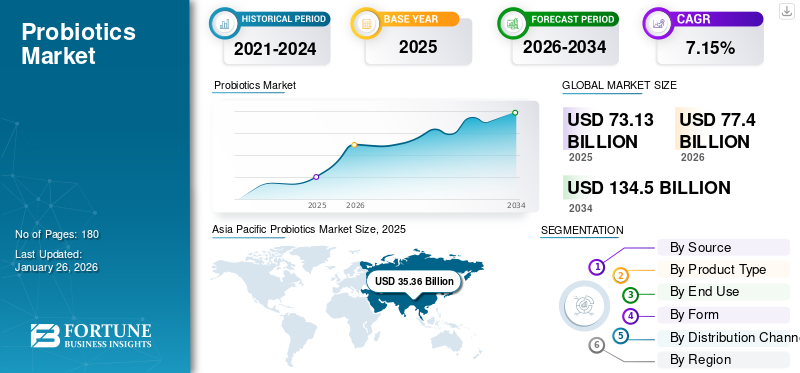
The global probiotics market size was valued at USD 73.13 billion in 2025 and is projected to grow from USD 77.40 billion in 2026 to USD 134.50 billion by 2034, exhibiting a CAGR of 7.15% during the forecast period. Asia Pacific dominated the probiotics market with a market share of 48.35% in 2025.
Probiotics are live microorganisms which are incorporated in food, feed, beverages, dietary supplements and cosmetics products providing a wide range of health benefits to the host, mainly through gut microbiota balance. Rising health awareness and growing focus on digestive and immune wellness are significantly boosting market growth worldwide.
Companies such as Yakult Honsa, Danone S.A., Meiji Holdings are some of the key players operating to meet the growing demand for probiotics. New product launches are key strategy adopted by the manufacturers to attract new consumers and increase sales. Major multinational players lead the market through their strong product portfolios, advanced strain innovation, and extensive distribution networks.
Download Free sample to learn more about this report.
Probiotics Market Key Takeaways
 Market Size & Forecast
- 2025 Market Size: USD 73.13 billion
- 2026 Market Size: USD 77.40 billion
- 2034 Forecast Market Size: USD 134.50 billion
- CAGR: 7.15% from 2026–2034
 Market Share
- Asia Pacific dominated the probiotics market with a 48.35% share in 2025.
- Food & Beverages segment dominated the market with a 61.76% share in 2026.
- Bacteria segment led the market with an 86.77% share in 2026.
 Key Regional Highlights
North American
North America accounted for USD 12.89 billion in 2025, driven by rising preventive wellness awareness.
Europe
Europe reached USD 13.21 billion in 2025, supported by strong demand for fermented and gut health products.
Asia Pacific
Asia Pacific accounted for USD 35.36 billion in 2025, driven by rising functional food consumption.
U.S.
Market expected to reach USD 10.5 billion in 2026, driven by strong probiotic food adoption.
Japan
Japan is estimated to reach USD 8.3 billion in 2026.
Read More

MARKET DYNAMICS
MARKET DRIVERS:
Shift Toward Functional Food and Beverages to Support Market Growth
Consumers are increasingly shifting from traditional food and beverages to products that are composed of functional ingredients. Therefore, plant-based, dairy free and probiotic ingredient-based food products are growing in popularity in the market. Companies are launching products that include targeted strains of probiotic bacteria and yeast that help to combat specific illnesses or disease. With growing innovation in this sector, the popularity of these products is expected to increase further, boosting the overall probiotics market growth.
MARKET RESTRAINTS:
High Production Cost and Premium Prices of Products Hinders Market Development
Manufacturing of probiotics through bacteria and yeast is challenging and requires industry-specific know-how. The infrastructure required for this production is also costly, making the market entry for small players extremely challenging. Probiotic-enriched products are costly compared to traditional product varieties available in the market. As these products are positioned as functional food and beverage, they command a premium price, which makes them unaffordable for price-sensitive consumers.
MARKET OPPORTUNITIES:
Expansion in E-Commerce Platform Enhances Accessibility and Create Opportunity to Expand Sales
Expansion in e-commerce platforms is playing a pivotal role in increasing the reach of companies and making these products accessible to consumers across the world. Consumers can even place an order directly with the manufacturers through online platforms, which is then shipped to their address. Thus, with the rise in inconvenience and growth in internet penetration, the accessibility of the market will increase, creating more opportunities for companies to personalize product offerings for a specific target market and increase sales.
PROBIOTICS MARKET TRENDS:
Personalized Solution and Adoption of Advanced Technology for Formulation are Key Trends Influencing Market Growth
Personalized solution is one of the key emerging areas of this market. As individuals suffer from ailment that differs from person to person, customized food, beverages, and dietary supplement solutions are expected to enhance immunity and treat disease. Thus, companies are using advanced technology to create individual microbiome-based product formulations for the market.
Download Free sample to learn more about this report.
Segmentation Analysis
By Source
Strong Clinical Evidence Contributes to Popularity of Bacteria Source
The market is divided by source into Bacteria, Yeast and Others. Bacteria is further divided into Lactobacillus, Bifidobacterium, and Others.
The Bacteria segment is expected to lead the market, contributing 86.77% globally in 2026. The Bacteria segment is expected to account for the largest market share during the forecast period. Exhaustive research is conducted on different probiotic strains of bacteria that help to validate the benefits of consuming such products. Clinical trials have proven that bacterial strains in probiotics help to improve digestive health and prevent gastrointestinal disease, such as irritable bowel syndrome, and improve immunity. Among these bacterial strains, Lactobacillus is the most widely used bacterial strain for yogurt production.
The yeast segment is expected to grow at a CAGR of 6.06% over the forecast period. These strains complement the function of bacterial strains by providing higher stabilities, leading to wide usage in dietary supplements.
By Product Type
Food and Beverages are Popular Owing to its Popularity as Health Care Product Among Consumers
The Food & Beverages segment is projected to dominate the market with a share of 61.76% in 2026. The market is segmented by product type into food and beverages, supplements, animal feed and cosmetics. Food and beverages are further segmented into Dairy-based products, Non-dairy based beverages, Cereals & snacks, Baked food, Frozen & confectionery, and Ready-to-eat packaged meals. Supplements are further divided into Nutritional supplements, Specialty supplements and Infant formula.
Food and beverages accounted for the largest market share in 2024. As there is a growing preference to consume food and beverages enriched with functional ingredients such as probiotics, the segment is noticing a rapid growth. They also compliment the growing demand for clean label preventative healthcare products among consumer which appeals to a broad consumer base. Among these products, the dairy based beverages account for the largest share.
Supplements is another major product type which is expected to grow by 6.30% during the forecast period. As such products provide targeted health benefits to the consumers, they are used in manufacturing customized solution for the consumers. The expanding application of probiotics in dietary supplements and animal feed continues to drive segment’s growth and diversification across end-use industries.
By End Use
Strong Demand for Preventative Healthcare Products Contributes to Higher Usage of Such Products Among Humans
Based on end use, the market is segmented into human and animal.
The human end-use segment is expected to account for the highest market share of 94.81% in 2026. Rising consumer awareness about the need for preventative and natural wellness health care combined with the growth in clinical studies to assess the efficacy claims of such products is contributing to the segment’s growth.
Usage of probiotics in manufacturing animal feed has also increased in recent years. Microorganisms are increasingly used in animals feeds of livestock, aquaculture and pets to improve nutrient absorption and enhance animal gut health and immunity. The segment is expected to grow at a CAGR of 5.59% during the forecast period.
By Form
Liquid Form Accounts for Higher Market Share Owing to its Higher Bioavailability
On the basis of form, the market is segregated into powder, liquid, encapsulated and others.
Liquid products are expected to account for the largest market share of 53.54% in 2026. The bioavailability of live microorganisms is higher in liquid form, and hence, they act fast and are consumed easily by people compared to other forms. Liquid products are available in pre-dissolved format, which is easily available for quick absorption by the digestive system.
The powder format is expected to grow at a rate of 6.90% during the forecast period, the second-fastest growth rate in this category. This form is most suitable for manufacturing dietary supplements and infant formula products with higher shelf life. It is also suitable for consumers looking for comprehensive wellness products in a single dosage.
To know how our report can help streamline your business, Speak to Analyst
By Distribution Channel
Supermarkets/Hypermarkets hold significant market share owing to wide reach and brand image
The market is segregated into supermarkets & hypermarkets, pharmacies & drug stores, health & specialty stores, online retail / e-commerce and others.
Supermarkets/Hypermarkets account for the highest market share in 2024. Such stores provide wide reach of the consumers, access to availability of wide range of products. As such stores often have a strong brand visibility and image among consumers it builds trust among consumers prompting them to purchase products from such stores.
Online retail/e-commerce account for the fastest growth and the segment is projected to grow at a CAGR of 7.47% during the study period. Convenience driven shopping is one of the major factor which is contributing to the increasing sale of products through thus channel.
Probiotics Market Regional Outlook
Asia Pacific Probiotics Market Size, 2025 (USD Billion)
To get more information on the regional analysis of this market, Download Free sample
By geography, the market is categorized into Europe, North America, Asia Pacific, South America, and Middle East & Africa.
Asia Pacific
The Asia Pacific market accounted for USD 35.36 billion in 2025, representing 48.35% of the global industry, and is expected to reach USD 37.67 billion in 2026. The expanding middle class with higher disposable income in countries such as India, China, Southeast Asia, and other is leading to an increase in purchase of such products. There is a growing demand for infant nutrition, functional beverages, and skincare products, leading to companies expanding probiotic-related product lines in these categories. In this region, China and Japan are estimated to reach USD 14.08 billion and USD 8.3 billion, each, in 2026.
Europe
In 2025, Europe generated USD 13.21 billion, contributing 18.06% to global market revenue, and is projected to grow to USD 13.93 billion in 2026. and secure a position of second-largest region in the market. Countries such as the U.K., Germany, and Nordic nations are familiar with fermented products such as yogurt. As Kefir and other natural probiotics are popular among consumers, manufacturers have opportunity of expand their production capabilities and launch innovative offerings in this market. As the region has a large geriatric and health-conscious consumers who prefer gut health and immunity-boosting, these products are popular in the region, leading to the market’s growth. During the forecast period, the European region is projected to record a growth rate of 6.23%. Backed by these factors, countries including Germany are expected to record the valuation of USD 1.69 billion, France to record USD 1.69 billion, and the U.K. to record USD 1.89 billion in 2026.
North America
North America maintained a strong presence in the global market, reaching USD 12.89 billion in 2025, accounting for 17.62% share, and is expected to reach USD 13.57 billion in 2026. In this region, consumers are awareness of the importance of gut health and overall wellness. Digital media and several dieticians also promote the consumption of food products that improve the overall gut wellbeing. Thus, probiotic products are popular as they are naturally produced and can help to prevent ailments. Probiotics food products, such as yogurt, drinks, and cereals, are popular among consumers in the U.S. market as well. In 2026, the U.S. market is estimated to reach USD 10.5 billion of value.
South America
Expected to witness moderate growth, with the market projected to reach USD 6.80 billion in 2025, driven by increasing consumer adoption of functional foods, dietary supplements, and wellness products as part of a healthier lifestyle trend.
Latin America contributed 9.30% to the global market in 2025, with a valuation of USD 6.8 billion, and is projected to reach USD 7.14 billion in 2026.
Middle East & Africa
In 2025, Middle East & Africa represented USD 4.88 billion, accounting for 6.67% of the worldwide market, and is projected to grow to USD 5.09 billion in 2026. Anticipated to grow steadily, with South Africa expected to register a CAGR of 5.03% during the forecast period. Growth is supported by rising focus on nutrition and preventive healthcare across several Middle Eastern countries.
COMPETITIVE LANDSCAPE
Key Industry Players:
Focus on Product Portfolio Expansion is Key Strategy Adopted by Manufacturers
The global market exhibits a consolidated structure as there are several well established multinational companies, multinational food and beverage manufacturers, biotech startups and nutraceutical manufacturers competing with each other in this market. Manufacturers are increasingly focusing on developing functional ingredient based food and drinks which are alternatives to dairy products. Some of the dietary supplement forms such as Align and BioGaia are using different strains of microorganism to develop probiotics. Additionally, few formulations are also used in livestock probiotics and hence key strategy followed by the manufacturers is expanding the probiotics enriched product category in the market. Companies continue to invest in research and development of new bacterial strains to develop innovative product offerings.
LIST OF KEY PROBIOTICS COMPANIES PROFILED:
- Yakult Honsha Co., Ltd. (Japan)
- Danone S.A. (France.)
- Nestle S.A. (Switzerland)
- Hansen Holding A/S (Denmark)
- DuPont Nutritona dn Biosciences (S.)
- BioGaia AB (Sweden)
- Probi AB (Sweden)
- ADM (U.S.)
- Kerry Group Plc (Ireland)
- Meiji Holdings Co., Ltd. (Japan)
KEY INDUSTRY DEVELOPMENTS:
- August 2025: Danone’s probiotic yogurt brand Activia launched Activia Proactive products which supports gut health. Such products are made off simpler ingredient and also has reduce sugar content.
- June 2025: Activa launched the Gut Glow up campaign to promote its probiotic products in the North American market.
- March 2024: Nounós Creamery launched 16 ounce of probiotics strained yogurt in the U.S. market. The product is available in classic plain and vanilla bean flavors in the market.
- June 2024: India based company Microbio Tx, a gut health startup laughed probiotic based gut product offerings in the market. This product is one of the country’s first prebiotics and probiotics blend for health enthusiast.
- September 2023: SIG and AnaBio Technologies launched probiotics yogurt which are suitable for probiotics beverages made of aseptic packaging. Such products support shelf-stable storage of products for prolonged period.
REPORT COVERAGE
The global probiotics analysis provides an in-depth study of market size & forecast by all the market segments included in the report. The market forecast includes details on the market dynamics and trends expected to drive the market during the forecast period. It offers information on the technological advancements, new product launches, key industry developments, and details on partnerships, mergers & acquisitions. The probiotics industry forecast also encompasses detailed competitive landscape with information on the market share and profiles of key operating players.
Request for Customization to gain extensive market insights.
Report Scope & Segmentation
|
ATTRIBUTE |
DETAILS |
|
Study Period |
2021-2034 |
|
Base Year |
2025 |
|
Forecast Period |
2026-2034 |
|
Historical Period |
2021-2024 |
|
Growth Rate |
CAGR of 7.15% from 2026-2034 |
|
Unit |
Value (USD Billion) |
|
Segmentation |
By Source, Product Type, Form, End Use, Distribution Channel, and Region |
|
By Product Type |
Food and Beverages
Supplements
Animal Feed Cosmetics |
|
By Source |
Bacteria
Yeast Others |
|
By Form |
|
|
By End Use |
|
|
By Distribution Channel |
|
|
By Geography |
North America (By Source, Product Type, Form, End Use, Distribution Channel , and Country)
Europe (By Source, Product Type, Form, End Use, Distribution Channel, and Country)
Asia Pacific (By Source, Product Type, Form, End Use, Distribution Channel, and Country)
South America (By Source, Product Type, Form, End Use, Distribution Channel , and Country)
Middle East and Africa (By Source, Product Type, Form, End Use, Distribution Channel and Country)
Rest of the Middle East & Africa (By Form) |
Frequently Asked Questions
Fortune Business Insights says that the global market value stood at USD 73.13 billion in 2025 and is projected to reach USD 134.50 billion by 2034.
In 2025, the market value stood at USD 35.36 billion.
The market is expected to exhibit a CAGR of 7.15% during the forecast period of 2026-2034.
By product type, the food and beverages segment led the global market in 2026.
Shift toward functional food and beverages to support market growth.
Yakult Honsa, Danone S.A., Meiji Holdings are a few of the players in the market.
Asia Pacific held the largest market share in 2025.
Personalized solution and adoption of advanced technology for formulation are key trends influencing product sales.



- 2021-2034
- 2025
- 2021-2024
- 180
-
(Offer valid till 15th Oct 2026)
Get 30-60 hrs Free Customization
Expand Regional and Country Coverage, Segments Analysis, Company Profiles, Competitive Benchmarking, and End-user Insights.




















Related Reports
-
US +1 833 909 2966 ( Toll Free )
-
Get In Touch With Us