Probiotic Sports Nutrition Market Size, Share & Industry Analysis, By Form (Powder, Tablets/Capsules, and Liquid), By Function (Gut Health & Digestion Support, Immune System Support, and Others), By End-Use (Bodybuilders, Athletes and Lifestyle Users), By Distribution Channel (Hypermarkets/Supermarkets, Convenience Stores, Drug Stores/Pharmacy, Specialty stores/Fitness Centres, and Online Retail) and Regional Forecast, 2026-2034
 Download Free Sample
(Offer valid till 15th Oct 2026)

KEY MARKET INSIGHTS
 Listen to Audio Version
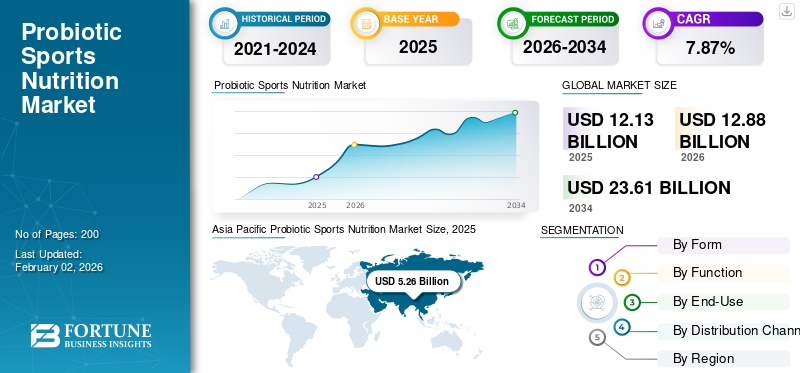
The global probiotic sports nutrition market size was valued at USD 12.13 billion in 2025. The market is projected to grow from USD 12.88 billion in 2026 to USD 23.61 billion by 2034, exhibiting a CAGR of 7.87% during the forecast period. Asia Pacific dominated the probiotic sports nutrition market with a market share of 23.19% in 2025.
The trend toward natural and organic probiotic products is driving market expansion. Probiotics are increasingly used in functional sports nutrition products, including probiotic protein powders, probiotic hydration blends, and energy bars. Probiotics support a healthy athletic gut microbiome, improving nutrient use, disease resistance, and overall productivity, which is further fueling the growth of the global probiotic sports nutrition market.
With the growing preference for organic and natural products, consumers are looking for probiotics with natural and sustainable origins. Natural source-based probiotics align with the consumer demand for clean-label products that are completely free from artificial additives and preservatives.
Wren Laboratories, BLIS Probiotics, Nestle S.A., Royal FrieslandCampina N.V., and Zinereo Pharma are prominent players in the global market.
Download Free sample to learn more about this report.
Probiotic Sports Nutrition Market Key Takeaways
 Global Market Size & Forecast
- 2025 Market Size: USD 12.13 billion
- 2026 Market Size: USD 12.88 billion
- 2034 Forecast Market Size: USD 23.61 billion
- CAGR: 7.87% from 2026-2034
 Market Share
- Asia Pacific dominated the probiotic sports nutrition market with a 23.19% share in 2025.
- The tablets/capsules segment is expected to grow significantly during the forecast period.
- The gut health & digestion support segment dominated the global market.
 Key Regional Highlights
North America
North America accounted for USD 4.27 billion in 2025 and is projected to reach USD 4.53 billion in 2026.
Asia Pacific
Asia Pacific represented USD 5.26 billion in 2025 and is expected to grow to USD 5.61 billion in 2026.
Europe
Europe recorded USD 2.07 billion in 2025 and is projected to reach USD 2.19 billion in 2026.
U.S.
Increasing demand for functional nutrition products is supporting market growth.
Japan
Rising consumer awareness of gut health and sports nutrition is driving market expansion.
Read More

MARKET DYNAMICS
MARKET DRIVERS
Growing Focus on Gut Health and Athletic Recovery to Drive Market Growth
Among the key features of the probiotic sports nutrition foods are gut health ingredients that facilitate digestion, absorption of nutrients, and post-exercise recovery. Probiotics, prebiotics, and enzymes have been increasingly used in protein powder, fermented sports drinks, and energy bars for their role in improving digestion and nutrient absorption. Fermented protein foods and collagen peptides, combined with added probiotic supplements for athletes, help them maintain gut integrity. This trend reflects broader consumer demand for gut-friendly products that promote digestive ease and improve endurance, stamina, and probiotics for muscle recovery from exercise, further fueling the probiotic sports nutrition market growth.
MARKET RESTRAINTS
Consumer Sensitivity to Highly Priced Products Hinders Market Growth
The high pricing of probiotic sports nutrition products presents a significant barrier to market growth, especially in emerging markets such as the Asia Pacific, South America, and the Middle East. Price sensitivity among consumers, combined with competitive pressures and different economic conditions, may limit the adoption of such products. Several potential consumers perceive high-value products as too expensive over lower-priced ones. This dynamic poses challenges to market penetration and limits the potential customer base, thereby hampering market growth.
MARKET OPPORTUNITIES
E-commerce and Direct-to-Consumer Sales to Offer Opportunities for Market Players
The convenience of online shopping has changed the sales dynamics of probiotic sports nutrition products. Online retailers and e-commerce websites provide vast coverage of products, allowing consumers to easily access and buy digestive health sports supplements and nutritional products. Additionally, convenience has become a decisive factor in consumer behavior, further influenced by the pandemic-driven growth of e-commerce, thereby providing new opportunities for market expansion.
PROBIOTIC SPORTS NUTRITION MARKET TRENDS
Rising Trend Toward Personalized Nutrition to Fuel Industry Growth
Personalized nutrition is a developing trend in probiotic sports nutrition, with individuals increasingly seeking customized plans to maximize performance and recovery. Gut flora and physical performance are largely dependent on nutrition; however, individuals respond differently to the identical foods, nutrients, and immunity-boosting sports probiotics. This holds true across various age groups, ethnic backgrounds, and proficiency levels, whether the goal is enhancing general health and fitness or achieving peak performance at the highest competitive levels. As the economy grows, it presents a promising platform for firms to develop and provide innovative solutions that meet evolving and changing consumer demands. This trend opens a massive landscape of growth for the sector, making it an attractive and promising place for investment and the growth of the market.
Download Free sample to learn more about this report.
Segmentation Analysis
By Form
Convenience and Long Shelf Life Support the Powder Segment Growth
Based on form, the market is trifurcated into powder, tablets/capsules, and liquid.
The powder segment dominates the global probiotic sports nutrition market. Powdered supplements are preferred due to their convenience of use, greater stability, and longer shelf life. Adults interested in muscle development and physique enhancement are key users of sports nutrition powders. Breakthroughs in this category involve the introduction of powders that produce thick shakes, which enable sportspeople to stay energized. The expanding trend of individualized nutrition further supports the growth of powder-based supplements, since they can be easily adjusted to address certain health issues or eating habits.
The tablets/capsules segment is expected to grow significantly during the forecast period. Tablets are convenient and are an ideal choice for people with busy schedules. They can also be formulated to deliver an exact dose, which is important for natural sports performance supplements that need accuracy for effectiveness and safety. Additionally, natural coatings can enhance dissolving properties, while efficacy and quality remain important factors influencing absorption rates.
By Function
Probiotics’ Secondary Health Benefits For Athletes Boost the Gut Health & Digestion Segment Expansion
Based on function, the market is divided into gut health & digestion support, immune system support, and others.
The gut health & digestion support segment dominates the global probiotic sports nutrition market. Probiotics can enhance the absorption and digestion of some nutrients and medications, making them more efficiently utilized by the body. Probiotics also generate beneficial products such as short-chain fatty acids (SCFAs), which play an important role in maintaining gut health. Probiotics offer secondary health benefits for athletes by improving recovery from fatigue, immune function, and healthy gastrointestinal tract function.
The immune system support segment will significantly expand during the forecast period. Supplementation with certain probiotic strains in the diets of athletes and the intake of multi-strain products to enhance performance outcomes. Probiotics may enhance sports performance by reducing fatigue and muscle soreness, improving body composition, and potentially boosting cardiorespiratory fitness.
By End-Use
Athletes Segment Dominates the Market Owing to Their Training Objectives
Based on end-use, the market is trifurcated into bodybuilders, athletes, and lifestyle users.
The athlete segment dominates the global market. Nutrition serves as the foundation of an athlete's profession, significantly influencing performance and wellness. Besides maintaining a balanced diet, most athletes rely on nutritional supplements to enhance their nutritional intake and complement their dietary needs and support their training objectives. According to the International Society of Sports Nutrition (ISSN), probiotic supplementation helps in optimizing the performance, health, and recovery of athletes at all stages of their careers. Probiotic sports supplements are essential in fulfilling the metabolic needs of athletes and bodybuilders who undergo frequent physical exertion, thereby fueling the segment's growth.
Physical exercises and sports are on the rise among lifestyle consumers; thus, consumption of such products is increasing rapidly. Demand for products that are nutrient-enriched, such as probiotics, vitamins and minerals, proteins, amino acids, and botanicals, with certain values in the product formulations, is on the rise. These products are available in capsules, tablets, liquid, and powder formats.
By Distribution Channel
Hypermarkets/Supermarkets Segment Leads the Market Owing to Wide Product Range and Easy Accessibility
Based on distribution channel, the market is fragmented into hypermarkets/supermarkets, convenience stores, drug stores/pharmacy, specialty stores/fitness centres, and online retail.
The hypermarkets/supermarkets segment dominates the global probiotic sports nutrition market share. The dominance is driven by factors such as attractive cashback or discounts provided by them. Moreover, the arrangement of distinct shelves for the probiotics and sports nutrition products and easy accessibility to a large range of products are likely to boost product sales.
The online retail segment is anticipated to be the fastest-growing segment during the forecast period. Online players provide attractive discounts on sports supplements, thereby fueling product demand through online channels. Furthermore, a rise in strategies adopted by online players to compete with their retail counterparts may accelerate the growth of online channels in the forthcoming years.
Pharmacists and healthcare professionals employed in these drug stores/pharmacies are able to supply beneficial information and advice to consumers in search of appropriate probiotic products. They can assist customers in selecting probiotics that fit their health objectives and solve certain health issues.
Probiotic Sports Nutrition Market Regional Outlook
By geography, the market is categorized into North America, Europe, Asia Pacific, South America, and the Middle East & Africa.
Asia Pacific
Asia Pacific Probiotic Sports Nutrition Market Size, 2025 (USD Billion)
To get more information on the regional analysis of this market, Download Free sample
Asia Pacific dominates the global probiotic sports nutrition market. Consumers in the region are increasingly focused on maintaining healthy lifestyles and actively look for products that support fitness and well-being. Japan, China, and India are the major markets supporting this growth, with Japan being a major contributor due to its high level of consumer interest and awareness toward fitness and health. According to the CEIC Data, participation in sports and fitness activities such as China increased by 49.6 % in 2024, compared to 30.9 % in 2018. Furthermore, increased disposable incomes in nations such as China and India, combined with urbanization, are allowing consumers to spend more money on health and wellness items, including sports nutrition. In 2025, Asia Pacific represented USD 5.26 billion, accounting for 23.19% of the worldwide market, and is projected to grow to USD 5.61 billion in 2026.
North America
The U.S. and Canada are the major markets in the North American region, experiencing strong growth due to rising consumer awareness about gut health, immune function, and overall wellness benefits of using probiotics. Increased demand for personalized nutrition and growth in e-commerce platforms have also further spurred product adoption and accessibility. The North America market accounted for USD 4.27 billion in 2025, representing 21.68% of the global industry, and is expected to reach USD 4.53 billion in 2026.
Functional foods and dietary supplements are increasingly becoming a staple in the typical North American diet, prompting startups and established brands to diversify their probiotic offerings. For instance, in April 2023, NextFoods, one of the leaders in the U.S functional food and beverage industry, merged its dairy-free probiotic brand GoodBelly with sports nutrition innovator Cheribundi. The acquisition aims to expand strategic channels and positions both companies at the forefront of whole foods-based nutrition.
Europe
European probiotic sports nutrition is on the rise as more individuals seek to optimize athletic performance and maintain healthy lifestyles. European consumers are becoming increasingly selective about the ingredients used in their sports nutrition. They are looking for products with functional ingredients that provide benefits in addition to protein and carbohydrates. This trend has resulted in increasing demand for products containing ingredients such as probiotics, creatine, glutamine, caffeine, and beta-alanine. Manufacturers are promoting these functional ingredients by launching new products and are targeting customers seeking targeted solutions for enhancing their sporting performance. For instance, in June 2024, DSM-Firmenich, one of the leading innovators in nutrition, health, and beauty, launched a new line of Up4 sports nutrition products in collaboration with the Team DSM-Firmenich PostNL cycling team. The new line included Culturelle probiotics, AZO women’s health products, designed to support both performance and health. Europe recorded a market size of USD 2.07 billion in 2025, capturing 15.09% of the global market share, and is projected to reach USD 2.19 billion in 2026.
Latin America
The probiotic sports nutrition market in South America is witnessing substantial growth, backed by an increased awareness of wellness and fitness among the populace. The influx of health-conscious consumers and the rising number of gyms and fitness clubs in the region position Brazil, Argentina, and Chile as the benchmark markets. An increasing middle class with improved disposable incomes is building awareness, innovation, and availability of products throughout the region, further driving market growth. The Latin America market was valued at USD 0.36 billion in 2025, capturing 17.74% of global revenue, and is estimated to reach USD 0.38 billion in 2026.
Middle East & Africa
The addition of probiotics into sports nutrition is becoming popular in the Middle East due to growing awareness of gut health in sports nutrition and how it affects performance. Athletes are becoming more aware of the possibility of using probiotics to reduce stress caused by exercise, enhance recovery, and improve general performance. Fitness clubs, yoga clubs, and sports outdoors have been an integral part of the culture, and hence, there has been an upsurge in demand for sports nutrition products. The UAE government, through numerous initiatives, is encouraging sports and microbiome-based fitness products, in accordance with the Vision 2021 plan, creating favorable conditions for market growth in the region. Middle East & Africa contributed 16.73% to the global market in 2025, with a valuation of USD 0.16 billion, and is projected to reach USD 0.17 billion in 2026.
COMPETITIVE LANDSCAPE
Key Industry Players
Industry Emphasis on New Product Development to Aid Market Growth
The increasing consumer awareness regarding probiotic sports nutrition products and their benefits beyond digestive well-being is expected to drive demand at a healthy pace. The surging demand for the product is encouraging industry players to diversify their product range and distribution network to expand their market share and consumer base. For instance, in April 2024, FrieslandCampina Ingredients, one of the global leaders, launched Biotis Fermentis, a high-protein and gut-supporting solution that supports both athletic performance and holistic health. The major players in the market, such as Wren Laboratories, BLIS Probiotics, Nestle S.A., Royal FrieslandCampina N.V., and Zinereo Pharma, are investing significantly in research and development in order to upgrade their product lines and develop innovative products with better properties to meet rising consumer demand.
LIST OF KEY PROBIOTIC SPORTS NUTRITION COMPANIES PROFILED
- Glanbia PLC (U.S.)
- Vitaquest International LLC (U.S.)
- Wren Laboratories (U.S.)
- BLIS Probiotics (New Zealand)
- Nestle S.A. (Switzerland)
- Royal FrieslandCampina N.V. (Netherlands)
- Lonza Group AG (Switzerland)
- Zinereo Pharma (Spain)
- DSM-Firmenich (Switzerland)
- Premiere Nutrition Limited (U.K.)
KEY INDUSTRY DEVELOPMENTS
- May 2024: Sinopharm Foreign Trade, Probi, and Jiangsu Guoxi Biological Technology Co., Ltd, launched Sinopharm Foreign Trade’s self-operated brand Yuelewei’s new sports nutrition product, namely Yuelewei Plant Selenium Compound Probiotic Peptide Powder.
- June 2021: Kaged Muscle, a premium sports nutrition supplements manufacturer, partnered with Lonza to launch TWK10 sports probiotic capsules, formulated to address athletes' health, performance, and endurance at all levels.
- November 2020: Kerry, the Taste & Nutrition company, acquired the Canadian probiotic company, Bio-K Plus International. The acquisition expanded the company’s portfolio and opened pathways to offer clinically supported sports nutrition products.
- September 2020: Lonza Group AG launched its first probiotic ingredient for sports nutrition in North America, under the brand TWK10.
- March 2019: Zinereo Pharma launched its first line of probiotics specifically formulated for sports nutrition, named TOP4U. This new product line consists of 8 different products with varying characteristics. The products can be purchased online through the TOP4U website, www.top4usports.com, or through Amazon.
REPORT COVERAGE
The report provides the market size and forecast for all segments. It includes details on the market dynamics and global probiotic sports nutrition market trends expected to drive the market in the forecast period. It offers information about the key regions, key industry developments, new product launches, and details on partnerships, mergers, and acquisitions. The report also covers a detailed competitive landscape with information on the market share and profiles of key players.
Request for Customization to gain extensive market insights.
Report Scope & Segmentation
|
ATTRIBUTE |
DETAILS |
|
Study Period |
2021–2034 |
|
Base Year |
2025 |
|
Estimated Year |
2026 |
|
Forecast Period |
2026-2034 |
|
Historical Period |
2021–2024 |
|
Growth Rate |
CAGR of 7.87%% from 2026-2034 |
|
Unit |
Value (USD Billion) |
|
Segmentation |
By Form
|
|
By Function
|
|
|
By End Use
|
|
|
By Distribution Channel
|
|
|
By Region
|
Frequently Asked Questions
Fortune Business Insights says that the global market value stood at USD 12.13 billion in 2025 and is projected to reach USD 23.61 billion by 2034.
The market is expected to exhibit a CAGR of 7.87% during the forecast period (2026-2034).
The athletes segment leads the market by end-use.
Growing focus on gut health and athletic recovery is a key factor driving market growth.
Wren Laboratories, BLIS Probiotics, Nestle S.A., Royal FrieslandCampina N.V., and Zinereo Pharma are the top players in the market.
Asia Pacific dominates the market.
Rising trend toward personalized nutrition is a key trend in the market.



- 2021-2034
- 2025
- 2021-2024
- 200
-
(Offer valid till 15th Oct 2026)
Get 30-60 hrs Free Customization
Expand Regional and Country Coverage, Segments Analysis, Company Profiles, Competitive Benchmarking, and End-user Insights.




















Related Reports
-
US +1 833 909 2966 ( Toll Free )
-
Get In Touch With Us