Heart Failure Drugs Market Size, Share & Industry Analysis, By Drug Class (SGLT2 Inhibitors, ARNI, Beta Blockers, ACE Inhibitors & ARBs, Mineralocorticoid Receptor Antagonists, Diuretics, and Others), By Indication (HFrEF, HFpEF, HFmrEF, Acute Decompensated Heart Failure, Post-MI Heart Failure / LV Dysfunction, and Others), By Type (Branded and Generics), By Route of Administration (Oral and Parenteral), By Age Group (Adults and Pediatrics), By Distribution Channel (Hospital Pharmacies, Retail Pharmacies & Drug Stores, Online Pharmacies, and Others), and Regional Forecast, 2026-2034
 Download Free Sample
Heart Failure Drugs Market Size and Future Outlook
 Listen to Audio Version
The global heart failure drugs market size was valued at USD 11.79 billion in 2025 and is projected to grow from USD 13.43 billion in 2026 to USD 38.46 billion by 2034, exhibiting a CAGR of 14.06% during the forecast period. North America dominated the heart failure drugs market with a market share of 43.34% in 2025.
The global market includes prescription therapies used to manage chronic and acute heart failure across various indications. The market is growing due to the rising global burden of heart failure, aging population, increasing cardiometabolic comorbidities, wider use of guideline-directed medical therapy, and expanding adoption of branded therapies.
Key players in the global market include Novartis AG, AstraZeneca, Boehringer Ingelheim International GmbH, and Merck & Co., Inc. Their competitive positioning is supported by strong geographical presence, focus on innovative drug development, and other strategic initiatives.
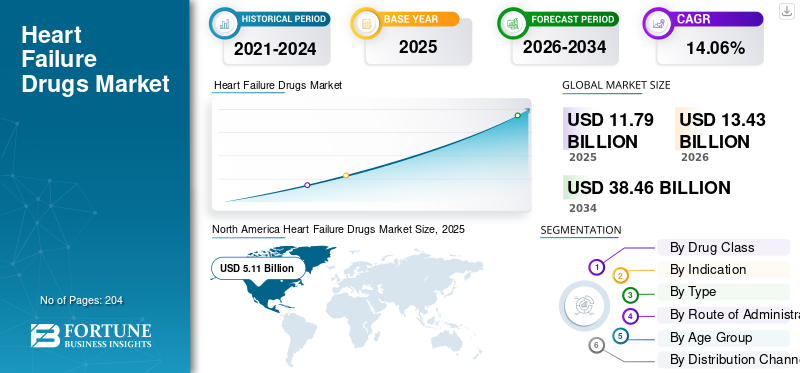
Download Free sample to learn more about this report.
HEART FAILURE DRUGS MARKET TRENDS
Rapid Uptake of SGLT2 Inhibitors Reshaping Heart Failure Treatment is a Remarkable Market Trend
The global market is experiencing a significant transition toward SGLT2 inhibitors, as these medications are increasingly applied beyond diabetes treatment and are becoming essential in heart failure management. Their application in HFrEF, HFpEF, and HFmrEF is broadening the patient demographic and enhancing their revenue impact in the market. This trend is diminishing the market’s previous reliance on ARNI and older generic treatments such as beta blockers, ACE inhibitors/ARBs, and diuretics. With physicians expanding the use of SGLT2 inhibitors for wider heart failure risk mitigation, this category is projected to experience the rapid expansion among drug classes. These factors are anticipated to support the global heart failure drugs market growth during the forecast period.
- For instance, in May 2023, AstraZeneca announced that the U.S. FDA approved Farxiga for adults with heart failure to reduce the risk of cardiovascular death, hospitalization for heart failure, and urgent HF visits, regardless of left ventricular ejection fraction status.
MARKET DYNAMICS
MARKET DRIVERS
Download Free sample to learn more about this report.
Rising Heart Failure Burden and Aging Population to Drive Drug Demand
The market growth is mainly propelled by the increasing number of patients needing extended care for chronic and acute heart failure. Increasing age demographics, growing rates of diabetes, hypertension, obesity, and enhanced survival following cardiac incidents expand the pool of patients suitable for treatments such as ARNI, SGLT2 inhibitors, beta blockers, MRAs, ACE inhibitors/ARBs, and diuretics. Since heart failure is a chronic condition, the growing patient population directly drives ongoing prescription needs and increased uptake of guideline-directed treatments. This is anticipated to bolster expansion for both branded and generic medication categories, driving the global market growth.
- For instance, in September 2025, the Heart Failure Society of America reported that around 6.7 million Americans aged 20 years and above have heart failure and the number is expected to rise to 8.7 million by 2030, highlighting the growing treatment burden.
|
Rank |
Market Driver |
Expected Impact on Market Growth |
Estimated Gross Market Growth Contribution (USD Billion) |
Impact: 2026-2028 |
Impact: 2029-2031 |
Impact: 2032-2034 |
|
1 |
Expansion of SGLT2 inhibitors across HFrEF, HFpEF, and HFmrEF |
High |
9.2 |
High |
High |
Medium |
|
2 |
Rising heart failure prevalence and aging population |
High |
7.8 |
High |
High |
High |
|
3 |
Wider adoption of guideline-directed medical therapy, or GDMT |
Medium-High |
6.3 |
Medium |
High |
High |
|
4 |
Growing treatment of HFpEF and HFmrEF patients |
Medium-High |
5.8 |
Medium |
High |
High |
|
5 |
Improving access to branded and generic HF drugs in emerging markets |
Medium |
3.6 |
Medium |
Medium |
High |
|
6 |
Others |
Low |
1.63 |
Low |
Low |
Low |
|
|
Total Gross Growth Contribution |
|
34.33 |
|
|
|
MARKET RESTRAINTS
Limited Reimbursement and Access to Premium HF Therapies to Restrain Market Growth
Constraints on reimbursement and issues with affordability are anticipated to hinder the market, particularly in low-and-middle income countries. Premium treatments such as ARNI and SGLT2 inhibitors are crucial for clinical practice, yet their uptake is lower in low- and middle-income nations due to high out-of-pocket expenses, restricted public financing, and inconsistent access to specialists. This limits the adoption of branded treatments and keeps many developing markets reliant on affordable generics, constraining global market expansion.
- For example, in August 2023, a European Journal of Heart Failure study reported that publicly funded drug programs in low- and middle-income countries improved affordability but still limited access to newer HFrEF therapies, with ARNI and SGLT2 inhibitors remaining inaccessible through these programs in several LMICs.
|
Rank |
Market Driver |
Expected Impact on Market Growth |
Estimated Gross Market Growth Contribution (USD Billion) |
Impact: 2026-2028 |
Impact: 2029-2031 |
Impact: 2032-2034 |
|
1 |
Expansion of SGLT2 inhibitors across HFrEF, HFpEF, and HFmrEF |
High |
9.2 |
High |
High |
Medium |
|
2 |
Rising heart failure prevalence and aging population |
High |
7.8 |
High |
High |
High |
|
3 |
Wider adoption of guideline-directed medical therapy, or GDMT |
Medium-High |
6.3 |
Medium |
High |
High |
|
4 |
Growing treatment of HFpEF and HFmrEF patients |
Medium-High |
5.8 |
Medium |
High |
High |
|
5 |
Improving access to branded and generic HF drugs in emerging markets |
Medium |
3.6 |
Medium |
Medium |
High |
|
6 |
Others |
Low |
1.63 |
Low |
Low |
Low |
|
|
Total Gross Growth Contribution |
|
34.33 |
|
|
|
MARKET OPPORTUNITIES
Expanding HFpEF and HFmrEF Treatment Pool to Create New Growth Opportunities
The market presents significant opportunities in HFpEF and HFmrEF, since these patient populations have been historically neglected due to a lack of treatment options that modify the disease. The wider application of SGLT2 inhibitors throughout the ejection fraction range is increasing the potential patient population beyond conventional HFrEF therapy. This will facilitate increased prescription volumes, enhanced adoption of branded therapies, and better revenue per patient in preserved and mildly reduced EF groups. With advancements in diagnosis and the increase in guideline-based prescribing, HFpEF and HFmrEF are anticipated to emerge as significant growth areas for market participants. All these factors would drive the market growth in the coming years.
- For instance, in March 2022, Boehringer Ingelheim and Eli Lilly announced that the European Commission approved Jardiance as a treatment for adults with symptomatic chronic heart failure regardless of ejection fraction. These also include HFpEF patients, an underserved population that previously had no approved therapies in Europe.
MARKET CHALLENGES
Safety and Tolerability Concerns to Challenge SGLT2 Inhibitor Uptake
Safety and tolerability concerns may challenge the wider adoption of SGLT2 inhibitors in the market, especially among elderly, frail, renally impaired, or volume-depleted patients. Although these drugs are increasingly used across HFrEF, HFpEF, and HFmrEF, physicians may require careful patient selection and monitoring due to risks such as ketoacidosis, volume depletion, and serious genitourinary infections. This can slow treatment initiation or continuation in high-risk patients and limit full market penetration despite strong clinical benefits, affecting market expansion.
- For instance, the 2026 U.S. FDA label for Farxiga warns about diabetic ketoacidosis/other ketoacidosis, volume depletion, and genitourinary infections including urosepsis, pyelonephritis, Fournier’s gangrene, and genital mycotic infections.
Segmentation Analysis
By Drug Class
ARNI Segment Led the Market due to High Treatment Value and Strong Deployment for Treating Chronic Conditions
In terms of drug class, the market is divided into SGLT2 inhibitors, ARNI, beta blockers, ACE inhibitors & ARBs, mineralocorticoid receptor antagonists, diuretics, and others.
The ARNI segment accounted for the largest heart failure drugs market share in 2025 due to the strong commercial position of Entresto in chronic heart failure treatment. The segment captured the highest share as ARNI therapy is mainly used for the long-term management of HFrEF patients and has a much higher annual treatment value than other drug classes. Moreover, strong adoption in developed markets, guideline-supported use, and recurring prescription demand helped the segment maintain its leading revenue contribution.
- For instance, in February 2026, Novartis reported that Entresto generated USD 7.75 billion in full-year 2025 sales, making it one of the company’s top-selling brands despite U.S. generic pressure.
The SGLT2 inhibitors segment is anticipated to rise with a CAGR of 23.92% over the forecast period.
To know how our report can help streamline your business, Speak to Analyst
By Indication
Established Multi-Drug Treatment Pathway Led to the Dominance of HFrEF Segment
On the basis of indication, the market is divided into HFrEF, HFpEF, HFmrEF, acute decompensated heart failure, post-MI heart failure / LV dysfunction, and others.
The HFrEF segment dominated the global market in 2025 due to its well-established treatment pathway and higher use of multiple drug classes, including ARNI, SGLT2 inhibitors, and others. Additionally, HFrEF has stronger guideline-backed drug adoption and wider use of premium therapies such as Entresto and SGLT2 inhibitors. The segment also has higher treatment intensity, longer therapy duration, and greater hospitalization-risk reduction focus, which supported its leading revenue share. ACC guidance also identifies ARNI, beta blockers, SGLT inhibitors, and MRAs as core therapy for chronic HFrEF, further supporting high drug utilization in this indication. Furthermore, the segment is set to hold a share of 57.6% in 2026.
- For instance, in August 2025, Novartis announced that its ESC 2025 cardiovascular data would include the PARACHUTE-HF study evaluating Entresto in heart failure with reduced ejection fraction due to chronic Chagas disease, highlighting continued clinical focus on HFrEF populations.
The HFpEF segment is poised to expand at a CAGR of 19.24% over the forecast period.
By Type
Branded Segment Dominated the Market due to Increasing Number of High-Value HF Therapies
Based on type, the market is classified into branded and generics.
The branded segment dominated the global market in 2025 owing to the higher treatment value of key heart failure drugs. Although generic therapies are widely used, their low pricing limited their revenue contribution. Branded drugs captured a larger market share as they are increasingly used for hospitalization-risk reduction, cardiovascular death reduction, and broader treatment across HFrEF, HFpEF, and HFmrEF patients. Strong clinical positioning, premium pricing, and expanding approvals supported the segment’s leading market share. Furthermore, the segment is set to hold a share of 68.1% in 2026.
- For instance, in May 2023, Lexicon Pharmaceuticals announced that the U.S. FDA approved Inpefa, a once-daily branded oral tablet. The solution has been launched to reduce the risk of cardiovascular death, hospitalization for heart failure, and urgent HF visits in adults with heart failure or related cardiovascular risk conditions.
The generics segment is anticipated to rise at a CAGR of 12.47% over the forecast period.
By Route of Administration
High Deployment of Long-term Therapies Bolstered Oral Segment Leadership in 2025
In terms of type, the market is divided into oral and parenteral.
The oral segment captured the highest share of the global market in 2025. This can be attributed to the strong use of long-term heart failure therapies in outpatient settings. Moreover, majority of the therapies are largely administered as tablets, capsules, or oral formulations, thereby supporting the segment’s dominance. The leading share is further supported by recurring prescriptions, ease of use, better suitability for chronic disease management, and wider availability through retail and online pharmacies. Compared to parenteral drugs, which are mostly used in acute hospital settings, oral drugs generated higher value due to broader patient coverage and longer treatment duration. Furthermore, the segment is set to hold a share of 93.9% in 2026.
- For instance, in May 2024, Otsuka announced the launch of Entresto Granular Tablets for Pediatric Use in Japan after approval for chronic heart failure in pediatric patients in February 2024.
The parenteral segment is anticipated to rise at a CAGR of 11.61% over the forecast period.
By Age Group
Adults Segment Led the Market due to Higher Disease Burden and Long-Term Therapy Use
On the basis of age group, the market is divided into adults and pediatrics.
The adults segment captured the highest market share in 2025 owing to the substantially higher prevalence of heart failure among adult and elderly patients. Moreover, adult patients account for most prescriptions across key drug classes, thereby supporting segment dominance. The segment’s leading share was supported by long-term therapy use, higher comorbidity burden such as hypertension, diabetes, and CKD, and greater hospitalization risk among older patients. Compared with pediatric heart failure, adult HF has a much larger diagnosed and treated population, which supported the segment’s dominant share. Furthermore, the segment is set to hold a share of 98.2% in 2026.
- For instance, in May 2024, the CDC reported that nearly 6.7 million adults aged 20 years or older in the U.S. have heart failure, highlighting the large adult treatment pool for HF drugs.
The pediatrics segment is anticipated to rise at a CAGR of 17.55% over the forecast period.
By Distribution Channel
Retail Pharmacies & Drug Stores Segment Dominated due to Chronic Refill-Based Treatment
In terms of distribution channel, the market is segmented into hospital pharmacies, retail pharmacies & drug stores, online pharmacies, and others.
In 2025, the retail pharmacies & drug stores segment held the leading position in the global market. The segment’s dominance can be attributed to the fact that most heart failure drugs are used for long-term outpatient management and are commonly dispensed through retail channels for repeat prescriptions. The segment also benefited from the large adult HF patient pool, recurring monthly refills, and wider availability of branded as well as generic cardiovascular drugs. Compared with hospital pharmacies, retail channels captured higher value as chronic maintenance therapy accounts for a larger share of total HF drug consumption. Furthermore, the segment is set to hold a share of 59.8% in 2026.
- For instance, in August 2025, MSN Pharmaceuticals announced the U.S. launch of generic sacubitril/valsartan tablets for chronic heart failure with reduced ejection fraction. The move aimed at expanding access to affordable cardiovascular medication across the country.
In addition, the online pharmacies segment is projected to witness a CAGR of 19.64% during the forecast period.
Heart Failure Drugs Market Regional Outlook
By geography, the market is divided into North America, Latin America, Asia Pacific, Europe, and the Middle East & Africa.
North America
North America Heart Failure Drugs Market Size, 2025 (USD Billion)
To get more information on the regional analysis of this market, Download Free sample
The North America market reached USD 4.46 billion in 2024 and led the global market. In 2025, the region continued to hold its leading position, with a value of USD 5.11 billion. High adoption of branded therapies such as ARNI and SGLT2 inhibitors, strong specialist access, better reimbursement coverage, and high diagnosis rates are supporting market growth. The region also benefits from the faster use of guideline-directed medical therapy across the region.
U.S. Heart Failure Drugs Market
The U.S. dominated the North America market and can be analytically approximated at around USD 5.34 billion in 2026, accounting for roughly 39.8% of the global market.
Europe
The Europe market is anticipated to grow at a CAGR of 13.02% during the forecast period. Europe is witnessing steady growth supported by wider guideline-based treatment, strong cardiology infrastructure, aging population, and increasing use of SGLT2 inhibitors across HFrEF, HFpEF, and HFmrEF.
U.K. Heart Failure Drugs Market
The U.K. market is estimated to touch a valuation of around USD 0.61 million in 2026, representing roughly 4.5% of global revenues.
Germany Heart Failure Drugs Market
The Germany market size is projected to reach approximately USD 0.76 billion in 2026, equivalent to around 5.7% of global sales.
Asia Pacific
The Asia Pacific market is expected to reach a valuation of USD 2.75 billion by 2026. The regional market is expected to record the fastest growth due to a large underdiagnosed HF population, rising diabetes and hypertension burden, aging demographics, and improving access to branded cardiovascular drugs in China, Japan, India, South Korea, and Australia.
Japan Heart Failure Drugs Market
The Japan market is estimated to reach a value of around USD 0.61 billion in 2026, accounting for roughly 4.6% of global revenues.
China Heart Failure Drugs Market
The China market is projected to reach revenues of around USD 0.91 billion in 2026, representing roughly 6.8% of global sales.
India Heart Failure Drugs Market
The India market is estimated to touch a valuation of around USD 0.33 billion in 2026, accounting for roughly 2.4% of global revenues.
Latin America and Middle East & Africa
The Middle East & Africa and Latin America markets are likely to witness moderate growth over the forecast period. The market in Latin America is projected to attain a valuation of USD 0.74 billion by 2026. The regional growth is supported by increasing cardiovascular disease burden, improving diagnosis, expanding access to generics, and gradual uptake of premium therapies in Brazil, Mexico, and urban private healthcare settings.
In the Middle East and Africa region, the GCC market is projected to reach approximately USD 0.25 billion by 2026, representing about 1.9% of global revenues. The growth is supported by rising CVD and diabetes burden, improving healthcare access in GCC countries, and gradual expansion of chronic disease management programs.
COMPETITIVE LANDSCAPE
Key Industry Players
Focus on Branded Innovative Products and Generic Cardiovascular Portfolios by Key Players for a Competitive Edge
The global heart failure drugs market is moderately consolidated, with companies such as Novartis AG, AstraZeneca, Boehringer Ingelheim International GmbH, and Merck & Co. Inc., holding notable positions. These players compete through branded HF drugs, SGLT2 inhibitors, ARNI therapy, sGC stimulators, If-channel inhibitors, and broad generic cardiovascular portfolios. The introduction of new products coupled with emphasis on strategic initiatives are some of the strategies undertaken by these players to maintain their market positions.
- For instance, in August 2025, Merck reported new Phase 3 VICTOR data for Verquvo in chronic HFrEF, reflecting continued investment in add-on HF therapies.
Additional key contributors include Amgen Inc., Pfizer Inc., LEXICON PHARMACEUTICALS, INC., Viatris Inc., Teva Pharmaceutical Industries Ltd., and Sandoz Inc. These players are focusing on product lifecycle expansion, generic launches, regional access expansion, and clinical evidence generation for chronic and worsening heart failure.
- For instance, in October 2024, Viatris entered an exclusive licensing agreement with Lexicon Pharmaceuticals for sotagliflozin in markets outside the U.S. and Europe, strengthening its cardiovascular and heart failure.
LIST OF KEY HEART FAILURE DRUGS COMPANIES PROFILED
- Novartis AG (Switzerland)
- AstraZeneca (U.K.)
- Boehringer Ingelheim International GmbH (Germany)
- Merck & Co., Inc. (U.S.)
- Amgen Inc. (U.S.)
- Pfizer Inc. (U.S.)
- LEXICON PHARMACEUTICALS, INC. (U.S.)
- Viatris Inc. (U.S.)
- Teva Pharmaceutical Industries Ltd. (Israel)
- Sandoz Inc. (Switzerland)
KEY INDUSTRY DEVELOPMENTS
- January 2026: Viatris launched Inpefa / sotagliflozin in the UAE for the treatment of heart failure. This marked the first launch of the product within Viatris territories, supporting its cardiovascular portfolio expansion outside the U.S. and Europe.
- October 2025: Sandoz Canada launched PrSandoz Sacubitril-Valsartan, an affordable alternative to Entresto, approved for all reference product indications, expanding access to ARNI-based heart failure treatment in Canada.
- July 2025: Bayer announced the U.S. FDA approval of Kerendia / finerenone for patients with heart failure and LVEF ≥40%, expanding the product into HF with mildly reduced or preserved ejection fraction.
- January 2025: Lupin received the U.S. FDA approval for sacubitril and valsartan tablets, the generic version of Entresto, in three strengths.
- August 2024: Bayer announced that the Phase III FINEARTS-HF trial of Kerendia met its primary endpoint in patients with heart failure with mildly reduced or preserved ejection fraction, supporting future HF label expansion.
REPORT COVERAGE
The global heart failure drugs market analysis encompasses an extensive examination of the market size and projections for all market segments featured in the report. It provides information on the market dynamics and trends that are anticipated to propel the market during the forecast period. It offers insights into crucial elements, such as innovations in products, the regulatory landscape, pipeline analysis, and the introduction of new products. Furthermore, it outlines collaborations, mergers, and acquisitions, along with significant advancements in the industry. The global market forecast report additionally offers a comprehensive competitive landscape with details on market share and profiles of major active participants.
Request for Customization to gain extensive market insights.
Report Scope & Segmentation
| ATTRIBUTE | DETAILS |
| Study Period | 2021-2034 |
| Base Year | 2025 |
| Estimated Year | 2026 |
| Forecast Period | 2026-2034 |
| Historical Period | 2021-2024 |
| Growth Rate | CAGR of 14.06% from 2026-2034 |
| Unit | Value (USD Billion) |
| Segmentation | By Drug Class, Indication, Type, Route of Administration, Age Group, Distribution Channel, and Region |
| By Drug Class |
|
| By Indication |
|
| By Type |
|
| By Route of Administration |
|
| By Age Group |
|
| By Distribution Channel |
|
| By Region |
|
Frequently Asked Questions
According to Fortune Business Insights, the global market value stood at USD 11.79 billion in 2025 and is projected to reach USD 38.46 billion by 2034.
In 2025, the North America market value stood at USD 5.11 billion.
The market is expected to exhibit a CAGR of 14.06% during the forecast period of 2026-2034.
By drug class, the ARNI segment led the market in 2025.
Rising global heart failure burden and aging population coupled with expansion of SGLT2 inhibitors into heart failure care are key factors primarily driving market expansion.
Novartis AG, AstraZeneca, Boehringer Ingelheim International GmbH, and Merck & Co., Inc. are the prominent players in the global market.
North America dominated the market in 2025.



- 2021-2034
- 2025
- 2021-2024
- 204
Get 30-60 hrs Free Customization
Expand Regional and Country Coverage, Segments Analysis, Company Profiles, Competitive Benchmarking, and End-user Insights.













.webp)






Related Reports
-
US +1 833 909 2966 ( Toll Free )
-
Get In Touch With Us