Hearth Glass Ceramic Market Size, Share & Industry Analysis, By Product Type (Stoves, Inserts, and Fireplaces), By Fuel Type (Wood, Gas, and Pellet), and Regional Forecast, 2026-2034
 Download Free Sample
Hearth Glass Ceramic Market Size and Future Outlook
 Listen to Audio Version
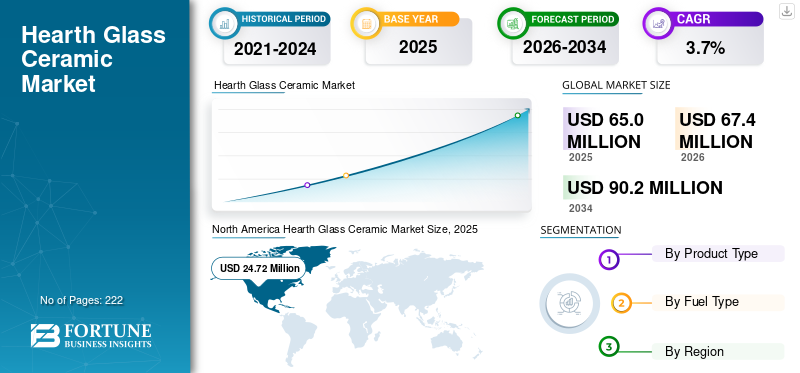
The global hearth glass ceramic market size was valued at USD 65.0 million in 2025. The market is projected to grow from USD 67.4 million in 2026 to USD 90.2 million by 2034, exhibiting a CAGR of 3.7% during the forecast period. North America dominated the hearth glass ceramic market with a market share of 38.03% in 2025.
Hearth glass ceramic refers to highly heat-resistant, low-expansion glass-ceramic panels used in stoves, fireplace inserts, enclosed fireplaces, pellet stoves, gas fireplaces, and other hearth appliances. These panels are designed to withstand high operating temperatures, repeated heating and cooling cycles, thermal shock, and direct exposure to radiant heat while maintaining flame visibility and structural stability. In hearth systems, glass ceramic serves as a protective viewing panel and a design-enabling component that supports larger viewing areas, cleaner appliance fronts, and premium fireplace aesthetics.
The increased demand for enclosed and energy-efficient hearth systems, growing consumer preference for premium home heating products, and the replacement of conventional open fireplaces are driving the demand for advanced materials such as glass ceramics. Furthermore, market growth will be driven by new hearth appliance production and by the shift toward larger-format, coated, decorative, and higher-value glass-ceramic solutions.
The global market is led by a limited group of specialized glass and glass-ceramic manufacturers with strong capabilities in controlled crystallization, high-temperature material engineering, coating technologies, precision cutting, and appliance-grade certification.
Key players include SCHOTT Group, EuroKera, Nippon Electric Glass, and other regional processors and specialty glass suppliers serving hearth OEMs, fabricators, and replacement channels. Continuous development of heat-reflective, anti-reflective, tinted, black-effect, and large-format panels is strengthening product differentiation in the market.
Download Free sample to learn more about this report.
hearth glass ceramic market KEY TAKEAWAYS
 Global Market Size & Forecast
- 2025 Market Size: USD 65.0 Million
- 2026 Market Size: USD 67.4 Million
- 2034 Forecast Market Size: USD 90.2 Million
- CAGR: 3.7% from 2026-2034
 Market Share
- North America dominated with a revenue share of 38.03% in 2025.
- Stoves dominated the market in 2025.
- Wood-based hearth systems dominated the market in 2025.
 Key Regional Highlights
North America
North America led with USD 24.72 Million in 2025.
Europe
Europe reached USD 24.0 Million in 2025.
Asia Pacific
Asia Pacific reached USD 11.9 Million in 2025.
U.S.
Expected to reach USD 21.9 Million in 2026.
Japan
Expected to reach USD 2.5 Million in 2026.
Read More

hearth glass ceramic market TRENDS
Shift Toward High-Efficiency, Safer, and Lower-Emission Hearth Appliances to Accelerate Product Adoption
The hearth industry is moving toward enclosed, controlled-combustion appliances that offer better heat retention, improved safety, and lower visible emissions compared to traditional open fireplaces. This transition is increasing the use of glass-ceramic panels, as modern wood stoves, pellet stoves, fireplace inserts, and gas fireplaces require transparent viewing windows capable of withstanding high temperatures and repeated thermal cycling. Glass ceramic supports this shift by enabling sealed combustion chambers while maintaining flame visibility and front-facing aesthetics. Regulatory pressure on appliance efficiency and particulate emissions in key markets such as North America and Europe is also encouraging manufacturers to redesign hearth products with safer and more efficient systems. As a result, glass ceramic is becoming a core functional component in next-generation hearth appliance design. Hence, the shift toward high-efficiency, safer, and lower-emission hearth appliances is set to accelerate product adoption.
MARKET DYNAMICS
MARKET DRIVERS
Download Free sample to learn more about this report.
Growing Replacement Demand from Aging Installed Fireplaces and Home Renovation to Fuel Market Growth
Glass-ceramic panels used in wood, pellet, and gas hearth systems may require replacement due to cracking, impact damage, heat stains, seal deterioration, or reduced visibility over time. In mature markets such as North America and Europe, a large number of installed hearth appliances continue to generate recurring aftermarket demand through local glass fabricators, hearth service providers, and replacement part distributors. Home renovation activity further supports this demand, as homeowners often upgrade or refurbish existing fireplaces to improve safety, appearance, and heating performance. This creates a stable demand base that is less dependent on new appliance sales alone. Therefore, steady replacement demand from the aging installed base of fireplaces and rising home renovations are anticipated to drive the global hearth glass ceramic market growth during the forecast period.
MARKET RESTRAINTS
High Product Cost Compared to Conventional Tempered or Heat-Resistant Glass Limits Market Growth
High product cost remains a key restraint for the hearth glass ceramic market, particularly in price-sensitive appliance categories and replacement channels. Glass ceramic is generally more expensive than conventional tempered or heat-resistant glass due to its specialized composition, controlled crystallization process, thermal shock resistance, and precision processing requirements. While its performance is essential in high-temperature enclosed hearth applications, the higher cost can restrict adoption in lower-end fireplaces, decorative units, and applications with limited direct heat exposure. In the aftermarket, some consumers may also delay replacement or search for cheaper alternatives, especially when the performance requirements of the original panel are not clearly understood. As a result, market penetration remains stronger in certified, premium, and high-temperature hearth systems than in economy-grade products.
MARKET OPPORTUNITIES
Premium Fireplace Design and Luxury Residential Projects to Create Lucrative Opportunities in Market
Premium fireplace design and luxury residential projects are creating attractive growth opportunities for hearth glass ceramic suppliers. Fireplaces are increasingly being positioned as architectural and lifestyle elements rather than only functional heating systems, especially in high-end homes, hospitality spaces, cabins, and premium renovation projects. This trend is supporting demand for glass ceramics for larger viewing panels. Additionally, growing preference for cleaner appliance fronts, tinted glass, reflective finishes, and black-effect panels that enhance visual appeal is creating demand for high-value products. Glass ceramic allows manufacturers and designers to combine flame visibility, heat resistance, and premium aesthetics in a single material platform. As consumers continue to invest in modern interiors and differentiated fireplace designs, suppliers offering customized, large-format, and value-added glass-ceramic panels are expected to capture higher margins and stronger specification opportunities.
Segmentation Analysis
By Product Type
Stoves Segment Dominated the Market Owing to High Installed Base and Wider Use in Residential Heating Applications
Based on product type, the market is segmented into stoves, inserts, and fireplaces.
Stoves accounted for the largest global hearth glass ceramic market share in 2025, supported by their wide use in residential heating, cabins, rural homes, and cold-climate households. Glass ceramic is a critical component in wood, pellet, and gas stoves as it enables flame visibility while withstanding high temperatures, thermal shock, and repeated heating cycles. The segment benefits from both OEM demand for new stove production and recurring replacement demand from the large installed base of older units. In mature markets such as North America and Europe, stove glass replacement remains a steady aftermarket channel. In contrast, premium stove models increasingly use larger and cleaner front panels to improve aesthetics and user experience.
Inserts represent an important growth segment as homeowners increasingly convert traditional open fireplaces into enclosed, more energy-efficient heating systems. Fireplace inserts require durable glass-ceramic panels capable of withstanding direct radiant heat while supporting sealed combustion and improved safety. The segment is also supported by home renovation activities, as consumers prefer retaining existing fireplace structures while improving heating efficiency, appearance, and usability. Supported by rising home refurbishment and energy-efficiency upgrades, the inserts segment is projected to grow at a CAGR of 3.8% from 2026 to 2034.
Fireplaces are expected to record comparatively faster growth as glass ceramic becomes more closely linked with premium interior design and luxury residential projects. Modern gas fireplaces, built-in fireplace systems, and decorative hearth units increasingly use larger viewing panels, tinted finishes, reflective glass, and black-effect designs to create a more refined visual appeal. While the segment has a smaller installed base compared to stoves, its value contribution is strengthened by higher panel sizes and the greater use of premium glass-ceramic variants. The fireplaces segment is projected to grow at a CAGR of 4.0% from 2026 to 2034.
By Fuel Type
Wood-Based Hearth Systems Dominate the Market Owing to Recurring Replacement Demand
Based on fuel type, the market is segmented into wood, gas, and pellet.
Wood account for the largest share of the global hearth glass ceramic market, driven by their strong installed base across residential heating applications. Wood stoves, wood-burning inserts, and traditional enclosed fireplaces operate at high temperatures and require glass ceramic panels with excellent thermal shock resistance, low expansion, and long-term durability. The segment benefits from recurring replacement demand, as panels in wood-fired systems are more exposed to soot, ash, staining, and intense heat cycles compared to some other fuel types. Demand remains particularly strong in regions with colder climates, rural heating needs, and continued consumer preference for wood-burning fireplaces. As a result, wood remains the core fuel-based demand contributor to the market.
To know how our report can help streamline your business, Speak to Analyst
The gas segment is gaining traction due to its strong fit with modern residential preferences for convenience, cleaner operation, controlled flame output, and premium fireplace design. Gas fireplaces and inserts often emphasize large viewing areas and sleek front-facing designs, creating demand for high-clarity and aesthetically refined glass-ceramic panels. The segment is also supported by urban and suburban households that prefer lower-maintenance hearth systems compared to wood-burning units. In many premium installations, gas fireplaces are used as design elements in living rooms, hotels, and luxury residential spaces, raising the value contribution of glass-ceramic panels. Supported by design-led adoption and higher-value fireplace formats, the gas segment is projected to grow at a CAGR of 4.0% from 2026 to 2034.
The pellet segment continues to create stable demand for glass ceramic, supported by their controlled combustion, automated fuel feeding, and relatively efficient residential heating performance. Pellet stoves and inserts require durable viewing panels that can withstand continuous heating cycles while maintaining visibility and safety. The segment is positioned between traditional wood systems and convenience-led gas appliances, appealing to consumers seeking efficient solid-fuel heating with more control than conventional wood burning. Supported by energy-efficiency considerations and recurring replacement needs, the pellet segment is projected to grow at a CAGR of 3.8% from 2026 to 2034.
hearth glass ceramic market Regional Outlook
By geography, the market is segmented into North America, Europe, Asia Pacific, South America, and Rest of the World.
Asia Pacific
North America Hearth Glass Ceramic Market Size, 2025 (USD Million)
To get more information on the regional analysis of this market, Download Free sample
Asia Pacific reached USD 11.9 million in 2025 and is projected to grow at a CAGR of 4.2% during the forecast period. The region remains smaller than North America and Europe; however, it shows relatively faster growth, supported by premium residential construction, lifestyle-led fireplace installations, and rising demand for modern gas and electric-look hearth systems in selected urban markets. Adoption is more concentrated in higher-income households, hospitality projects, and premium interior applications than in mass residential heating. Japan and China remain the key contributors to regional demand.
China Hearth Glass Ceramic Market
China’s market is expected to reach USD 4.9 million in 2026, equivalent to around 7.3% of global sales. The market is supported less by traditional residential heating and more by premium residential projects, luxury interiors, hospitality spaces, and export-linked hearth appliance manufacturing. Urban consumers increasingly use fireplaces as decorative and lifestyle elements, creating demand for large, clean-front, and design-oriented glass-ceramic panels. China’s role in appliance manufacturing and glass processing also supports regional consumption, although adoption remains more concentrated in premium and export-oriented applications.
Japan Hearth Glass Ceramic Market
Japan is set to reach around USD 2.5 million in 2026, representing nearly 3.7% of global market value. The market is supported by the selective use of premium stoves, compact heating appliances, and high-quality fireplace systems in residential and hospitality settings. While the demand remains moderate, higher product quality expectations and preference for reliable materials support demand for certified glass-ceramic panels in premium hearth and heating applications.
North America
North America dominated the global market, reaching USD 24.72 million in 2025. The market is estimated to grow at a CAGR of 3.7% during the forecast period. The region remains the largest market, supported by a strong installed base of wood stoves, gas fireplaces, inserts, and recurring replacement demand for glass. Mature residential heating practices, demand from cold-climate regions, and the continued preference for enclosed hearth systems support steady consumption. Demand is further strengthened by the aftermarket, as older fireplace and stove panels require periodic replacement due to cracking, staining, or thermal stress.
U.S. Hearth Glass Ceramic Market
The U.S. market is projected to reach USD 21.9 million in 2026, accounting for approximately 32.5% of global sales. The massive demand is supported by a large installed base of residential fireplaces, wood stoves, pellet stoves, and gas hearth systems. Replacement demand remains particularly strong through hearth dealers, glass fabricators, online custom-cut channels, and service providers. In addition, premium home renovation activity and strong consumer preference for large-viewing-area fireplaces continue to support demand for higher-value glass-ceramic panels.
Europe
Europe accounted for USD 24.0 million in 2025 and is anticipated to expand at a CAGR of 3.5% during the forecast period. The regional market is supported by the strong adoption of high-efficiency enclosed stoves, fireplace inserts, and premium heating appliances across colder European countries. Stringent energy-efficiency requirements, established residential heating traditions, and growing preference for low-emission appliances continue to support demand for certified hearth glass ceramic. Europe also benefits from a strong design-led fireplace culture, which supports the use of coated, tinted, and larger-format panels in premium products.
Germany Hearth Glass Ceramic Market
Germany’s market is set to reach USD 5.5 million in 2026, representing around 8% of global market size. The market benefits from the country’s well-established strong stove and fireplace industry, high consumer awareness of efficient residential heating, and strong preference for durable, certified materials. Germany also has a relatively strong premium hearth appliance segment, where larger glass viewing areas and modern fireplace designs continue to support demand for glass-ceramic panels.
U.K. Hearth Glass Ceramic Market
The U.K. market will reach USD 3.3 million in 2026, accounting for ~5% of the global market. Demand is primarily driven by replacement requirements for installed wood-burning stoves, multi-fuel stoves, and fireplace inserts. Home renovation activity, rural and semi-urban heating preferences, and the continued use of stoves as both heating and lifestyle products support glass-ceramic consumption. The U.K. also has a well-established aftermarket, with custom-cut replacement panels supplied through stove dealers, online platforms, and local glass processors.
South America
South America reached USD 1.9 million in 2025 and is set to grow at a CAGR of 3.0% throughout the forecast period. The regional market remains comparatively small, with demand concentrated in colder southern areas, premium homes, and selected fireplace installations. Adoption is mainly driven by residential renovation, lifestyle heating, and replacement demand in countries with colder seasonal climates. However, growth is expected to remain moderate due to lower penetration of enclosed hearth systems compared with North America and Europe.
Brazil Hearth Glass Ceramic Market
Brazil will reach USD 0.7 million in 2026, contributing around 1.0% of global sales. The market is niche, with consumption concentrated in higher-income households, luxury residences, hospitality projects, and the country’s colder southern states, where fireplaces and stoves are more relevant. Demand is primarily driven by premium fireplace installations and selective replacement requirements rather than broad-based residential heating.
Rest of the World
The rest of the world was valued at around USD 2.4 million in 2025 and is set to expand at a CAGR of 3.3% throughout the forecast period. Demand is spread across smaller markets in the Middle East, Africa, and other emerging regions, where the product is supported by premium residential, hospitality, and imported fireplace systems. Market growth is supported by luxury construction and the selective adoption of decorative fireplaces rather than large-scale heating demand. Although the segment remains small, it offers stable opportunities for premium and custom glass-ceramic solutions.
COMPETITIVE LANDSCAPE
Key Industry Players
Major Players Focus on Design-Led Hearth Appliances to Strengthen Their Market Position
The hearth glass ceramic market is led by a limited group of specialized glass and glass-ceramic manufacturers, including SCHOTT AG, EuroKera, Nippon Electric Glass, ILVA Glass, and other regional processors and custom glass suppliers. Companies compete based on high-temperature resistance, low thermal expansion, thermal shock durability, optical clarity, coating capability, panel size flexibility, and appliance-grade certification. Competitive positioning is increasingly influenced by the ability to supply large-format, coated, tinted, reflective, and black glass-ceramic panels for premium stoves, inserts, and fireplaces. In addition, strong relationships with hearth appliance OEMs, fireplace manufacturers, glass fabricators, and replacement part distributors remain critical to market access. As demand shifts toward safer, enclosed, high-efficiency, and design-led hearth appliances, suppliers with advanced glass-ceramic processing capabilities are expected to strengthen their long-term competitive position. Therefore, the market is moving toward value-added product differentiation rather than competing on volume alone.
LIST OF KEY HEARTH GLASS CERAMIC COMPANIES PROFILED
- SCHOTT Group (Germany)
- EuroKera (France)
- Nippon Electric Glass (Japan)
- Saida Glass (China)
- Liaoning EO Technology Co., Ltd. (China)
- Risch Glass (China)
- Lasi Nygård (Finland)
- Virtue Glass Group (China)
- Qingdao Vatti Glass Co., Ltd. (China)
- Kanger Enterprise (China)
- ILVA GLASS spa (Italy)
KEY INDUSTRY DEVELOPMENTS
- February 2026: EuroKera strengthened the market reach of its KeraLite glass-ceramic solutions through a collaboration with Tecfire, which expanded its fire-rated glazing portfolio by offering KeraLite glass-ceramic loose lites. Through this collaboration, EuroKera reinforced its position as a trusted supplier of advanced glass-ceramic materials that combine thermal resistance, durability, and certified fire-rated performance.
- April 2025: SCHOTT announced the launch of its ROBAX NightFlame curved fire-viewing panel at the World of Fireplaces trade fair in Leipzig, Germany. The new curved fire-viewing panel was developed to enhance premium fireplace design by offering a semi-transparent black appearance when the fireplace is not in use while maintaining a natural flame-viewing experience during operation.
REPORT COVERAGE
The global hearth glass ceramic market analysis provides an in-depth study of market size & forecast across all market segments included in the report. It includes details on the market dynamics and market trends expected to drive the market during the forecast period. It offers information on technological advancements, new product launches, key industry developments, and partnerships, mergers & acquisitions. The market research report also encompasses a detailed competitive landscape, including market share and profiles of key operating players.
Request for Customization to gain extensive market insights.
Report Scope & Segmentation
| ATTRIBUTE | DETAILS |
| Study Period | 2021-2034 |
| Base Year | 2025 |
| Estimated Year | 2026 |
| Forecast Period | 2026-2034 |
| Historical Period | 2021-2024 |
| Growth Rate | CAGR of 3.7% from 2026 to 2034 |
| Unit | Value (USD Million) and Volume (Thousand Square Meters) |
| Segmentation | By Product Type, Fuel Type, and Region |
| By Product Type |
|
| By Fuel Type |
|
| By Geography |
|
Frequently Asked Questions
Fortune Business Insights says that the global market size was valued at USD 65.0 million in 2025 and is projected to reach USD 90.2 million by 2034.
In 2025, the market value stood at USD 24.72 million.
Recording a CAGR of 3.7%, the market is slated to exhibit steady growth during the forecast period.
By fuel type, the wood segment leads the market.
Growing replacement demand from aging installed fireplaces and home renovation are the key factors driving market growth.
SCHOTT, EuroKera, and Nippon Electric Glass are some of the top players in the market.
North America held the highest market share in 2025.
Shift toward high-efficiency, safer, and lower-emission hearth appliances is expected to favor product adoption.



- 2021-2034
- 2025
- 2021-2024
- 222
Get 30-60 hrs Free Customization
Expand Regional and Country Coverage, Segments Analysis, Company Profiles, Competitive Benchmarking, and End-user Insights.


















Related Reports
-
US +1 833 909 2966 ( Toll Free )
-
Get In Touch With Us