Hemostasis Valve Market Size, Share & Industry Analysis, By Type (Hemostasis Valve Y-Connectors, Double Y-Connector Hemostasis Valves, One-Handed Hemostasis Valves, and Others), By Application (Angiography, Angioplasty, Neurovascular Interventions, Interventional Radiology, and Others), By End-user (Hospitals & ASCs, Catheterization Labs, Specialty Clinics, and Others), and Regional Forecast, 2026-2034
 Download Free Sample
KEY MARKET INSIGHTS
 Listen to Audio Version
The global hemostasis valve market size was valued at USD 195.2 million in 2025. The market is projected to grow from USD 207.2 million in 2026 to USD 324.8 million by 2034, exhibiting a CAGR of 5.8% during the forecast period. North America dominated the global hemostasis valve market with a market share of 31.1% in 2025.
A hemostasis valve is a medical device used in catheter-based procedures to create a seal that prevents bleeding and air embolism, while allowing the insertion and manipulation of guidewires, catheters, or other instruments during cardiovascular, neurovascular, and other interventions. The growth is attributed to the increasing incidence of cardiovascular and neurovascular conditions, which necessitate further intervention, thereby driving product demand.
Furthermore, the market is dominated by major players, including Merit Medical Systems, Teleflex Incorporated, and Argon Medical Devices. These players have a strong market position with a diversified portfolio and a robust product supply.
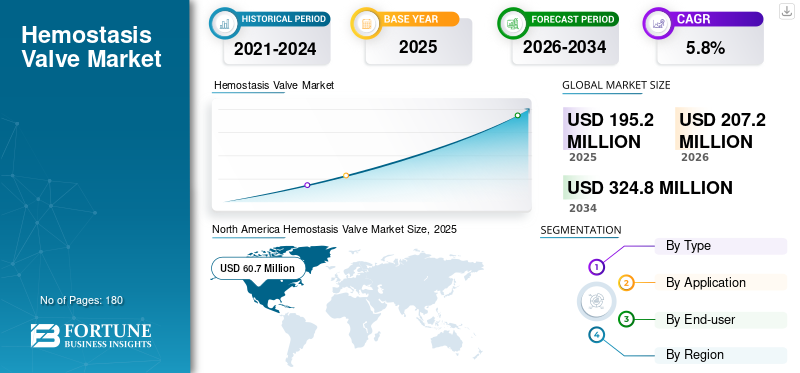
Download Free sample to learn more about this report.
HEMOSTASIS VALVE MARKET KEY TAKEAWAYS
 Market Size & Forecast
- 2025 Market Size: USD 195.2 Million
- 2026 Market Size: USD 207.2 Million
- 2034 Forecast Market Size: USD 324.8 Million
- CAGR: 5.8% from 2026–2034
 Market Share
- North America dominated the global hemostasis valve market with a market share of 31.1% in 2025.
- Hemostasis Valve Y-Connectors held the largest share of the type segment in 2025.
- Hospitals & ASCs led the end-user segment and are projected to account for 63.3% of the market in 2026.
 Key Regional Highlights
North America
North America led the market with a value of USD 60.7 million in 2025, driven by the strong presence of cath labs, hybrid operating rooms, and ambulatory surgical centers.
Europe
Europe is projected to reach USD 61.1 million in 2026, supported by the presence of major medical device manufacturers and increasing product availability.
Asia Pacific
Asia Pacific is expected to reach USD 58.9 million in 2026, fueled by growing cardiovascular intervention volumes and expanding healthcare infrastructure.
U.S.
U.S.: The market is projected to reach USD 64.4 million in 2026, supported by a large number of Medicare-certified ASCs and increasing minimally invasive procedures.
Japan
Japan: The market is expected to reach USD 13.0 million in 2026, accounting for approximately 6.3% of global hemostasis valve revenues.
Read More

HEMOSTASIS VALVE MARKET TRENDS
Increasing Shift toward One-Handed Hemostasis Valves to Emerge as a Key Market Trend
Currently, there is a rising shift toward one-handed, bloodless, and integrated systems. They are easier to use, enabling operators to manage the valve while deploying guidewires with the other hand.
- For instance, the PhD Hemostasis Valve streamlines procedures using a simple one-handed push-and-release design, allowing the other hand to manage interventional tools freely.
Moreover, there is also a surge in the integration of hemostasis valves into introducer sheaths, steerable introducer platforms, and radial access kits. Such integration supports procedural efficiency and simplifies inventory management.
Download Free sample to learn more about this report.
MARKET DYNAMICS
MARKET DRIVERS
Surging Adoption of Minimally Invasive Cardiovascular Procedures to Drive the Market Growth
Over the past few years, there has been a surge in procedures such as angiography and angioplasty, which require reliable hemostasis at the access site. This growth is mainly driven by the increasing incidence of cardiovascular conditions and an aging population.
- For instance, according to data from the Regents of the University of Michigan in April 2024, more than 500,000 U.S. individuals undergo percutaneous coronary intervention (PCI) annually.
In such a scenario, one-handed valves that reduce blood loss and procedure time are increasingly preferred, further supporting demand for replacement and upgrades. This is expected to drive the global hemostasis valve market growth.
MARKET RESTRAINTS
High Cost & Regulatory Burden to Restrict Market Growth
In recent years, there has been a growing regulatory and cost burden on device manufacturers. This is attributed to several factors, including the EU-MDR re-certification, raw material volatility, and others.
Moreover, the value-based purchasing and tender-driven procurement in developed countries are compressing costs for accessories, such as hemostasis valves, while post-market surveillance is increasing the overall compliance costs. Such a scenario is anticipated to hinder the market expansion over the forthcoming years.
MARKET OPPORTUNITIES
Emerging Markets to Offer Lucrative Growth Opportunities
In recent years, there has been an increase in Y-connector valves in structural heart and neurovascular access platforms in emerging countries. This is primarily due to a larger patient pool in India, China, and Brazil.
- For instance, according to data from the WILEY Online Library in June 2024, the prevalence of ischemic heart disease in India increased from 2.0% to 5.0% in rural regions and from 7.0% to 11.0% in urban regions over the last 30 years.
As a result, major players such as Teleflex Incorporated, Argon Medical Devices, and Cordis are capitalizing on these opportunities through procedure-specific platforms that include hemostasis valves in kits. Additionally, the custom/OEM f programs and private-label Y-connector sets are expected to expand further business-to-business (B2B) opportunities with mid-sized catheter manufacturers.
MARKET CHALLENGES
Recalls and Competition to Challenge Market Growth
Hemostasis valves are facing major challenges leaks, air ingress, or occlusion, which compromise patient safety. Such issues are resulting in recalls and safety notices around valve components or insertion tools.
- For instance, in April 2023, Boston Scientific Corporation’s WATCHDOG Hemostasis Valve Kit was recalled due to a risk of valve-related air embolism in a steerable delivery sheath.
Additionally, the hemostasis valve industry is crowded with contract manufacturers and private suppliers offering products at competitive prices, which is anticipated to challenge market expansion.
Segmentation Analysis
By Type
Increasing Adoption of Hemostasis Valves in Cath Labs to Drive Segmental Growth
Based on segmentation by type, the market is classified as hemostasis valve Y-connectors, double Y-connector hemostasis valves, one-handed hemostasis valves, and others.
To know how our report can help streamline your business, Speak to Analyst
The hemostasis valve Y-connectors segment held the largest global hemostasis valve market share in 2025. The growth is mainly attributed to their essential role in coronary and peripheral angiography, which allows for simultaneous device passage and injection via dual ports. As a result, they are highly utilized in cath labs, thereby increasing their global penetration.
In addition, the one-handed hemostasis valves segment is projected to grow at a CAGR of 6.1% during the forecast period.
By Application
Rising Volume of Angiographies to Drive the Angiography Segment Growth
Based on application, the market is segmented into angiography, angioplasty, neurovascular interventions, interventional radiology, and others.
The angiography segment accounted for the largest share in 2025. The segment’s growth is attributed to the increasing volume of diagnostic coronary and peripheral angiographies worldwide, which nearly always use Y-connector valves for contrast injection. Furthermore, the segment is expected to hold a 41.2% share in 2026.
- For instance, according to data from Merck & Co., Inc., in July 2025, more than a million cardiac catheterizations and angiographic procedures are performed annually in the U.S.
In addition, the angioplasty segment is projected to grow at a CAGR of 5.6% during the forecast period.
By End-user
High Volume of Medical Interventions in Hospitals & ASCs Globally to Drive the Segment Growth
Based on end-user, the market is segmented into hospitals & ASCs, catheterization labs, specialty clinics, and others.
In 2025, the hospitals & ASCs segment dominated the market in terms of end-users. The growth is attributed to the primary usage of the hemostasis valve in hospitals & ASCs due to the high volume of PCI, neuro-interventions, and structural heart procedures in these settings. Furthermore, the segment is set to hold a share of 63.3% in 2026.
In addition, the catheterization labs segment is projected to grow at a CAGR of 5.7% during the forecast period.
Hemostasis Valve Market Regional Outlook
Based on geography, the market is segmented into North America, Europe, Asia Pacific, Latin America, and the Middle East & Africa.
North America
North America Hemostasis Valve Market Size, 2025 (USD Million) To get more information on the regional analysis of this market, Download Free sample
North America held the highest market share in 2024, accounting for USD 57.2 million, and also led the global market in 2025 with a value of USD 60.7 million. The growth is attributed to the dense network of well-established hybrid operating rooms, cath labs, and ambulatory surgical centers (ASCs) that depict a regular demand for newer hemostasis valves. In 2026, the U.S. market is estimated to reach USD 64.4 million.
- For instance, as of March 2025, the Ambulatory Surgery Center Association stated that there were more than 6,500 Medicare-certified ASCs in the U.S.
U.S. Hemostasis Valve Market
In 2026, the U.S. market is expected to hold a value of USD 60.6 million, accounting for 29.3% of global market revenue.
Europe
The Europe market is forecasted to achieve a 5.7% growth rate over the forecast period, the second-highest globally, reaching a market value of USD 61.1 million by 2026. The growth is primarily driven by the significant presence of major players in Germany, the U.K., and France, which is increasing the availability of the product in the region.
U.K. Hemostasis Valve Market
The U.K. market is projected to reach USD 7.9 million in 2026, accounting for approximately 3.8% of the global revenues.
Germany Hemostasis Valve Market
The Germany market is anticipated to account for approximately USD 15.0 million in 2026, equivalent to around 7.2% of the global market value.
Asia Pacific
In 2026, the Asia Pacific is projected to reach USD 58.9 million and secure the position of the third-largest region. India and China are both anticipated to account for USD 4.8 billion and USD 27.7 million, respectively, in 2026.
Japan Hemostasis Valve Market
The Japan market is expected to reach USD 13.0 million in 2026, accounting for approximately 6.3% of global hemostasis valve revenues.
China Hemostasis Valve Market
The China market is anticipated to reach USD 27.7 million by 2026, accounting for 13.4% of the global market.
India Hemostasis Valve Market
The India market is estimated to reach USD 4.8 million by 2026, accounting for 2.3% of the global market.
Latin America and Middle East & Africa
Latin America and the Middle East & Africa regions are poised for moderate growth in this market during the forecast period. The Latin America market is projected to reach USD 12.8 billion by 2026, driven by improved healthcare infrastructure and increasing awareness of medical interventions. Meanwhile, in the Middle East & Africa, the GCC market is expected to reach USD 6.4 billion in 2026.
COMPETITIVE LANDSCAPE
Key Industry Players
Pivotal Companies Hold Leading Market Positions Owing to their Procedure-specific Portfolios
In 2025, Merit Medical Systems, Teleflex Incorporated, and Argon Medical Devices held the largest share in the global hemostasis valve market. The share is attributed to broad and procedure-specific portfolios. Furthermore, their products depict deep penetration across high-volume interventional settings.
Other prominent companies, including B. Braun SE and Terumo Corporation, among others, have a global distribution footprint, enabling strong penetration across the globe. Moreover, these companies are focusing on building relationships with hospitals and other healthcare settings to expand their product reach.
LIST OF KEY HEMOSTASIS VALVE COMPANIES PROFILED
- Boston Scientific Corporation (U.S.)
- B Braun SE (Germany)
- Terumo Corporation (Japan)
- Teleflex Incorporated (U.S.)
- Abbott (U.S.)
- Argon Medical Devices (U.S.)
- Freudenberg Medical (Ireland)
- Merit Medical Systems (U.S.)
- SCW Medicath Ltd (China)
- Shenzhen Antmed Co., Ltd. (China)
KEY INDUSTRY DEVELOPMENTS
- February 2025: Teleflex Incorporated announced BIOTRONIK’s Vascular Intervention business’s plans to scale up its coronary and peripheral portfolio.
- February 2024: Terumo Corporation broke ground on a new 64,000-square-foot manufacturing facility at its Puerto Rico site to meet rising global demand for the Angio-Seal Vascular Closure Device.
- November 2023: Cerenovus obtained FDA 510(k) clearance for the CEREGLIDE™ 92 Intermediate Catheter, which uses a Borst hemostasis valve with side port and slit introducers.
- November 2022: Merit Medical Systems announced the U.S. commercial release of PreludeSYNC EZ Radial Compression Device to optimize hemostasis after transradial access.
- June 2021: Abbott received CE Mark and Health Canada approval for its Amplatzer Steerable Delivery Sheath. The product has been designed for use with the Amplatzer Amulet LAA occluder in minimally invasive procedures to reduce stroke risk in atrial fibrillation patients.
REPORT COVERAGE
The global hemostasis valve market report provides a comprehensive analysis of all segments, encompassing key drivers, trends, opportunities, challenges, and restraints. It offers vital insights, including procedure volumes, prevalence of key conditions, product launches and approvals, major industry developments, technological innovations, market share distributions, and the profiles of top companies.
Request for Customization to gain extensive market insights.
Report Scope & Segmentation
|
ATTRIBUTE |
DETAILS |
|
Study Period |
2021-2034 |
|
Base Year |
2025 |
|
Estimated Year |
2026 |
|
Forecast Period |
2026-2034 |
|
Historical Period |
2021-2024 |
|
Growth Rate |
CAGR of 5.8% from 2026-2034 |
|
Unit |
Value (USD Million) |
|
Segmentation |
By Type, Application, End-user, and Region |
|
By Type |
· Hemostasis Valve Y-Connectors · Double Y-Connector Hemostasis Valves · One-Handed Hemostasis Valves · Others |
|
By Application |
· Angiography · Angioplasty · Neurovascular Interventions · Interventional Radiology · Others |
|
By End-user |
· Hospitals & ASCs · Catheterization Labs · Specialty Clinics · Others |
|
By Geography |
· North America (By Type, Application, End-user, and Country) o U.S. (Type) o Canada (Type) · Europe (By Type, Application, End-user, and Country/Sub-region) o Germany (Type) o U.K. (Type) o France (Type) o Spain (Type) o Italy (Type) o Scandinavia (Type) o Rest of Europe (Type) · Asia Pacific (By Type, Application, End-user, and Country/Sub-region) o China (Type) o Japan (Type) o India (Type) o Australia (Type) o Southeast Asia (Type) o Rest of Asia Pacific (Type) · Latin America (By Size, Procedure, End-user and Country/Sub-region) o Brazil (Type) o Mexico (Type) o Rest of Latin America (Type) · Middle East & Africa (By Type, Application, End-user, and Country/Sub-region) o GCC (Type) o South Africa (Type) o Rest of the Middle East & Africa (Type) |
Frequently Asked Questions
Fortune Business Insights says that the global market value stood at USD 195.2 million in 2025 and is projected to reach USD 324.8 million by 2034.
In 2025, the North America market value stood at USD 60.7 million.
The market is expected to exhibit a CAGR of 5.8% during the forecast period of 2026-2034.
The hemostasis valve Y-connectors segment led the market by type in 2025.
The growing adoption of minimally invasive cardiovascular procedures is a key factor driving the market.
Merit Medical Systems, Teleflex Incorporated, and Argon Medical Devices are some of the prominent players in the market.
North America dominated the market in 2025.



- 2021-2034
- 2025
- 2021-2024
- 180
Get 30-60 hrs Free Customization
Expand Regional and Country Coverage, Segments Analysis, Company Profiles, Competitive Benchmarking, and End-user Insights.













.webp)






Related Reports
-
US +1 833 909 2966 ( Toll Free )
-
Get In Touch With Us