Hemp Fiber Market Size, Share & Industry Analysis, By Type (Bast, Hurd/Shives, Tow, and Others), By End Use (Textiles & Apparel, Composites, Pulp & Paper, Bioplastics & Additives, and Others), and Regional Forecast, 2026–2034
 Download Free Sample
(Offer valid till 15th Oct 2026)

Hemp Fiber Market Size and Future Outlook
 Listen to Audio Version
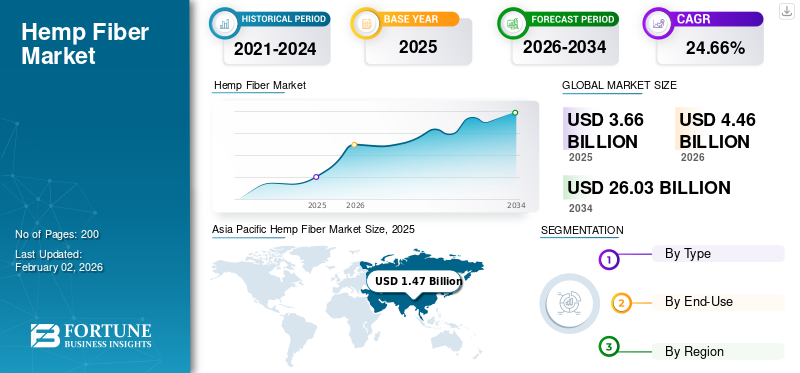
The global hemp fiber market size was valued at USD 3.67 billion in 2025. The market is projected to grow from USD 4.37 billion in 2026 to USD 24.65 billion by 2034, exhibiting a compound annual growth rate CAGR of 24.14% during the forecast period. Asia Pacific dominated the hemp fiber market with a market share of 40.05% in 2025.
Hemp fiber is the natural bast fiber obtained from the stalk of the Cannabis sativa L. plant, primarily from its outer stem (bast). It is one of the strongest and most durable plant-based fibers, known for its high tensile strength, breathability, and resistance to rot and pests. The product is increasingly utilized across textiles, automotive parts, construction materials (such as hempcrete), bioplastics, and insulation due to its favorable mechanical and environmental properties, fueling the growth of the market. The crop’s fast growth cycle, lower pesticide requirement, and broad industrial utility make it attractive for manufacturers seeking sustainable alternatives to cotton, synthetic fibers, wood pulp, and petroleum-based materials.
The global market demand is led by key companies, including HempFlax Group B.V., La Chanvrière, BAFA Neu GmbH, Bast Fibre Technologies Inc., and Panda Biotech, LLC. These companies compete through fiber processing capacity, mechanical decortication technologies, product diversification, and partnerships across hemp textiles, automotive, construction, and biocomposite supply chains.
Download Free sample to learn more about this report.
Hemp Fiber Market Key Takeaways
 Global Market Size & Forecast
- 2025 Market Size: USD 3.67 billion
- 2026 Market Size: USD 4.37 billion
- 2034 Forecast Market Size: USD 24.65 billion
- CAGR: 24.14% from 2026–2034
 Market Share
- Asia Pacific dominated the hemp fiber market with a 40.05% share in 2025.
- The tow segment is projected to grow at a CAGR of 24.82% during 2026–2034.
- The textiles application segment is projected to reach USD 7.38 billion by 2034, expanding at a CAGR of 24.59% from 2026–2034.
 Key Regional Highlights
Asia Pacific
Asia Pacific led the global hemp fiber market in 2025, valued at USD 1.47 billion, and is projected to reach USD 10.66 billion by 2034.
Europe
Europe was valued at USD 0.96 billion in 2025 and is expected to reach USD 6.00 billion by 2034.
North America
North America was valued at USD 0.90 billion in 2025 and is projected to reach USD 6.05 billion by 2034.
U.S.
U.S. The U.S. hemp fiber market was valued at approximately USD 0.64 billion in 2025.
Japan
Japan The Japan hemp fiber market is expected to witness steady growth during the forecast period.
Read More

Hemp Fiber Market Trends
Rising Demand for Bio-Based Fibers to Shape Industry Trends
The market is increasingly shaped by the global shift toward bio-based, recyclable, and low-carbon materials. Textile brands, automotive component manufacturers, packaging producers, and construction material companies are exploring hemp fiber due to its strength, light weight, biodegradability, and suitability for blending with cotton, linen, recycled fibers, and biopolymers. The growing use of hemp in technical textiles, nonwoven mats, insulation panels, molded composites, and hemp-lime construction is expanding its commercial relevance beyond traditional rope and paper applications.
- For instance, the European Commission reported that EU hemp area grown for fiber increased from 20,540 hectares in 2015 to 33,020 hectares in 2022, while hemp production increased from 97,130 tonnes to 179,020 tonnes during the same period, reflecting stronger institutional and industrial interest in hemp-based raw materials.
MARKET DYNAMICS
Market Drivers
Download Free sample to learn more about this report.
Legalization of Industrial Hemp Cultivation to Fuel Product Demand
Legalization of industrial hemp allows for expanded cultivation and production of hemp fibers utilized in a wide range of industries such as textiles, construction, automotive components, packaging, and others. However, in recent years, the establishment of legal differentiation between cannabis and industrial hemp, coupled with strong policy frameworks, has significantly enhanced the operating environment. This transition has allowed improved participation from growers and structured farming practices, thereby boosting the overall supply of hemp-based products.
With respect to legalization, the market has restructured from an informal ecosystem to a regulated sector. Traceability requirements, compliance frameworks, and licensing systems minimize the risk of unverified supply and enhance transparency in the system. Moreover, this legalization allows agricultural bodies, research institutions, and universities to actively work on hemp-related studies. Along with this, it also lowers entry barriers for new market entrants and startups, fostering chances of innovation.
- For instance, in December 2025, the Himachal Pradesh Government launched a “Green to Gold Initiative” to enhance the state’s bio economy and self-reliance by the year 2027. This initiative aims to transform cannabis from an illegally associated plant to a valuable medicinal and industrial resource. Moreover, this approach will support start-ups, youth employment, and sustainable and eco-friendly rural growth across the Indian market.
Market Restraints
High Production Costs to Restrict Market Expansion
Hemp fiber requires complex, multi-step processing, such as decortication, carding, and spinning, with insufficient mechanization and infrastructure to support efficiency. Establishing such facilities demands substantial capital, limiting adoption, particularly among smaller players.
- For instance, in August 2025, according to the European Industrial Hemp Association (EIHA) reports, the average cost of producing hemp straw in Europe is USD 931-1,397 per ton, depending on cultivation practices, scale, and processing facilities. This is significantly higher than flax, USD 466- 698 per ton, or jute imported from Asia, USD 233–466 per ton.
Market Opportunities
Introduction of Hemp Fiber-based Bioplastics to Create Growth Opportunities
The emergence of bioplastic packaging represents a strong global hemp fiber market growth opportunity. Today, bioplastic packaging is gaining huge popularity owing to the rising shift toward sustainability and minimizing reliance on fossil fuels. Hemp fiber (hurd fractions and short fiber) can be utilized as a natural filler in bioplastic formulations, which enhances dimensional stability and strength. Moreover, incorporating hemp-based fiber can easily reduce the proportion of plastic in the formulation. Additionally, it can attain strength without increasing the overall weight of the material. In addition, the product improves the thermal resistance of bioplastic components, which makes them stable under different temperature conditions during transport and storage. By witnessing such benefits, companies are producing new packaging composed of hemp.
- For instance, in September 2024, Element6 Dynamics, an American hemp company, and Papacks, a German molded fiber packaging firm, launched Renew, a new venture that produces molded fiber packaging from hemp.
SEGMENTATION ANALYSIS
By Type
Bast Segment Dominated the Market Due to its Rising Use in Textiles
Based on type, the market is segmented into bast, hurd/shives, tow, and others.
The bast segment held the dominant hemp fiber market share, valued at USD 1.98 billion in 2025, supported by its strong tensile strength, durability, and growing use in textiles, apparel, nonwovens, paper, and natural fiber composites. Bast fibers contain significantly higher cellulose and less lignin than the woody core (hurds), making them stronger, longer, and more flexible, and better suited for spinning and composite reinforcement applications. These properties make bast hemp fibers highly suitable for use in textiles, technical fabrics, and high-performance composite materials. Their characteristics enable usage in textile segment, automotive and aerospace composites, building (insulation, reinforcement), packaging, and even bio-composites. Bast hemp fibers are in rising demand as they are weather-resistant, UV-resistant, and antimicrobial, further broadening their base of application.
The tow segment is projected to grow at a CAGR of 24.82% during 2026-2034, driven by increasing use in nonwovens, blended yarns, insulation materials, and industrial fiber processing.
To know how our report can help streamline your business, Speak to Analyst
By End-Use
Textiles & Apparel Segment Dominated Due to Rising Demand for Sustainable Fibers
Based on end use, the market is segmented into textiles & apparel, composites, pulp & paper, bioplastics & additives, and others.
The textiles & apparel segment held a leading position in the global hemp fiber market, valued at USD 1.06 billion in 2025. The segment is projected to reach USD 7.38 billion by 2034, expanding at a CAGR of 24.59% from 2026 to 2034. Growth is primarily driven by increasing demand for sustainable, biodegradable, and durable natural fibers in apparel, home textiles, denim, footwear, and fashion accessories. The product is gaining strong traction in the textile industry as brands and manufacturers seek alternatives to cotton, polyester, and other resource-intensive fibers.
The pulp & paper segment was valued at USD 0.58 billion in 2025 and is expected to reach USD 3.70 billion by 2034, registering a CAGR of 23.49% from 2026 to 2034. The segment is supported by the growing use of hemp fiber in specialty paper, packaging paper, cigarette paper, filter paper, technical paper, stationery, and sustainable packaging applications.
Hemp Fiber Market Regional Outlook
Regionally, the market is studied across North America, Europe, Asia Pacific, South America, and the Middle East & Africa.
North America
Asia Pacific Hemp Fiber Market Size, 2025 (USD Billion)
To get more information on the regional analysis of this market, Download Free sample
North America was valued at USD 0.90 billion in 2025 and is projected to reach USD 6.05 billion by 2034, growing at a CAGR of 24.03%. Growth is driven by expanding product cultivation, increasing investment in decortication capacity, and rising demand from textiles, insulation, animal bedding, biocomposites, and sustainable packaging applications.
U.S. Hemp Fiber Market
The U.S. dominates the region, valued at approximately USD 0.64 billion in 2025, and is projected to grow at a CAGR of around 24.27% from 2026 to 2034. Growth is supported by the expansion of industrial hemp acreage for fiber, rising demand for sustainable materials, domestic natural fiber supply, and increasing use of hemp in nonwovens, textiles, building materials, and biocomposites.
Europe
Europe was valued at USD 0.96 billion in 2025 and is projected to reach USD 6.00 billion by 2034, growing at a CAGR of 23.12%. Growth is supported by strong cultivation history, established processing companies, regulatory support for industrial hemp, and increasing demand from construction, textiles, composites, and specialty paper industries.
Germany Hemp Fiber Market
Germany was valued at approximately USD 0.14 billion in 2025 and is expected to grow at a CAGR of around 23.74%. The market is supported by growing demand for bio-based construction materials, natural fiber composites, insulation, and sustainable industrial inputs.
U.K. Hemp Fiber Market
The U.K.’s market reached approximately USD 0.04 billion in 2025 and is projected to grow at a CAGR of around 22.67%. Growth is supported by increasing interest in hempcrete, low-carbon construction, sustainable textiles, and domestic natural fiber supply chains.
Asia Pacific
Asia Pacific dominated the global market, valued at USD 1.47 billion in 2025, and is projected to reach USD 10.66 billion by 2034, growing at a CAGR of 25.24%. The region benefits from large-scale hemp cultivation, strong textile manufacturing capacity, established natural fiber processing, and growing use of the product in apparel, paper, composites, and industrial materials.
China Hemp Fiber Market
China accounted for the largest market, valued at approximately USD 1.01 billion in 2025, and is projected to grow at a CAGR of around 25.48%. Growth is driven by large-scale fiber hemp cultivation, established textile processing capacity, and increasing use of hemp in apparel, yarn, fabrics, and industrial fiber applications.
India Hemp Fiber Market
The Indian market was valued at approximately USD 0.10 billion in 2025 and is projected to grow at a CAGR of around 25.09%. Growth is supported by rising interest in natural fibers, technical textiles, sustainable apparel, and bio-based industrial materials.
South America and the Middle East & Africa
South America was valued at USD 0.22 billion in 2025 and is projected to reach USD 1.26 billion by 2034, growing at a CAGR of 22.22%. Growth is supported by expanding interest in industrial hemp cultivation, rising demand for sustainable fibers, and the region’s strong agricultural base. Brazil and Argentina are expected to be important markets as hemp-based materials gain visibility in textiles, paper, construction, and biocomposite applications.
The Middle East & Africa market was valued at USD 0.12 billion in 2025 and is projected to reach USD 0.68 billion by 2034, expanding at a CAGR of 21.82%. Growth is driven by rising demand for sustainable construction materials, increasing use of natural fibers in industrial applications, and gradual development of hemp-related regulatory frameworks in selected markets. Urban construction markets such as the UAE and Saudi Arabia may create demand for hempcrete, insulation, and low-carbon building materials over the forecast period.
Brazil Hemp Fiber Market
The Brazilian market was valued at approximately USD 0.10 billion in 2025 and is projected to grow at a CAGR of around 22.55%. Growth is supported by demand for sustainable textiles, bio-based packaging, construction materials, and industrial fiber imports. Brazil’s strong agricultural base also provides long-term potential for hemp cultivation and downstream processing.
COMPETITIVE LANDSCAPE
Key Industry Players
Key Players are Forging Collaborations to Expand Application-Specific Demand
Key players are focusing on mechanical decortication, cottonized hemp fiber, hurd processing, nonwoven-grade fiber, biocomposite materials, hemp bedding, and construction-grade hemp shives. Companies are also strengthening partnerships with textile brands, automotive suppliers, construction material producers, and sustainable packaging companies to expand application-specific demand.
Key Players in the Hemp Fiber Market
|
Rank |
Company Name |
|
1 |
HempFlax Group B.V. |
|
2 |
La Chanvrière |
|
3 |
BAFA Neu GmbH |
|
4 |
Bast Fibre Technologies Inc. |
|
5 |
Panda Biotech, LLC |
List of Key Hemp Fiber Companies Profiled
- HempFlax Group B.V. (Netherlands)
- La Chanvrière (France)
- BAFA Neu GmbH (Germany)
- Bast Fibre Technologies Inc. (Canada)
- Panda Biotech, LLC (U.S.)
- BastCore, Inc. (U.S.)
- Dun Agro Hemp Group (Netherlands)
- Hemp Fortex (China)
- IND HEMP, LLC (U.S.)
- Cavac Biomateriaux (France)
KEY INDUSTRY DEVELOPMENTS
- April 2026: IND HEMP, an American hemp firm, along with Summit International Trading, a partner of IND Hemp, and Thien Phuoc, a Vietnamese firm, collaborated to integrate U.S.-grown hemp fiber into the textile supply chain of Vietnam.
- January 2026: Heartland, a U.S.-based hemp fiber exporter, constructed a new textile plant in India to boost the adoption of the product within the textile sector.
- March 2025: Ekolution AB, a Swedish company, developed environmentally friendly building materials, with a particular focus on hemp fiber insulation. The innovation offered excellent thermal performance and actively contributed to carbon sequestration, addressing the pressing need for eco-conscious construction solutions.
- January 2025: Ma’Rijany Hemp Company, one of the largest producers of high-quality long hemp fibers, constructed a USD 25 million industrial hemp processing plant in the Zhytomyr region.
- September 2024: Element6 Dynamics, an American hemp firm, partnered with a German molded fiber packaging company, Papacks, to introduce a joint venture, “Renew,” to launch fiber packaging made of hemp.
REPORT COVERAGE
The global hemp fiber industry report analyzes the market in depth and highlights crucial aspects such as global market trends, market dynamics, prominent companies, investment in research and development, and end-use. Besides this, the report also provides insights into the global market analysis and highlights significant industry developments.
Request for Customization to gain extensive market insights.
Report Scope & Segmentation
| ATTRIBUTE | DETAILS |
| Study Period | 2021-2034 |
| Base Year | 2025 |
| Estimated Year | 2026 |
| Forecast Period | 2026-2034 |
| Historical Period | 2021-2024 |
| Growth Rate | CAGR of 24.14% from 2026 to 2034 |
| Unit | Value (USD Billion) |
|
Segmentation |
By Type
|
|
By End-Use
|
|
|
By Region
|
Frequently Asked Questions
Fortune Business Insights says that the global market was valued at USD 3.67 billion in 2025 and is anticipated to reach USD 24.65 billion by 2034.
At a CAGR of 24.14%, the global market will exhibit steady growth over the forecast period.
By type, the bast segment led the market.
Asia Pacific held the largest market share in 2025.
Legalization of industrial hemp cultivation is the crucial factor driving the market.
HempFlax Group B.V., La Chanvrière, BAFA Neu GmbH, Bast Fibre Technologies Inc., and Panda Biotech, LLC are the leading players in the market.
Rising demand for bio-based fibers is the key industry trend.



- 2021-2034
- 2025
- 2021-2024
- 200
-
(Offer valid till 15th Oct 2026)
Get 30-60 hrs Free Customization
Expand Regional and Country Coverage, Segments Analysis, Company Profiles, Competitive Benchmarking, and End-user Insights.














Related Reports
-
US +1 833 909 2966 ( Toll Free )
-
Get In Touch With Us