High Performance Tire Market Size, Share & Industry Analysis, By Vehicle Type (Sedans, Hatchbacks, and Coupes, SUVs and Crossovers, Light Commercial Vehicles, and Others), By Rim Diameter (17 Inches and Below, 18-20 Inches, and 22 Inches and Above), By Seasonal Tire Type (Summer Performance Tires, All-Season Performance Tires, and Winter Performance Tires), By Speed Rating (V-Rated, W-Rated, and Y-Rated and Above), By Distribution Channel (Original Equipment Manufacturer and Replacement), and Regional Forecast, 2026-2034
 Download Free Sample
(Offer valid till 15th Oct 2026)

High Performance Tire Market Size and Future Outlook
 Listen to Audio Version
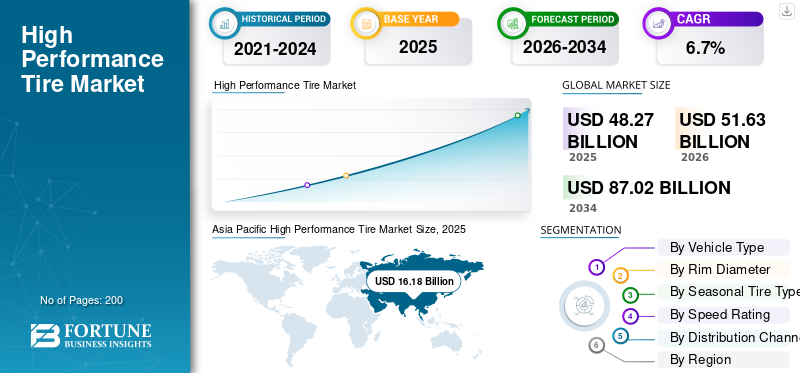
The global high performance tire market size was valued at USD 48.27 billion in 2025 and is projected to grow from USD 51.63 billion in 2026 to USD 87.02 billion by 2034, exhibiting a CAGR of 6.7% during the forecast period. Asia Pacific dominated the high performance tire market with a market share of 33.52% in 2025.
The global market covers road-legal tires designed to deliver stronger grip, shorter braking distances, sharper steering response, better cornering stability, and reliable operation at sustained speed. It includes products fitted to premium sedans, hatchbacks, coupes, SUVs, crossovers, selected light commercial vehicles, and road-approved performance models. The market includes factory-fitted OEM tires and aftermarket performance tires, while racing-only, motorcycle, heavy-truck, agricultural, and standard economy tires remain outside the scope.
Expansion will be supported by the rising demand for high performance vehicles, larger wheel diameters, premium SUVs, electric vehicles, and sports cars. Heavier electric models generate high torque and require advanced automotive performance tires that balance traction, durability, noise control, and rolling efficiency. Demand is also moving from traditional touring performance tires toward ultra-high performance tires with stronger load capacity and more sophisticated compounds.
The tires industry will increasingly combine mechanical engineering with software-led development. Manufacturers are using virtual testing, sensors, intelligent compounds, and connected-vehicle data to shorten development cycles and improve safety. Growth in the market will also come from off-road performance vehicles that use road-legal high-speed fitments, although dedicated off-highway tires are excluded. Replacement sales will remain important since the installed vehicle base is much larger than annual new-vehicle production.
Future competition will depend on product performance, sustainability, availability, and cost control across the supply chain. Leading tire manufacturers such as Michelin, The Goodyear Tire & Rubber Company, Pirelli & C. S.p.A. are expanding ultra-high performance portfolios, developing lower-energy products, securing premium vehicle homologations, and increasing regional production. Their investments are expected to improve braking, durability, comfort, and energy efficiency without weakening the driving characteristics expected from high performance tires across both mature and emerging automotive markets globally.
Download Free sample to learn more about this report.
HIGH PERFORMANCE TIRE MARKET TRENDS
Performance All-Season Products Gain Acceptance Among Premium Vehicle Owners
Performance-focused all-season products are moving beyond basic year-round convenience. New designs aim to provide summer-like steering and braking while retaining certified cold-weather capability. This shift allows drivers in moderate climates to avoid separate summer and winter tires. As a result, manufacturers are expanding high-speed season tires for premium cars and electric vehicles, increasing competition in a category once centered mainly on conventional touring products.
- For instance, in July 2025, Michelin launched CrossClimate 3 Sport, an all-season tire developed for sports cars and certified for safe operation in winter conditions.
Download Free sample to learn more about this report.
MARKET DRIVERS
Rising Premium SUV and Electric Vehicle Sales Accelerate High-Performance Tire Demand
Premium SUVs, electric crossovers, and powerful sedans use wider tires, larger rims, higher load ratings, and stronger compounds than ordinary vehicles. Their rapid expansion increases both factory fitment and future replacement demand. Electric vehicles also deliver immediate torque and carry heavy battery packs, creating added requirements for grip, wear control, noise reduction, and efficiency. These conditions directly support higher sales and drive high performance tire market growth.
- For instance, in May 2026, the IEA reported electric-car sales exceeded 20 million in 2025, while large cars and SUVs represented nearly 70% of electric sales.
|
Rank |
Market Drivers |
Overall Impact Rank |
CAGR Contribution (2026–2034) |
Impact 2026–2028 |
Impact 2029–2031 |
Impact 2032–2034 |
|
1 |
Rising Premium SUV and Electric Vehicle Sales Accelerate High-Performance Tire Demand |
High |
1.90% |
High |
High |
High |
|
2 |
Increasing Adoption of Larger Rim Sizes and Higher Speed-Rated Tires |
High |
1.55% |
High |
High |
High |
|
3 |
Expanding Vehicle Parc and Recurring Replacement Tire Demand |
Medium-High |
1.45% |
Medium |
High |
High |
|
4 |
Technological Advancements in UHP, EV-Specific, and Low-Rolling-Resistance Tires |
Medium-High |
1.25% |
Medium |
High |
High |
|
5 |
Rising Premiumization and Performance-Oriented Vehicle Ownership |
Medium |
1.10% |
Medium |
Medium |
High |
|
6 |
Others |
Low |
0.85% |
Low |
Low |
Low |
|
|
Total Positive Growth Contribution |
|
8.10% |
|
|
|
MARKET RESTRAINTS
High Product Costs and Trade Pressures Restrict Wider Market Adoption
High performance tires require specialized polymers, silica, reinforcement materials, complex testing, and precise manufacturing. These inputs raise retail prices and make replacement purchases easier to postpone during inflation or weak consumer confidence. Producers must also balance grip with rolling resistance, wear, and noise, which increases development expense. Tariffs, currency changes, freight disruption, and volatile rubber or petrochemical costs further pressure margins and reduce affordability.
- For instance, in March 2026, Continental said tariffs and exchange-rate effects burdened its Tires business by several hundred million euros during the 2025 financial year.
|
Rank |
Market Restraints |
Overall Impact Rank |
CAGR Contribution (2026–2034) |
Impact 2026–2028 |
Impact 2029–2031 |
Impact 2032–2034 |
|
1 |
High Product Costs and Trade Pressures Restrict Wider Market Adoption |
High |
-0.55% |
High |
High |
Medium |
|
2 |
Volatility in Natural Rubber, Petrochemical, Energy, and Supply-Chain Costs |
Medium-High |
-0.40% |
High |
Medium |
Medium |
|
3 |
Consumer Price Sensitivity and Slower Vehicle Demand in Mature Markets |
Medium |
-0.30% |
Medium |
Medium |
Low |
|
4 |
Others |
Low |
-0.15% |
Low |
Low |
Low |
|
|
Total Negative Growth Contribution |
|
-1.40% |
|
|
|
MARKET OPPORTUNITIES
Electric Mobility and Abrasion Regulations Create New Product Opportunities
The transition toward electric mobility creates demand for products that combine strong acceleration grip with longer life, low noise, and improved energy efficiency. Suppliers can gain premium contracts by developing tires specifically for heavier vehicles and high torque. Future abrasion rules also create an opportunity to commercialize compounds that deliver reduced tire emissions without weakening braking or handling, helping brands differentiate through measurable environmental performance.
- For instance, in March 2026, Michelin introduced Pilot Sport 5 Energy in 19 sizes, combining sporty grip, improved longevity, and an A rating for rolling resistance.
MARKET CHALLENGES
Conflicting Performance and Sustainability Requirements Increase Development Complexity
High performance tires must deliver strong grip and braking while also meeting durability, noise, efficiency, and abrasion targets. Improving traction can increase wear or rolling resistance, while harder compounds may reduce handling performance. New rules focused on reduced tire emissions require additional testing, material changes, and validation. These technical trade-offs raise development costs, extend product-launch timelines, and make premium vehicle homologation more difficult.
- For instance, in June 2026, the European Commission’s JRC highlighted upcoming Euro 7 tire-abrasion limits, creating additional testing and compliance pressure for manufacturers.
Segmentation Analysis
By Vehicle Type
SUVs and Crossovers Segment Dominate Owing to Larger Fitments and Growing Sales
On the basis of vehicle type, the market is segmented into sedans, hatchbacks and coupes, SUVs and crossovers, light commercial vehicles, and others.
SUVs and crossovers segment dominate owing to their growing global sales base combines with larger wheel sizes, heavier vehicle weights, and higher tire prices. Premium and electric utility models commonly require reinforced structures, strong wet grip, low noise, and high load capacity. Their expanding factory population also creates a widening replacement pool, supporting value growth across both original-equipment and retail channels globally.
- For instance, in May 2026, the IEA reported large cars and SUVs represented nearly 70% of global electric-car sales during 2025 globally.
To know how our report can help streamline your business, Speak to Analyst
Light commercial vehicles segment is expected to grow at a CAGR of 7.1% over the forecast period.
By Rim Diameter
The 18-20 Inches Segment Dominates Through Broad Premium Vehicle Applicability
On the basis of rim diameter, the market is segmented into 17 inches and below, 18-20 inches, and 22 inches and above.
The 18-20 inches segment dominates as it is widely fitted to premium sedans, performance hatchbacks, midsize SUVs, electric crossovers, and sports-oriented vehicles. It offers stronger handling and visual appeal without the extreme price and ride penalties of very large tires. Broad original-equipment adoption has also created a substantial replacement base, while extensive size availability supports sales across several vehicle classes globally.
- For instance, in March 2026, Continental reported that 18-inch-and-above products reached 62% of Continental-brand passenger-car tire sales during 2025, up from 60% in 2024.
The 22 inches and above segment is expected to grow at a CAGR of 7.5% over the forecast period.
By Seasonal Tire Type
Summer Performance Tires Segment Dominates Due to Broad Warm-Climate Applications
On the basis of seasonal tire type, the market is segmented into summer performance tires, all-season performance tires, and winter performance tires.
Summer performance tires segment dominate since most high-performance vehicles operate in warm or moderate climates, where dry grip, precise steering, wet braking, and heat resistance are primary requirements. Major vehicle markets across Asia Pacific, South America, the Middle East, and parts of Europe generate substantial summer demand. These products also remain common factory fitments for premium and performance-oriented road vehicles globally.
The all-season performance tires segment is expected to grow at a CAGR of 7.7% over the forecast period.
By Speed Rating
W-Rated Segment Dominates Owing to its Higher Average Price than V-Rated Tires
On the basis of speed rating, the market is segmented into v-rated, w-rated, and y-rated and above.
W-rated segment dominates by value as it provides a practical middle ground between V-rated products and more specialized Y-rated fitments. They are widely available for premium sedans, performance hatchbacks, electric crossovers, midsize SUVs, and 18-20-inch wheels. Their broad vehicle coverage, higher average price than V-rated tires, and large replacement base support the segment’s leading global revenue position across the market.
- For instance, in June 2026, Pirelli’s catalogue listed P Zero performance sizes across W, Y, (Y), and ZR speed indices for premium cars and SUVs.
V-Rated segment is expected to grow at a CAGR of 6.0% over the forecast period.
By Distribution Channel
Replacement Segment Dominates Through Large Installed Vehicle Base
On the basis of distribution channel, the market is segmented into original equipment manufacturer and replacement.
Replacement segment dominates the high performance market share supported by the number of vehicles already in use as compared to annual new-vehicle production. Performance tires wear, age, suffer damage, and are replaced throughout a vehicle’s service life, often at higher retail prices than factory supply contracts. Premium cars and SUVs also maintain model-specific fitment requirements, creating recurring annual demand through specialist dealers, service centers, and online retailers globally.
- For instance, in March 2026, USTMA reported 2025 U.S. passenger replacement shipments of 221.9 million units, versus 41.3 million passenger original-equipment units
Original equipment manufacturer segment is expected to grow at a CAGR of 7.2% over the forecast period.
High Performance Tire Market Regional Outlook
By geography, the global market is categorized into North America, Europe, Asia Pacific, South America, and the Middle East & Africa.
Asia Pacific
Asia Pacific High Performance Tire Market Size, 2025 (USD Billion)
To get more information on the regional analysis of this market, Download Free sample
Asia Pacific held the dominant high performance tire market share in 2025, valuing at USD 16.18 billion, and also maintained the leading share in 2024, with USD 15.23 billion. The dominance is driven by the world’s largest vehicle-production base with fast growth in premium cars, electric vehicles, SUVs, and replacement demand. China leads regional scale, while India expands rapidly from a lower performance-tire penetration level. Japan and South Korea add advanced engineering and premium products, while Australia contributes high SUV fitment. Rising incomes, larger wheels, domestic brands, road development, and manufacturing investment support growth despite tariffs, competition, and currency volatility risks.
- For instance, in April 2026, OICA reported Asia produced 59.2 million vehicles in 2025, while China alone produced approximately 34.5 million units.
China High Performance Tire Market
China’s market is projected to be one of the largest globally, with 2025 revenues valued at USD 7.49 billion, representing roughly 15.5% of global market.
Japan High Performance Tire Market
Japan’s market reached USD 3.04 billion in 2025, accounting for roughly 6.3% of global revenues.
Europe
Europe is estimated to reach USD 15.12 Billion in 2026 and secure the position of the second-largest region in the market. Europe will grow through premium vehicle production, high-speed motorway use, seasonal replacement, and increasing adoption of electric and hybrid models. Larger rims, vehicle-specific homologations, and strong all-season demand will raise average selling prices. Growth will remain moderate since vehicle ownership is mature, production costs are high, and manufacturers face weak consumer confidence, energy volatility, geopolitical tension, and import competition globally.
Germany High Performance Tire Market
Germany’s market was valued at USD 3.18 billion in 2025, accounting for roughly 6.6% of global revenues.
U.K. High Performance Tire Market
The U.K. market reached USD 2.10 billion in 2025, accounting for roughly 4.3% of global revenues.
North America
North America is projected to record a growth rate of 6.1% in the coming years, and reach a valuation of USD 14.50 billion by 2026. North America will expand mainly through replacement demand, premium SUVs, pickups, electric crossovers, and larger all-season fitments. The U.S. will remain the regional center owing to its vehicle parc and high mileage. Growth will be steady rather than rapid, with tariffs, financing costs, inflation, and mature unit demand limiting expansion.
U.S. High Performance Tire Market
The U.S. market reached a valuation of USD 11.54 billion in 2025, representing roughly 23.9% of global market.
South America
South America will grow through Brazil’s large replacement base, recovering vehicle demand, premium compact SUVs, and high-specification pickups. Argentina and selected Andean markets will add smaller growth pools. However, currency depreciation, inflation, expensive credit, import dependence, and low-priced Asian products may delay purchases and pressure established producers’ margins over time.
Brazil High Performance Tire Market
The Brazilian market reached a valuation of USD 1.33 billion in 2025, representing roughly 2.7% of global market.
Middle East & Africa
Middle East & Africa will expand through premium Gulf SUVs, harsh-climate replacement, rising vehicle ownership, infrastructure projects, and gradual automotive localization. Saudi Arabia will support high-value demand, while South Africa anchors regional production and formal retail. Conflict, shipping disruption, weak currencies, oil-price swings, and affordability constraints will create uneven growth.
South Africa High Performance Tire Market
South Africa’s market reached a valuation of USD 0.46 billion in 2025, representing roughly 0.9% of global market.
COMPETITIVE LANDSCAPE
Key Industry Players
Key Players to Focus on Innovation, Homologation, and Scale to Expand Market Share
Competition in the global high performance tire market is concentrated among large international groups with strong research capabilities, premium vehicle relationships, broad replacement networks, and manufacturing plants across several regions. Michelin, Bridgestone, Goodyear, Continental, Pirelli, Yokohama, and Toyo Tire form the leading group. Regional companies compete through attractive pricing, local production, rapid size expansion, and stronger access to developing markets.
Major tire manufacturers seek advantage through continuous product renewal rather than price alone. They develop new compounds, reinforced structures, low-noise solutions, and tread patterns that maintain grip as the tire wears. Premium vehicle homologation is especially important since approval for a new car model creates original-equipment revenue and later supports replacement demand for the same specification. Companies also offer dedicated products for electric vehicles, performance SUVs, sports sedans, and all-season applications.
Technology is becoming a major competitive differentiator. Virtual engineering and 3D tire simulation reduce the number of physical prototypes, shorten development time, and allow products to be tuned before a vehicle enters production. Companies are also studying adaptive tread design, connected sensors, and links between the tire pressure monitoring system (TPMS) and vehicle control systems. Pirelli’s Cyber Tyre approach, for example, uses tire-mounted sensing and software to communicate information to vehicle electronics.
Sustainability strategies increasingly influence brand positioning and contracts. Leading companies are working on recycled and renewable materials, lower rolling resistance, reduced noise, longer service life, and more efficient factories. At the same time, they are regionalizing production to reduce freight exposure, tariff risk, currency movements, and supply interruptions.
Competition will remain intense as Asian producers expand premium offerings and established brands defend the ultra-high performance category. The strongest companies will combine recognized performance, dependable supply, vehicle-specific engineering, digital retail support, motorsport knowledge, and consistent quality across factory and replacement channels.
- For instance, in March 2025, Pirelli launched the fifth-generation P Zero, using artificial intelligence and virtual development, with more than 50 products covering 18-23-inch sizes.
LIST OF KEY HIGH PERFORMANCE TIRE COMPANIES PROFILED IN REPORT
- Michelin (France)
- The Goodyear Tire & Rubber Company (U.S.)
- Pirelli & C. S.p.A. (Italy)
- The Yokohama Rubber Co., Ltd. (Japan)
- CEAT Limited (India)
- Toyo Tire Corporation (Japan)
- Nexen Tire Corporation (South Korea)
- Apollo Tyres Ltd. (India)
- JK Tyre & Industries Ltd. (India)
- Bridgestone Corporation (Japan)
- Continental AG (Germany)
- Giti Tire Pte. Ltd. (Singapore)
- Kenda Rubber Industrial Co., Ltd. (Taiwan)
- Petlas Tire Industry and Trade Inc. (Turkey)
- MRF Limited (India)
KEY INDUSTRY DEVELOPMENTS
- June 2026: Bridgestone became the sole tire partner for Maserati’s MCPURA super sportscar. The company developed 20-inch Potenza Sport tires with model-specific compounds, carcass construction and asymmetric tread designs, supported by virtual development and joint track testing.
- May 2026: Continental inaugurated the expansion of its Rayong tire plant in Thailand. The investment exceeded USD 341.7 million and added annual capacity for three million passenger-car and light-truck tires, strengthening Continental’s regional supply of premium, SUV and ultra-high-performance products.
- February 2026: Bridgestone launched the POTENZA RE-71RZ and POTENZA Adrenalin RE005 in Japan. The products target high-performance driving, combining enhanced handling, grip, wet performance, and improved fuel efficiency.
- October 2025: Goodyear launched the Eagle F1 All Season in the U.S. and Canada. The ultra-high-performance product was developed for sports cars, premium crossovers and performance sedans, offering dry and wet handling alongside light-snow capability and extended tread durability.
- September 2025: Yokohama Rubber began supplying ADVAN Sport V107 tires for the BMW 7 Series and electric BMW i7. The jointly developed 19- and 20-inch Y-rated products combined steering stability, ride comfort, wear resistance and an EU A rating for rolling resistance.
- April 2025: Hankook Tire secured an original-equipment contract for the Lucid Gravity electric SUV. Hankook’s iON evo AS SUV all-season tires were specifically adapted for the premium three-row EV, with emphasis on grip, low noise, mileage performance, and high-load operation.
- March 2025: Nokian Tyres launched the Seasonproof 2 all-season range for Central Europe. The product contains up to 38% renewable, recycled and mass-balance-certified materials and was designed to combine snow and slush grip with stable summer handling.
REPORT COVERAGE
The global high performance tire market analysis provides an in-depth study of market size & forecast by all the market segments included in the report. It includes details on the market dynamics and market trends expected to drive the market during the forecast period. It offers information on the technological advancements, new product launches, key industry developments, and details on partnerships, mergers & acquisitions. The research report also encompasses detailed competitive landscape with information on the market share and profiles of key operating players.
Request for Customization to gain extensive market insights.
Report Scope & Segmentation
| ATTRIBUTE | DETAILS |
| Study Period | 2021-2034 |
| Base Year | 2025 |
| Estimated Year | 2026 |
| Forecast Period | 2026-2034 |
| Historical Period | 2021-2024 |
| Growth Rate | CAGR of 6.7% from 2026-2034 |
| Unit | Value (USD Billion) |
| Segmentation | By Vehicle Type, Rim Diameter, Seasonal Tire Type, Speed Rating, Distribution Channel, and Region |
| By Vehicle Type |
|
| By Rim Diameter |
|
| By Seasonal Tire Type |
|
| By Speed Rating |
|
| By Distribution Channel |
|
| By Region |
|
Frequently Asked Questions
Fortune Business Insights says that the global market value stood at USD 48.27 billion in 2025 and is projected to reach USD 87.02 billion by 2034.
In 2025, the Asia Pacific’s market value stood at USD 16.18 billion.
The market is expected to exhibit a CAGR of 6.7% during the forecast period of 2026-2034.
SUVs and crossovers segment led the market by vehicle type.
Rising premium SUV and electric vehicle sales is driving the global market.
Michelin, The Goodyear Tire & Rubber Company, Pirelli & C. S.p.A., and The Yokohama Rubber Co., Ltd. are the top players in the market.
Asia Pacific held the largest market share.



- 2021-2034
- 2025
- 2021-2024
- 200
-
(Offer valid till 15th Oct 2026)
Get 30-60 hrs Free Customization
Expand Regional and Country Coverage, Segments Analysis, Company Profiles, Competitive Benchmarking, and End-user Insights.




















-
US +1 833 909 2966 ( Toll Free )
-
Get In Touch With Us