High Resolution Melting Analysis Market Size, Share & Industry Analysis, By Product (Instruments), By Application (Mutation Scanning, Epigenetics), By End-use (Academic Research) and Regional Forecast, 2026-2034
 Download Free Sample
High Resolution Melting Analysis Market Overview
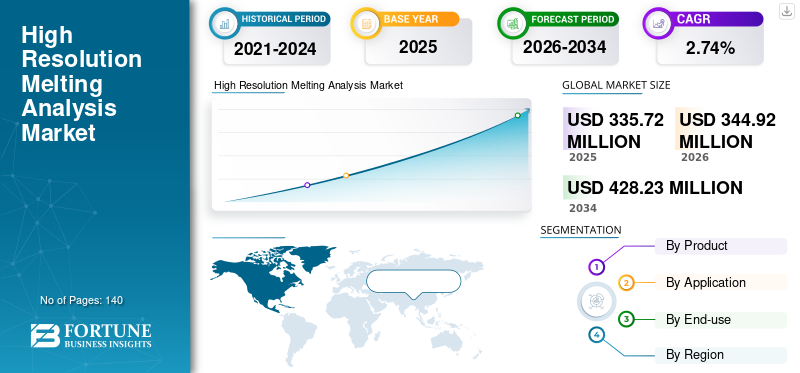
The high resolution melting analysis market size was valued at USD 335.72 million in 2025. The market is projected to grow from USD 344.92 million in 2026 to USD 428.23 million by 2034, exhibiting a CAGR of 2.74% during the forecast period.

The high resolution melting analysis market is experiencing significant growth due to the increasing adoption of molecular diagnostics, genetic testing, and precision medicine worldwide. High Resolution Melting Analysis technology enables rapid identification of DNA sequence variations, mutations, polymorphisms, and epigenetic changes, making it an essential tool in clinical diagnostics and biomedical research. The market is benefiting from advancements in real-time PCR systems, automated laboratory workflows, and enhanced data analysis software. Rising demand for cost-effective genetic screening methods and increasing applications in oncology, infectious disease detection, and personalized healthcare continue to support the expansion of the high resolution melting analysis market. Growing investments in genomics research are further strengthening market development.
The United States remains the largest contributor to the high resolution melting analysis market in North America. Strong investments in biotechnology, genomic medicine, and cancer research programs have accelerated the adoption of High Resolution Melting Analysis technologies. More than 72% of molecular diagnostic laboratories in the country utilize advanced PCR-based testing platforms. Academic research centers, biotechnology companies, and healthcare institutions are increasingly incorporating mutation scanning and genetic testing applications into routine workflows. The expanding focus on precision medicine and personalized treatment approaches continues to support demand for High Resolution Melting Analysis systems across the United States market.
Download Free sample to learn more about this report.
High Resolution Melting Analysis Market Key Takeaways
 Global market size & Forecast
- 2025 market size: USD 335.72 Million
- 2026 market size: USD 344.92 Million
- 2034 Forecast market size: USD 428.23 Million
- CAGR: 2.74% from 2026-2034
 market share
- North America dominated with a revenue share of 38% in 2025.
- High Resolution Melting Analysis instruments accounted for approximately 58% of the market share.
- Mutation scanning held approximately 46% of the market share.
 Key Regional Highlights
North America
North America led the market with a 38% regional share in 2025.
Europe
Europe accounted for 29% of the global high resolution melting analysis market.
Asia-Pacific
Asia-Pacific represented 24% of the market, supported by expanding genomic research and molecular diagnostics.
U.S
Strong adoption of HRM technologies across academic research, clinical diagnostics, and biotechnology.
Japan
Accounted for 26% of the Asia-Pacific high resolution melting analysis market.
Read More

High Resolution Melting Analysis Market Latest Trends
The high resolution melting analysis market trends indicate a growing preference for rapid, accurate, and cost-efficient genomic testing technologies. Laboratories are increasingly integrating High Resolution Melting Analysis systems with automated PCR workflows to improve throughput and minimize manual intervention. The technology is gaining popularity in mutation screening, genotyping, and infectious disease diagnostics due to its ability to deliver reliable results without extensive sequencing requirements. Improvements in fluorescent dye chemistry and thermal cycling precision are also enhancing assay sensitivity and reproducibility.
Download Free sample to learn more about this report.
Another notable trend in the high resolution melting analysis market Research Report is the increased utilization of HRM technology in epigenetics and methylation studies. Researchers are leveraging High Resolution Melting Analysis for biomarker discovery, cancer research, and pharmacogenomics applications. The growing demand for personalized medicine is encouraging healthcare providers to adopt genetic screening solutions that support individualized treatment strategies. Additionally, compact and portable HRM instruments are becoming increasingly popular among research laboratories and diagnostic centers. Collaborations between biotechnology firms and academic institutions are fostering innovation and accelerating product development across the high resolution melting analysis market.
High Resolution Melting Analysis Market Dynamics
DRIVER
Rising Demand for Molecular Diagnostics and Genetic Testing
The primary growth driver for the high resolution melting analysis market is the increasing global demand for molecular diagnostics and genetic testing services. Healthcare systems are emphasizing early disease detection, preventive healthcare, and precision medicine initiatives, which require reliable and efficient genomic testing technologies. High Resolution Melting Analysis offers rapid mutation detection and genotyping capabilities without the need for costly sequencing procedures, making it an attractive solution for diagnostic laboratories and research institutions.
The increasing prevalence of cancer, hereditary disorders, and infectious diseases has significantly expanded the need for advanced molecular diagnostic methods. Hospitals and clinical laboratories are utilizing High Resolution Melting Analysis for mutation scanning, pathogen identification, and genetic variation studies. The technology provides high sensitivity, simplified workflows, and reduced testing costs. Pharmaceutical and biotechnology companies are also integrating HRM technologies into drug discovery and biomarker identification programs. Growing awareness of genetic health risks and personalized medicine is expected to continue driving demand for high resolution melting analysis market solutions across developed and emerging healthcare markets.
RESTRAINT
Competition from Advanced Sequencing Technologies
One of the major restraints affecting the high resolution melting analysis market is the growing adoption of advanced sequencing technologies. While HRM offers cost advantages and rapid screening capabilities, next-generation sequencing methods provide more comprehensive genomic information for complex diagnostic applications. Many healthcare institutions prefer sequencing technologies when extensive mutation profiling is required.
Furthermore, certain mutation analyses require confirmatory sequencing after HRM screening, increasing diagnostic complexity and operational costs. Laboratories may face challenges related to assay optimization, sample quality management, and interpretation of melting curve data. Smaller healthcare facilities often encounter limitations in terms of technical expertise and infrastructure requirements. As sequencing technologies continue to become more accessible and affordable, the high resolution melting analysis market faces increasing competitive pressure. Manufacturers must focus on technological innovation and workflow simplification to maintain competitiveness within the molecular diagnostics sector.
OPPORTUNITY
Expansion of Personalized Medicine and Oncology Research
The rapid growth of personalized medicine presents significant opportunities for the high resolution melting analysis market. Healthcare providers are increasingly utilizing genetic information to guide treatment selection, monitor disease progression, and improve patient outcomes. High Resolution Melting Analysis supports fast and cost-effective identification of disease-associated mutations, making it highly valuable in precision healthcare programs.
Oncology remains one of the most promising application areas. Researchers are using High Resolution Melting Analysis to identify mutations associated with breast cancer, lung cancer, colorectal cancer, and other malignancies. The technology is also being utilized in pharmacogenomics studies to understand patient-specific drug responses. Expanding genomic research initiatives across emerging economies are creating new opportunities for instrument manufacturers and reagent suppliers. Increased collaboration between biotechnology companies and academic institutions is supporting the development of advanced HRM assays and expanding the commercial potential of the high resolution melting analysis market.
CHALLENGE
Standardization and Technical Complexity
A major challenge within the high resolution melting analysis market is ensuring consistent assay performance across different laboratory settings. HRM testing requires precise thermal control, optimized assay design, and high-quality sample preparation to achieve accurate and reproducible results. Variability in laboratory procedures can impact testing outcomes and limit adoption among certain end users.
The increasing complexity of molecular diagnostics also requires skilled professionals capable of interpreting melting curve data and validating genetic findings. Many healthcare facilities face shortages of trained molecular biology specialists, creating operational challenges. Regulatory compliance requirements for molecular diagnostic products continue to evolve, adding complexity for manufacturers and laboratory operators. To address these issues, companies are investing in automated software solutions, standardized assay protocols, and comprehensive training programs. Improving ease of use and data interpretation will remain critical for expanding the adoption of High Resolution Melting Analysis technologies globally.
High Resolution Melting Analysis Market Segmentation
By Product
High Resolution Melting Analysis instruments account for approximately 58% of the global market share. These instruments are specifically designed to perform accurate melting curve analysis following PCR amplification and are widely used in research laboratories, hospitals, biotechnology companies, and diagnostic centers. Modern systems feature advanced thermal cycling capabilities, sensitive fluorescence detection technologies, and integrated software platforms that improve analytical performance. The demand for High Resolution Melting Analysis instruments continues to increase due to the growing need for high-throughput genetic screening and mutation detection. Manufacturers are introducing systems with improved automation, enhanced data management capabilities, and greater testing flexibility. The segment benefits from expanding genomic research programs and increasing investments in molecular diagnostics infrastructure. Applications in oncology, infectious disease testing, and pharmacogenomics are driving widespread adoption of advanced HRM instrument platforms across global markets.
By Application
Scanning Mutation scanning represents approximately 46% of the global high resolution melting analysis market share. This application utilizes HRM technology to identify sequence variations, genetic mutations, and single nucleotide polymorphisms efficiently. Clinical laboratories frequently employ mutation scanning for hereditary disease screening, cancer diagnostics, and population genetics studies. The high resolution melting analysis market Research Report highlights growing utilization of mutation scanning technologies in precision medicine programs. Early identification of disease-associated mutations enables healthcare providers to implement targeted therapeutic strategies and improve clinical outcomes. Pharmaceutical companies are also utilizing mutation scanning methods during biomarker discovery and drug development processes. The increasing prevalence of genetic disorders and the expansion of genomic research initiatives continue to support demand for mutation scanning applications worldwide.
Epigenetics accounts for approximately 31% of the high resolution melting analysis market. HRM technology is widely used for DNA methylation analysis and epigenetic profiling studies. Researchers utilize these techniques to investigate gene regulation mechanisms, cancer progression pathways, and disease-associated biomarkers. The ability to distinguish methylated from unmethylated DNA sequences makes HRM an effective tool in epigenetics research. Growing interest in personalized medicine and biomarker discovery has accelerated investments in epigenetic research worldwide. Academic institutions, biotechnology firms, and healthcare organizations are conducting extensive studies aimed at understanding the molecular basis of disease. The high resolution melting analysis market size continues to expand within this segment as researchers seek cost-effective methods for analyzing epigenetic changes. Improvements in assay standardization and analytical software are further enhancing the value of HRM technologies in epigenetics applications.
By End-use
Academic research contributes approximately 42% of total high resolution melting analysis market demand. Universities, research institutes, and government laboratories rely heavily on HRM technologies for genomic investigations, mutation discovery, infectious disease studies, and molecular biology research. The affordability and efficiency of High Resolution Melting Analysis make it a preferred tool for academic applications. Increasing funding for genomics, cancer biology, and precision medicine research continues to support demand within this segment. Academic institutions are collaborating with biotechnology companies to develop innovative HRM assays and testing platforms. Researchers are exploring applications beyond healthcare, including agriculture, veterinary diagnostics, and environmental sciences. Continued advancements in molecular biology research are expected to sustain strong growth in the academic research segment of the high resolution melting analysis market.
High Resolution Melting Analysis Market Regional Outlook
North America
North America holds approximately 38% of the global high resolution melting analysis market share. The region maintains a strong position due to advanced healthcare infrastructure, extensive genomic research activities, and widespread adoption of molecular diagnostic technologies. The United States and Canada continue to invest heavily in biotechnology innovation, cancer genomics programs, and precision medicine initiatives. Academic research institutions, pharmaceutical companies, and clinical laboratories are increasingly utilizing High Resolution Melting Analysis systems for mutation detection, genotyping, and infectious disease monitoring.
The high resolution melting analysis market outlook for North America remains favorable because of ongoing technological advancements and strong government support for biomedical research. Healthcare providers are integrating HRM technologies into diagnostic workflows to improve testing efficiency and reduce operational costs. The presence of leading biotechnology companies and research organizations further contributes to market expansion. Increased demand for personalized treatment approaches and early disease detection continues to strengthen adoption across the region.
Europe
Europe accounts for approximately 29% of the global high resolution melting analysis market share. The region has established a strong foundation in molecular diagnostics, genomic medicine, and biotechnology research. Countries such as Germany, the United Kingdom, France, Italy, and the Netherlands are actively investing in genetic testing infrastructure and advanced research programs. Healthcare systems across Europe increasingly recognize the importance of genomic screening for disease prevention and treatment optimization.
The High Resolution Melting Analysis Industry Analysis highlights growing adoption of mutation scanning and epigenetic research applications throughout Europe. Academic institutions and biotechnology firms are collaborating to develop innovative diagnostic solutions and improve molecular testing capabilities. Regulatory support for precision medicine initiatives and increasing research funding continue to drive market growth. The region also benefits from a well-developed healthcare network and strong focus on scientific innovation.
Germany high resolution melting analysis market
Germany represents approximately 28% of the European high resolution melting analysis market. The country serves as one of Europe's leading biotechnology and life sciences hubs, supported by strong research infrastructure and substantial investment in molecular diagnostics. Universities, healthcare institutions, and biotechnology companies actively utilize HRM technologies for cancer research, mutation analysis, and genetic screening programs.
The Germany high resolution melting analysis market continues to benefit from government-backed innovation programs and increasing adoption of precision healthcare solutions. Research organizations are focusing on biomarker discovery, genomic medicine, and personalized treatment development. Clinical laboratories are integrating High Resolution Melting Analysis into routine diagnostic workflows to improve testing efficiency and accuracy. The country's strong biotechnology ecosystem and advanced laboratory capabilities continue to support market expansion.
United Kingdom High Resolution Melting Analysis Market
The United Kingdom contributes approximately 23% of the European high resolution melting analysis market. The country has a highly developed biomedical research sector and a strong focus on genomics-driven healthcare initiatives. Academic institutions and research centers play a major role in advancing molecular diagnostic technologies and expanding applications for High Resolution Melting Analysis.
Growing investments in personalized medicine and cancer genomics programs continue to support demand for HRM technologies. Healthcare providers are increasingly utilizing mutation detection and genetic screening tools to improve patient care. The high resolution melting analysis market in the United Kingdom benefits from collaborative research projects involving universities, healthcare organizations, and biotechnology companies. These partnerships are accelerating innovation and supporting broader adoption across clinical and research environments.
Asia-Pacific
Asia-Pacific holds approximately 24% of the global high resolution melting analysis market share. Rapid healthcare modernization, expanding biotechnology industries, and increasing genomic research activities are driving market growth throughout the region. Countries such as China, Japan, India, South Korea, and Australia are investing significantly in molecular diagnostics infrastructure and advanced laboratory technologies.
The high resolution melting analysis market forecast for Asia-Pacific remains highly positive due to increasing awareness of genetic testing and precision medicine. Academic research institutes and diagnostic laboratories are expanding their use of HRM technologies for mutation screening, infectious disease detection, and epigenetic studies. Rising healthcare expenditures and government support for biotechnology innovation continue to create favorable market conditions across the region.
Japan High Resolution Melting Analysis Market
Japan accounts for approximately 26% of the Asia-Pacific high resolution melting analysis market. The country possesses advanced healthcare infrastructure, strong biotechnology capabilities, and a highly developed research ecosystem. High Resolution Melting Analysis technologies are widely utilized in oncology studies, pharmacogenomics research, and hereditary disease screening programs.
Government initiatives supporting genomic medicine and precision healthcare continue to stimulate demand for advanced molecular diagnostic solutions. Japanese research institutions are actively investigating novel genetic biomarkers and disease mechanisms using HRM technologies. Healthcare providers increasingly rely on molecular testing to improve treatment outcomes and optimize patient care. Continuous innovation and strong research investments support long-term market growth in Japan.
China High Resolution Melting Analysis Market
China contributes approximately 35% of the Asia-Pacific high resolution melting analysis market. The country has experienced substantial growth in biotechnology research, healthcare infrastructure development, and genomic medicine initiatives. Academic institutions, hospitals, and biotechnology companies are expanding investments in molecular diagnostic technologies to meet rising healthcare demands.
The high resolution melting analysis market insights for China indicate significant opportunities driven by increasing disease screening programs and government-supported research activities. The adoption of HRM technologies is growing rapidly in oncology diagnostics, infectious disease monitoring, and genetic testing applications. Expanding laboratory networks and increasing healthcare modernization efforts continue to strengthen market demand. China is expected to remain one of the most influential markets within the Asia-Pacific region.
Rest of World
The Rest of World region accounts for approximately 9% of the global high resolution melting analysis market share. Countries in Latin America, the Middle East, and Africa are gradually increasing investments in molecular diagnostics and genomic research infrastructure. Rising awareness of genetic testing and personalized healthcare is creating new opportunities for market participants.
Healthcare providers and research institutions in these regions are adopting High Resolution Melting Analysis technologies to improve diagnostic capabilities and support disease surveillance programs. International collaborations, technology transfer initiatives, and laboratory modernization efforts are contributing to market expansion. As healthcare systems continue to evolve and access to advanced diagnostic tools improves, demand for High Resolution Melting Analysis solutions is expected to increase steadily.
List of Top High Resolution Melting Analysis Companies
- Thermo Fisher Scientific Inc.
- Bio-Rad Laboratories, Inc.
- F. Hoffman-La Roche Ltd.
- Bio Farma
- QIAGEN
- Illumina, Inc.
- Agilent Technologies, Inc.
- BIOMÉRIEUX
- Meridian Bioscience, Inc.
- Novacyt
- PREMIER Biosoft
- Azura Genomics Inc.
- Canon Medical Systems Corporation
Top Two Companies with Highest market share
- Thermo Fisher Scientific Inc. – 19%
- Bio-Rad Laboratories, Inc. – 15%
Investment Analysis and Opportunities
The high resolution melting analysis market is attracting increasing investment from biotechnology companies, healthcare organizations, venture capital firms, and academic research institutions. Investments are primarily focused on improving molecular diagnostic capabilities, enhancing assay sensitivity, and expanding laboratory automation. Companies are allocating significant resources toward the development of advanced PCR platforms and integrated genomic analysis systems.
Numerous opportunities exist in oncology diagnostics, pharmacogenomics, infectious disease testing, and epigenetics research. The high resolution melting analysis market opportunities are expanding as healthcare systems prioritize personalized medicine and precision treatment strategies. Emerging economies are investing heavily in laboratory modernization and biotechnology infrastructure, creating new growth avenues for market participants. Strategic collaborations, mergers, and research partnerships are accelerating innovation and facilitating the commercialization of advanced HRM solutions. Companies that successfully develop cost-effective and user-friendly testing platforms are expected to benefit from increasing global demand.
New Product Development
Product innovation remains a key focus area within the high resolution melting analysis market. Manufacturers are developing next-generation instruments that offer enhanced thermal accuracy, improved fluorescence detection, and more sophisticated data analysis capabilities. Automation features are being incorporated into new systems to reduce manual workloads and improve laboratory productivity.
Recent developments include the introduction of compact HRM instruments designed for decentralized testing environments and smaller laboratories. Companies are also investing in advanced reagents and fluorescent dyes that improve assay sensitivity and reproducibility. Artificial intelligence-based analysis software is emerging as an important innovation, enabling faster interpretation of melting curve data and reducing operator dependency. These advancements are helping laboratories improve efficiency, accuracy, and scalability while expanding the range of applications for High Resolution Melting Analysis technologies.
Five Recent Developments (2023-2025)
- Thermo Fisher Scientific expanded its portfolio of real-time PCR systems compatible with advanced High Resolution Melting Analysis workflows.
- Bio-Rad Laboratories launched enhanced software tools for automated mutation analysis and melting curve interpretation.
- QIAGEN strengthened its molecular diagnostics portfolio through expanded genomic research collaborations.
- Roche introduced upgraded molecular testing solutions supporting integrated genetic analysis and mutation screening applications.
- Agilent Technologies expanded research-focused genomic analysis offerings to support oncology and biomarker discovery programs.
Report Coverage of high resolution melting analysis market
The high resolution melting analysis market report provides comprehensive coverage of industry trends, market dynamics, technological advancements, and competitive developments. The report evaluates market performance across multiple product categories, applications, end-user segments, and geographic regions. It examines the factors influencing market growth, including increasing adoption of molecular diagnostics, expansion of genomic medicine programs, and rising demand for personalized healthcare solutions.
Request for Customization to gain extensive market insights.
The high resolution melting analysis market Research Report also includes detailed assessments of competitive strategies, product innovations, investment activities, and emerging business opportunities. Market segmentation analysis covers mutation scanning, epigenetics, academic research, and instrument categories. Regional assessments highlight growth patterns across North America, Europe, Asia-Pacific, and Rest of World markets. The report further examines technological developments in PCR systems, fluorescence detection technologies, and bioinformatics software, providing stakeholders with valuable insights into the future direction of the High Resolution Melting Analysis Industry.
Frequently Asked Questions
Fortune Business Insights says that the global market value stood at USD 335.72 million in 2025 and is projected to reach USD 428.23 million by 2034.
The market is expected to exhibit a CAGR of 2.74% during the forecast period of 2026-2034.
Instruments was the leading product segment, accounting for approximately 58% of the market, supported by growing demand for high-throughput genetic screening and mutation detection.
Key players include Thermo Fisher Scientific Inc., Bio-Rad Laboratories, Inc., F. Hoffmann-La Roche Ltd., Bio Farma, QIAGEN, and Illumina, Inc.
Major trends include growing adoption of automated PCR workflows and rapid mutation screening, alongside increasing use of HRM in epigenetics, biomarker discovery, and personalized medicine. North America leads regionally with approximately 38% market share.



- 2021-2034
- 2025
- 2021-2024
- 140
-

(Offer valid till 30th Sep 2026)
Get 30-60 hrs Free Customization
Expand Regional and Country Coverage, Segments Analysis, Company Profiles, Competitive Benchmarking, and End-user Insights.













.webp)






-
US +1 833 909 2966 ( Toll Free )
-
Get In Touch With Us