High Visibility Clothing Market Size, Share & Industry Analysis, By Product (Vest, Jacket, Shirt, Pant), By Type (Type O, Type R, Type P), and Regional Forecast, 2026-2034
 Download Free Sample
High Visibility Clothing Market Overview
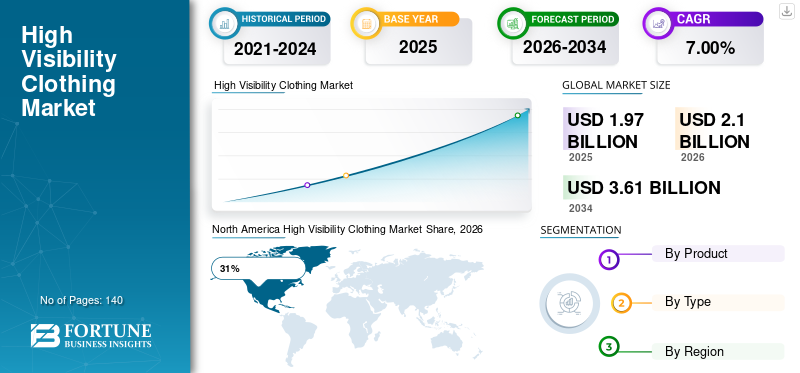
The high visibility clothing market size was valued at USD 1.97 Billion in 2025. The market is projected to grow from USD 2.1 Billion in 2026 to USD 3.61 Billion by 2034, exhibiting a CAGR of 7.00% during the forecast period.

The high visibility clothing market is an essential segment of the global personal protective equipment industry, serving workers operating in construction, transportation, logistics, manufacturing, mining, utilities, emergency response, and public safety environments. High visibility garments are manufactured using fluorescent fabrics and retroreflective materials that improve worker visibility during daylight, low-light, and nighttime conditions. Increasing workplace safety regulations, mandatory compliance standards, and employer focus on accident prevention continue to support demand. The high visibility clothing market Report indicates strong adoption of advanced fabrics featuring moisture management, durability, breathability, and weather resistance. Growing infrastructure projects and industrial expansion are strengthening high visibility clothing market Growth and creating significant high visibility clothing market Opportunities.
Download Free sample to learn more about this report.
USA High Visibility Clothing Market
The United States remains one of the largest consumers of high visibility clothing due to strict workplace safety requirements across highway construction, utility maintenance, warehousing, logistics, and emergency services. ANSI/ISEA visibility classifications are widely implemented across industries, driving consistent procurement of compliant garments. The expansion of transportation infrastructure projects, renewable energy installations, and large-scale warehousing facilities has increased demand for reflective vests, jackets, shirts, and pants. Employers are increasingly investing in lightweight and breathable safety apparel to improve worker comfort and compliance. The USA High Visibility Clothing Industry Analysis also highlights growing interest in smart visibility garments incorporating LED illumination and enhanced reflective technologies.
High Visibility Clothing Market Key Takeaways
 Global Market Size & Forecast
- 2025 Market Size: USD 1.97 Billion
- 2026 Market Size: USD 2.10 Billion
- 2034 Forecast Market Size: USD 3.61 Billion
- CAGR: 7.00% from 2026-2034
 Market Share
- The market in Asia-Pacific dominated with a revenue share of 35% in 2025.
- Safety vests dominated by product with a market share of approximately 38%.
- Type O garments dominated by type with a market share of approximately 44%
 Key Regional Highlights
Asia-Pacific
Asia-Pacific led the market with a 35% share, supported by expanding industrial activities and growing workplace safety requirements.
North America
North America accounted for 31% of the market, driven by stringent worker safety standards and strong demand for protective apparel.
Europe
Europe held a 28% share, supported by established occupational safety regulations and demand for high-performance workwear.
U.S
The U.S. remains a key market, supported by strong workplace safety requirements and demand across construction and transportation sectors.
Japan
Japan accounted for approximately 16% of the Asia-Pacific market, supported by established industrial activities and increasing focus on workplace safety.
Read More

High Visibility Clothing MarketLatest Trends
One of the most important high visibility clothing market Trends is the development of lightweight and ergonomic garments that improve comfort without reducing visibility performance. Manufacturers are introducing moisture-wicking fabrics, stretch materials, mesh ventilation systems, and weather-resistant coatings to enhance usability across different work environments. Smart textile integration is also emerging as a significant innovation area.
Another major trend shaping the high visibility clothing market Research Report is sustainability. Manufacturers are increasingly utilizing recycled polyester fibers and environmentally responsible production methods. Demand for durable garments with extended service life is growing among industrial buyers seeking cost efficiency and sustainability targets.
Download Free sample to learn more about this report.
The market is also witnessing increasing adoption of LED-enhanced visibility apparel, particularly among transportation workers, emergency responders, and utility personnel. Multi-functional workwear combining flame resistance, arc protection, and high visibility features is gaining traction. Digital procurement platforms and direct B2B sales channels are streamlining purchasing processes, enabling organizations to manage large-scale workforce safety programs more efficiently. These developments are supporting high visibility clothing market Outlook improvements across developed and emerging industrial economies.
High Visibility Clothing Market Dynamics
DRIVER
Increasing Workplace Safety Regulations and Compliance Requirements
The primary driver of the high visibility clothing market Growth is the implementation of stringent workplace safety regulations across construction, transportation, mining, manufacturing, and utility industries. Governments and occupational safety authorities continue to strengthen requirements related to worker visibility in hazardous environments. Employers increasingly recognize that high visibility apparel reduces accident risks involving vehicles, machinery, and low-light operations.
Large infrastructure investments are creating substantial demand for protective apparel. Road construction projects, railway expansion programs, logistics hubs, airports, and energy facilities require workers to wear compliant visibility garments throughout operational activities. Organizations are also investing in safety culture initiatives that emphasize proactive risk management. The High Visibility Clothing Industry Report indicates that procurement managers increasingly prioritize certified garments with enhanced durability and comfort features. Worker awareness regarding personal safety equipment has improved significantly, further contributing to market expansion. These factors collectively strengthen long-term demand across industrial and public-sector applications.
RESTRAINT
Price Sensitivity and Availability Of Low-Cost Alternatives
Despite strong demand, the high visibility clothing market faces challenges associated with pricing pressures. Many small and medium-sized enterprises operate under strict budget constraints and often prioritize lower-cost products over premium safety apparel. The presence of low-cost imports and non-certified alternatives creates pricing competition for established manufacturers.
Replacement cycles can also affect purchasing decisions. Organizations may extend garment usage periods to control operating expenses, reducing short-term procurement volumes. In some developing regions, awareness of compliance requirements remains limited, leading to inconsistent adoption of certified high visibility apparel. Additionally, premium garments incorporating advanced reflective materials, weather protection, and flame-resistant features may carry higher procurement costs. These factors can slow penetration rates in cost-sensitive sectors. The high visibility clothing market Analysis identifies pricing pressure as an important consideration for manufacturers seeking to balance performance, compliance, and affordability while maintaining competitive positioning.
OPPORTUNITY
Expansion of Smart Protective Clothing Technologies
The emergence of smart protective apparel presents substantial opportunities for the high visibility clothing market. Manufacturers are developing garments that integrate LED lighting systems, sensors, GPS tracking capabilities, and connected worker safety technologies. Such innovations are particularly valuable for transportation, emergency response, mining, and utility operations.
Growing adoption of industrial digitalization programs creates opportunities for connected workwear capable of monitoring worker location and environmental conditions. Sustainability initiatives are also generating demand for recyclable materials and environmentally responsible manufacturing processes. Emerging economies continue to invest heavily in transportation networks, industrial facilities, and urban development projects, creating additional demand for protective apparel. The high visibility clothing market Forecast suggests that companies capable of combining visibility, comfort, durability, and smart technology features will benefit from significant growth opportunities. Product customization and corporate branding services also offer additional revenue streams for manufacturers serving large enterprise customers.
CHALLENGE
Maintaining Performance Standards across Diverse Environments
One of the major challenges facing the high visibility clothing market is ensuring consistent performance across varying environmental and operational conditions. Workers often operate in extreme temperatures, heavy rain, dust, chemical exposure, and high-abrasion environments. Maintaining visibility performance under such conditions requires advanced materials and rigorous quality control.
Reflective tapes and fluorescent fabrics may experience wear over time, reducing effectiveness and requiring regular replacement. Manufacturers must continuously invest in research and development to improve durability while maintaining worker comfort. Regulatory requirements vary across regions, creating additional complexity for global suppliers. Supply chain disruptions affecting textile materials and reflective components can also influence production schedules. The high visibility clothing market Insights indicate that balancing regulatory compliance, product innovation, durability requirements, and cost competitiveness remains a key challenge for industry participants seeking sustainable long-term growth.
High Visibility Clothing Market Segmentation
By Product
Safety vests account for approximately 38% of the high visibility clothing market Share, making them the largest product segment. Their widespread adoption is driven by affordability, versatility, and regulatory acceptance across construction, logistics, transportation, and utility sectors. Safety vests are frequently used as mandatory visibility garments for workers operating near vehicles and machinery.
Manufacturers continue introducing lightweight mesh designs, adjustable closures, and enhanced reflective tape configurations. High visibility vests are particularly popular among contractors and temporary workforce operators due to ease of deployment. Large infrastructure projects and transportation activities continue to support strong demand. The high visibility clothing market Research Report identifies vests as the preferred solution for organizations seeking cost-effective compliance with workplace visibility requirements.
Jackets represent approximately 24% of market demand and are widely utilized in colder climates and outdoor operations. High visibility jackets provide both visibility and weather protection, making them essential for construction workers, utility crews, transportation personnel, and emergency responders.
Modern designs incorporate waterproof materials, thermal insulation, and breathable fabrics that improve worker comfort. Growing demand for all-weather protective apparel supports segment growth. Organizations increasingly procure high visibility jackets as part of comprehensive worker safety programs. Reflective technology improvements and multi-functional garment designs continue to enhance market penetration.
High visibility shirts account for nearly 21% of the market. These garments are commonly used in manufacturing, warehousing, transportation, and utility sectors where lightweight visibility solutions are preferred. Moisture-wicking fabrics and enhanced ventilation systems have increased adoption among workers operating in warm climates.
Manufacturers are focusing on durability and comfort while maintaining compliance with safety standards. Demand is particularly strong among organizations seeking alternatives to traditional vests. Enhanced corporate branding opportunities also contribute to the popularity of high visibility shirts across commercial applications.
High visibility pants hold approximately 17% of the market and are frequently utilized in combination with jackets, shirts, and vests. These garments provide enhanced visibility for workers operating around vehicles and heavy equipment.
Demand is increasing within road construction, mining, and utility maintenance operations. Manufacturers are developing reinforced designs featuring abrasion resistance, weather protection, and ergonomic construction. The segment benefits from growing awareness that full-body visibility solutions improve overall worker safety in hazardous environments.
To know how our report can help streamline your business, Speak to Analyst
By Type
Type O garments represent approximately 44% of the market and are designed for workers operating in environments where vehicle speeds are relatively low. Warehousing, maintenance, logistics, and industrial facilities are key application areas. These garments focus on providing sufficient visibility while maximizing comfort and flexibility.
Growing industrial employment and expansion of distribution centers continue supporting demand. Organizations increasingly select Type O apparel for routine workplace safety programs due to cost efficiency and broad applicability.
Type R products account for roughly 39% of market demand and are intended for workers exposed to roadway traffic and higher-risk environments. Construction crews, highway maintenance personnel, and transportation workers constitute major user groups.
Regulatory compliance requirements significantly influence procurement decisions within this segment. Demand remains strong due to ongoing transportation infrastructure development projects and increasing investment in road maintenance programs. Enhanced reflective materials continue improving product performance.
Type P garments hold around 17% of the market and serve emergency responders, law enforcement personnel, and public safety professionals. These garments often incorporate specialized design features supporting communication equipment and operational mobility.
Public safety organizations increasingly prioritize garments offering visibility, durability, and comfort. Product innovation focuses on balancing protection requirements with professional appearance and operational functionality.
High Visibility Clothing Market Regional Outlook
North America High Visibility Clothing Market Share, 2026 (%)
To get more information on the regional analysis of this market, Download Free sample
North America
North America remains a leading region in the high visibility clothing market due to strong workplace safety regulations and extensive infrastructure investments. Construction, transportation, utilities, warehousing, and public safety sectors represent major demand generators. Employers prioritize compliance and worker protection, supporting continuous procurement of certified visibility apparel. The region also benefits from advanced product innovation and high adoption of premium protective garments. Growth is supported by transportation modernization projects, renewable energy installations, and expansion of logistics facilities.
Europe
Europe represents a mature market characterized by strict occupational safety requirements and advanced manufacturing capabilities. Demand remains strong across construction, transportation, industrial manufacturing, and emergency services. Sustainability initiatives encourage adoption of recyclable materials and environmentally responsible production methods. European buyers increasingly prioritize garment durability and comfort alongside visibility performance. The region continues to serve as an important center for protective apparel innovation.
Germany High Visibility Clothing Market
Germany represents one of the most significant national markets within Europe. Strong industrial manufacturing, engineering activities, logistics operations, and infrastructure maintenance programs contribute to sustained demand for high visibility apparel. Employers maintain strict adherence to worker safety regulations, supporting procurement of premium garments.
The German market also benefits from advanced textile engineering and innovation capabilities. Manufacturers emphasize durable, comfortable, and sustainable visibility solutions. Demand is particularly strong in automotive manufacturing, industrial production facilities, railway infrastructure, and utility services. Continued industrial modernization supports long-term market expansion.
United Kingdom High Visibility Clothing Market
The United Kingdom remains an important market supported by construction activities, transportation networks, logistics facilities, and public infrastructure maintenance. High visibility clothing is widely used across roadworks, railway operations, airports, and utility services.
Organizations increasingly invest in garments offering improved weather resistance and comfort due to varied environmental conditions. Procurement managers prioritize compliance with visibility standards while seeking cost-effective workforce protection solutions. Demand for sustainable and high-performance workwear continues to rise.
Asia-Pacific
Asia-Pacific leads the global high visibility clothing market with a 35% share. Rapid industrialization, infrastructure development, manufacturing expansion, and urbanization continue driving demand. Countries across the region are strengthening workplace safety regulations and increasing awareness of occupational risk management.
Construction, transportation, mining, logistics, and manufacturing industries remain major end users. Regional manufacturing capabilities also support cost-efficient production of visibility apparel. Growing adoption of international safety standards is creating additional opportunities for market participants.
Japan High Visibility Clothing Market
Japan maintains a sophisticated market characterized by advanced workplace safety practices and high-quality manufacturing standards. Demand is concentrated within transportation infrastructure, industrial production, utilities, and public services. Employers emphasize premium garments featuring durability, comfort, and advanced reflective technologies.
The country's aging workforce has encouraged greater focus on accident prevention and worker protection. Smart textile innovation and ergonomic garment designs continue influencing purchasing decisions among industrial buyers.
China High Visibility Clothing Market
China represents the largest national market within Asia-Pacific. Massive infrastructure investments, industrial manufacturing activity, logistics expansion, and urban development projects drive substantial demand for high visibility apparel.
Government emphasis on workplace safety and industrial modernization continues supporting market growth. Domestic manufacturing capabilities enable large-scale production, while increasing adoption of international compliance standards encourages demand for higher-quality products. The market also serves as a major production hub for global supply chains.
Rest of World
The Rest of World region includes Latin America, the Middle East, and Africa. Demand is supported by mining operations, oil and gas projects, infrastructure development, and transportation activities. Governments are gradually strengthening workplace safety regulations, creating opportunities for market expansion.
Construction and energy projects remain key demand drivers. International companies operating in these regions often implement global safety standards, increasing adoption of certified high visibility garments. Rising industrial investment and urban development initiatives continue supporting market opportunities.
List of Top High Visibility Clothing Companies
- 3M
- Bulwark Protection (Workwear Outfitters, LLC)
- Carhartt, Inc.
- Cintas Corporation
- Radians, Inc.
- Honeywell International Inc.
- Jiangsu Tianshi New Material Co., Ltd.
- Lakeland Industries, Inc.
- Portwest Ltd.
- Pyramex
Top Two Companies by Estimated Market Share
- 3M – 11%
- Honeywell International Inc. – 9%
Investment Analysis and Opportunities
The high visibility clothing market presents attractive investment opportunities driven by regulatory compliance requirements, infrastructure development, and industrial workforce expansion. Investors are increasingly targeting manufacturers specializing in advanced reflective materials, smart textile technologies, and sustainable garment production. Demand for high-performance visibility apparel continues expanding across transportation, logistics, renewable energy, construction, and public safety sectors.
Strategic investments are also focused on automation, digital supply chains, and product customization capabilities. Emerging economies offer significant opportunities due to growing industrialization and improving occupational safety frameworks. Companies developing integrated visibility solutions with wearable technology features are attracting increased interest. Mergers, acquisitions, and strategic partnerships continue reshaping the competitive landscape as manufacturers seek broader geographic reach and stronger product portfolios.
New Product Development
Innovation remains a major focus within the high visibility clothing market. Manufacturers are introducing garments utilizing lightweight reflective materials, enhanced moisture management systems, and improved ergonomic designs. Advanced fabrics capable of maintaining visibility performance after repeated laundering are gaining popularity among industrial buyers.
Smart visibility apparel incorporating LED illumination, location tracking, and environmental monitoring capabilities is emerging as a key development area. Sustainable products manufactured from recycled materials are also receiving increased attention. Multi-functional garments combining flame resistance, arc protection, weather resistance, and visibility features are becoming increasingly common. These innovations enhance worker safety while improving comfort, durability, and operational efficiency.
Five Recent Developments (2023-2025)
- Several leading manufacturers expanded production of sustainable high visibility garments using recycled polyester materials.
- New LED-integrated visibility jackets were introduced for transportation and emergency response applications.
- Multiple companies launched lightweight breathable high visibility apparel designed for hot-weather environments.
- Manufacturers increased investment in reflective technology research to improve visibility performance and garment durability.
- Strategic partnerships were established between protective apparel producers and industrial distributors to expand market reach.
Report Coverage
The high visibility clothing market Report provides a comprehensive assessment of industry trends, competitive dynamics, product innovation, regional developments, and market opportunities. The report evaluates demand across construction, transportation, manufacturing, mining, logistics, utilities, and public safety sectors.
Request for Customization to gain extensive market insights.
Coverage includes detailed segmentation by product type and visibility category, along with analysis of procurement trends, regulatory influences, and technological developments. The study examines regional performance across North America, Europe, Asia-Pacific, and Rest of World markets. Competitive analysis highlights leading manufacturers, strategic initiatives, product development activities, and investment trends. The high visibility clothing market Research Report also explores future opportunities related to sustainability, smart protective apparel, and emerging industrial safety requirements.
Frequently Asked Questions
Fortune Business Insights says that the global market value stood at USD 1.97 billion in 2025 and is projected to reach USD 3.61 billion by 2034.
The market is expected to exhibit a CAGR of 7.00% during the forecast period of 2026-2034.
Safety vests led the product segment with approximately 38% market share, driven by their affordability, versatility, and regulatory acceptance across major industrial sectors.
Key players include 3M, Bulwark Protection, Carhartt, Inc., Cintas Corporation, Radians, Inc., and Honeywell International Inc.
Major trends include the development of lightweight, ergonomic, and sustainable garments, along with growing adoption of LED-enhanced smart visibility apparel. Asia-Pacific dominated the market with a 35% share.



- 2021-2034
- 2025
- 2021-2024
- 140
-

(Offer valid till 15th Oct 2026)
Get 30-60 hrs Free Customization
Expand Regional and Country Coverage, Segments Analysis, Company Profiles, Competitive Benchmarking, and End-user Insights.













-
US +1 833 909 2966 ( Toll Free )
-
Get In Touch With Us