 Download Free Sample



Get a Quote
Receive a tailored pricing based on your needs.
- Choose license type
- Multiple user options
- Custom scope & coverage
- Fast turnaround
"Designing Growth Strategies is in our DNA"
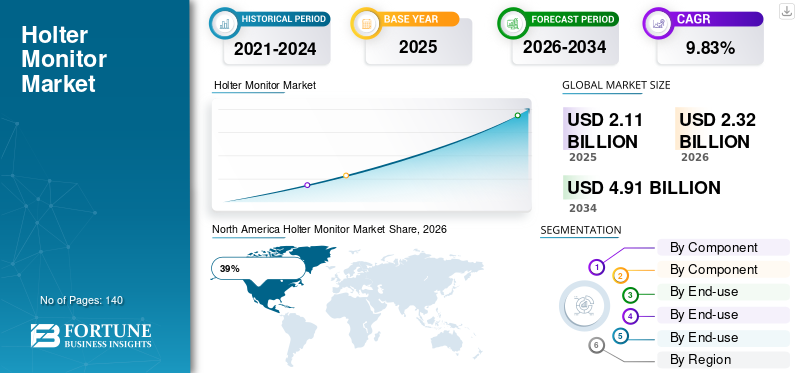
The holter monitor market size was valued at USD 2.11 billion in 2025. The market is projected to grow from USD 2.32 billion in 2026 to USD 4.91 billion by 2034, exhibiting at a CAGR of 9.83% during the forecast period.

The holter monitor market is expanding steadily due to the rising prevalence of cardiovascular disorders, growing elderly population, and increasing demand for continuous cardiac monitoring solutions. Holter monitor systems are widely used for detecting arrhythmias, irregular heart rhythms, and silent cardiac abnormalities that may not appear during routine electrocardiogram testing. The holter monitor market report indicates that wireless monitoring systems and portable diagnostic technologies are becoming standard across hospitals and outpatient facilities. More than 64% of cardiology departments globally now utilize digital Holter monitoring solutions for long-term cardiac assessment. The integration of AI-assisted ECG interpretation and cloud-based patient data analysis is further strengthening holter monitor market growth.
The USA holter monitor market remains the largest regional contributor due to high cardiovascular disease incidence and strong healthcare infrastructure. Around 72% of major hospitals in the United States use advanced ambulatory ECG monitoring systems for cardiac diagnostics and patient management. Rising cases of atrial fibrillation, hypertension, and obesity-related cardiac conditions are increasing demand for wearable monitoring technologies. Holter monitor industry analysis shows that outpatient cardiac monitoring adoption has increased significantly across ambulatory care settings and telehealth networks. Technological advancements such as wireless ECG transmission, remote physician access, and AI-powered arrhythmia detection continue to support holter monitor market opportunities across the United States healthcare sector.
Download Free sample to learn more about this report.
 Global Market Size & Forecast
 Market Share
 Key Regional Highlights
North America
North America led the market with a 39% regional share, supported by advanced cardiac monitoring infrastructure.
Europe
Europe accounted for 28% of the global market, driven by rising cardiac diagnostic demand.
Asia-Pacific
Asia-Pacific held a significant 24% share, supported by expanding healthcare infrastructure.
U.S.
Demand is supported by increasing cardiac disease prevalence and adoption of remote monitoring technologies.
Japan
Market growth is supported by an aging population and increasing demand for advanced cardiac monitoring.
Read More

The holter monitor market is witnessing rapid technological evolution driven by wearable healthcare innovation and digital cardiology solutions. One of the major holter monitor market trends is the shift toward wireless and patch-based monitoring devices that improve patient comfort and mobility during long-term cardiac observation. Nearly 61% of newly deployed monitoring systems in advanced healthcare facilities are now wireless-enabled. These devices allow continuous ECG recording without restricting daily activities, making them highly preferred in outpatient and homecare environments.
Download Free sample to learn more about this report.
Another important trend highlighted in the holter monitor market research report is the integration of artificial intelligence and cloud analytics into ambulatory ECG systems. AI-assisted monitoring tools can identify irregular cardiac patterns with improved diagnostic efficiency, reducing physician workload and interpretation time. Hospitals and cardiology clinics are increasingly implementing remote cardiac monitoring solutions connected through telemedicine platforms. The holter monitor market Outlook also reflects rising adoption of smartphone-compatible monitoring systems that provide real-time patient alerts and physician notifications. Growing investments in miniaturized sensors, battery optimization, and wearable biosignal technologies continue to strengthen holter monitor market forecast expansion among healthcare providers, diagnostic centers, and cardiac specialty clinics worldwide.
Rising Prevalence of Cardiovascular Diseases and Arrhythmia Disorders
The increasing incidence of cardiovascular disorders is the primary growth driver for the holter monitor market. Conditions such as atrial fibrillation, coronary artery disease, hypertension, and cardiac arrhythmias are becoming more common among aging populations and sedentary lifestyles. More than 59% of cardiologists globally now recommend ambulatory ECG monitoring for patients with intermittent cardiac symptoms. Holter monitor market analysis indicates that continuous monitoring technologies are increasingly preferred over conventional ECG tests for identifying irregular heart rhythms that occur unpredictably.
Healthcare providers are adopting advanced Holter monitoring systems to support early diagnosis and preventive cardiac care. Rising awareness regarding cardiac screening and preventive cardiology programs is also contributing to market expansion. Hospitals and diagnostic centers are increasingly investing in portable ECG systems that enable remote patient observation and real-time physician access. The growth of telecardiology services and wearable healthcare technologies is further strengthening holter monitor industry report demand across developed and emerging healthcare markets.
High Device Costs and Limited Reimbursement Coverage
One of the major restraints affecting the holter monitor market is the high cost associated with advanced wireless monitoring systems and AI-enabled cardiac analysis platforms. Smaller healthcare facilities and clinics often face financial limitations when implementing next-generation ambulatory monitoring technologies. Nearly 43% of outpatient diagnostic centers in developing economies continue using older ECG monitoring systems due to budget constraints.
Limited reimbursement policies for extended cardiac monitoring procedures also restrict broader adoption in several regions. holter monitor market insights reveal that healthcare providers in cost-sensitive markets frequently delay upgrades to digital monitoring infrastructure because of uncertain reimbursement frameworks. Patients in low-income healthcare systems may avoid long-term cardiac monitoring due to high out-of-pocket expenses. In addition, maintenance requirements, software integration costs, and physician training needs further impact market penetration among smaller medical facilities and rural healthcare providers.
Expansion of Remote Patient Monitoring and Telecardiology
The growing adoption of telemedicine and remote healthcare services presents major opportunities for the holter monitor market. Remote cardiac monitoring systems allow physicians to evaluate ECG data from patients located outside hospital settings, improving diagnostic accessibility and reducing hospital admissions. Nearly 57% of healthcare organizations implementing digital health programs are investing in connected cardiac monitoring technologies.
Holter monitor market opportunities are expanding rapidly due to increasing demand for home-based healthcare solutions and wearable medical devices. Remote patient monitoring is particularly beneficial for elderly populations and patients with chronic cardiovascular conditions requiring continuous observation. Healthcare systems are also integrating cloud-based ECG analytics and AI-driven arrhythmia detection software into telecardiology platforms. The expansion of smartphone-connected monitoring devices and wireless biosensors continues to improve patient convenience and diagnostic efficiency, creating strong growth potential within the holter monitor market forecast landscape.
Data Management Complexities and Cybersecurity Concerns
One of the key challenges facing the holter monitor market is the management of large volumes of continuous ECG data generated by long-term monitoring systems. Healthcare providers often struggle with data storage, interpretation accuracy, and integration with hospital information systems. Around 46% of cardiology facilities report operational challenges related to ECG data standardization and workflow integration.
Cybersecurity concerns associated with wireless cardiac monitoring devices also remain significant. Connected monitoring systems transmit sensitive patient health information through cloud-based platforms, increasing the risk of data breaches and unauthorized access. Holter monitor market research report findings indicate that healthcare organizations are under pressure to strengthen cybersecurity infrastructure while maintaining efficient remote monitoring operations. In addition, interpreting long-duration ECG recordings requires skilled cardiologists and trained technicians, creating workforce challenges in regions with limited cardiac diagnostic expertise.
Wired Holter monitors account for approximately 44% of the holter monitor market share due to their long-established clinical reliability and widespread use in hospital-based diagnostics. These systems are commonly used in cardiology departments where stable signal transmission and continuous ECG recording are required for accurate cardiac analysis. Wired monitoring systems remain preferred in healthcare settings handling high-risk cardiac patients because of consistent recording quality and minimal connectivity interruptions.
Many hospitals continue utilizing wired Holter monitors for inpatient diagnostics and emergency cardiac assessment programs. Holter monitor market trends indicate that wired systems are frequently used in intensive care units and specialized cardiology centers where controlled clinical environments support effective patient monitoring. These systems are also valued for their lower device costs compared to advanced wireless platforms. Despite the growth of wearable technologies, wired monitors maintain strong market demand in healthcare institutions prioritizing reliability, extended recording duration, and established diagnostic workflows.
Wireless Holter monitors represent nearly 56% of the holter monitor market due to increasing adoption of wearable and patient-friendly cardiac monitoring solutions. Wireless systems provide improved mobility, comfort, and remote data transmission capabilities, making them highly suitable for outpatient monitoring and homecare applications. Holter monitor market analysis shows strong demand for wireless patch-based ECG devices among elderly patients and individuals requiring long-term cardiac observation.
The integration of Bluetooth connectivity, smartphone applications, and cloud-based ECG analytics has significantly improved the functionality of wireless monitoring systems. Hospitals and ambulatory care providers are increasingly adopting wireless devices to support telecardiology programs and remote patient management initiatives. Wireless Holter monitors also reduce hospital visits by enabling physicians to monitor cardiac activity remotely. Advances in miniaturized sensors, battery efficiency, and AI-powered rhythm analysis continue to strengthen the market position of wireless cardiac monitoring technologies globally.
To know how our report can help streamline your business, Speak to Analyst
Hospitals and clinics dominate the holter monitor market with approximately 63% market share due to high patient volumes and increasing demand for advanced cardiac diagnostic services. Cardiology departments rely extensively on Holter monitoring systems for arrhythmia detection, post-surgical cardiac evaluation, and chronic heart disease management. holter monitor market insights reveal that healthcare institutions are rapidly adopting digital ambulatory ECG systems integrated with electronic medical records and AI-assisted interpretation software.
Large hospitals are also expanding telecardiology infrastructure to improve remote patient monitoring and reduce emergency admissions related to cardiac complications. Continuous ECG monitoring is increasingly becoming a standard diagnostic procedure for patients experiencing chest pain, dizziness, palpitations, and unexplained syncope episodes. Growing awareness regarding preventive cardiac healthcare and early diagnosis programs continues to support holter monitor market growth across hospital networks and specialty clinics.
Ambulatory surgical centers account for nearly 22% of the holter monitor market share due to increasing demand for cost-effective outpatient cardiac diagnostics. These facilities utilize portable ECG monitoring systems for preoperative cardiac assessment and post-procedural patient monitoring. Ambulatory care providers are increasingly investing in compact and wireless monitoring devices that support fast patient turnaround and reduced hospitalization duration.
Holter monitor market forecast trends indicate rising adoption of ambulatory cardiac monitoring systems in minimally invasive treatment centers and outpatient specialty clinics. Wireless ECG monitoring allows healthcare professionals to evaluate cardiac conditions efficiently without requiring prolonged hospital stays. The growth of same-day surgical procedures and outpatient cardiovascular services is creating additional opportunities for ambulatory monitoring technology providers worldwide.
The “Others” segment, including homecare settings, diagnostic laboratories, and research institutions, holds approximately 15% of the holter monitor market share. Home-based cardiac monitoring adoption is increasing rapidly due to telehealth expansion and growing preference for remote patient management. Patients with chronic arrhythmias and elderly populations are increasingly using wearable ECG devices for continuous heart rhythm tracking.
Diagnostic laboratories and academic research institutions are also utilizing advanced Holter monitoring systems for clinical studies and cardiac health screening programs. Holter monitor industry analysis highlights increasing demand for compact monitoring technologies in sports medicine, preventive healthcare, and occupational health assessment. Growing awareness regarding cardiac wellness and remote healthcare accessibility continues to drive demand within this segment.
North America Holter Monitor Market Share, 2025 (%)
To get more information on the regional analysis of this market, Download Free sample
North America holds approximately 39% of the holter monitor market share due to advanced healthcare infrastructure, strong cardiac diagnostic adoption, and increasing prevalence of cardiovascular disorders. Hospitals and specialty cardiology centers across the United States and Canada are heavily investing in wearable ECG technologies and telecardiology systems. The region benefits from widespread implementation of AI-assisted cardiac diagnostics and high awareness regarding preventive heart health monitoring.
The holter monitor market Outlook in North America is further strengthened by rising elderly populations and increasing incidence of atrial fibrillation and hypertension-related complications. Healthcare providers are adopting cloud-connected monitoring systems to support remote patient management and reduce hospital readmissions. The presence of leading medical device manufacturers and strong investments in digital healthcare innovation continue to support regional market expansion.
Europe accounts for nearly 28% of the holter monitor market due to increasing investments in digital cardiology and remote healthcare infrastructure. Countries such as Germany, the United Kingdom, France, and Italy are rapidly implementing ambulatory ECG monitoring systems across hospitals and outpatient diagnostic centers. The region is witnessing rising adoption of wearable cardiac monitoring technologies for preventive healthcare and chronic disease management.
European healthcare providers are increasingly integrating wireless ECG systems with telemedicine platforms to improve patient accessibility and long-term cardiac observation. Holter monitor market trends indicate strong demand for compact monitoring devices capable of supporting aging populations and homecare applications. Government healthcare modernization initiatives and increasing awareness regarding cardiovascular disease prevention continue to support regional market development.
Germany contributes approximately 32% of the European holter monitor market due to strong healthcare infrastructure and advanced cardiac diagnostic capabilities. German hospitals and cardiology centers are increasingly adopting wireless ECG monitoring technologies for arrhythmia detection and long-term patient observation. The country’s aging population and growing incidence of cardiovascular diseases are significantly increasing demand for ambulatory cardiac monitoring systems.
Healthcare providers in Germany are investing heavily in telecardiology integration and AI-assisted ECG interpretation platforms. Holter monitor market research report findings indicate that remote patient monitoring adoption has expanded across outpatient care networks and rehabilitation centers. German medical institutions also prioritize wearable healthcare technologies that improve patient comfort and diagnostic efficiency. Rising focus on preventive cardiology programs continues to support Holter monitor industry analysis growth within the country.
The United Kingdom represents nearly 24% of the European holter monitor market due to expanding telehealth services and rising cardiovascular screening programs. Hospitals and diagnostic clinics across the UK are increasingly utilizing portable ECG systems to improve early diagnosis of arrhythmias and heart rhythm disorders. Healthcare providers are integrating wireless monitoring devices into outpatient cardiac care pathways to reduce emergency hospital admissions.
The holter monitor market forecast for the United Kingdom is supported by increasing demand for remote patient monitoring among elderly and chronic cardiac patients. Public healthcare modernization initiatives are also driving adoption of AI-powered cardiac analysis systems. The growth of wearable health technologies and smartphone-integrated monitoring devices continues to strengthen market opportunities across hospitals, specialty clinics, and homecare services.
Asia-Pacific accounts for approximately 24% of the holter monitor market share due to expanding healthcare infrastructure and increasing cardiovascular disease burden across emerging economies. Countries such as China, Japan, India, and South Korea are investing significantly in ambulatory cardiac monitoring technologies and telemedicine services. The region is witnessing strong demand for affordable wireless monitoring devices capable of supporting large patient populations.
Healthcare providers across Asia-Pacific are increasingly implementing portable ECG systems for preventive cardiac screening and chronic disease management. Holter monitor market opportunities are growing due to rising awareness regarding early cardiac diagnosis and wearable healthcare technologies. Government healthcare digitization programs and increasing investments in remote patient monitoring continue to support regional market expansion.
Japan holds approximately 21% of the Asia-Pacific holter monitor market due to the country’s aging population and advanced medical technology adoption. Japanese healthcare providers are increasingly implementing wearable ECG monitoring systems to manage chronic cardiac conditions among elderly patients. Hospitals and specialty cardiac centers are adopting AI-enabled arrhythmia detection software to improve diagnostic precision and reduce physician workload.
The growth of home healthcare services and remote patient monitoring programs is strengthening holter monitor market insights across Japan. Healthcare organizations are also integrating cloud-based ECG data platforms with telemedicine systems to improve accessibility and patient management efficiency. Rising demand for compact, lightweight, and battery-efficient monitoring devices continues to drive innovation within Japan’s cardiac diagnostics sector.
China contributes approximately 36% of the Asia-Pacific holter monitor market due to rapid healthcare modernization and increasing incidence of cardiovascular disorders. Large urban hospitals and diagnostic centers are investing heavily in wireless cardiac monitoring systems and AI-driven ECG interpretation platforms. holter monitor market growth in China is supported by expanding telehealth infrastructure and rising awareness regarding preventive cardiovascular care.
The country’s large patient population and increasing healthcare digitization initiatives are creating strong demand for affordable ambulatory monitoring solutions. Chinese manufacturers are also developing compact wearable ECG devices targeted at homecare and outpatient applications. Government support for digital healthcare innovation and growing investments in medical device manufacturing continue to strengthen China’s position within the global holter monitor industry report landscape.
The Rest of World region accounts for nearly 9% of the holter monitor market share, driven by increasing healthcare infrastructure investments across Latin America, the Middle East, and Africa. Cardiovascular disease prevalence is rising steadily in these regions, increasing demand for affordable cardiac diagnostic technologies and portable ECG systems. Healthcare providers are gradually implementing telecardiology and remote monitoring services to improve access to cardiac care.
The holter monitor market Outlook in the Rest of World region is also supported by expanding private healthcare networks and growing awareness regarding preventive cardiology. Hospitals and diagnostic centers are increasingly investing in wireless monitoring technologies to reduce hospitalization costs and improve patient management efficiency. The adoption of wearable healthcare solutions and mobile-based diagnostic systems continues to create long-term market opportunities across emerging healthcare economies.
The holter monitor market is attracting substantial investments due to growing demand for remote cardiac monitoring and wearable healthcare technologies. Healthcare providers and medical device manufacturers are increasingly investing in AI-powered ECG analysis systems, wireless monitoring devices, and cloud-connected cardiac diagnostics platforms. More than 53% of digital cardiology investments are currently directed toward ambulatory monitoring and telecardiology infrastructure.
Holter monitor market opportunities are particularly strong in remote patient monitoring, home healthcare, and AI-driven arrhythmia detection technologies. Venture capital firms and healthcare technology investors are supporting startups focused on miniaturized wearable biosensors and smartphone-integrated ECG systems. Emerging markets in Asia-Pacific and Latin America are also witnessing increased investments in affordable portable cardiac monitoring technologies. The expansion of preventive healthcare programs and digital health ecosystems continues to create long-term investment potential within the holter monitor market forecast landscape.
Innovation in the holter monitor market is focused on wearable, lightweight, and AI-enabled cardiac monitoring technologies. Manufacturers are launching patch-based ECG monitors with extended battery life, cloud connectivity, and real-time physician alert systems. Several companies have introduced smartphone-compatible monitoring solutions capable of transmitting ECG data directly to healthcare providers through secure digital platforms.
Holter monitor market trends also highlight the development of waterproof wearable monitors designed for continuous patient use during daily activities. AI-assisted analytics software capable of automated arrhythmia detection and predictive cardiac risk assessment is becoming increasingly common. Companies are investing in compact biosensors and wireless transmission technologies to improve patient comfort and diagnostic efficiency. The integration of telehealth compatibility and cloud-based ECG interpretation systems continues to accelerate innovation across the holter monitor industry report ecosystem.
The holter monitor market report provides detailed analysis of ambulatory ECG monitoring technologies, wearable cardiac diagnostics, and remote patient monitoring solutions across global healthcare sectors. The report evaluates major market drivers, restraints, opportunities, and challenges influencing the adoption of wired and wireless cardiac monitoring systems. It includes segmentation analysis based on component type and end-use applications such as hospitals, ambulatory surgical centers, and homecare settings.
Request for Customization to gain extensive market insights.
The holter monitor market research report also delivers comprehensive regional analysis covering North America, Europe, Asia-Pacific, and Rest of World markets. Country-level analysis for Germany, the United Kingdom, Japan, and China highlights advancements in telecardiology infrastructure and wearable healthcare technologies. The report further examines competitive strategies, product innovation trends, AI integration, remote monitoring adoption, and healthcare investment activity among leading manufacturers. Detailed insights regarding cloud-based ECG analytics, wireless monitoring systems, and preventive cardiac healthcare programs are also included within the report scope.
Fortune Business Insights says that the global market value stood at USD 2.11 billion in 2025 and is projected to reach USD 4.91 billion by 2034.
The market is expected to exhibit a CAGR of 9.83% during the forecast period of 2026-2034.
Hospitals and clinics was the leading end-use segment, accounting for approximately 63% of the market, supported by high patient volumes and growing demand for cardiac diagnostic services.
Key players include Koninklijke Philips N.V., GE HealthCare, Hill-Rom Holdings, Inc., Spacelabs Healthcare (OSI Systems, Inc.), SCHILLER AG, and Bittium.
Major trends include the shift toward wireless and patch-based monitoring devices and growing integration of AI-assisted ECG interpretation and cloud analytics. North America leads the market with approximately 39% share.


(Offer valid till 31st Oct 2026)
Get 30-60 hrs Free Customization
Expand Regional and Country Coverage, Segments Analysis, Company Profiles, Competitive Benchmarking, and End-user Insights.













.webp)






Get In Touch With Us
US +1 833 909 2966 ( Toll Free )
Receive a tailored pricing based on your needs.
Discuss your questions with our industry experts.
Have questions? Get quick answers before you purchase.

