Hovercraft Market Size, Share & Industry Analysis, By Passenger Capacity (Up to 4, 5 to 8, and Above 8), By Length (Up to 10 m and Above 10 m), By Application (Recreation & Travel and Commercial), and Regional Forecast, 2026-2034
 Download Free Sample
(Offer valid till 30th Sep 2026)

KEY MARKET INSIGHTS
 Listen to Audio Version
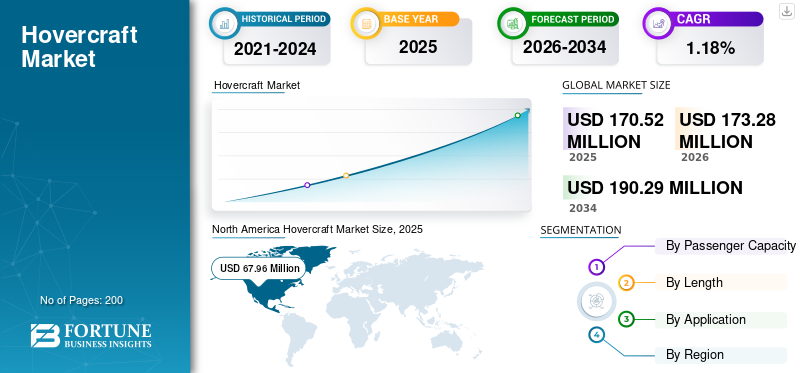
The global hovercraft market size was valued at USD 170.52 million in 2025. The market is projected to grow from USD 173.28 million in 2026 to USD 190.29 million by 2034, exhibiting a CAGR of 1.18% during the forecast period. North America dominated the global market with a share of 39.85% in 2025.
A hovercraft, or an Air Cushion Vehicle (ACV), is a type of vehicle that can travel or hover over land or water. It works on the principle of creating a high-pressure cushion of air beneath the vehicle, which lifts it off the surface, allowing it to hover. This air cushion reduces friction and enables the vehicle to glide smoothly over various terrains, including water, mud, ice, or grass. Hovercraft are used for transportation, military applications, search and rescue operations, and in some recreational activities.
Air cushion vehicles use a combination of lift and propulsion systems. The lift system consists of a large fan that creates high-pressure air under the craft, forming an air cushion. This cushion lifts the amphibious craft off the ground or water surface. The propulsion system typically includes one or more engines that power fans or propellers for forward and directional movements. Over the years, many designs and improvements have been introduced to make air cushion vehicles more efficient and eco-friendly. Some modern amphibious craft incorporate hybrid or electric propulsion systems to minimize fuel consumption and emissions. Disruptions caused by the COVID-19 pandemic, including factory closures and transportation restrictions, led to delays in the manufacturing and delivery of air cushion vehicles and their components. The outbreak also reduced the demand for many transportation solutions, including ACVs. Travel restrictions, lockdowns, and decreased tourism activities affected the need for air cushion vehicles in certain regions.
Download Free sample to learn more about this report.
Hovercraft Market Key Takeaways
 Global Market Size & Forecast
- 2025 Market Size: USD 170.52 million
- 2026 Market Size: USD 173.28 million
- 2034 Forecast Market Size: USD 190.29 million
- CAGR: 1.18% from 2026-2034
 Market Share
- North America dominated the hovercraft market with a 39.85% share in 2025.
- The above 10 m segment accounted for the largest share of 68.08% in 2026.
- The commercial segment accounted for the largest share of 81.98% in 2026.
 Key Regional Highlights
North America
North America accounted for USD 67.96 million in 2025 and is projected to reach USD 68.85 million in 2026.
Asia Pacific
Asia Pacific generated USD 44.86 million in 2025 and is projected to reach USD 45.81 million in 2026.
Europe
Europe accounted for USD 39.31 million in 2025 and is expected to reach USD 39.91 million in 2026.
U.S.
The hovercraft market is projected to reach USD 66.77 million in 2026.
Japan
The hovercraft market is projected to reach USD 3.67 million in 2026.
Read More

Hovercraft Market Trends
Design Improvements and Use of Hybrid & Electric Propulsion to Propel Market Growth
Manufacturers of air cushion vehicles are exploring hybrid and electric propulsion systems to minimize fuel consumption and emissions. Electric hovercraft are being developed for applications where environmental concerns and fuel efficiency are paramount. Automation and autonomy are becoming increasingly important in the industry. Researchers and manufacturers are working on autonomous navigation systems to enhance the air cushion vehicle's safety and operational capabilities, especially for military and surveillance applications.
Rising emphasis on making hovercraft more fuel-efficient and eco-friendly will drive the hovercraft market share. The measures taken in this regard include innovations in hull design, propulsion systems, and materials to reduce drag and energy consumption. Manufacturers are increasingly considering the environmental sustainability of their designs. This involves the use of eco-friendly materials, reduction of emissions, and exploring renewable energy sources for propulsion. Air cushion vehicle manufacturers are offering more customization options to meet the specific needs of customers, whether for military, commercial, or recreational purposes.
Download Free sample to learn more about this report.
Hovercraft Market Growth Factors
Rising Global Military Expenditure to Drive Product Sales
Increasing military expenditures across the globe has become a notable trend in recent years due to various factors and regional dynamics. Heightened geopolitical tensions between major economies, such as the U.S., China, and Russia, have increased military spending as nations seek to maintain or enhance their military capabilities in response to perceived threats. Ongoing conflicts and instability in regions, such as the Middle East & Africa, Eastern Europe, and the South China Sea, have prompted countries in those regions to bolster their military forces and invest in defense.
Some regions have been part of the race to acquire arms, where neighboring countries increase their military spending in response to each other's actions, leading to a cycle of heavy defense expenditures. Many nations have introduced military modernization programs to upgrade their equipment, technology, and infrastructure. Governments are allocating more resources to the defense sector in alignment with their national security priorities and strategic interests. These trends, as mentioned above, will drive hovercraft market growth during the forecast period.
Adoption of Safe Transportation Options for Search and Rescue (SAR) Operations will Propel Market Growth
The severity and frequency of natural disasters, including floods, hurricanes, earthquakes, wildfires, and tsunamis, have been on the rise. These events often result in people needing rescue from hazardous conditions. Climate change-related events, such as more intense storms and a rise in sea level, can increase the need for Search and Rescue (SAR) operations, especially in coastal and flood-prone areas. Search and rescue operations are crucial for responding to maritime accidents, shipwrecks, plane crashes, and emergencies at sea.
Accidents in industrial settings, such as mining, construction, and offshore drilling, can necessitate search and rescue operations to rescue trapped workers. Remote and inaccessible areas may require search and rescue teams for medical evacuations of injured or ill individuals who cannot be reached easily. In regions experiencing ongoing conflicts or humanitarian crises, search and rescue teams may be involved in rescuing civilians caught in dangerous situations. All these operations will positively influence market growth during the forecast period.
RESTRAINING FACTORS
High Costs Associated with Air Cushion Vehicles May Restrain Market Growth
Air Cushion Vehicles can be expensive to manufacture and purchase, making them less accessible to some potential buyers. High initial costs can be a barrier, especially for smaller operators and governments with budget constraints. ACVs tend to have higher operating costs compared to other modes of transportation. Factors such as high fuel consumption, regular maintenance, and the requirement for skilled personnel can increase these expenses. Traditional ACVs are not known for their fuel efficiency, and their environmental impact is a concern. Addressing the problem of fuel consumption and emissions is essential to meet modern environmental standards.
Hovercraft engines can be noisy, which can limit their use in certain areas, especially near residential zones and wildlife habitats. The possibility of using quieter propulsion systems is being explored to mitigate this issue. Operations of ACVs can be weather-dependent, particularly in adverse conditions, such as strong winds or extreme cold. Unpredictable weather patterns can disrupt schedules and impact the vehicle’s safety. ACVs require a stable infrastructure for operation, including hover pads, docks, or landing areas. Developing and maintaining this infrastructure can be costly and challenging in remote or undeveloped regions, thereby restricting market growth.
Hovercraft Market Segmentation Analysis
By Passenger Capacity Analysis
Above 8 Segment to Gain Traction Owing to Rising Military Operations and Increases Passenger Capacity
Based on passenger capacity, the market is categorized into up to 4, 5 to 8, and above 8.
The above 8 segment is expected to dominate the market with a share of 70.09% in 2026. ACVs with a large passenger capacity are used for troop transport, reconnaissance, and various specialized missions in the military. Furthermore, consumers are focused on purchasing hovercrafts with large seating capacities to accommodate larger people during rescue operations. These hovercrafts are designed to operate on both water and land, allowing them to access a wide range of terrains, including marshes, rivers, swamps, beaches, and ice. This factor makes them ideal for military operations. These air cushion vehicles have a high payload capacity and can carry troops, equipment, and vehicles, making them useful for rapid deployment and providing logistics support.
Air cushion vehicles with up to 4 passenger capacities are typically used for recreational activities, such as family outings, adventures, and leisure activities. They are often used in locations with marshy or shallow waters, offering a unique and fun way to explore such environments. These smaller air cushion vehicles can be valuable in search & rescue operations, especially in areas with limited access or difficult terrain. Researchers and conservationists use these ACVs to access and study ecosystems in remote or ecologically sensitive areas.
To know how our report can help streamline your business, Speak to Analyst
By Length Analysis
Above 10 m Segment to Dominate Due to its use in Several Applications with Increasing Coastal Tourism
By length, the market is categorized into up to 10 m and above 10 m.
The above 10 m segment accounted for the largest market share of 68.08% in 2026. The Air cushion vehicles that are longer than 10 meters will hold the majority of the market share within the forecast period and are generally used for passenger transport and tourism. These types of ACVs are used in areas where a larger passenger capacity is required, such as ferry services, tours in coastal or wetland areas, and passenger transport in regions with deep or shallow waters. The growing coastal tourism will drive the segment’s growth during the forecast period. Coastal areas often feature natural landscapes, such as beaches, cliffs, and ocean views. Beaches provide opportunities for numerous recreational activities that appeal to travelers seeking fun and adventure. This factor will bolster the segment’s growth over the next few years.
The up to 10 m hovercraft segment is expected to grow at the highest rate during the forecast period. ACVs up to 10 meters in length are used for scientific expeditions and amphibious explorations. Scientists and researchers use these small ACVs to access remote or challenging research sites, especially in regions with waterlogged or swamp-like conditions. Few organizations and educational institutions use small ACVs for training purposes, teaching individuals how to operate and navigate the vehicles safely.
By Application Analysis
Commercial Segment to Lead with Increasing Use in Defense Sector
Based on application, the market is divided into recreational & travel and commercial.
The commercial segment accounted for the largest market share of 81.98% in 2026 and is expected to continue its dominance throughout the forecast period. In 2022, the total global military expenditure increased by more than 3%. Russia’s invasion of Ukraine and tensions in East Asia have increased governments’ spending in the defense sector. Various countries are enhancing their military strength in response to a deteriorating security environment. Rising geopolitical tensions and worsening trade & political relations between countries will compel them to enhance maritime security, thereby driving the defense sector’s spending and augmenting the market’s growth in the future.
The recreational and travel segment accounted for a decent share in 2023 and is expected to grow at a steady growth rate during the forecast period. The growth is attributed to the increasing popularity of watersports activities among the populace, especially at tourist sports. ACVs are popular in the recreational segment as well, offering a unique and thrilling experience for adventure enthusiasts. Competitive ACV racing has gained a major following in various regions. Racers drive ACVs through courses on water and land, showcasing speed and agility. These events often attract adrenaline-seekers and fans of motorsports. In regions with frozen lakes and rivers, ACVs are used to reach ice fishing spots quickly and efficiently. These ACVs offer mobility on ice and prevent the need for drilling multiple holes.
REGIONAL INSIGHTS
Based on region, the market is categorized into North America, Europe, Asia Pacific, and the rest of the world.
North America Hovercraft Market Size, 2025 (USD Million)
To get more information on the regional analysis of this market, Download Free sample
North America
North America remained the largest regional market for hovercraft in 2025, generating USD 67.96 million and accounting for 39.85% of global revenue, with the market projected to reach USD 68.85 million in 2026. The region’s leadership is primarily supported by robust defense spending and advanced military modernization programs, particularly in the U.S., which is expected to reach USD 66.77 million in 2026, representing the overwhelming majority of regional demand. Strong government funding for amphibious warfare capabilities, maritime security operations, and rapid-response logistics continues to sustain demand for air cushion vehicles (ACVs). Regulatory frameworks emphasizing defense readiness, operational safety, and vessel performance standards further support procurement activities across military and government agencies.
Europe
Europe accounted for USD 39.31 million in 2025, representing 23.05% of global demand, and is expected to reach USD 39.91 million in 2026. The regional market benefits from a well-established recreational and sporting ecosystem, supported by organized hovercraft racing events and competitive leagues across several countries.
The U.K. is projected to contribute USD 8.02 million in 2026, while Germany is expected to reach USD 4.26 million. Regulatory oversight related to marine safety, environmental compliance, and recreational vessel operations contributes to the structured development of the market. Specialized commercial and rescue applications further support demand, while technological advancements and operational expertise continue to strengthen the region’s position.
Asia Pacific
Asia Pacific generated USD 44.86 million in revenue in 2025, capturing 26.31% of the global market, and is projected to reach USD 45.81 million in 2026. The region is witnessing increasing adoption of hovercraft due to evolving maritime security requirements, territorial disputes, and growing investments in naval modernization programs.
China is expected to remain the largest country-level market in the region with a value of USD 23.21 million in 2026, followed by India at USD 6.49 million and Japan at USD 3.67 million. Governments are strengthening defense capabilities to safeguard strategic waterways and critical trade routes, creating favorable conditions for ACV deployment. Regulatory initiatives focused on maritime security, coastal surveillance, and infrastructure development continue to support market expansion across the region.
Latin America
Latin America is a developing market for hovercraft, driven by growing demand for coastal transportation, border surveillance, disaster response, and access to remote areas with limited infrastructure. Governments across the region are increasingly evaluating versatile mobility solutions capable of operating across challenging terrains, including wetlands, river systems, and coastal zones. Regulatory efforts aimed at improving maritime safety and strengthening emergency response capabilities are gradually creating opportunities for market growth. Rising investments in transportation resilience and public safety applications are expected to support steady demand over the forecast period.
Middle East & Africa
The Middle East & Africa market is driven by increasing focus on coastal security, maritime patrol operations, and infrastructure development across strategically important waterways. Growing investments in defense modernization and border protection programs are encouraging the adoption of specialized amphibious platforms for surveillance and rapid deployment missions. Regulatory frameworks emphasizing national security, maritime governance, and operational safety continue to influence procurement decisions. Additionally, the region’s expanding offshore activities and requirement for reliable transportation across difficult coastal and desert environments are contributing to sustained demand for hovercraft solutions.
Together with Latin America, these regions formed the Rest of the World market, which was valued at USD 18.38 million in 2025 and is projected to reach USD 18.72 million in 2026.
List of Key Companies in Hovercraft Market
Diversification of Product Portfolios Will Aid Companies in Gaining Competitive Advantage
Key players in the market are implementing strategies, such as product diversification, expansion of sales network, and forming partnerships & collaborations to gain a strong foothold in the market. Such initiatives will help these major companies increase their customer base significantly. Technological advancements in hovercraft will drive the market growth over the next few years.
LIST OF KEY COMPANIES PROFILED:
- Airlift Hovercraft (Australia)
- Christy Hovercraft (Russia)
- Griffon Hoverwork Ltd. (U.K.)
- MAD Hovercraft (Italy)
- Neoteric Hovercraft, Inc. (U.S.)
- The British Hovercraft Company (U.K.)
- Amphibious Marine Inc. (U.S.)
- Hoverstream LLC (U.S.)
- Airflow Hovercraft NZ (New Zealand)
- MARIAH INTERNATIONAL HOVERCRAFT AUSTRALIA PTY LTD. (Australia)
KEY INDUSTRY DEVELOPMENTS:
- September 2023 – Griffon Hoverwork announced the name and details of its new class of Landing Craft Air Cushion: The Wyvern. The Wyvern class claims to deliver a rapid, amphibious transport solution for the world’s military forces looking to deploy their resources in response to conflict scenarios, natural disasters, or humanitarian crises.
- July 2023 – China announced that it is going to build a Zubr-class assault hovercraft, which will be capable of high speed and carrying tanks and troops. The country aims to strengthen its marine and coastal surveillance capabilities.
- September 2022 – Hoverlink Ontario Inc. announced its services for passengers. The company plans to transport passengers from Toronto to the Niagara region in 30 minutes.
- April 2022 – The Christy Hovercraft team successfully tested the Christy-7186 FC Deluxe hovercraft. The new model, the 2022 Christy 7186 FC Deluxe was made available for order.
- April 2022 – Neoteric Hovercraft, Inc. announced that the newest Neoteric Hovercraft – the Hovertrek II – would be exclusively powered by Briggs & Stratton’s Vanguard BIG BLOCK 40.0 Gross HP EFI – marine engine
REPORT COVERAGE
The market research report provides a detailed analysis of the market. This analysis focuses on key factors, such as major companies, product types, and leading product applications. Moreover, the report offers insights regarding the latest market trends and highlights top industry developments. In addition to the factors mentioned above, the report contains several factors that have contributed to the market’s growth in recent years.
Request for Customization to gain extensive market insights.
Report Scope & Segmentation
|
ATTRIBUTE |
DETAILS |
|
Study Period |
2021-2034 |
|
Base Year |
2025 |
|
Estimated Year |
2026 |
|
Forecast Period |
2026-2034 |
|
Historical Period |
2021-2024 |
|
Growth Rate |
CAGR of 1.18% from 2026 – 2034 |
|
Unit |
Value (USD Million) |
|
Segmentation |
By Passenger Capacity
|
|
By Length
|
|
|
By Application
|
|
|
By Geography
|
Frequently Asked Questions
Fortune Business Insights says that the market size was valued at USD 173.28 million in 2026 and is projected to reach USD 190.29 million by 2034.
The market is expected to register a CAGR of 1.18% during the forecast period of 2026-2034.
Rising naval military spending across the world is set to propel the market expansion.
North America led the market in 2025 and is predicted to exhibit appreciable growth over the forecast period.



- 2021-2034
- 2025
- 2021-2024
- 200
-
(Offer valid till 30th Sep 2026)
Get 30-60 hrs Free Customization
Expand Regional and Country Coverage, Segments Analysis, Company Profiles, Competitive Benchmarking, and End-user Insights.




















Related Reports
-
US +1 833 909 2966 ( Toll Free )
-
Get In Touch With Us