HR Software Market Size, Share & Industry Analysis, By Type, By Organization Size (Large Enterprises, Small & Medium Enterprises), By Deployment (Hosted, On-premise), By End-use, By Region, and Regional Forecast, 2026-2034
 Download Free Sample
HR Software Market Overview
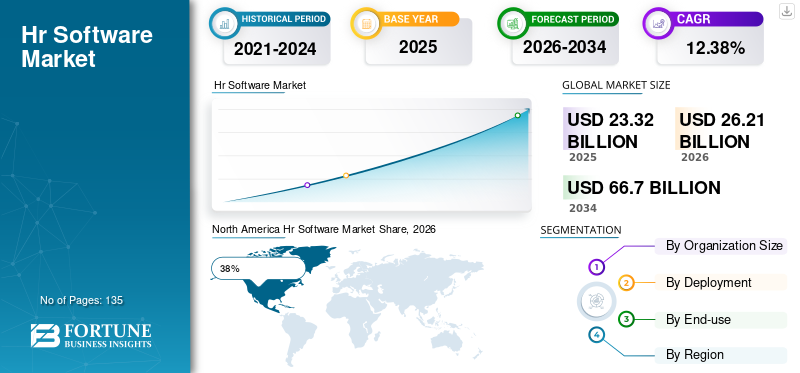
The HR Software market size was valued at USD 21.07 billion in 2025. The market is projected to grow from USD 23.68 billion in 2026 to USD 60.26 billion by 2034, exhibiting a CAGR of 12.38 % during the forecast period.

The HR Software Market is transforming how organizations manage employee data, recruitment, payroll coordination, attendance, performance, learning, workforce planning, benefits, and employee engagement. Modern HR software connects traditionally separate HR processes through centralized platforms, enabling organizations to improve data visibility and administrative efficiency. Cloud deployment, mobile access, automation, workforce analytics, artificial intelligence, and employee self-service are becoming important purchasing criteria. The HR Software Market Report indicates that organizations increasingly prefer integrated platforms capable of supporting the complete employee lifecycle. Demand is particularly strong among businesses seeking standardized HR workflows, regulatory compliance, workforce insights, and scalable technology infrastructure.
The USA HR Software Market remains one of the most mature and technologically advanced markets because enterprises have extensive experience with cloud computing, workforce analytics, payroll automation, and enterprise applications. Large organizations are increasingly replacing fragmented HR applications with integrated human capital management platforms that connect recruiting, employee records, compensation, performance, workforce planning, and analytics. The USA also represents a major innovation center for AI-enabled HR software, with vendors introducing conversational assistants, automated recruiting support, predictive workforce analytics, and employee-service capabilities. Strong demand from technology, healthcare, financial services, retail, manufacturing, and professional services supports the USA HR Software Market Outlook.
Download Free sample to learn more about this report.
HR Software Market Key Takeaways
 Global Market Size & Forecast
- 2025 Market Size: USD 21.07 billion
- 2026 Market Size: USD 23.68 billion
- 2034 Forecast Market Size: USD 60.26 billion
- CAGR: 12.38% from 2026–2034
 Market Share
- North America dominated the HR Software market with a 38% share in 2025.
- Hosted and cloud deployment led with a 64% market share.
- Large enterprises accounted for approximately 58% of the market.
 Key Regional Highlights
North America
North America led the global HR Software market with an approximately 38% share.
Europe
Europe accounted for approximately 27% of the global HR Software market.
Asia-Pacific
Asia-Pacific represented approximately 25% of the global HR Software market.
U.S.
The United States represents the largest national HR Software market in North America, supported by mature enterprise software adoption.
Japan
Japan accounted for approximately 24% of the Asia-Pacific HR Software market.
Read More

HR Software Market Latest Trends
Artificial intelligence is becoming one of the strongest HR Software Market Trends. Vendors are embedding generative AI assistants into recruiting, employee support, performance management, career development, and HR analytics. AI can help create job descriptions, summarize employee information, identify skills, answer HR policy questions, recommend learning opportunities, and automate repetitive administrative activities. Recent product releases have also emphasized AI-assisted applicant screening, skills matching, employee insights, career recommendations, and conversational HR support.
Another important trend is the movement toward skills-based workforce management. Organizations increasingly want HR platforms to understand employee capabilities rather than relying only on job titles and historical employment information. Skills libraries, talent marketplaces, learning recommendations, internal mobility tools, and workforce planning functions are therefore becoming integrated into HR platforms.
Employee experience is also influencing the HR Software Market Analysis. Employees increasingly expect consumer-like digital experiences through mobile applications, messaging platforms, self-service portals, and natural-language interfaces. HR software vendors are responding by simplifying workflows for leave requests, payroll questions, onboarding, benefits, performance activities, and employee documentation.
Cloud-based deployment continues to dominate purchasing decisions because organizations want faster implementation, automatic updates, scalability, remote accessibility, and lower dependence on internal infrastructure. At the same time, hybrid architectures remain important for organizations with strict data-residency, security, or regulatory requirements.
HR Software Market Dynamics
DRIVER
Rising demand for automated and integrated workforce management
The increasing complexity of workforce administration is a major driver of the HR Software Market Growth. Organizations managing large employee populations often operate across multiple locations, business units, employment categories, and regulatory environments. Manual HR processes can create duplicated records, delayed approvals, inconsistent reporting, and increased administrative workloads. HR software addresses these problems by centralizing employee information and automating repetitive workflows.
Integration is particularly important because HR teams increasingly need connections between recruiting, payroll, finance, time management, learning, performance, and workforce planning. An integrated platform allows organizations to create a more consistent employee record and reduce the need for repeated data entry. Large enterprises are especially interested in platforms capable of handling complex organizational structures and global workforce requirements.
Artificial intelligence is strengthening this driver by introducing automation into areas that traditionally required substantial HR involvement. AI-assisted recruiting, employee-service chatbots, automated document generation, workforce analytics, and skills recommendations can reduce repetitive work while allowing HR professionals to focus on strategic activities. The HR Software Market Research Report therefore identifies automation, integration, analytics, and AI-enabled decision support as major purchasing priorities for business buyers.
RESTRAINT
Data security, privacy, integration complexity, and implementation costs
Data sensitivity remains a significant restraint for the HR Software Market. HR systems contain highly confidential information, including employee identities, compensation records, performance information, benefits data, attendance details, and employment documentation. Organizations must therefore evaluate security architecture, access controls, encryption, data retention, compliance capabilities, and vendor governance before adopting new systems.
Implementation complexity can also slow adoption. Large organizations frequently have legacy payroll systems, multiple HR databases, customized workflows, and country-specific processes. Migrating this information into a new platform can require substantial planning and data cleansing. Poorly managed migration projects may create duplicate records or disrupt payroll and employee services.
Another restraint is organizational resistance. Employees and managers accustomed to established processes may be reluctant to adopt unfamiliar digital workflows. Training, change management, and ongoing support are therefore essential. Smaller organizations can also face budget limitations and may postpone advanced HR technology investments when immediate operational priorities take precedence. These factors create a barrier despite the long-term efficiency benefits of HR software.
OPPORTUNITY
Expansion of AI-powered, skills-based, and SME-focused HR platforms
The HR Software Market Opportunities are expanding as vendors move beyond basic employee administration toward intelligent workforce management. AI provides opportunities to automate recruitment screening, generate HR content, answer employee questions, identify workforce trends, recommend learning programs, and support managerial decision-making. Vendors that combine AI with reliable employee data can create differentiated solutions for organizations seeking measurable productivity improvements.
Small and medium-sized enterprises represent another important opportunity. Cloud delivery allows smaller businesses to access capabilities that previously required large technology investments. Vendors can target SMEs with modular platforms covering employee records, leave management, payroll integration, recruitment, performance, and employee self-service. Simplified onboarding and preconfigured workflows can further reduce implementation barriers.
Skills-based workforce management is another major opportunity. Companies increasingly need to understand what skills employees possess, where shortages exist, and which employees can be developed for emerging roles. HR platforms that combine skills intelligence, learning, career mobility, and workforce planning can become strategic systems rather than administrative tools.
Emerging markets also provide opportunities as businesses digitize paper-based HR processes. Mobile-first platforms, localized compliance features, multilingual interfaces, and flexible pricing can help vendors address organizations with limited existing HR technology infrastructure.
CHALLENGE
Managing AI governance, compliance, interoperability, and changing workforce requirements
A central challenge for the HR Software Industry is balancing technological innovation with responsible handling of employee information. AI-based HR functions can influence recruitment, performance evaluation, career recommendations, and workforce decisions. Organizations therefore need transparent governance frameworks to reduce inappropriate automation, bias, inaccurate recommendations, and privacy risks.
Interoperability is another challenge. Businesses rarely operate entirely within one software environment. HR platforms must exchange information with payroll applications, accounting systems, identity management platforms, collaboration tools, benefits providers, scheduling systems, and other enterprise applications. Weak integration can create fragmented employee information and undermine the benefits of centralization.
Regulatory requirements are also becoming more complex. HR technology providers need to support changing labor laws, payroll requirements, data protection rules, reporting obligations, and country-specific employment practices. Global enterprises require localization across multiple jurisdictions.
Finally, vendors must keep pace with rapidly changing workforce expectations. Hybrid work, flexible employment, skills-based hiring, internal mobility, employee experience, and AI-assisted work are changing the requirements placed on HR departments. Software providers must continuously update their products without creating excessive complexity for customers.
HR Software Market Segmentation
By Type
Core HR software represented approximately 34% of the HR Software Market in the latest market assessment. It provides the foundational employee database used for maintaining employee profiles, organizational structures, job information, employment history, documentation, and HR workflows. Core HR functionality is increasingly becoming the central data layer for broader HCM platforms.
Organizations adopt core HR software to establish a single source of employee information. Instead of maintaining separate spreadsheets or disconnected databases, HR teams can manage employee records through standardized digital workflows. This improves information availability for HR professionals, managers, and employees.
Core HR platforms increasingly include employee self-service, organizational charts, workflow automation, document management, compliance support, and integration capabilities. Mobile access has become important because employees and managers increasingly complete HR activities remotely. The segment is also benefiting from AI capabilities that can summarize employee information and assist with routine HR questions.
By Organization Size
Large enterprises accounted for approximately 58% of the HR Software Market. Their dominance reflects the complexity of managing thousands of employees across departments, locations, countries, and employment categories. Large companies typically require integrated HR platforms supporting core HR, payroll coordination, recruiting, performance, learning, benefits, workforce management, and analytics.
Large organizations also have greater requirements for security, governance, auditability, integration, and customization. Enterprise HR platforms must connect with financial systems, identity management tools, collaboration applications, and other business technologies. Global organizations additionally need multilingual capabilities and country-specific compliance support.
AI is becoming an important investment area for enterprise buyers. Large organizations can use AI for workforce planning, employee support, skills analysis, recruitment, and talent development. However, enterprise buyers generally require strong governance before deploying AI in sensitive HR processes.
Large enterprises also generate opportunities for implementation partners, consulting firms, systems integrators, and managed service providers. These organizations often require extensive migration, configuration, integration, training, and change management. Consequently, enterprise HR software demand extends beyond licenses or subscriptions to include a broader implementation ecosystem.
Small and medium enterprises represented approximately 42% of the market. Although their individual technology budgets are smaller, the large number of SMEs creates substantial demand for affordable and scalable HR solutions.
SMEs increasingly prefer cloud-based software because it reduces infrastructure requirements and enables faster deployment. Typical requirements include employee records, attendance, leave, payroll integration, recruitment, onboarding, document management, and basic reporting. Vendors are responding with modular products that allow companies to start with core functions and add advanced capabilities as their workforce expands.
Ease of use is particularly important for SME buyers because many do not have dedicated HR technology teams. Simple interfaces, automated workflows, mobile access, preconfigured templates, and customer support can influence purchasing decisions as strongly as advanced functionality.
The SME segment also represents a significant HR Software Market Opportunity in developing economies where digital HR adoption remains at an earlier stage. Vendors capable of offering localized compliance, flexible pricing, multilingual interfaces, and rapid implementation can address a broad customer base.
By Deployment
To know how our report can help streamline your business, Speak to Analyst
Hosted and cloud deployment represented approximately 64% of the HR Software Market. Cloud platforms provide organizations with remote access, centralized updates, scalable infrastructure, and reduced dependence on internal hardware.
Cloud HR software is particularly suitable for distributed and hybrid workforces because employees and managers can access HR services through browsers and mobile applications. Vendors can also release product enhancements more frequently, allowing customers to adopt new features without major software upgrade projects.
Cloud deployment supports integration with other SaaS applications and enterprise platforms. APIs and standardized connectors enable HR systems to exchange information with finance, collaboration, identity, payroll, and benefits applications.
AI adoption is further supporting cloud deployment because advanced AI capabilities often depend on centralized data processing and scalable computing infrastructure. Organizations are increasingly evaluating cloud platforms not simply as replacement systems but as foundations for broader workforce transformation.
On-premise HR software represented approximately 36% of the market. Although cloud adoption is increasing, on-premise systems remain relevant among organizations with established infrastructure, strict security requirements, highly customized workflows, or regulatory considerations.
Certain government organizations, financial institutions, and large enterprises may maintain greater control over data storage and system configuration through on-premise environments. Organizations with significant investments in legacy HR technology may also continue using existing infrastructure while gradually moving selected workloads to cloud environments.
However, on-premise systems can require greater internal IT resources for maintenance, upgrades, security, and infrastructure management. The segment is therefore increasingly competing with hybrid architectures that combine local control for sensitive information with cloud-based functionality for analytics and employee experience.
By End-use
IT and telecommunications organizations represent a major end-use segment of the HR Software Market, accounting for approximately 18% of demand. The sector has large numbers of skilled employees, distributed teams, contractors, and hybrid workers, creating strong requirements for digital employee management. Companies use HR software for recruitment, onboarding, employee records, performance management, learning, workforce planning, and employee engagement.
The rapid evolution of artificial intelligence, cybersecurity, cloud computing, and software development has increased the importance of skills management. HR platforms help technology companies identify skill gaps, recommend training, support internal mobility, and connect workforce capabilities with business requirements. Automated recruitment and AI-assisted candidate matching are also increasingly used to manage technical hiring.
HR Software Market Regional Outlook
North America
North America HR Software Market Share, 2025 (%) To get more information on the regional analysis of this market, Download Free sample
North America represented approximately 38% of the global HR Software Market, making it the leading regional market. The region benefits from mature enterprise software adoption, strong cloud infrastructure, high demand for workforce analytics, and a large concentration of HR technology vendors. The United States represents the largest national market within the region, supported by extensive adoption across technology, healthcare, finance, retail, manufacturing, and professional services.
Organizations in North America increasingly seek integrated platforms rather than isolated HR applications. Demand is particularly strong for AI-assisted recruiting, employee self-service, workforce analytics, payroll integration, talent management, and workforce planning. Large enterprises are also investing in skills-based workforce systems to support internal mobility and strategic talent development.
Canada contributes through cloud HR adoption, workforce modernization, and increasing demand for employee experience technologies. North American buyers generally place strong emphasis on data security, integration, usability, analytics, and vendor scalability. The region's mature procurement environment also encourages competition between established enterprise vendors and specialized HR technology providers.
Europe
Europe accounted for approximately 27% of the HR Software Market. European demand is supported by digital transformation, workforce modernization, regulatory compliance, employee experience initiatives, and the need to manage complex employment requirements across multiple countries. Organizations operating across European markets require software capable of handling localized HR processes, multilingual environments, and country-specific payroll and compliance requirements.
European companies are increasingly focusing on skills management, workforce analytics, employee engagement, and flexible work administration. Data protection and responsible AI are particularly important purchasing considerations. Vendors must demonstrate strong governance and security controls when processing employee information.
Germany, the United Kingdom, France, Italy, Spain, and the Nordic countries represent important markets. Large European enterprises are increasingly consolidating fragmented HR systems, while SMEs are adopting cloud platforms that reduce implementation complexity. The regional HR Software Market Outlook remains closely connected with employee experience, compliance automation, AI governance, and workforce productivity.
Germany
Germany represented approximately 30% of Europe's HR Software Market. The country has a strong industrial and enterprise economy, creating demand for workforce management, employee records, time management, recruiting, learning, and workforce analytics. Manufacturing, automotive, engineering, healthcare, financial services, and technology organizations are important users.
German buyers place significant emphasis on data protection, system reliability, integration, and compliance. HR platforms must support complex organizational structures while maintaining secure employee information. Cloud adoption is increasing, although hybrid and carefully governed deployments remain important for organizations with strict data requirements.
Skills management is also gaining importance as companies address workforce shortages and changing technical requirements. HR software that connects employee skills, learning, internal mobility, and workforce planning can support German businesses in adapting their workforce strategies.
United Kingdom
The United Kingdom accounted for approximately 25% of Europe's HR Software Market. The UK has a mature HR technology environment supported by strong adoption of cloud platforms, workforce analytics, recruitment technologies, payroll applications, and employee experience tools.
UK organizations increasingly seek systems that support flexible work, employee self-service, workforce planning, talent development, and compliance management. Financial services, professional services, healthcare, retail, education, and technology companies represent significant users.
AI-enabled recruitment and workforce analytics are becoming important areas of investment. Businesses are also looking for integrated systems that reduce administrative workloads and improve employee access to HR services. The UK market provides opportunities for both enterprise HCM providers and specialized HR technology companies serving SMEs.
Asia-Pacific
Asia-Pacific represented approximately 25% of the HR Software Market and is characterized by diverse adoption patterns across developed and emerging economies. Japan, China, India, Australia, South Korea, and Southeast Asian economies are expanding their use of cloud HR systems as businesses modernize workforce administration.
The region benefits from a large working population, expanding digital businesses, increasing SME digitization, and multinational enterprise investment. Mobile-first HR applications are especially relevant because employees in many Asian markets frequently access business services through smartphones.
Organizations are adopting recruiting automation, employee self-service, attendance management, workforce analytics, payroll integration, and learning systems. Local compliance capabilities are essential because employment regulations and payroll practices differ considerably between countries. Vendors that provide localized interfaces and flexible integrations can capture opportunities across fragmented markets.
Japan
Japan represented approximately 24% of the Asia-Pacific HR Software Market. Japanese organizations are increasingly investing in HR digitalization to improve workforce visibility, employee productivity, talent management, and operational efficiency.
Workforce demographics and labor shortages are encouraging companies to focus on productivity, employee development, and strategic workforce planning. HR platforms can help organizations manage recruitment, skills development, attendance, performance, and internal mobility.
Japanese buyers also value reliability, security, workflow consistency, and localized functionality. Cloud adoption is increasing as businesses modernize legacy systems, although larger organizations may continue using hybrid architectures during transition periods.
China
China accounted for approximately 35% of the Asia-Pacific HR Software Market. The country's large enterprise population, expanding technology sector, manufacturing base, and accelerating digital transformation create substantial demand for HR platforms.
Chinese organizations are adopting employee management, recruitment, attendance, payroll coordination, learning, performance, and analytics solutions. Mobile HR capabilities are particularly relevant because employees and managers expect convenient digital access.
Localization is a critical requirement because organizations need platforms adapted to local employment practices, language, payroll processes, and regulatory requirements. Large enterprises increasingly seek integrated HR platforms capable of supporting multiple subsidiaries and locations.
Rest of World
Rest of World accounted for approximately 10% of the HR Software Market and includes Latin America, the Middle East, and Africa. Adoption is increasing as organizations replace paper-based HR processes and fragmented spreadsheets with centralized digital systems.
Latin American businesses are increasingly adopting cloud HR solutions for employee records, payroll coordination, attendance, recruitment, and workforce analytics. Mobile accessibility and flexible deployment models are particularly attractive to businesses operating across distributed locations.
In the Middle East, government modernization initiatives, large enterprise projects, workforce nationalization programs, and digital transformation are supporting HR technology adoption. Organizations increasingly require systems capable of managing diverse workforces and complex organizational structures.
Africa presents a longer-term opportunity as businesses digitize HR administration and expand formal workforce management. Cloud solutions can reduce infrastructure barriers and allow organizations to implement HR systems without major internal technology investments. Localized compliance, mobile functionality, affordable pricing, and implementation support remain critical market requirements.
List of Top HR Software Companies
- Accenture plc
- Cezanne HR Limited
- IBM Corporation
- NetSuite, Inc.
- Zellis Group
- PwC
- SAP SE
- Talentsoft
- UKG, Inc.
- Workday Inc.
Top two companies by estimated market share
- Workday Inc. – approximately 12%
- SAP SE – approximately 10%
Investment Analysis and Opportunities
Investment activity in the HR Software Market is increasingly concentrated around artificial intelligence, workforce analytics, skills intelligence, employee experience, and integrated HCM platforms. Investors are attracted to vendors that can combine recurring software adoption with strong customer retention and expansion opportunities across multiple HR functions.
Enterprise buyers are also creating opportunities for implementation partners, consulting companies, data integration specialists, and managed service providers. As organizations consolidate HR systems, investment opportunities are emerging in migration tools, integration platforms, security technologies, compliance automation, and HR analytics.
SME-focused HR technology is another attractive area because cloud delivery lowers barriers to adoption. Vendors offering modular products can expand customers from basic employee management into recruiting, payroll integration, performance, learning, and analytics. Emerging markets provide additional opportunities because many organizations are moving directly from manual HR processes to cloud-first platforms.
New Product Development
New product development in the HR Software Market is increasingly focused on AI-enabled employee experiences. Vendors are embedding conversational assistants that allow employees to ask questions, locate HR information, complete administrative activities, and access personalized recommendations. AI is also being integrated into recruiting, performance management, talent development, and workforce planning.
Skills intelligence is another major development area. New platforms can build employee skills profiles, identify skill gaps, recommend learning programs, and connect employees with career opportunities. This creates a more dynamic relationship between talent management and workforce planning.
Recent product development has also emphasized integration with workplace collaboration applications, mobile interfaces, natural-language search, automated document workflows, and personalized employee services. Modern HR platforms are increasingly designed as extensible ecosystems rather than isolated applications.
Security and responsible AI are simultaneously becoming product-development priorities. Vendors are introducing stronger permission controls, audit trails, governance mechanisms, and responsible AI frameworks to help organizations deploy intelligent HR functions while protecting employee information.
Five Recent Developments (2023-2025)
- 2023 – SAP SuccessFactors expanded skills-based HR capabilities: The company continued strengthening its Talent Intelligence Hub and skills-oriented workforce management capabilities, supporting more structured skills information across recruiting, development, and employee career processes.
- 2023 – Workday expanded AI and machine-learning capabilities: Workday continued integrating AI into recruiting, talent, skills, analytics, and employee experience functions, strengthening its positioning around intelligent enterprise HR management.
- 2024 – SAP SuccessFactors introduced more than 25 new AI capabilities: New functionality included AI-assisted applicant screening, employee insights, AI-assisted writing, goal creation, conversational HR support through Joule, and other intelligent HR workflows.
- 2024 – SAP SuccessFactors introduced more than 250 product enhancements: The second-half release added more than 30 purpose-built AI capabilities, including skills identification, career recommendations, AI-supported recruiting, employee experience improvements, and additional core HR functionality.
- 2025 – HR technology vendors accelerated AI-agent and automation strategies: Major providers increasingly shifted from basic AI assistants toward intelligent agents capable of supporting multi-step HR workflows, employee service, recruiting, analytics, and workforce decision support.
Report Coverage of HR Software Market
The HR Software Market Report covers the global market for digital technologies used to manage human resources, workforce administration, talent processes, employee experience, workforce analytics, and related HR activities. The HR Software Market Analysis evaluates market structure by software type, organization size, deployment model, end-use requirements, and geographic region.
The HR Software Market Research Report includes analysis of core HR platforms, talent management systems, workforce management and HR analytics solutions, hosted deployments, on-premise systems, large enterprises, SMEs, and major industry applications. The HR Software Industry Report also examines adoption drivers, restraints, opportunities, and challenges influencing purchasing decisions.
The geographic coverage includes North America, Europe, Germany, the United Kingdom, Asia-Pacific, Japan, China, and Rest of World. The HR Software Market Forecast perspective considers technology adoption, cloud migration, artificial intelligence, workforce analytics, skills-based talent management, employee self-service, regulatory requirements, and digital workforce transformation.
Competitive coverage includes Accenture plc, Cezanne HR Limited, IBM Corporation, NetSuite, Inc., Zellis Group, PwC, SAP SE, Talentsoft, UKG, Inc., and Workday Inc. The report also examines investment opportunities, product development, recent manufacturer developments, enterprise adoption patterns, and emerging HR technology requirements.
The HR Software Market Insights provided in this analysis are designed for B2B decision-makers, technology providers, investors, HR leaders, procurement teams, consultants, and organizations evaluating workforce technology strategies.
Frequently Asked Questions
Fortune Business Insights says that the global market value stood at USD 21.07 billion in 2025 and is projected to reach USD 60.26 billion by 2034.
The market is expected to exhibit a CAGR of 12.38% during the forecast period of 2026-2034.
Hosted HR software was the leading deployment segment, accounting for approximately 64% of the market, driven by its scalability, flexibility, and lower maintenance requirements.
Key players include SAP SE, Workday Inc., UKG, Inc., IBM Corporation, Zellis Group, and Accenture plc.
Major trends include growing adoption of AI-driven recruitment and predictive analytics and increasing demand for cloud-native HR platforms. North America dominated with a 38% market share in 2025.



- 2021-2034
- 2025
- 2021-2024
- 135
-

(Offer valid till 15th Oct 2026)
Get 30-60 hrs Free Customization
Expand Regional and Country Coverage, Segments Analysis, Company Profiles, Competitive Benchmarking, and End-user Insights.




















-
US +1 833 909 2966 ( Toll Free )
-
Get In Touch With Us