Human Machine Interface Market Size, Share & Industry Analysis, By Configuration (Embedded, Standalone, and Others), By Offering (Hardware (Basic HMI, Advanced Panel-based HMI, Advanced PC-based HMI, and Others), Software (On-premises HMI and Cloud-based HMI), and Services), By Technology (Tactile HMI, Optical HMI, Conversational HMI, Bionic HMI, and Others), By End User (Automotive, Food and Beverage, Pharmaceutical, Packaging, Energy and Utilities, and Others), and Regional Forecast, 2026-2034
 Download Free Sample
KEY MARKET INSIGHTS
 Listen to Audio Version
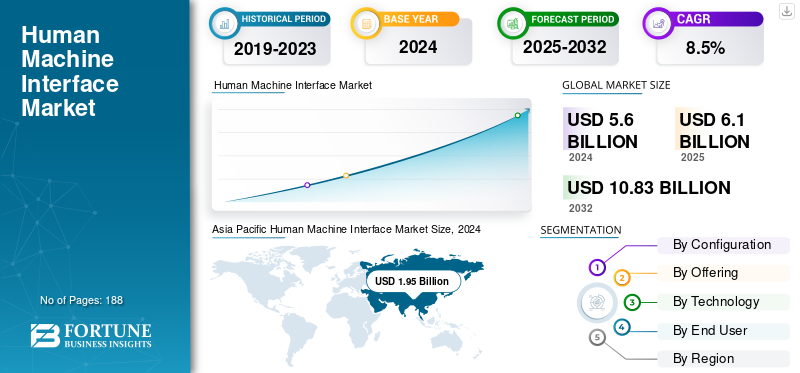
The global human machine interface market size was valued at USD 6.1 billion in 2025. The market is projected to grow from USD 6.63 billion in 2026 to USD 12.74 billion by 2034, exhibiting a CAGR of 8.5% during the forecast period. Asia Pacific dominated the human machine interface market with a market share of 35.40% in 2025.
A Human-Machine Interface (HMI) is an interface that is easy to use and enables a person to interact with a machine, computer program, or system. It serves as a dashboard where human commands are translated into machine inputs, and real-time signal data is displayed, allowing users to oversee, control, and operate efficiently in industrial and everyday applications.
The market is growing due to the advancement of automation in industry and demand for user friendly control systems to improve operational efficiency and reduce costs. Major drivers of growth are the proliferation of the Internet of Things (IoT), artificial intelligence (AI), and the advancement of touchscreen and voice recognition, and more recently, the rising need for sophisticated HMIs across sectors, including automotive, healthcare, and manufacturing, especially with the proliferation of electric and autonomous vehicles.
The top firms in the industry are ABB Ltd, Beijer Electronics Group AB, Delta Electronics, Inc., EAO AG, Emerson Electric Co., and Honeywell International Inc.
Download Free sample to learn more about this report.
Human Machine Interface Market Key Takeaways
 Market Size & Forecast
- 2025 Market Size: USD 6.10 billion
- 2026 Market Size: USD 6.63 billion
- 2034 Forecast Market Size: USD 12.74 billion
- CAGR: 8.5% from 2026–2034
 Market Share
- Asia Pacific dominated the human machine interface market with a 35.40% share in 2025.
- The embedded segment held the largest market share, generating USD 3.09 billion in revenue in 2024.
- The services segment dominated the market with revenue of USD 1.92 billion.
 Key Regional Highlights
Asia Pacific
accounted for USD 2.15 billion in 2025 and is expected to register the highest CAGR of 9.1%, driven by rapid industrial automation, smart manufacturing adoption, and digital transformation initiatives.
North America
reached USD 1.70 billion in 2025, supported by early adoption of advanced technologies and a strong industrial base across manufacturing, automotive, and energy sectors.
Europe
generated USD 1.46 billion in 2025, benefiting from growing automation investments in automotive, food & beverage, and pharmaceutical industries.
U.S
The market is projected to reach USD 1.43 billion in 2026, fueled by increasing demand for industrial automation, advanced touch and gesture-based interfaces, and Industry 4.0 implementation.
Japan
The market is projected to reach USD 0.35 billion in 2026, driven by strong manufacturing capabilities, increasing deployment of connected industrial systems, and ongoing investments in automation technologies.
Read More

MARKET DYNAMICS
Market Drivers
Growing Demand for Industrial Automation Drives Market Growth
The major forces behind the growth of the human machine interface market are increased industrial automation and efficient process management across the globe. To attract customers to new intelligent factories and digitalized processes, industries must be equipped with HMI systems, which serve as the most important link for interactive communication between humans and machines. Easy visualization, faster control, and precise monitoring of industrial operations are key features of these interfaces. Performance across manufacturing sectors is enhanced, downtime is reduced and productivity is increased as a result of the integration of HMI systems. Moreover, as companies aim for higher accuracy and fewer human errors, the implementation of HMI-based automation has been growing in use exponentially all over the globe.
Market Restraints
Cybersecurity and System Integration Issues Hamper the Market Growth
While automation technologies have been widely adopted, the market is still confronted with major problems of cybersecurity and system integration. With HMI platforms becoming increasingly interconnected via cloud and networked systems, they are vulnerable to possible data breaches, cyberattacks, and unauthorized intrusions. The risks resulting from these create hesitation to implement them, particularly in the areas that are highly dependent on the energy, manufacturing, and transportation sectors. Besides that, integrating the latest HMI technologies with existing legacy structures is generally a significant investment, requires expert technical skills, and involves long hours of downtime. Such obstacles limit the market's growth and make it evident that there is a demand for safer, interoperable, and easily deployable HMI architectures.
Market Opportunities
Expansion of Smart Manufacturing and IIoT Applications to Open Up New Opportunities
The fast development of smart manufacturing and the Industrial Internet of Things is opening up new possibilities for the HMI market. Data-driven operations have become the backbone of industries, where the need for real-time insights and predictive analytics is paramount to maintain a competitive edge. HMIs serve as a primary interface to access and comprehend the vast amount of data generated by machines, thereby enhancing managerial decision-making and operational control. With the proliferation of connected devices and cloud platforms, the demand for highly adaptable and intelligent HMIs that can facilitate remote monitoring, automated monitoring, and edge computing is on the rise, thus opening up enormous potential for innovation across different sectors.
HUMAN MACHINE INTERFACE MARKET TRENDS
Growing Adoption of Advanced Interface Technologies Emerges as a Major Market Trend
Rapid technology developments are revolutionizing the abilities of human-machine interfaces to become more smart, intuitive and user friendly. The adoption of next-generation technologies such as voice recognition, gesture control, and augmented reality allows users to communicate with machines in a natural way, hence increasing the responsiveness and reducing the need for training. Such breakthroughs are enabling different sectors to renovate their working places in a safer, more efficient, and more ergonomic way. Besides the movement toward personalized and adaptive interface designs that allow multi-device access and facilitate a hassle free industrial ecosystem is getting more and more popular. As industries move toward a better user experience and real-time collaboration, sophisticated HMI technologies are turning into the core of future automation systems.
Download Free sample to learn more about this report.
SEGMENTATION ANALYSIS
By Configuration
Widespread Adoption in Industrial Automation and Process Control Systems Boosts Embedded Segment Growth
Based on the configuration, the market is segmented into embedded, standalone, and others.
The embedded segment held the largest revenue share of USD 3.09 billion in the overall global market in the year 2024. Their widespread adoption in industrial automation and process control systems stems from their ability to offer reliable performance, compact design, and seamless integration with machinery. The growing preference for intelligent control panels and real-time data visualization further fuels the segment’s growth.
The embedded segment also holds the highest CAGR of 8.8% in the global market. The segment’s growth is attributable to the advancements in microprocessors and control systems. Increasing demand for efficient, space-saving solutions in manufacturing and automotive applications continues to fuel growth in this segment.
To know how our report can help streamline your business, Speak to Analyst
By Offering
Services Segment Dominates Market Owing to Rising Demand for System Integration and Operator Training
Based on offering, the market is divided into hardware (basic HMI, advanced panel-based HMI, advanced PC-based HMI, and others), software (on-premises HMI and cloud-based HMI), and services.
The services segment dominates with a market share of USD 1.92 billion. The segment continues to generate the major revenue due to its rising demand for system integration, maintenance, and operator training. Industries are investing heavily in service support to ensure optimized performance, minimal downtime, and enhanced user experience across HMI platforms.
Software will hold the highest market share of 34.23% in the global market in 2026. The segment’s growth is mainly due to increasing adoption of advanced visualization, analytics, and cloud-based HMI solutions. The shift toward digitalization and the Industrial Internet of Things (IIoT) is driving demand for intuitive.
By Technology
Intuitive Operation, Responsiveness, and Durability Augments the Tactile HMI Segment Growth
Based on the technology, the market is divided into tactile HMI, optical HMI, conversational HMI, bionic HMI, and others.
The tactile HMI segment will accounting for the largest market share of 46.16% in 2026. The segment remains the most prevalent technology, as touch-based interfaces continue to dominate control systems in manufacturing and process industries. Their intuitive operation, responsiveness, and durability make them ideal for industrial environments requiring precision and efficiency.
Conversational HMI represent the largest CAGR at 9.3% in the global market. The segment’s growth is attributable to the integration of voice recognition and natural language processing. The shift toward hands-free and user-friendly interaction is enhancing productivity and accessibility in both industrial and commercial applications.
By End User
Increasing Use of Digital Dashboards Augments the Automotive Segment Growth
Based on the end user, the market is divided into automotive, food and beverage, pharmaceutical, packaging, energy and utilities, and others.
The automotive industry will accounting for the largest human machine interface market share of 29.69% in 2026. The segment’s growth is attributable to the increasing use of digital dashboards, infotainment systems, and driver-assistance interfaces. The emphasis on safety, connectivity, and enhanced user experience continues to drive the adoption in both passenger and commercial vehicles.
The energy and utilities sector represent the largest CAGR at 9.4% in the global market. The segment’s growth is attributable to rising investments in smart grid systems and automated control infrastructure. The need for real-time monitoring and efficient energy management is accelerating the integration of advanced HMI solutions.
HUMAN MACHINE INTERFACE MARKET REGIONAL OUTLOOK
Geographically the market is segmented into North America, Europe, Asia Pacific, South America and Middle East & Africa.
North America
Asia Pacific Human Machine Interface Market Size, 2025 (USD Billion)
To get more information on the regional analysis of this market, Download Free sample
The North America market accounted for USD 1.7 Billion in 2025, representing 27.90% of the global industry, and is expected to reach USD 1.85 Billion in 2026. The region’s growth is attributable to early adoption of cutting-edge technologies and a strong industrial base across various sectors, including manufacturing, automotive, and energy.
The U.S. market is projected to reach USD 1.43 billion by 2026. This growth is due to the increasing demand for industrial automation, advancements in HMI technology such as touch and gesture controls, and the adoption of Industry 4.0 concepts.
Europe
Europe recorded a market size of USD 1.46 Billion in 2025, capturing 23.70% of the global market share, and is projected to reach USD 1.57 Billion in 2026. The region’s growth is attributable to the increasing demand for automation in industries such as automotive, food and beverage, and pharmaceuticals.
The UK market is projected to reach USD 0.24 billion by 2026, while the Germany market is projected to reach USD 0.41 billion by 2026.
Asia Pacific
In 2025, Asia Pacific represented USD 2.15 Billion, accounting for 35.40% of the worldwide market, and is projected to grow to USD 2.35 Billion in 2026. The region’s growth is attributable to expanding industrial automation and the strong presence of manufacturing hubs in countries such as China, Japan, and South Korea. Continuous investments in infrastructure and technology development further contribute to the region’s leading position.
At the same time, Asia Pacific is also expected to have the highest CAGR of 9.1%, further solidifying the market as the fastest growing. The region’s growth is attributable to rapid adoption of smart manufacturing and digital transformation initiatives. The increasing deployment of connected systems and user-centric interface technologies is expected to sustain this momentum in the coming years.
The Japan market is projected to reach USD 0.35 billion by 2026, while the China market is projected to reach USD 1.14 billion by 2026, and the India market is projected to reach USD 0.3 billion by 2026.
Latin America and Middle East & Africa
The markets of Latin America and Middle East & Africa are growing due to large-scale industrialization and infrastructure projects. Middle East & Africa contributed 9.30% to the global market in 2025, with a valuation of USD .58 Billion, and is projected to reach USD .62 Billion in 2026. The Latin America market was valued at USD 0.22 Billion in 2025, capturing 3.60% of global revenue, and is estimated to reach USD 0.24 Billion in 2026.
GCC countries are predicted to have a market share of USD 0.32 billion by 2025.
COMPETITIVE LANDSCAPE
Key Industry Players
Leading Firms Focus On Product Innovation and Acquisitions to Lead the Industry
The leading firms in the industry include ABB Ltd, Beijer Electronics Group AB, Delta Electronics, Inc., EAO AG, Emerson Electric Co., and Honeywell International Inc. The firms focus on strategies such as research and development (R&D), acquisitions, and product innovation to gain a competitive edge. These strategies are centered around integrating advanced technologies such as AI, machine learning, and IoT to create smarter, more intuitive, and user-friendly HMI solutions that cater to the growing demand for industrial automation.
LIST OF KEY HUMAN MACHINE INTERFACE COMPANIES PROFILED
- ABB Ltd (Switzerland)
- Beijer Electronics Group AB (Sweden)
- Delta Electronics, Inc. (Taiwan)
- EAO AG (Switzerland)
- Emerson Electric Co. (U.S.)
- Honeywell International Inc. (U.S.)
- Mitsubishi Electric Corporation (Japan)
- Omron Corporation (Japan)
- RAFI GmbH & Co. KG (Germany)
- Rockwell Automation, Inc. (U.S.)
- Schneider Electric SE (France)
- Siemens AG (Germany)
- Weintek Labs., Inc. (Taiwan)
KEY INDUSTRY DEVELOPMENTS
- November 2025 - Accuenergy Inc., a leading provider of advanced energy measurement and monitoring solutions, announced the release of the AcuHMI, a touchscreen human-machine interface (HMI) and multi-protocol gateway that streamlines data integration, real-time monitoring, and control for data center power distribution units (PDUs), industrial automation, energy management, and building automation applications.
- October 2025- NTX Embedded, a leader in embedded display and control solutions, announced the launch of its Octolux® Industrial HMI Platform, a next-generation industrial Human-Machine Interface (HMI) platform engineered to simplify design, speed development, and extend product lifecycles.
- August 2025- Mitsubishi Electric announced the global launch of its GOT3000 Human-Machine Interface (HMI), which is designed to support the manufacturing sector’s accelerating digital transformation (DX) with powerful new capabilities that enhance connectivity, usability, and system integration.
- February 2025- Unity, the leading platform to create and grow games and interactive experiences, announced it has been selected by Toyota Motor Corporation to develop the Graphical User Interface (GUI) for Toyota’s next-generation in-car Human Machine Interface (HMI), elevating the in-car experience.
- February 2025- VI-grade announced the launch of its COMPACT HMI Simulator, a tool designed to enhance the development, evaluation, and testing of Human-Machine Interface systems in vehicle interiors.
- July 2024- Bosch Packaging Technology introduced its next gen Human Machine Interface HMI 4.0, suited for both stand-alone machines and entire lines. It provides an interface for data collection, data sharing and visualization and Bosch will successively equip all new machines of its processing and packaging units with the HMI 4.0.
REPORT COVERAGE
The global report provides a detailed analysis of the market and focuses on key aspects such as prominent companies, deployment modes, types, and end users of the product. Besides this, it offers insights into the human machine interface market trends and highlights key industry developments and market share analysis for key companies. In addition to the aforementioned factors, the report encompasses several factors that have contributed to the growth of the market over recent years.
Request for Customization to gain extensive market insights.
Report Scope & Segmentation
|
ATTRIBUTE |
DETAILS |
|
Study Period |
2021-2034 |
|
Base Year |
2025 |
|
Estimated Year |
2026 |
|
Forecast Period |
2026-2034 |
|
Growth Rate |
CAGR of 8.5% from 2026-2034 |
|
Historical Period |
2021-2024 |
|
Unit |
Value (USD Billion) |
|
Segmentation |
By Configuration, Offering, Technology, End User, and Region |
|
By Configuration |
|
|
By Offering |
|
|
By Technology |
|
|
By End User |
|
|
By Region |
|
Frequently Asked Questions
Fortune Business Insights says that the global market stood at USD 6.1 billion in 2025 and is projected to reach USD 12.74 billion by 2034.
The market is expected to exhibit steady growth at a CAGR of 8.5% during the forecast period.
Rising demand for industrial automation is speeding up the market growth.
ABB Ltd, Beijer Electronics Group AB, Delta Electronics, Inc., EAO AG, Emerson Electric Co., and Honeywell International Inc are some of the top players in the market.
The Asia Pacific region held the largest market share.
Asia Pacific was valued at USD 2.15 billion in 2025.


- 2021-2034
- 2025
- 2021-2024
- 188
Get 30-60 hrs Free Customization
Expand Regional and Country Coverage, Segments Analysis, Company Profiles, Competitive Benchmarking, and End-user Insights.















-
US +1 833 909 2966 ( Toll Free )
-
Get In Touch With Us