Human Organoids Market Size, Share & Industry Analysis, By Product (Organoid Models and Supplements, Media & Reagents), By Application (Drug Discovery & Development, Disease Modeling, Personalized Medicine, and Others), By Model Type (Brain Model, Liver Model, Intestinal Model, Lung Model, Pancreatic Model, and Others), By End-user (Pharmaceutical & Biotechnology Companies, Contract Research Organizations (CROs), Academic & Research Institutes, and Others), and Regional Forecast, 2026-2034
 Download Free Sample
KEY MARKET INSIGHTS
 Listen to Audio Version
The global human organoids market size was valued at USD 1.18 billion in 2025 and is projected to grow from USD 1.44 billion in 2026 to USD 5.71 billion by 2034, exhibiting a CAGR of 18.8% during the forecast period. North America dominated the global human organoids market with a share of 41.52% in 2025.
Human organoids are 3D, self-organizing mini-tissues grown from stem cells or patient samples that reproduce key structural and functional features of real organs. They are used to study disease biology, test the efficacy of drugs, assess toxicity, and support precision medicine. The market growth is attributed to increasing investments in organoid-based drug discovery and collaboration between pharmaceutical companies, biotechnology firms, and academic institutes.
Furthermore, Thermo Fisher Scientific Inc., Crown Bioscience (Danaher), and Corning Incorporated held the largest market share, driven by increasing investments and strategic initiatives, such as collaborations and partnerships.
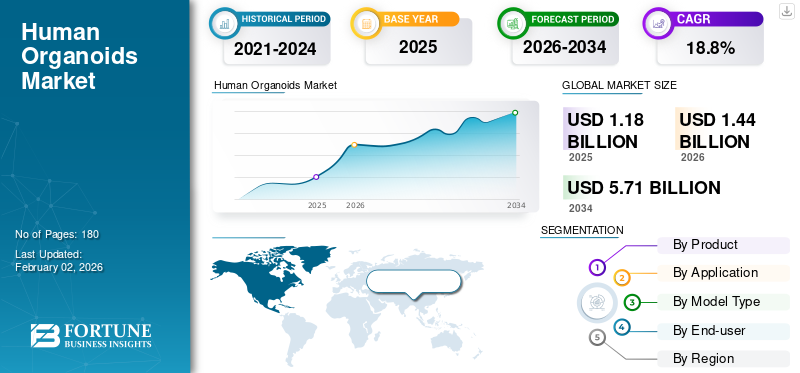
Download Free sample to learn more about this report.
Human Organoids Market Key Takeaways
 Market Size & Forecast
- 2025 Market Size: USD 1.18 billion
- 2026 Market Size: USD 1.44 billion
- 2034 Forecast Market Size: USD 5.71 billion
- CAGR: 18.80% from 2026–2034
 Market Share
- North America dominated the human organoids market with a 41.52% share in 2025.
- The Drug Discovery & Development segment is projected to hold a 46.4% market share in 2026.
- The Brain Model segment is projected to hold a 25.7% market share in 2026.
 Key Regional Highlights
North America
North America held a 41.52% share in 2025, valued at USD 0.49 billion.
Asia Pacific
Asia Pacific is projected to reach USD 0.36 billion by 2026, ranking as the third-largest regional market.
Europe
Europe is projected to reach USD 0.44 billion by 2026 and is expected to be the second-largest regional market.
U.S.
The market projected to reach USD 0.55 billion by 2026.
Japan
The market projected to reach USD 0.10 billion by 2026.
Read More

HUMAN ORGANOIDS MARKET TRENDS
Automation, Partnerships, and Scale-Up to Emerge as a Key Market Trend
Currently, there has been an increasing automation, standardized workflows, and partnerships that turn organoids into scalable products rather than modified research projects. As a result, the innovation efforts in organoid development, as well as newer automation collaborations such as HeartBeat.bio, which utilizes molecular devices to automate or scale cardiac organoids, are becoming central to commercialization.
- For instance, in April 2021, Molecular Devices, LLC. opened an Organoid Innovation Center at its San Jose headquarters to streamline 3D organoid workflows from culturing to screening with automated imaging and analysis.
Moreover, key players are launching assay-ready organoid products designed for screening workflows, reflecting demand for “plug-and-play” organoids rather than custom differentiation every time.
Download Free sample to learn more about this report.
MARKET DYNAMICS
MARKET DRIVERS
Advancements in Stem Cell Research to Fuel Market Expansion
In recent years, stem cell science innovations have significantly transformed the fidelity and functionality of organoids. Such breakthroughs are overcoming the organoid viability limitations of being restricted to a few millimeters, thereby opening up more physiologically relevant disease models.
Additionally, the vascularized organoids are enhancing tissue modeling and drug screening, thereby accelerating adoption in pharmaceutical R&D, personalized medicine, and regenerative medicine, which is expected to drive the global human organoids market growth.
- For instance, in June 2025, Stanford University researchers in the U.S. developed the first lab-grown heart and liver organoids with their own blood vessels, which allowed mini-organs to grow larger and more mature for advanced disease modeling and regenerative therapies.
MARKET RESTRAINTS
High Development and Maintenance Costs of Organoid Model to Restrict Market Growth
In recent years, the high development and maintenance costs of organoid models are expected to limit their adoption globally. Most often, the 3D models require expensive specialty reagents such as complex bioreactors and proprietary growth media.
- For instance, according to the National Center for Biotechnology Information (NCBI), as of March 2023, the cost of 50 ml of conventional culture medium is approximately USD 646, making organoid experiments extremely expensive.
These costs are limiting their adoption in resource-constrained companies, especially small and mid-sized labs for drug discovery and other applications. Such a scenario is projected to slow down the market expansion in the forthcoming years.
MARKET OPPORTUNITIES
Integration of Artificial Intelligence (AI) to Create Significant Growth Opportunities
In recent years, several advancements, including multi-omics, high-throughput screening (HTS), and the integration of AI with organoid models, have demonstrated transformative potential for biomedical research.
Innovations such as the high-throughput bioreactors for scalable organoid production, paired with label-free imaging systems, are scaling up drug screening, increasing reproducibility, and advancing personalized medicine through patient-derived organoids. This is further anticipated to offer lucrative opportunities for human organoids in personalized medicine and regenerative treatment.
- For instance, during September 2023-October 2024, researchers at Karolinska Institutet, with funding support from Vinnova, developed a high-throughput bioreactor integrated with an AI-driven, label-free imaging platform to enable scalable organoid production and non-invasive drug screening.
MARKET CHALLENGES
Ethics, Data Interpretation, and Translational Validation to Challenge Market Expansion
Ethical governance limitations in capturing full systemic biology and the need for rigorous translational validation linking organoid readouts to real patient outcomes pose major challenges.
Moreover, in several conditions, interpretation can be complex, depending heavily on matrix chemistry, media supplements, and maturity stage, which is also anticipated to challenge the market growth over the forthcoming period.
Segmentation Analysis
By Product
Increasingly Growing Demand for Supplements, Media & Reagents to Drive Segment Growth
Based on product, the market is segmented into organoid models and supplements, media & reagents.
The supplements, media & reagents segment accounted for the largest global human organoids market share in 2025. The labs are increasingly adopting organoids for routine screening, and the demand for media & reagents is growing faster to maintain the models. Additionally, there is an increasing collaboration among pharmaceutical companies, universities, and hospitals for drug development using organoid technology, further driving the adoption of supplements, media & reagents.
- For instance, in February 2023, Danaher initiated a multi-year strategic partnership with Cincinnati Children's Hospital Medical Center to enhance patient safety in early drug development through advanced liver organoid technology, enabling superior drug toxicity screening.
In addition, the organoid models segment is estimated to expand at a CAGR of 18.9% over the forecast period.
To know how our report can help streamline your business, Speak to Analyst
By Application
Increasing Drug Discovery & Development Globally to Drive Segment’s Growth
By application, the market is categorized into drug discovery & development, disease modeling, personalized medicine, and others.
The drug discovery & development segment accounted for the largest market share in 2025. The segment’s growth is attributed to increasing drug discovery & development efforts by pharmaceutical companies, which are driving the utilization of organoids. Moreover, the segment is projected to hold a 46.4% share in 2026.
Additionally, the personalized medicine segment is estimated to grow at a CAGR of 19.4% during the forecast period.
By Model Type
Increasing Prevalence of Neurological Diseases to Accelerate Brain Model Segment
By model type, the market is classified into brain model, liver model, intestinal model, lung model, pancreatic model, and others.
The brain model segment accounted for the major market share in 2025. Brain models are supporting neurodevelopment studies, infection effects, neurotoxicity, and neurodegenerative research where human-specific pathways matter. As a result, the increasing prevalence of neurological diseases is driving the demand for brain models, which is expected to augment the segment’s growth. Moreover, the segment is projected to hold a 25.7% share in 2026.
- For instance, in August 2023, World Health Organization (WHO) data shows Parkinson's disease (PD) impacted more than 8.5 million people worldwide in 2019, a figure that has doubled over the previous 25 years.
Additionally, the pancreatic model segment is estimated to grow at a CAGR of 19.4% during the forecast period.
By End-user
High Number of Pharmaceutical & Biotechnology Companies to Propel Segment Growth
On the basis of end-user, the market is classified into pharmaceutical & biotechnology companies, contract research organizations (CROs), academic & research institutes, and others.
In 2025, pharmaceutical & biotechnology companies dominated the market by end-users. The segment’s growth is attributed to a significant number of pharmaceutical & biotechnology companies, which are increasing the drug discovery and development trials, driving the utilization of human organoids. Furthermore, the segment is set to hold 48.4% share in 2026.
- For instance, the Organization for Economic Co-operation and Development (OECD) reported that there were 2,840 active biotechnology firms worldwide in 2021, increasing to 3,040 by 2022.
In addition, the contract research organizations (CROs) segment is projected to grow at a CAGR of 19.1% during the forecast period.
Human Organoids Market Regional Outlook
Based on region, the market is classified into North America, Europe, Asia Pacific, Latin America, and the Middle East & Africa.
North America
[fTCqRvCtoj]
North America held the largest revenue share in 2024, at USD 0.38 billion, and is expected to reach USD 0.49 billion in 2025. The growth is primarily driven by increasing investments in stem cell research and the presence of major pharmaceutical & biotechnology companies, which are expected to increase innovation in human organoid technology.
- For instance, in August 2022, research teams at the University of Colorado Anschutz Medical Campus and Albert Einstein College of Medicine in the U.S. were selected as winners of the final phase of the NIH’s 3D Retinal Organoid Challenge (3D ROC) after successfully developing physiologically functional retinal organoids that replicate critical cellular characteristics of the human retina.
U.S Human Organoids Market
In 2026, the U.S. market is forecasted to represent USD 0.55 billion, capturing 38.2% of total global revenue.
Europe
Europe is expected to achieve an 18.2% growth rate in the coming years, the second-highest globally, reaching USD 0.44 billion by 2026. The growth is attributed to deep academic expertise, public-private collaborations, and early regulatory acceptance of alternative testing models.
U.K Human Organoids Market
The U.K. market is projected to reach USD 0.13 billion by 2026, accounting for 9.0% of the global market revenue.
Germany Human Organoids Market
Germany's market is forecasted to reach about USD 0.08 billion by 2026, representing roughly 5.7% of global revenue.
Asia Pacific
In 2026, the Asia Pacific human organoids market is predicted to be valued at USD 0.36 billion, ranking as the third-largest globally.
Japan Human Organoids Market
Japan is projected to generate approximately USD 0.10 billion in revenue by 2026, contributing nearly 7.1% to the global market.
China Human Organoids Market
China’s market is forecast to reach approximately USD 0.15 billion by 2026, contributing about 10.1% to global revenues.
India Human Organoids Market
India is forecast to contribute approximately USD 0.03 billion to the market by 2026, corresponding to about 2.0% of global revenues.
Latin America and Middle East & Africa
Both Latin America and the Middle East & Africa are anticipated to witness moderate market growth, with Latin America expected to reach around USD 0.03 billion by 2026. The growth is attributed to the increasing focus of pharmaceutical companies and CROS to enter these regions for R&D purposes.
GCC Human Organoids Market
By 2026, the GCC is expected to generate approximately USD 0.08 billion in the market, accounting for nearly 0.8% of global revenues.
COMPETITIVE LANDSCAPE
Key Industry Players
Diversified Product Offerings to Strengthen Market Position of Prominent Players
In 2025, Thermo Fisher Scientific Inc., Crown Bioscience (a Danaher company), and Corning Incorporated held the major share of the global market. This share is mainly due to a strong portfolio of cell culture media, reagents, and organoid models.
Moreover, global manufacturing scale, trusted quality standards, and deep penetration into pharmaceutical, biotech, and academic laboratories are also supporting the position of these companies. Other major players, including STEMCELL Technologies and HUB Organoids, among others, are focusing on material science innovation and compatibility across multiple organoid types.
LIST OF KEY HUMAN ORGANOIDS COMPANIES PROFILED
- STEMCELL Technologies (Canada)
- Crown Bioscience (Danaher) (U.S.)
- HUB Organoids (Netherlands)
- Thermo Fisher Scientific Inc. (U.S.)
- DefiniGEN Limited (U.K.)
- 3Dnamics (U.S.)
- Corning Incorporated (U.S.)
- Organovo Holdings Inc. (U.S.)
- Emulate (U.S.)
KEY INDUSTRY DEVELOPMENTS
- October 2025: Creative Diagnostics launched its OGN Tumor-Derived Organoid Culture Kit, offering optimized protocols for culturing organoids from various tumor tissues, including colorectal, gastric, and breast cancers.
- September 2025: Pluristyx and Solesis signed a Memorandum of Understanding to collaborate on standardized organoid kits using Solesis' Hydralese biomaterials and Pluristyx's iPSC and PluriForm technology.
- June 2025: Pluristyx launched the PluriForm Organoid Kit, providing a turnkey solution with ready-to-differentiate iPSCs to generate thousands of uniform pluripotent aggregates in one day.
- October 2022: HeartBeat.bio AG and Molecular Devices, LLC announced a co-development agreement to automate and scale cardiac organoids (Cardioids) for high-throughput screening in drug discovery.
- February 2021: Zentalis Pharmaceuticals, Inc. announced a strategic collaboration with Tempus to utilize Tempus' patient-derived organoid platform for enhancing Zentalis' oncology research capabilities.
REPORT COVERAGE
The report provides an in-depth analysis of all market segments, highlighting key drivers, trends, opportunities, restraints, and challenges. It also provides insights into technological advancements, key industry developments, company market share analysis, and profiles of leading companies.
Request for Customization to gain extensive market insights.
Report Scope & Segmentation
|
ATTRIBUTE |
DETAILS |
|
Study Period |
2021-2034 |
|
Base Year |
2025 |
|
Estimated Year |
2026 |
|
Forecast Period |
2026-2034 |
|
Historical Period |
2021-2024 |
|
Growth Rate |
CAGR of 18.8% from 2026-2034 |
|
Unit |
Value (USD Billion) |
|
Segmentation |
By Product, Application, Model Type, End-user, and Region |
|
By Product |
|
|
By Application |
|
|
By Model Type |
|
|
By End-user |
|
|
By Region |
North America (By Product, Application, Model Type, End-user, and Country)
Europe (By Product, Application, Model Type, End-user, and Country/Sub-region)
Asia Pacific (By Product, Application, Model Type, End-user, and Country/Sub-region)
Latin America (By Size, Procedure, End-user and Country/Sub-region)
Middle East & Africa (By Product, Application, Model Type, End-user, and Country/Sub-region)
|
Frequently Asked Questions
Fortune Business Insights says that the global market value stood at USD 1.18 billion in 2025 and is projected to reach USD 5.71 billion by 2034.
In 2025, the market value stood at USD 0.49 billion.
The market is expected to exhibit a CAGR of 18.8% during the forecast period.
The supplements, media & reagents segment led the market by product.
The key factors driving the market are advancements in stem cell research, expanding drug discovery & development applications, and others.
Thermo Fisher Scientific Inc., Crown Bioscience (a Danaher company), and Corning Incorporated are some of the major players in the market.
North America dominated the market in 2025.



- 2021-2034
- 2025
- 2021-2024
- 180
Get 30-60 hrs Free Customization
Expand Regional and Country Coverage, Segments Analysis, Company Profiles, Competitive Benchmarking, and End-user Insights.













.webp)






Related Reports
-
US +1 833 909 2966 ( Toll Free )
-
Get In Touch With Us