Organs-On-Chips Market Size, Share & Industry Analysis by Offering (Products {Devices and Consumables & Accessories} and Services), By Organ Model (Liver-on-a-Chip, Lung-on-a-Chip, Intestine-on-a-Chip, Kidney-on-a-Chip, and Others), By Application (Drug Discovery & Development, Toxicology Research, Disease Modeling, and Others), By End-user (Pharmaceutical & Biotechnology Companies, Academic & Research Institutes, and Others), and Regional Forecast, 2026-2034
 Download Free Sample
KEY MARKET INSIGHTS
 Listen to Audio Version
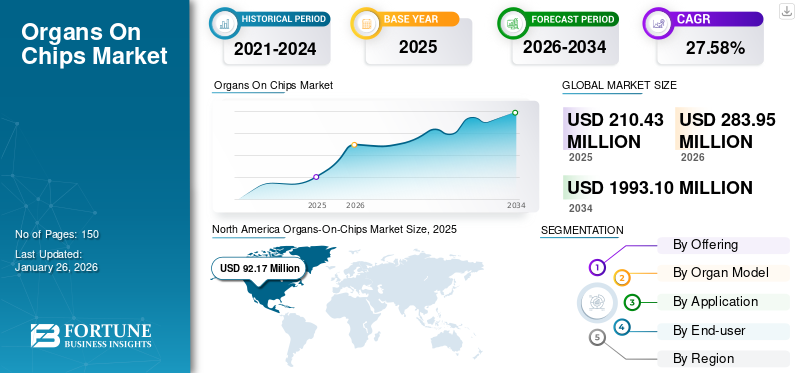
The global organs-on-chips market size was valued at USD 210.43 million in 2025 and is projected to grow from USD 283.95 million in 2026 to USD 1,993.10 million by 2034, exhibiting a CAGR of 27.58% during the forecast period. North America dominated the Organs On Chips Market with a market share of 43.80% in 2025.
Organ-on-a-chip, a microengineered device with living cells in microfluidic channels, offers a stimulation to the physiological functioning of organs in the human body. These chips are useful in research and testing as they mimic fluid flow, tissue interfaces, and mechanical forces for replicating the behavior of real organs. Furthermore, they can model human responses without the deployment of animal testing. The chip adoption is surging with the mounting demand for more accurate, cost-effective, ethical alternatives to animal testing in the areas of toxicity studies and drug development. This is expected to fuel market growth.
Furthermore, the market is dominated by Emulate, MIMETAS, InSphero, and CN Bio. These players have a significant focus on increasing product reach to key countries. This is expected to help them capture a major portion of the market.
Download Free sample to learn more about this report.
Organs On Chips MARKET KEY TAKEAWAYS
 Market Size & Forecast
- 2025 Market Size: USD 210.43 million
- 2026 Market Size: USD 283.95 million
- 2034 Forecast Market Size: USD 1,993.10 million
- CAGR: 27.58% from 2026–2034
 Market Share
- North America dominated the organs-on-chips market with a 43.80% share in 2025.
- The services segment accounted for 57.01% of the market share in 2026.
- The liver-on-a-chip segment held a 36.64% market share in 2026.
 Key Regional Highlights
North American
North America reached USD 121.85 million in 2026, driven by strong pharmaceutical R&D investments and strategic partnerships.
Europe
Europe is projected to reach USD 73.12 million in 2026, supported by extensive academic and biomedical research activities.
Asia Pacific
Asia Pacific is projected to reach USD 72.74 million in 2026, driven by expanding life sciences research and biotechnology investments.
U.S.
The market is projected to reach USD 115.36 million in 2026, supported by increasing adoption of organ-on-chip technologies in drug development.
Japan
The market is projected to reach USD 14.87 million in 2026, driven by growing investments in biomedical research and precision medicine.
Read More

MARKET DYNAMICS
MARKET DRIVERS
Increasing Demand for Predictive Preclinical Models to Propel the Market Growth
Biotech and pharma companies have been seen adopting organ-on-chip systems at a rising rate owing to the provision of human-relevant and highly predictive data compared to traditionally used animal models or 2D cell cultures. These microfluidic platforms improve the predictability of toxicity and drug efficacy analyses as they streamline the research process by replicating the physiology of real organs. The technology enables the identification of ineffective and unsafe compounds at an early stage and even though the R&D costs in general and clinical failure rates are high, it helps save resources and time during the drug development process. This inclination toward reliability and precision in the area of preclinical testing is anticipated to propel the global organs-on-chips market growth over the forthcoming years.
- For instance, Emulate’s Liver-Chip S1 has been accepted into the FDA’s ISTAND pilot program, marking a major milestone toward regulatory qualification of Organ-Chip technologies for drug safety testing. The tool demonstrated up to 87% sensitivity and 100% specificity in predicting drug-induced liver injury, paving the way for more human-relevant, reliable preclinical drug assessment models.
MARKET RESTRAINTS
High Development and Implementation Costs to Hamper Market Expansion
The widespread adoption of organ-on-chip devices is limited by the high cost involved in their design, fabrication, and validation. The integration of advanced microfluidic sensors, systems, sensors, and human-derived cells increases the demand for specialized infrastructure and expertise. However, small biotech companies and academic labs often encounter difficulties when it comes to standardizing or affording these technologies.
Additionally, a lack of universal protocols has increased costs and slowed regulatory acceptance. These financial and technical barriers are hindering the scaling up of production and establishing consistent performance across devices, thereby impeding market growth.
MARKET OPPORTUNITIES
Expansion into Personalized Medicine Applications to Offer Lucrative Growth Opportunities
Recently, organ-on-chip technology has offered tremendous potential for creating patient-specific disease models using cells derived from individual patients. This capability has allowed researchers to test different responses in patients to the same drugs. This is paving the way for tailored treatment approaches. Moreover, the increasing demand for precision medicine is also supporting the adoption of organ-on-chip platforms, which can bridge the gap between genomics and clinical response, thereby providing functional insights about the behavioral aspects of various therapies in diverse genetic and physiological contexts. In addition, the growing adoption of induced pluripotent stem cells (iPSCs) is further enhancing this opportunity, enabling chips to represent real patient biology. As a result, researchers are developing the liver-on-a-chip model incorporating iPSC-derived hepatocytes.
- For instance, in April 2023, researchers affiliated with the Drug Discovery Institute and the Department of Computational and Systems Biology at the University of Pittsburgh, Pennsylvania, created an effective static, plate-based liver-on-a-chip model incorporating iPSC-derived hepatocytes, macrophages, and endothelial cells to evaluate drug toxicity.
ORGANS-ON-CHIPS MARKET TRENDS
Integration of AI with Multi-Organ Systems to Emerge as a Key Market Trend
The integration of organs-on-chips platforms with artificial intelligence (AI) and multi-organ “organ-on-a-chip” configurations is a significant trend in the market. AI algorithms can help enable the predictive modeling of human pharmacokinetics and disease progression, given their potential to analyze large datasets from chip experiments. More inclusive simulation of systemic drug responses has been enabled through the combination of multiple organ models, such as the gut-brain or liver-heart. This integration provides way for supporting more data-driven and faster and decision-making in the areas of toxicology, drug development, and precision healthcare research.
- For instance, in October 2025, CN Bio launched PhysioMimix Core, an all-in-one multi-organ-on-a-chip system integrated into a single microphysiological system (MPS). This platform supports validated performance across single-organ, multi-organ, and high-throughput configurations, enabling researchers to recreate complex human physiology in vitro with ease and scalability.
MARKET CHALLENGES
Regulatory Validation and Standardization Issues to Challenge Market Growth
In recent years, the lack of standardized validation guidelines is expected to pose a major challenge for market growth. Regulatory bodies, such as the FDA and EMA, have not yet fully established frameworks for integrating organ-on-chip data into drug approval processes. This discourages pharmaceutical companies from heavily investing in the technology for pivotal studies.
Moreover, the reproducibility across different platforms and laboratories remains inconsistent, complicating cross-study comparison and acceptance. This is expected to challenge the market expansion during the forecast period.
Download Free sample to learn more about this report.
Segmentation Analysis
By Offering
Increasing Outsourcing for Drug Discovery and Other Applications by Research Institutions & Pharma Companies Fueled Segmental Growth
On the basis of segmentation by offering, the market is classified into products and services. Furthermore, the product segment is sub-classified into devices and consumables & accessories.
To know how our report can help streamline your business, Speak to Analyst
The services segment is projected to dominate the global organs-on-chips market share with 57.01% in 2026. Several research institutions and pharmaceutical companies are opting for contract research or testing services offered by organ-on-chip providers, which deliver ready-to-use data packages for toxicity, drug efficacy, and disease modeling. This reduces setup costs, accelerates R&D, and ensures access to validated chip platforms and regulatory-grade data.
- In January 2024, CN Bio and Altis Biosystems announced a strategic partnership to develop a next-generation human gut/liver in vitro model, aiming to improve ADME (absorption, distribution, metabolism, and excretion) studies. This collaboration combines Altis’s RepliGut Planar-Jejunum gut model with CN Bio’s PhysioMimix liver-on-a-chip, creating an integrated multi-organ system that more accurately mimics oral drug administration and enhances the predictability of human drug bioavailability.
In addition, the product segment is projected to grow at a CAGR of 30.2% during the forecast period.
By Organ Model
High Significance of CGE in Nucleic Acid Analysis to Drive the Segment’s Growth
Based on the organ model, the market is segmented into liver-on-a-chip, lung-on-a-chip, intestine-on-a-chip, kidney-on-a-chip, and others.
By organ model, the liver-on-a-chip segment will account for the largest share of 36.64% in 2026. The liver is the most common site of drug-induced toxicity, responsible for a significant proportion of clinical trial failures and drug withdrawals. As a result, accurate liver models are crucial for predicting human-specific drug metabolism and hepatotoxicity. This is driving the need for the development of advanced liver-on-chips, which is expected to contribute to the segment's growth.
In addition, the lung-on-a-chip segment is projected to grow at a CAGR of 30.0% during the forecast period.
By Application
Rapid Expansion of Drug Discovery & Development Services by Organ-on-Chip Providers Propelled Segment Growth
Based on application, the market is segmented into drug discovery & development, toxicology research, disease modeling, and others.
By application, the drug discovery & development segment is projected to account for the largest share of 52.89% in 2026. The segment's growth is attributed to the increasing focus of organs-on-chips service providers on expanding drug discovery & development services, thereby improving R&D efficiency, reducing costs, and enhancing the predictive accuracy of clinical studies.
- For instance, in January 2021, Emulate announced an expanded application and services roadmap for its organ-on-a-chip technology, extending its use from small molecules to advanced biologics and gene therapies, addressing complex human biology and immune responses to improve drug development.
In addition, the disease modeling segment is projected to grow at a CAGR of 30.5% during the forecast period.
By End-user
Significant Number of Pharmaceutical & Biotechnology Companies Globally to Drive the Segment Growth
Based on end-user, the market is segmented into pharmaceutical & biotechnology companies, academic & research institutes, and others.
In 2024, the global market was dominated by pharmaceutical & biotechnology companies in terms of end-user. The growth is attributed to the significant number of pharmaceutical & biotechnology companies, utilizing organs-on-chips systems for drug discovery & development, which is increasing its demand and encouraging key players to innovate advanced systems. Furthermore, the segment will hold 55.49% share in 2026.
In addition, the academic & research institutes segment is projected to grow at a CAGR of 30.3% during the forecast period.
Organs-On-Chips Market Regional Outlook
By geography, the market is categorized into North America, Europe, Asia Pacific, Latin America, and Middle East & Africa.
North America
North America Organs-On-Chips Market Size, 2025 (USD Million) To get more information on the regional analysis of this market, Download Free sample
The North America market generated USD 92.17 million in 2025, representing 43.80% of the global market landscape, and is expected to reach USD 121.85 million in 2026. The growth is primarily driven by higher investments in research and development by pharmaceutical & biotechnology companies in the U.S., which is fueling the demand for organs-on-chips systems and attracting several key players to expand their product and service offerings. Moreover, key companies are increasingly entering into partnerships to enhance the research & development scenario in the region, which is expected to increase the utilization of organ-on-chip technology further. In 2026, the U.S. market is estimated to have reached USD 115.36 million.
- For instance, in June 2025, Hesperos, Inc. partnered with biopharmaceutical company Psilera to accelerate the preclinical development of Psilera's lead neuroplastogen compound, PSIL-006, targeting frontotemporal dementia (FTD).
Europe and Asia Pacific
Other regions, such as Europe and the Asia Pacific, are projected to grow at a substantial rate during the forecast period. Over 2025-2032, the Europe contributed 25.94% to the global market in 2025, with a valuation of USD 54.58 million, and is projected to reach USD 73.12 million in 2026. The region’s growth is mainly due to significant studies being conducted in the academic & research institutes in countries such as the U.K., and Germany. Due to such factors, countries including U.K., and Germany are projected to record the valuation of USD 18.33 million, and USD 17.05 million respectively, in the year 2026, while France is projected to record the valuation of USD 7.4 million in 2025.
Following Europe, the market in the Asia Pacific accounted for USD 51.73 million in 2025, representing 24.58% of the global market share, and is projected to reach USD 72.74 million in 2026 and emerge as the third-largest region in the global market. In the region, India, China, and Japan are estimated to reach the valuation of USD 9.16 million, USD 24.39 million, and USD 14.87 million respectively, in 2026.
Latin America and the Middle East & Africa
During the forecast period, Latin America and Middle East & Africa regions are set to depict moderate growth. Latin America contributed approximately USD 7.13 million to the global market in 2025, accounting for 3.39% share, and is expected to reach USD 9.75 million in 2026. The growth is primarily due to the increasing partnerships between service providers and regional companies to support research studies. In 2025, Middle East & Africa held 2.29% of the global market, reaching a valuation of USD 4.82 million, and is projected to grow to USD 6.48 million in 2026.
COMPETITIVE LANDSCAPE
Key Industry Players
Strong Focus on Service Expansions and Partnerships Strengthened the Position of Prominent Players
In 2024, Emulate, MIMETAS, and InSphero collectively held the largest organs-on-chips market share. These companies are partnering with CROs, pharmaceutical companies, and research institutions, which is expected to strengthen their product and service reach globally in the upcoming years.
Other prominent companies, including CN Bio, TissUse, AIM Biotech, and others, are increasing investments to expand their offerings and focusing on the development of advanced organ-on-chip systems to capture a significant market share in the forthcoming years.
LIST OF KEY ORGANS-ON-CHIPS COMPANIES PROFILED
- Emulate (U.S.)
- MIMETAS B.V. (U.S.)
- InSphero (Switzerland)
- SynVivo, Inc. (U.S.)
- CN Bio Innovations Ltd (U.K.)
- TissUse GmbH (Germany)
- BICO (Sweden)
- AlveoliX AG (Switzerland)
- BiomimX S.r.l. (Italy)
- AIM Biotech (Singapore)
KEY INDUSTRY DEVELOPMENTS
- October 2025: CN Bio Innovations Ltd. launched PhysioMimix Core, the first all-in-one Organ-on-a-Chip (OOC) system, delivering validated performance across single-organ, multi-organ, and high-throughput configurations within a single microphysiological system.
- September 2025: The Royal Veterinary College (RVC) partnered with Emulate to develop organ-on-a-chip models, pioneering veterinary & preclinical applications and expanding access to this technology for research.
- February 2025: Xellar Biosystems entered into a sponsored research collaboration with Sanofi (via its iDEA-TECH Awards) to develop OOC models for vascular toxicity assessment.
- January 2025: PhenoVista Biosciences, a CRO, partnered with NETRI, an organ-on-chip device manufacturer, to combine PhenoVista's high-content imaging assays with NETRI’s organ-on-chip devices to offer improved functional, scalable assay services for drug development.
- September 2024: Emulate unveiled the Chip-R1 Rigid Chip, engineered with minimally drug-absorbing plastics to enhance accuracy in ADME (absorption, distribution, metabolism, and excretion) and toxicology applications.
REPORT COVERAGE
Request for Customization to gain extensive market insights.
Report Scope & Segmentation
|
ATTRIBUTE |
DETAILS |
|
Study Period |
2021-2034 |
|
Base Year |
2025 |
|
Estimated Year |
2026 |
|
Forecast Period |
2026-2034 |
|
Historical Period |
2021-2024 |
|
Growth Rate |
CAGR of 27.58% from 2026-2034 |
|
Unit |
Value (USD Million) |
|
Segmentation |
By Offering, Organ Model, Application, End-user, and Region |
|
By Offering |
· Products o Organ-on-Chip Devices o Consumables & Accessories · Services |
|
By Organ Model |
· Liver-on-a-Chip · Lung-on-a-Chip · Intestine-on-a-Chip · Kidney-on-a-Chip · Others |
|
By Application |
· Drug Discovery & Development · Toxicology Research · Disease Modeling · Others |
|
By End-user |
· Pharmaceutical & Biotechnology Companies · Academic & Research Institutes · Others |
|
By Geography |
· North America (By Offering, Organ Model, Application, End-user, and Country) o U.S. o Canada · Europe (By Offering, Organ Model, Application, End-user, and Country/Sub-region) o Germany o U.K. o France o Spain o Italy o Scandinavia o Rest of Europe · Asia Pacific (By Offering, Organ Model, Application, End-user, and Country/Sub-region) o China o Japan o India o Australia o Southeast Asia o Rest of Asia Pacific · Latin America (By Offering, Organ Model, Application, End-user, and Country/Sub-region) o Brazil o Mexico o Rest of Latin America · Middle East & Africa (By Offering, Organ Model, Application, End-user, and Country/Sub-region) o GCC o South Africa o Rest of the Middle East & Africa |
Frequently Asked Questions
Fortune Business Insights says that the global market value stood at USD 283.95 million in 2026 and is projected to reach USD 1,993.10 million by 2034.
In 2025, the market value stood at USD 210.43 million.
The market is expected to exhibit a CAGR of 27.58% during the forecast period of 2026-2034.
The services segment led the market by offering in 2025.
The key factors driving the market are the increasing number of research and development initiatives and the growing presence of pharmaceutical & biotechnology companies.
Emulate, MIMETAS, and InSphero are some of the prominent players in the market.
North America dominated the market in 2025.



- 2021-2034
- 2025
- 2021-2024
- 150
Get 30-60 hrs Free Customization
Expand Regional and Country Coverage, Segments Analysis, Company Profiles, Competitive Benchmarking, and End-user Insights.













.webp)






Related Reports
-
US +1 833 909 2966 ( Toll Free )
-
Get In Touch With Us