HVAC Electronically Commutated Motor (ECM) Market Size, Share & COVID-19 Impact Analysis, By Motor Type (Brushless DC Motor, Permanent Magnet AC (PMAC) Motors, and Servo Motors), By Product Type (Constant Air Flow, Constant Torque, and Constant Speed), By Application (Residential, Commercial, and Industrial) and Regional Forecasts, 2021-2028
 Download Free Sample
KEY MARKET INSIGHTS
 Listen to Audio Version
The global HVAC electronically commutated motor (ECM) market size was USD 7.10 billion in 2020. The global impact of COVID-19 has been unprecedented and staggering, with the HVAC ECM systems witnessing a negative demand shock across all regions amid the pandemic. Based on our analysis, the market exhibited a decline of -13.35% in 2020. The market is projected to grow from USD 7.89 billion in 2021 to USD 13.13 billion in 2028 at a CAGR of 7.5% during the 2021-2028 period. Asia Pacific dominated the global market with a share of 36.2% in 2020. The sudden rise in CAGR is attributable to this market’s demand and growth returning to pre-pandemic levels once the pandemic is over. The HVAC electronically commutated motor market in the U.S. is projected to grow significantly, reaching an estimated value of USD 3.68 billion by 2032.
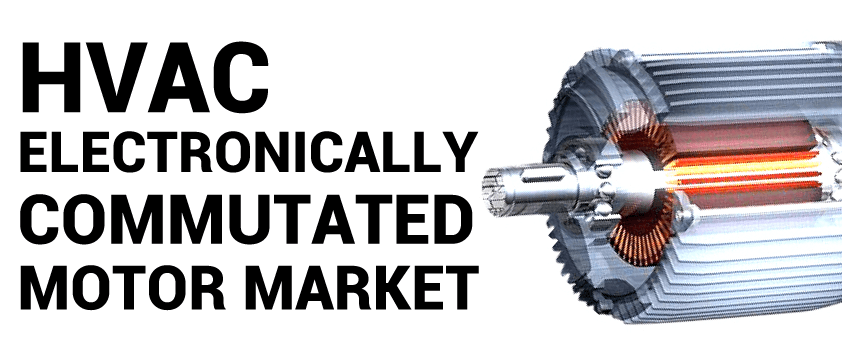
An electronically commutated motor uses electronic controls to fluctuate its speed. EC motors are brushless, due to which they help in reducing maintenance, ensuring high efficiency, improving energy conservation, and increasing service life. ECMs are lighter than other types of motors, making them easy to install. ECMs also reduce operating costs, are not prone to overheat, and also offset the generation of heat.
HVAC Electronically Commutated Motor Market Key Takeaways
 Global Market Size & Forecast
- 2020 Market Size: USD 7.10 billion
- 2021 Market Size: USD 7.89 billion
- 2028 Forecast Market Size: USD 13.13 billion
- CAGR: 7.5% from 2021–2028
 Market Share
- Asia Pacific dominated the market with a 36.2% share in 2020.
- Brushless DC Motors held the largest market share by motor type.
- Commercial dominated the market by application.
 Key Regional Highlights
North America
Strong demand supported by energy efficiency regulations and HVAC adoption.
Asia Pacific
The market reached USD 2.57 billion in 2020, driven by rapid urbanization and rising HVAC adoption.
Europe
Expected to witness significant growth, supported by infrastructure investments and manufacturing expansion.
U.S.
The market is projected to reach USD 3.68 billion by 2032.
Japan
The market is expected to grow steadily, supported by increasing demand for energy-efficient HVAC systems and smart building initiatives.
Read More

In HVAC systems, ECMs are primarily used in pumps, fans, and compressors, as they provide uniform temperature distribution with their speed control. EC motors are used in applications where a small size motor is needed, and a variable frequency drive is not economical. These motors deliver the highest energy savings when used in air-conditioning and refrigeration systems.
Unavailability of Financial Assistance to Industries amid COVID-19 to Affect Market Growth
COVID-19 continues to spread rapidly around the world. Almost every country has reported infected cases. Every country is at different stages of the pandemic. Amid increasing concerns over COVID-19, many industries across the globe, such as automotive, aviation, chemical, and oil & gas, are experiencing a negative impact. The drastic actions taken to reduce the spread of the virus have created challenges in working conditions for many of the commercial HVAC sector’s key processes. Workers are required to maintain social distancing while working in confined spaces.
Heating, ventilation, and air conditioning (HVAC) systems are the most commonly used equipment in urban homes and commercial spaces in many countries across the globe. HVAC plant operators are facing a shortage of working capital due to government policies suspending or delaying tariff payments by consumers. Social distancing measures could also affect maintenance activities of HVAC systems, and operators will have to train staff and provide appropriate personal protective equipment (PPE), especially where contact with the public is required.
LATEST TRENDS
Download Free sample to learn more about this report.
Rising Demand from Building & Construction Sector to Propel Market Growth
The adoption of HVAC electronically commutated motor systems is rapidly increasing in the building & construction sector, owing to their high efficiency, longer durability, minimum maintenance, performance, controllability, and reliability. These motors are widely used in HVAC systems as they help to provide control over airflow, consume less electricity as compared to an induction motor, facilitate serial communication, and allow programmability. EC motors also dissipate less heat, which helps AC and refrigeration systems and components, such as air handlers and evaporators, to operate more efficiently. According to the Systemair Group, the building & construction sector was valued at USD 4,352.48 billion in 2019 and is expected to grow at 8% CAGR during 2020-2025. Furthermore, energy regulations laid down by several governing authorities across the globe are estimated to drive the HVAC ECM market growth during the forecast period.
DRIVING FACTORS
Growing Investments from the Industrial Sector to Aid Market Dynamics
Growing investments from the manufacturing & processing sector, such as oil & gas, chemical, packaging, automotive, and consumer electronics, in developing economies are expected to accelerate the demand for HVAC EC motors. According to the World Investment Report 2018, published by the United Nations Conference on Trade and Development (UNCTAD), Asia holds the largest share for FDI inflows, with an increase of 4%, or USD 512 billion, in 2018. Moreover, China is the largest developing economy, attracting USD 139 billion in FDI investments in Asia. Additionally, Africa holds 11% of FDI investments worth USD 46 billion. Hence, the increasing investment from the industrial sector has created the need for deploying HVAC ECMs in various end-use industries, which include power generation, oil & gas, metallurgy, and consumer electronics, thus propelling the market’s growth during the projected period.
Increasing Initiatives for Smart Cities to Favor Growth
The growing initiatives for smart cities and infrastructural development in developing countries, such as China and India, hold promising opportunities for players in the HVAC ECM market. According to the International Data Corporation (IDC) Worldwide Smart Cities Spending Guide, global spending on smart cities stood at USD 124 billion in 2019. An increase in investments in the infrastructure sector and the rising focus towards less carbon emission-based heating and air conditioning systems are estimated to provide substantial growth opportunities for this market. Additionally, as per the World Economic Forum (WEF), the planned investments for the development of infrastructure are estimated to be worth USD 15 trillion by 2040. Hence, these developments are set to generate multiple investment opportunities in the HVAC electronically commutated motor market during the projected period.
RESTRAINING FACTORS
Availability of Superior-performance Substitutes to EC Motors to Hamper the Global Market
Electronically commutated motors provide high efficiency, energy savings, augmented operational lifespan, and cooler operation. The development of substitutes with similar or better functional values is a major factor that is likely to restrain the HVAC ECM market during the forecast period. Smart synchronous motor (SSM) and permanent split capacitor (PSC) motor, which is a permanent magnet motor, is possibly a key substitute to EC motors for use in HVAC applications. Smart synchronous motors limit the need to manage energy draw beyond the initial motor startup. However, ECM requires continual conversion between AC and DC voltage power throughout its hours of the operational cycle. This factor is likely to hamper this market during the forecast period.
SEGMENTATION
By Motor Type Analysis
Brushless DC Motor Segment Accounted for the Largest Market Share
Based on motor type, the market is categorized into brushless DC motors, permanent magnet AC (PMAC) motors, and servo motors. The brushless DC motors segment accounted for the major share of the market in 2020, owing to its several features and benefits over other types of motors, which include low noise and provide high torque to weight ratio, higher efficiency motors, low power consumption, and long battery life.
The permanent magnet AC motor segment is anticipated to experience considerable growth as it is mainly used to produce a constant magnetic field. It has a low torque ripple, high power density, low maintenance cost, small size, and low heat generation.
A servo motor comprises a control circuit, which helps the motor to rotate with great precision.
By Product Type Analysis
Constant Airflow Segment to Grow at a High Pace
Based on product type, the market is segregated into constant airflow, constant torque, and constant speed. The constant airflow segment accounted for the major market share in 2020, as motors with constant airflow give the highest efficiency. Constant airflow ECM also helps to reduce air noise and provide a soft start/stop.
In constant torque ECM motors, torque remains constant throughout the speed range, and the horsepower increases and decreases in direct proportion to the speed.
Constant speed motor operates at a fixed speed determined by the power supply frequency.
By Application Analysis
To know how our report can help streamline your business, Speak to Analyst
Commercial Segment to Hold the Highest Position
Based on application, the market is classified into residential, commercial, and industrial. The commercial segment accounted for the leading share of the market. The commercial sector includes office buildings, supermarkets, cinemas, department stores, recreation centers, shopping centers, restaurants, and others. In commercial buildings, HVAC ECMs are used to vary the speed and torque of the fan motor to match the changing system requirements.
In the residential sector, HVAC ECMs are primarily used to reduce starting current, save energy, modulate capabilities, and achieve a longer equipment lifespan.
The industrial sector comprises hospitals, production areas, aircraft, automobiles, railroad cars, buses, and cruise ships. HVAC electronically commutated motors help to maintain a high level of efficiency at a variety of speeds.
REGIONAL INSIGHTS
Asia Pacific HVAC Electronically Commutated Motor (ECM) Market Size, 2020 (USD Billion)
To get more information on the regional analysis of this market, Download Free sample
The market has been analyzed across five key regions, namely, North America, Asia Pacific, the Middle East & Africa, Europe, and Latin America.
Asia Pacific accounted for a 36.15% share of the market in 2020. In Asia Pacific, China accounts for the major share of the market, and it is anticipated to maintain its dominance during the forecast period. China is the most populated country in the world, with a rapidly increasing energy demand, which primarily impacts energy solutions, climate change, and air quality. Hence, China is prominently focusing on enhancing and improving industrial heating, ventilation, and air conditioning systems, which have generated the need for electronically commutated motors.
In North America, rapidly rising energy consumption, supportive government regulation for curbing air pollution, and enhanced exposure to HVAC systems are the prominent factors driving the growth of the HVAC ECM market.
The market in Europe is expected to create significant growth opportunities owing to the strong growth in the manufacturing & processing industries. Furthermore, in 2019, the European Commission had granted USD 4 billion for 25 large infrastructure projects in 10 member states projects, catering to the healthcare, transportation, and energy sectors and fueling the demand for HVAC ECMs in Europe.
Latin America is the fastest-growing region in the global market due to the rising investments in industrial infrastructures. Latin American countries have introduced several regulatory changes, including reduced royalties, tax breaks, relaxed qualification terms, longer contracts, and flexible exploration mandates, which are set to accelerate the regional market growth.
The Middle East & Africa is expected to hold a significant share in the market. Gulf countries, such as Qatar, Saudi Arabia, Oman, and Kuwait, are some of the fastest-growing regions in terms of energy demand owing to the increasing consumption of power, seasonal volatility, and rapid industrial growth. This is driving the application of HVAC ECMs in the Middle East & Africa market.
KEY INDUSTRY PLAYERS
Siemens AG to Diversify Its Offerings and Leverage Its Distribution Networks to Market New Products
Siemens is a leading engineering and manufacturing company that focuses on electrification, automation, and digitization. It is one of the largest providers of energy-efficient and resource-saving technologies. It also provides engineering solutions in automation and control, power, medical diagnosis, and transportation for various end-use industries, such as healthcare, transportation, communication, and power, among others. It has an extensive global presence across North America, Asia Pacific, the Middle East & Africa, Latin America. In January 2018, for instance, Siemens launched a new range of SIMOTICS 1LE7 low voltage IE3 in India. These new motors have efficiency values (IE3) higher than the existing energy-efficiency standards.
LIST OF KEY COMPANIES PROFILED:
- ABB (Switzerland)
- Siemens (Germany)
- WEG (Brazil)
- Nidec Motor Corporation (United States)
- Parker Hannifin (United States)
- maxon (Switzerland)
- ASTRO Motorengesellschaft mbH & Co.KG (Germany)
- Allied Motion Technologies Inc. (United States)
- Bühler Motor / Buehler Motor (Germany)
- Kollmorgen (United States)
KEY INDUSTRY DEVELOPMENTS:
- On May 13, 2021, Nidec Corporation has announced its cooperation in the US for extending its HVAC solution for the aftermarket solution. This includes the existing HVAC aftermarket structure including the Embraco solution to deliver a broader portfolio capability of products with high standards and performance to meet customer needs.
- On March 08, 2021, WEG delivers WEGM - Electronically Commuted Motor complete versatile solution for air handling applications. The developed solution meets the different types of applications such as exhaust and ventilation systems for animal comfort, parking lots, industrial kitchens, and others.
- On January 04, 2021, Qorvo has introduced the smallest industrial signal-chip motion control solution for brushless DC motors. The integration of this design enables motion control for compact brushless DC motors and new opportunities for market and electronics in healthcare, beauty, and others.
- In December 2020, Toshiba Corporation has developed a new magnetic material that delivers major improvements in motor efficiency. This enables the potential to significantly reduce power consumption and is a necessary step towards a low carbon future.
REPORT COVERAGE
An Infographic Representation of HVAC Electronically Commutated Motor (ECM) Market
 View Full Infographic
To get information on various segments, share your queries with us
The HVAC electronically commutated motor market research report presents a comprehensive assessment of the industry by offering valuable insights, facts, industry-related information, and historical data. Several methodologies and approaches have been adopted to make meaningful assumptions and views to formulate the market research report. Furthermore, the report covers a detailed analysis and information as per market segments, including motor type, product type, application, and regions, helping our readers to get a comprehensive overview of the global industry.
REPORT SCOPE & SEGMENTATION
|
ATTRIBUTE |
DETAILS |
|
Study Period |
2017-2028 |
|
Base Year |
2020 |
|
Forecast Period |
2021-2028 |
|
Historical Period |
2017-2019 |
|
Unit |
Value (USD Billion) |
|
Segmentation |
By Motor Type
|
|
By Product Type
|
|
|
By Application
|
|
|
By Region
|
Frequently Asked Questions
Fortune Business Insights says that the global HVAC electronically commutated motor market size was USD 7.10 billion in 2020 and is projected to reach USD 13.13 billion by 2028.
In 2020, the Asia Pacific market value stood at USD 2.57 billion.
Growing at a CAGR of 7.5%, the market will exhibit a decent growth rate during the forecast period (2021-2028).
The brushless DC motor segment is anticipated to hold a significant share and dominate the market during the forecast period.
The rising focus on smart city projects is the major factor driving the market growth.
Siemens AG, ABB Ltd, WEG, Nidec Motor Corporation, and Maxon Motor AG, among others, are the key players operating in the market.
Asia Pacific dominated the market in terms of share in 2020.



- 2017-2028
- 2020
- 2017-2019
- 250
Get 30-60 hrs Free Customization
Expand Regional and Country Coverage, Segments Analysis, Company Profiles, Competitive Benchmarking, and End-user Insights.



















Related Reports
-
US +1 833 909 2966 ( Toll Free )
-
Get In Touch With Us