Hybrid UAV Market Size, Share & Industry Analysis, By End User (Defense & Military, Commercial, Government & Law Enforcement, and Others), By Type (Fixed-wing Hybrid UAVs, Rotary-wing Hybrid UAVs, and VTOL Hybrid UAVs), By Mode of Operation (Remotely Piloted, Optionally Piloted, and Fully Autonomous), By Power Source (Gasoline-electric Hybrid, Solar-electric Hybrid, and Fuel Cell-electric Hybrid), By Application (Surveillance & Reconnaissance, Mapping & Surveying, Agriculture, Delivery & Logistics, and Others), and Regional Forecast, 2026-2034
 Download Free Sample
Hybrid UAV Market Size and Future Outlook
 Listen to Audio Version
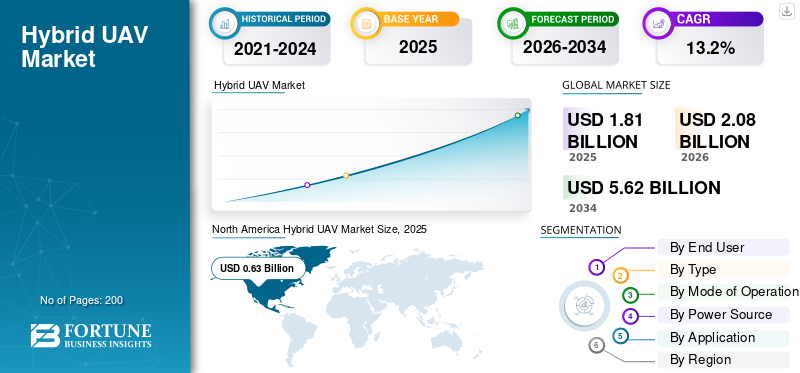
The global hybrid UAV market size was valued at USD 1.81 billion in 2025 and is projected to grow from USD 2.08 billion in 2026 to USD 5.62 billion by 2034, exhibiting a CAGR of 13.2% during the forecast period. North America dominated the hybrid uav market with a market share of 34.80% in 2025.
Hybrid UAVs combine electric and combustion propulsion for superior endurance and versatility over traditional drones, serving defense reconnaissance, commercial agriculture, logistics, and inspection needs. Innovations in VTOL capabilities, AI integration, and modular designs enable operations in diverse environments, from urban settings to remote areas. Growing demand stems from extended flight times addressing surveillance gaps, while investments expand applications in disaster response and precision tasks. This evolution positions hybrid UAVs as pivotal in unmanned systems transformation.
Key players in the market include AeroVironment, DJI Technology, Israel Aerospace Industries, Lockheed Martin, Northrop Grumman, Textron, Top Flight Technologies, Quaternium Technologies, BAE Systems, and United Aircraft Corporation. These companies compete through longer-endurance hybrid platforms, stronger payload integration, improved autonomy, and mission-focused UAV solutions designed for defense, surveillance, reconnaissance, mapping, logistics, and other high-performance operations across global markets.
Download Free sample to learn more about this report.
HYBRID UAV MARKET KEY TAKEAWAYS
 Market Size & Forecast
- 2025 Market Size: USD 1.81 Billion
- 2026 Market Size: USD 2.08 Billion
- 2034 Forecast Market Size: USD 5.62 Billion
- CAGR: 13.2% from 2026–2034
 Market Share
- North America dominated the hybrid UAV market with a 34.80% share in 2025.
- The VTOL hybrid UAVs segment dominated the market in 2025.
- The fuel cell-electric hybrid segment held the largest market share in 2025.
 Key Regional Highlights
North America
North America reached USD 0.63 billion in 2025, accounting for 34.80% of global market revenue.
Asia Pacific
Asia Pacific is projected to reach USD 0.66 billion by 2026 and record the highest regional CAGR of 13.9%.
Europe
Europe is projected to reach USD 0.53 billion by 2026, ranking as the third-largest regional market.
U.S.
The market is projected to reach USD 0.64 billion by 2026.
Japan
The market is projected to reach USD 0.09 billion by 2026.
Read More

HYBRID UAV MARKET TRENDS
Innovation In Propulsion Systems and AI Integration are Prominent Market Trend
Hybrid UAVs are gaining traction through innovations in propulsion systems and AI integration, which are enabling extended endurance and versatile operations in surveillance, agriculture, and logistics. Their demand is rising in defense for reconnaissance and in commercial markets for precision farming and delivery. Rotary-wing and VTOL hybrid UAVs lead the market as they can hover and take off vertically, making them more flexible for missions in confined or hard-to-access areas. Advancements in dual-mode propulsion and modular platforms support broader adoption across complex terrains and urban environments.
MARKET DYNAMICS
MARKET DRIVERS
Download Free sample to learn more about this report.
Need for Safer, Faster, and More Cost-Effective Operations in Organizations is Boosting the Demand in Market
Demand for long-endurance UAVs in surveillance, reconnaissance, and border patrolling propels the hybrid UAV market growth, as electric-fuel combinations outperform traditional drones in remote operations. Defense budgets propels the procurement for advanced unmanned systems, while commercial agriculture benefits from optimized farm management and pest detection. Advancements in hybrid propulsion and sensor technology, alongside favorable regulations, accelerate integration of such UAVs in logistics and emergency services.
MARKET RESTRAINTS
Fragmented Regulations, Safety Concerns, and High Upfront Costs Limit Market Growth
High upfront costs of hybrid systems, elevated development, and maintenance expenses deter adoption amongst smaller enterprises. Information security risks due to cyber vulnerabilities and lack of standardized air traffic regulations complicate operations. Limited payload capacity in certain models restricts versatility for heavy-duty missions.
MARKET OPPORTUNITIES
Rising Investments to Unlock New Uses, Pushing for New Growth Opportunities in the Market
Growing investments by commercial market players opens avenues in agriculture for crop monitoring, logistics for last-mile delivery, and infrastructure inspection. Technological progress in energy storage and package delivery accuracy enhances applications in disaster response and environmental monitoring. Expansion in emerging regions through partnerships with governments boosts deployment in defense modernization and smart city projects.
MARKET CHALLENGES
Regulations and Operational Complexity Challenge the Large-Scale Adoption of the Product
Regulatory hurdles and restrictions on beyond-visual-line-of-sight operations impede seamless integration into airspace management. Rapid progress in all-electric UAVs and battery technology competes with hybrid designs, alongside shortages of sustainable power sources. Operational constraints like weather fluctuations, privacy concerns, and maintenance complexities further test scalability.
Segmentation Analysis
By End User
Defense & Military is the Leading End-User As they Need Enduring UAVs for Persistent ISR Requirements
Based on end user, the market is segmented into defense & military, commercial, government & law enforcement, and others.
The defense & military segment is anticipated to account for the largest market share due to increasing need longer-endurance UAVs for border monitoring, battlefield intelligence, target tracking, and communications support for armed forces. Hybrid UAVs offer better range and persistence than battery-only systems, making them more suitable for mission-critical operations as military spending and operational urgency continue to increase.
The commercial segment is anticipated to rise with a CAGR of 13.7% over the forecast period.
By Type
Growing Need for Runway-Independent, Long-Endurance Missions is Accelerating Demand for VTOL Hybrid UAVs
Based on type, the market is segmented into fixed-wing hybrid UAVs, rotary-wing hybrid UAVs, and VTOL hybrid UAVs.
In 2025, the VTOL hybrid UAVs segment dominated the global market. Demand for VTOL hybrid UAVs (vertical take-off and landing) is rising because operators want vertical take-off flexibility without sacrificing endurance and payload capacity. These platforms are well suited for defense, inspection, logistics, and emergency-response missions where runway access is limited, and BVLOS expansion is making longer-range, point-to-point drone operations commercially more viable.
The rotary-wing hybrid UAVs segment is projected to grow at a CAGR of 13.1% over the forecast period.
By Mode of Operation
Requirement Of Human Oversight For mission Assurance Are Sustaining Highest Demand For The Remotely Piloted Segment
Based on mode of operation, the market is segmented into remotely piloted, optionally piloted, and fully autonomous.
The remotely piloted segment is anticipated to witness a dominating market share over the forecast period. Demand for remotely piloted hybrid UAVs remains strong as most complex drone operations still require human oversight for safety, compliance, and mission assurance. Even as autonomy improves, regulators continue building frameworks around supervised operations, which keeps remotely piloted platforms central to defense, infrastructure inspection, emergency services, and industrial monitoring deployments.
The fully autonomous segment is projected to grow at a high CAGR of 14.1% over the forecast period.
To know how our report can help streamline your business, Speak to Analyst
By Power Source
Longer Endurance and Cleaner High-Performance Propulsion is Boosting the Leadership of Fuel Cell-electric Hybrid systems
Based on power source, the market is segmented into gasoline-electric hybrid, solar-electric hybrid, and fuel cell-electric hybrid.
The fuel cell-electric hybrid segment dominated the segment. Demand for fuel cell-electric hybrid UAVs is rising because operators are looking for longer flight duration, reduced acoustic signature, and lower lifecycle emissions than conventional engine-based alternatives. Interest for fuel cell-electric hybrid is strongest in premium defense, surveillance, and industrial missions where endurance, reliability, and efficient power management are of utmost importance.
In addition, solar-electric hybrid is projected to grow at a CAGR of 13.0% during the study period.
By Application
Consistent Need For Aerial Coverage Over Larger Areas And Longer Missions is Furthering Demand For Surveillance & Reconnaissance Applications
Based on application, the market is segmented into surveillance & reconnaissance, mapping & surveying, agriculture, delivery & logistics, and others.
The surveillance & reconnaissance segment dominated the market. Demand for surveillance and reconnaissance segment is rising as governments, militaries, and security agencies require persistent aerial coverage over larger areas and longer missions. Hybrid platforms fit this requirement well by combining better endurance, heavier sensor payload support, and lower dependency on fixed infrastructure during sensitive or remote operations.
In addition, delivery & logistics are projected to grow at a CAGR of 14.3% during the study period.
Hybrid UAV Market Regional Outlook
By geography, the market is categorized into North America, Europe, Asia Pacific, and Rest of the World.
North America
North America Hybrid UAV Market Size, 2025 (USD Billion)
To get more information on the regional analysis of this market, Download Free sample
North America held the dominant hybrid UAV market share in 2024, valuing at USD 0.55 billion, and also maintained the leading share in 2025, with USD 0.63 billion. North America’s market demand is rising as the U.S. combines the world’s largest military budget along with large regulated drone base. The growth is further strengthen by expanding commercial inspection, public safety, and industrial missions under clearer integration rules.
U.S. Hybrid UAV Market
Based on North America’s strong contribution and the U.S. dominance within the region, the U.S. market can be analytically approximated at around USD 0.64 billion in 2026, accounting for roughly 12.6% of global sales. U.S. demand is also growing with advanced commercial drone use cases such as BVLOS inspection rising and agricultural spraying and package delivery expanding, increasing the need for hybrid UAVs that offer longer endurance, higher payload capacity, and more reliable field performance.
Europe
Europe is estimated to reach USD 0.53 billion in 2026 and secure the position of third largest region in the market. Europe’s market demand is rising because defense spending is climbing sharply as U-space and broader drone policy reforms are enabling more complex, longer-distance operations for inspection, logistics, emergency response, and security missions.
U.K. Hybrid UAV Market
The U.K. market growth in 2026 is estimated at around USD 0.10 billion, representing roughly 13.4% CAGR during the forecast period. U.K. demand is rising because the government and CAA are targeting routine BVLOS operations by 2027 and drone and counter-drone investment are expanding defense, inspection, medical, and infrastructure-use cases.
Germany Hybrid UAV Market
Germany’s market is projected to reach approximately USD 0.12 billion in 2026. Germany’s demand is rising because defense modernization has accelerated sharply, and broader European drone-integration reforms are improving the business case for long-endurance UAVs in security, industrial inspection, surveying, and infrastructure monitoring.
Asia Pacific
Asia Pacific, second highest among all regions, is projected to record a growth rate of 13.9% during the forecast period, expected to reach a valuation of USD 0.66 billion by 2026. Asia Pacific demand is rising with its defense budgets continuing an upward trend with China’s scaling of low-altitude infrastructure, India’s rapid formalization of its drone ecosystem, and Japan’s Level 4 regime supports advanced operations.
China Hybrid UAV Market
China’s market is projected to be one of the largest in Asia Pacific, with 2026 revenues estimated at around USD 0.26 billion. China’s demand is rising with low-altitude logistics routes, take-off infrastructure, and industrial drone manufacturing scale expanding quickly, creating stronger demand for higher-endurance UAV platforms across logistics, inspection, surveillance, and public-service operations.
Japan Hybrid UAV Market
The Japan market share in 2026 is estimated at around USD 0.09 billion, accounting for roughly 13.0% of CAGR during the forecast period. Japan’s demand is rising as Level 4 drone rules allow for more advanced operations, while higher defense spending and strong industrial quality standards support adoption of longer-endurance hybrid UAVs for security, inspection, logistics, and remote-area missions.
India Hybrid UAV Market
The India market in 2026 is estimated at around USD 0.12 billion. India’s demand is rising due to simplified drone rules, PLI support, pilot training expansion, and public-program deployment. They are turning drones into a mainstream tool across agriculture, surveying, infrastructure, governance, and defense-linked applications.
Rest of the World
The rest of the world include Middle East and Africa and Latin America. These regions are expected to witness moderate growth in this market space during the forecast period. The Middle East & Africa and Latin America market are set to reach a valuation of USD 0.10 billion and USD 0.07 billion, respectively in 2026. Rest of the World demand is rising with Middle East’s strong security spending, while Latin America continues adopting drones for border monitoring, public security, mining, energy, and infrastructure inspection where endurance and field flexibility play crucial role.
COMPETITIVE LANDSCAPE
Key Industry Players
Key Players Are Competing through Endurance, Mission Integration, and Defense-Grade Platform Development
The hybrid UAV market remains moderately fragmented, with competition shaped by a mix of established defense contractors and specialized UAV developers. Companies such as AeroVironment, Israel Aerospace Industries, Lockheed Martin, Northrop Grumman, Textron, BAE Systems, and United Aircraft Corporation bring strength in defense programs, mission systems, and long-range unmanned operations, while players such as DJI, Top Flight Technologies, and Quaternium Technologies contribute platform innovation in hybrid propulsion, VTOL capability, and endurance-focused designs. Competitive positioning increasingly depends on each company’s ability to combine reliable hybrid power architecture, payload flexibility, autonomy features, secure communications, and application-specific performance for surveillance, reconnaissance, mapping, logistics, and other demanding missions.
LIST OF KEY HYBRID UAV COMPANIES PROFILED IN REPORT
- AeroVironment, Inc. (U.S.)
- DJI Technology Co., Ltd (China)
- Israel Aerospace Industries (Israel)
- Lockheed Martin Corporation (U.S.)
- Northrop Grumman Corporation (U.S.)
- Textron, Inc. (U.S.)
- Top Flight Technologies (U.S.)
- Quaternium Technologies (Spain)
- BAE Systems (U.K.)
- United Aircraft Corporation (Russia)
KEY INDUSTRY DEVELOPMENTS
- March 2026: Hybrid Drones Limited, a U.K. SME backed by MBDA, achieved the first flight of the HYDRA-400, a heavy-lift, hybrid jet-electric UAV designed for battlefield logistics and weapon systems delivery.
- January 2026: The Indian Army signed a USD 18.6 million contract with NewSpace Research & Technologies for solar-powered High-Altitude Persistent Surveillance System (AS-HAPS) UAVs.
- June 2025, ideaForge secured an emergency procurement contract worth more than USD 16 million to supply advanced hybrid mini-VTOL UAVs for Intelligence, Surveillance, And Reconnaissance (ISR) operations, with a 12-month delivery timeline.
- February 2025: Xer Technologies partnered with Nordic Unmanned to deploy the Xer X8 hybrid electric UAV for long-endurance maritime surveillance.
- February 2025: Volatus partnered with Dufour Aerospace to introduce Dufour’s Aero2 heavy-lift, hybrid-electric VTOL drone into Canadian and African markets for cargo and surveillance.
REPORT COVERAGE
This research offers a detailed analysis of emerging trends and rapidly adopted technologies in the industry across key regions. The report outlines key drivers of market growth and challenges to expansion, delivering a detailed overview of the industry landscape. The study highlights recent advancements to boost industry insights and support stakeholders in making well-informed decisions.
Request for Customization to gain extensive market insights.
Report Scope & Segmentation
| ATTRIBUTE | DETAILS |
| Study Period | 2021-2034 |
| Base Year | 2025 |
| Estimated Year | 2026 |
| Forecast Period | 2026-2034 |
| Historical Period | 2021-2024 |
| Growth Rate | CAGR of 13.2% from 2026-2034 |
| Unit | Value (USD Billion) |
| Segmentation | By End User, By Type, By Mode of Operation, By Power Source, By Application, and Region |
| By End User |
|
| By Type |
|
| By Mode of Operation |
|
| By Power Source |
|
| By Application |
|
| By Region |
|
Frequently Asked Questions
According to Fortune Business Insights, the global market value stood at USD 1.81 Billion in 2025 and is projected to reach USD 5.62 Billion by 2034.
In 2025, the market value stood at USD 0.63 billion.
The market is expected to exhibit a CAGR of 13.2% during the forecast period.
Defense & military segment is expected to dominate the market.
Need for due safer, faster, and more cost-effective operations in organizations is driving market growth.
AeroVironment, Inc. (U.S.), DJI Technology Co., Ltd (China), Israel Aerospace Industries (Israel), Lockheed Martin Corporation (U.S.), Northrop Grumman Corporation (U.S.), Textron, Inc. (U.S.) are few major players in the global market.
North America dominated the market in 2025



- 2021-2034
- 2025
- 2021-2024
- 200
Get 30-60 hrs Free Customization
Expand Regional and Country Coverage, Segments Analysis, Company Profiles, Competitive Benchmarking, and End-user Insights.

















Related Reports
-
US +1 833 909 2966 ( Toll Free )
-
Get In Touch With Us