Identity Threat Detection and Response (ITDR) Market Size, Share & Industry Analysis, By Component (Software, and Services), By Deployment (Cloud and On-Premises), By Enterprise Type (Large Enterprises and Small & Medium Enterprises (SMEs)), By Identity Environment (Active Directory Security, Cloud Identity Security, and Hybrid Identity Security), By Industry (BFSI, Government, Healthcare, IT & Telecommunications, Retail & E-commerce, Manufacturing, Energy & Utilities, and Others), and Regional Forecast, 2026 – 2034
 Download Free Sample
Identity Threat Detection and Response Market Overview
 Listen to Audio Version
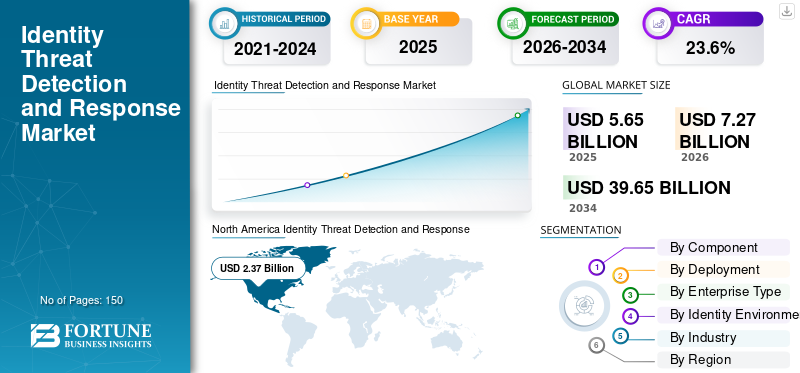
The global Identity Threat Detection and Response (ITDR) market size was valued at USD 5.65 billion in 2025. The market is projected to grow from USD 7.27 billion in 2026 to USD 39.65 billion by 2034, exhibiting a CAGR of 23.6% during the forecast period.
Identity Threat Detection and Response (ITDR) is an emerging cybersecurity category focused on protecting enterprise identities from increasingly sophisticated identity-based attacks. ITDR solutions continuously identify identity exposures, monitor authentication and identity activities, detect malicious behaviors targeting user and machine identities, and support rapid investigation, prevention, and recovery across enterprise identity environments.
The rapid evolution of cloud computing, hybrid work environments, Zero Trust security strategies, and identity-centric enterprise architectures has significantly increased the importance of protecting digital identities as the new security perimeter. Organizations across IT & telecommunications, BFSI, government, healthcare, manufacturing, retail, and other industries are increasingly investing in ITDR platforms to strengthen cyber resilience, improve threat detection, accelerate incident response, and reduce identity-related security risks. Furthermore, continuous advancements in AI-powered threat detection, identity analytics, security automation, and cloud-native identity protection are accelerating market growth.
Major companies operating in the market include Microsoft Corporation, CrowdStrike Holdings, Inc., CyberArk Software Ltd., Okta, Inc., and Palo Alto Networks, Inc. These vendors continue expanding investments in AI-driven identity analytics, identity posture management, adaptive risk scoring, automated investigation, and security orchestration to address the evolving identity threat landscape.
Download Free sample to learn more about this report.
Impact of Generative AI
Growing Adoption of Generative AI is Strengthening Identity Threat Detection and Response Capabilities
Generative AI is significantly transforming the market by enhancing the ability of security teams to detect sophisticated identity-based attacks, automate investigations, and accelerate incident response. Organizations are increasingly deploying generative AI to analyze massive volumes of authentication logs, identity telemetry, privileged access activities, and behavioral data to identify anomalous identity patterns that may indicate credential compromise, privilege escalation, account takeover, or insider threats. By correlating identity events, generative AI enables security teams to identify threats more quickly while reducing investigation time and improving detection accuracy.
Generative AI is improving security operations through automated threat hunting, contextual risk analysis, incident summarization, attack path visualization, remediation recommendations, and natural language security assistance. These capabilities enable security analysts to investigate identity-driven attacks more efficiently while reducing alert fatigue and strengthening overall cyber resilience. As generative AI capabilities mature, their integration with ITDR platforms is expected to improve the speed, scale, and contextual accuracy of identity threat detection and response throughout the forecast period.
- For instance, in April 2026, Microsoft expanded the capabilities of Microsoft Security Copilot by introducing additional AI-powered identity investigation and incident response features that help security teams analyze identity-related threats, prioritize risks, and accelerate remediation across hybrid identity environments.
Identity Threat Detection and Response (ITDR) Market Trends
Growing Convergence of ITDR with Identity Security Platforms and Zero Trust Architectures Emerging as a Key Market Trend
The market is witnessing increasing convergence with broader identity security platforms as organizations seek unified visibility across identity governance, Privileged Access Management (PAM), Identity and Access Management (IAM), Cloud Infrastructure Entitlement Management (CIEM), and Zero Trust security architectures. Rather than deploying standalone identity monitoring tools, enterprises are increasingly integrating ITDR capabilities into comprehensive identity security ecosystems that provide continuous identity risk assessment, real-time threat detection, adaptive access controls, and automated response across hybrid identity environments. This integrated approach enables organizations to reduce security complexity while strengthening protection against increasingly sophisticated identity-based cyber threats.
Cybersecurity vendors are embedding advanced identity analytics, behavioral intelligence, and automated policy enforcement into unified security platforms to improve operational efficiency and simplify identity protection across cloud, SaaS, and on-premises environments. The growing need for centralized identity visibility, continuous identity posture management, and coordinated threat response across distributed enterprise infrastructures is expected to remain a major trend shaping the evolution of the ITDR market throughout the forecast period.
- For instance, in September 2025, CrowdStrike expanded its identity security portfolio by introducing enhanced ITDR capabilities within the Falcon platform, enabling organizations to detect identity-based attacks and strengthen Zero Trust security through unified identity protection.
Market Dynamics
Market Drivers
Download Free sample to learn more about this report.
Growing Adoption of Identity-centric Security Strategies Amid Rising Identity-based Cyberattacks is Driving Market Growth
The increasing frequency of identity-based cyberattacks is emerging as one of the primary factors driving the identity threat detection and response (ITDR) market growth. As attackers increasingly target user identities, privileged accounts, service accounts, and machine identities instead of traditional network perimeters, organizations are strengthening identity-centric security strategies to detect and mitigate identity-related threats before they escalate into large-scale security incidents. Credential theft, account takeover, privilege escalation, lateral movement, and identity misuse have become common attack techniques, prompting enterprises to adopt ITDR solutions that provide continuous identity monitoring, behavioral analytics, threat detection, and automated response capabilities across hybrid identity environments.
The demand is particularly strong among organizations operating complex and increasingly distributed identity ecosystems that require continuous visibility and risk monitoring across multiple authentication and access environments. Enterprises across IT & telecommunications, BFSI, government, healthcare, manufacturing, retail, and other industries are increasingly deploying ITDR platforms to improve identity visibility, reduce attack dwell time, strengthen Zero Trust security frameworks, and accelerate incident response. Continuous investments in identity analytics, AI-powered threat detection, risk-based identity protection, and security automation are further supporting enterprise adoption, as organizations modernize identity security to address evolving cyber threats.
Market Drivers - Impact & CAGR Contribution (2026–2034)
| Rank | Market Drivers | Overall Impact Rank | CAGR Contribution (2026–2034) | Impact: 2026-2028 | Impact: 2029-2031 | Impact: 2032-2034 |
|---|---|---|---|---|---|---|
| 1 | Growing Identity-based Cyberattacks and Increasing Adoption of Identity-centric Security Strategies | High | 7.6% | High | High | High |
| 2 | Rising Enterprise Implementation of Zero Trust Architecture and Identity Security Frameworks | High | 5.3% | High | High | Medium |
| 3 | Increasing Adoption of Cloud Identity, Hybrid Work Environments, and Multi-cloud Infrastructure | Medium-High | 4.2% | Medium | High | High |
| 4 | Growing Integration of AI-driven Threat Detection, Identity Analytics, and Security Automation | Medium | 3.3% | Medium | Medium | High |
| 5 | Increasing Regulatory Compliance Requirements and Investments in IAM Modernization | Medium-Low | 2.4% | Low | Medium | High |
| 6 | Others (Expansion of privileged identity protection, identity governance initiatives, managed security services, strategic partnerships) | Low | 1.4% | Low | Low | Medium |
| Total Gross Growth Contribution | 24.20% | |||||
Source: Fortune Business Insights
Download Free sample For In-Depth Market Drivers & Impact Forecasts
Market Restraints
Complexity of Integrating ITDR with Legacy Identity and Security Infrastructure is Limiting Market Growth
The complexity of integrating ITDR solutions across diverse identity and security environments remains a significant challenge restraining market growth. Large enterprises often operate multiple identity providers, legacy Active Directory deployments, cloud identity platforms, privileged access management solutions, endpoint security tools, SIEM platforms, and security operations workflows that have evolved over many years. Integrating ITDR platforms across these heterogeneous environments while maintaining consistent identity visibility, policy enforcement, and threat detection can require substantial planning, technical expertise, and operational resources.
Organizations also face challenges associated with fragmented identity data, inconsistent identity governance policies, interoperability limitations, and varying security architectures across on-premises and cloud environments. These complexities may increase deployment timelines, implementation costs, and operational overhead, particularly for enterprises undergoing large-scale digital transformation or hybrid cloud migration.
Market Restraints - Impact & Negative CAGR Contribution (2026–2034)
| Rank | Market Restraints | Overall Impact Rank | CAGR Contribution (2026–2034) | Impact: 2026-2028 | Impact: 2029-2031 | Impact: 2032-2034 |
|---|---|---|---|---|---|---|
| 1 | Complexity of Integrating ITDR with Legacy Identity and Security Infrastructure | High | -0.2% | High | Medium | Medium |
| 2 | Shortage of Skilled Identity Security and Cybersecurity Professionals | Medium | -0.2% | Medium | Medium | Low |
| 3 | Budget Constraints Among Small and Medium-sized Enterprises | Medium-Low | -0.1% | Medium | Low | Low |
| 4 | Others (False positives, interoperability challenges, deployment complexity, evolving threat landscape) | Low | -0.1% | Low | Low | Low |
| Total Negative Growth Impact | -0.60% | |||||
Source: Fortune Business Insights
Download Free sample For In-Depth Market Restraints & Risk Analysis
Market Opportunities
Expansion of Non-human Identity Protection and Machine Identity Security is Creating Significant Growth Opportunities
The rapid growth of machine identities and non-human identities (NHIs) across modern enterprise environments is creating significant market growth opportunities. Organizations are increasingly deploying cloud-native applications, containers, Kubernetes environments, APIs, Robotic Process Automation (RPA), DevOps pipelines, IoT devices, and AI agents that rely on machine identities, service accounts, certificates, secrets, and cryptographic keys to authenticate and communicate securely.
As the number of non-human identities continues to exceed human identities across enterprise environments, organizations are seeking advanced ITDR solutions capable of continuously monitoring, detecting, and responding to identity-based threats targeting these rapidly expanding attack surfaces. Also, as organizations continue adopting AI-driven applications, cloud-native architectures, and highly automated digital infrastructure, demand for comprehensive identity threat detection capabilities across the entire identity ecosystem is expected to create substantial growth opportunities over the forecast period.
Segmentation Analysis
By Identity Environment
Increasing Need for Identity Management Platforms Across Enterprise IT Environments Boosted Active Directory Security Segment Growth
Based on identity environment, the market is segmented into active directory security, cloud identity security, and hybrid identity security.
The active directory security segment accounted for the largest market share of 42.5% in 2025. The segment's leadership is attributed to the widespread use of Microsoft Active Directory as the primary identity management platform across enterprise IT environments. Since Active Directory remains a frequent target for credential theft, privilege escalation, and lateral movement attacks, organizations are increasingly deploying ITDR solutions capable of continuously monitoring authentication activities, privileged accounts, identity configurations, and abnormal behavioral patterns to strengthen enterprise identity security.
The hybrid identity security segment is projected to register the fastest CAGR of 27.9% during the forecast period. Enterprises are increasingly operating hybrid identity environments that integrate on-premises directory services with cloud identity providers and SaaS applications. This growing complexity is driving demand for ITDR solutions capable of providing unified identity visibility, continuous threat detection, and coordinated incident response across distributed identity infrastructures while supporting Zero Trust security strategies.
To know how our report can help streamline your business, Speak to Analyst
By Component
Growing Focus on Protecting User Identities & Privileged Accounts Fueled Software Segment Growth
Based on component, the market is segmented into software and services.
The software segment accounted for the largest identity threat detection and response (ITDR) market share in 2025. The segment's dominance is attributed to increasing enterprise adoption of dedicated identity threat detection platforms that provide continuous identity monitoring, behavioral analytics, identity risk assessment, threat intelligence, automated investigation, and incident response capabilities. Organizations are increasingly investing in software solutions capable of protecting user identities, privileged accounts, service accounts, and machine identities. Growing enterprise focus on Zero Trust security and identity-first cybersecurity strategies continues to strengthen demand for comprehensive ITDR software platforms.
The services segment is projected to register the fastest CAGR of 25.2% during the forecast period. The increasing complexity of hybrid identity environments and enterprise cybersecurity operations is driving demand for consulting, implementation, integration, managed detection and response, identity security assessments, and incident response services. Organizations continue to rely on cybersecurity service providers to accelerate ITDR deployment, optimize identity protection strategies, and improve operational readiness against identity-driven cyber threats.
By Deployment
Rapid Migration of Enterprise Identities Led to Cloud Segment Leadership
Based on deployment, the market is segmented into cloud and on-premises.
The cloud segment accounted for the largest market share in 2025. The segment's leadership is attributed to the rapid migration of enterprise identities, applications, and workloads to cloud and hybrid environments. Cloud-native ITDR platforms enable organizations to continuously monitor identities across multiple cloud identity providers, SaaS applications, and distributed enterprise infrastructures while delivering real-time threat detection, automated response, and simplified platform management. The growing adoption of cloud-based identity security solutions is further supported by subscription-based deployment models, faster implementation, and continuous platform updates.
The on-premises segment is expected to grow at a CAGR of 21.8% during the forecast period. Organizations operating highly regulated environments continue to deploy on-premises ITDR solutions to maintain greater control over sensitive identity data, authentication infrastructure, and security operations. Government agencies, financial institutions, defense organizations, and critical infrastructure operators continue investing in on-premises identity protection to address stringent compliance, data sovereignty, and cybersecurity requirements.
By Enterprise Type
Growing Complexity of Identity Ecosystems Supported Large Enterprises Leadership
Based on enterprise type, the market is segmented into large enterprises and small & medium enterprises (SMEs).
The large enterprises segment accounted for the largest market share in 2025. The dominance is driven by the increasing complexity of enterprise identity ecosystems comprising thousands of employees, contractors, privileged users, cloud applications, machine identities, and hybrid identity infrastructures. Large organizations continue investing heavily in advanced ITDR platforms to improve identity visibility, strengthen Zero Trust implementation, automate threat detection, and protect mission-critical digital assets from increasingly sophisticated identity-based attacks.
The small & medium enterprises (SMEs) segment is projected to register the fastest CAGR of 26.8% during the forecast period. Growing awareness of identity-related cyber risks, increasing availability of cloud-based ITDR platforms, and rising adoption of managed security services are enabling SMEs to strengthen identity protection without significant upfront infrastructure investments. The expanding cybersecurity threat landscape and regulatory compliance requirements are further accelerating ITDR adoption among resource-constrained organizations.
By Industry
Rapid Expansion of Cloud-native Applications Boosted IT & Telecommunications Segment Growth
Based on industry, the market is segmented into IT & telecommunications, BFSI, government, healthcare, retail & e-commerce, manufacturing, energy & utilities, and others.
The IT & telecommunications segment accounted for the largest market share of 20.9% in 2025. The segment's growth is driven by the rapid expansion of cloud-native applications, hybrid identity environments, managed services, and large-scale digital ecosystems that require continuous identity protection. Technology companies and telecommunications providers are increasingly deploying ITDR platforms to protect privileged accounts, developer identities, cloud workloads, service accounts, and customer-facing applications from identity-driven cyber threats while supporting Zero Trust security initiatives.
The healthcare segment is expected to register the second-fastest CAGR of 26.5% during the forecast period. Healthcare organizations are increasingly investing in ITDR solutions to protect electronic health records, clinical systems, healthcare workers' identities, and connected digital services from credential compromise, ransomware, and unauthorized access. The growing adoption of cloud-based healthcare platforms, increasing regulatory requirements, and rising cyberattacks targeting healthcare institutions continue to accelerate identity security investments across the sector.
Identity Threat Detection and Response (ITDR) Market Regional Outlook
By geography, the market is categorized into North America, South America, Europe, the Middle East & Africa, and Asia Pacific.
North America
North America Identity Threat Detection and Response (ITDR) Market Size, 2025 (USD Billion)
To get more information on the regional analysis of this market, Download Free sample
North America accounted for the largest market share of 42.0% in 2025 and was valued at USD 2.37 billion. The market is projected to reach USD 15.34 billion by 2034, exhibiting a CAGR of 22.5% during the forecast period. The region's dominance is attributed to the strong presence of leading cybersecurity vendors, mature cloud infrastructure, and widespread adoption of identity-first security strategies across enterprises. Organizations are increasingly deploying ITDR platforms to protect hybrid identity environments, privileged accounts, cloud identities, and SaaS applications against credential compromise, identity misuse, and sophisticated cyberattacks.
U.S. Identity Threat Detection and Response (ITDR) Market
The U.S. market in 2025 was valued at USD 1.96 billion, representing roughly 34.6% of global sales. This growth is owing to its advanced cybersecurity ecosystem and large concentration of cloud service providers, technology companies, and identity security vendors.
Europe
Europe accounted for the second-largest market share of 28.7% in 2025. Organizations across the region are strengthening identity security frameworks as cyber threats increasingly target enterprise identities, privileged accounts, and cloud-based authentication systems. Enterprises are accelerating investments in ITDR platforms to improve identity visibility, detect identity-driven attacks, and strengthen cyber resilience across hybrid IT environments.
U.K. Identity Threat Detection and Response (ITDR) Market
The U.K. market in 2025 was valued at around USD 0.27 billion, representing roughly 4.8% of global revenues.
Germany Identity Threat Detection and Response (ITDR) Market
The German market is projected to reach approximately USD 0.34 billion in 2025, equivalent to around 6.0% of global sales.
Asia Pacific
Asia Pacific is projected to register the highest CAGR of 26.4% during the forecast period. The regional market is estimated at USD 1.49 billion in 2026 and is projected to reach USD 9.71 billion by 2034. The rapid growth is driven by increasing cloud adoption, digital transformation initiatives, expanding hybrid work environments, and growing enterprise cybersecurity investments across major economies.
China Identity Threat Detection and Response (ITDR) Market
The Chinese market in 2025 was valued at approximately USD 0.27 billion, representing roughly 4.7% of global revenues.
Japan Identity Threat Detection and Response (ITDR) Market
The Japanese market in 2025 was valued at around USD 0.26 billion, accounting for roughly 4.6% of global revenues.
India Identity Threat Detection and Response (ITDR) Market
The Indian market in 2025 was valued at around USD 0.22 billion, accounting for roughly 4.0% of global revenues.
Middle East & Africa
The Middle East & Africa market is projected to grow at a CAGR of 17.0% during the forecast period. Governments and enterprises across the region are increasingly investing in cybersecurity modernization as digital transformation initiatives expand across banking, government services, healthcare, energy, and telecommunications sectors.
GCC Identity Threat Detection and Response (ITDR) Market
The GCC market was valued at around USD 0.14 billion in 2025, representing roughly 2.4% of global revenues.
South America
South America was valued at USD 0.16 billion in 2025 and is projected to reach USD 0.93 billion by 2034. The region is witnessing gradual adoption of identity threat detection and response solutions as enterprises increasingly prioritize identity protection to support cloud migration, digital banking, e-commerce, and enterprise modernization initiatives.
Brazil Identity Threat Detection and Response (ITDR) Market
The Brazilian market in 2025 was valued at around USD 0.11 billion, accounting for roughly 1.9% of global revenues.
Competitive Landscape
Key Industry Players
Continuous Innovation in Identity Analytics and AI-powered Threat Detection Intensifying Market Competition
Strategic partnerships, acquisitions, and platform integrations have become key competitive strategies across the identity threat detection and response (ITDR) market. ITDR providers are collaborating with identity and access management vendors, privileged access management providers, endpoint security companies, SIEM vendors, cloud security providers, and managed security service providers to expand platform capabilities and improve interoperability across enterprise security ecosystems. Companies are increasingly integrating ITDR functionality into broader identity security platforms, enabling organizations to manage identity risks through centralized visibility, continuous monitoring, and automated response.
List of Key Identity Threat Detection and Response (ITDR) Companies Profiled
- Microsoft Corporation (U.S.)
- CrowdStrike Holdings, Inc. (U.S.)
- CyberArk Software Ltd. (Israel)
- Okta, Inc. (U.S.)
- Palo Alto Networks, Inc. (U.S.)
- SentinelOne, Inc. (U.S.)
- BeyondTrust Corporation (U.S.)
- Proofpoint, Inc. (U.S.)
- Semperis, Inc. (U.S.)
- Silverfort, Inc. (U.S.)
- Varonis Systems, Inc. (U.S.)
- Tenable Holdings, Inc. (U.S.)
- Delinea Inc. (U.S.)
- Zscaler, Inc. (U.S.)
- IBM Corporation (U.S.)
Key Industry Developments
- July 2026: Okta announced the acquisition of Permiso Security for the expansion of Identity threat detection technologies. Under this strategy, the company aims to integrate Permiso’s technology into its identity security platform, allowing it to detect and mitigate the risks across the full range of identities, including human, non-human, and agentic use cases.
- May 2026: ThreatDown launched ITDR solutions that help security teams monitor identities to detect suspicious activity, misconfigurations, and active attacks targeting user accounts and privileges. With native integrations for Microsoft Entra ID, Okta, and Active Directory, security teams gain unified visibility across hybrid identity environments without deploying additional agents.
- April 2026: SharkStriker and Delta Security announced a strategic partnership to deliver integrated ITDR services. Under this collaboration, both companies will combine their dual-wield strike force and identity native capabilities, respectively. These will be integrated in Striego platform to deliver quick, high-precision detection, investigation, and remediation of identity-based attacks across cloud and hybrid environments.
- March 2026: Blumira announced the expansion of its endpoint detection and response (EDR) and ITDR capabilities in its security Through this, the company wants to support its team which brings endpoint and identity response into a unified platform where threats are detected and investigated, and to cut down the time between threat detection and mitigation.
- January 2026: Cohesity announced the launch of new ITDR capabilities to expand their identity resilience portfolio. Through this, it will deliver a more comprehensive approach to securing, protecting, and recovering critical identity systems such as Active Directory (AD) and Microsoft Entra ID.
- October 2025: Sophos announced the launch of its new ITDR solutions, including XDR and MDR, that continuously monitor customer environments for identity risks and misconfigurations and scan the dark web for compromised credentials. It enables organizations to detect and respond to identity-based attacks rapidly and identify risky user behavior that could pose a threat to their business.
- July 2025: Stellar Cyber announced development of ITDR capabilities which will be embedded into its AI-Driven SecOps platform. This will help the company to empower security teams with identity-centric visibility and control.
- June 2025: Grip Security introduced new ITDR 2.0 solutions to help Security Operations (SecOps) teams prevent, detect, and respond to identity-based threats. It also helps teams to move beyond firefighting and toward proactive, prevention-driven security operations. It offers a powerful suite of capabilities.
Report Coverage
The global identity threat detection and response (ITDR) market report provides a comprehensive analysis of the industry's current landscape, future growth prospects, and emerging business opportunities across key market segments. The study evaluates market dynamics, technological advancements, competitive developments, regulatory landscape, and evolving identity security requirements influencing ITDR adoption across multiple industries.
Request for Customization to gain extensive market insights.
Report Scope and Segmentation
| ATTRIBUTE | DETAILS |
| Study Period | 2021-2034 |
| Base Year | 2025 |
| Estimated Year | 2026 |
| Forecast Period | 2026-2034 |
| Historical Period | 2021-2024 |
| Growth Rate | CAGR of 23.6% from 2026 to 2034 |
| Unit | Value (USD Billion) |
| Segmentation | By Component, By Deployment, By Enterprise Type, By Identity Environment, By Industry, and By Region |
| By Component |
|
| By Deployment |
|
| By Enterprise Type |
|
| By Identity Environment |
|
| By Industry |
|
| By Region |
|
Frequently Asked Questions
According to Fortune Business Insights, the global market value stood at USD 5.65 billion in 2025 and is projected to reach USD 39.65 billion by 2034.
In 2025, the market value in North America stood at USD 2.37 billion.
The market is expected to grow at a CAGR of 23.6% during the forecast period (2026–2034).
The active directory security segment led the market, by identity environment.
North America accounted for the largest market share in 2025.



- 2021-2034
- 2025
- 2021-2024
- 150
Get 30-60 hrs Free Customization
Expand Regional and Country Coverage, Segments Analysis, Company Profiles, Competitive Benchmarking, and End-user Insights.




















Related Reports
-
US +1 833 909 2966 ( Toll Free )
-
Get In Touch With Us