Immersive Entertainment Market Size, Share & Industry Analysis, By Technology (Virtual Reality (VR), Augmented Reality (AR), Mixed Reality (MR), and Others), By Application (Gaming, Live Events, Museum and Cultural Experiences, Music and Concerts, Sports, Arcade Studios, Immersive Theatre, and Others), and Regional Forecast, 2026 – 2034
 Download Free Sample
Immersive Entertainment Market Size & Overview
 Listen to Audio Version
The global immersive entertainment market size was valued at USD 146.6 billion in 2025 and is projected to grow from USD 185.7 billion in 2026 to USD 1,231.3 billion by 2034, exhibiting a CAGR of 26.7% during the forecast period. North America dominated the immersive entertainment market with a market share of 37.99% in 2025.
The global market refers to the ecosystem of technologies, platforms, and experiences designed to deeply engage users by blending the physical and digital worlds, creating a sense of presence, interaction, and realism. These experiences leverage advanced technologies such as Virtual Reality (VR), Augmented Reality (AR), Mixed Reality (MR), and other immersive media formats to create a sense of presence and active participation within digital or hybrid environments. The market is categorized based on technology and application.
Key players in the industry include Meta Platforms, Inc., Apple Inc., Sony Group Corporation, Microsoft Corporation, Google LLC, Samsung Electronics Co., Ltd., HTC Corporation, Qualcomm Technologies, Inc., Unity Technologies, and Magic Leap, Inc.
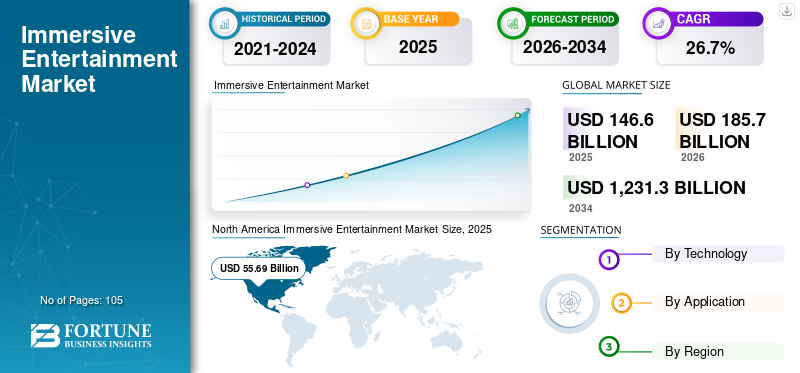
Download Free sample to learn more about this report.
Immersive Entertainment Market KEY TAKEAWAYS
 Global Market Size & Forecast
- 2025 Market Size: USD 146.6 billion
- 2026 Market Size: USD 185.7 billion
- 2034 Forecast Market Size: USD 1,231.3 billion
- CAGR: 26.7% from 2025–2034
 Market Share
- North America dominated the global market with 37.99% share in 2025.
- Virtual Reality held 42.1% market share, driven by fully immersive experiences.
- Gaming accounted for 35.6% market share, supported by the established use of VR and AR technologies.
 Key Regional Highlights
North America
The leading region with 37.99% share, characterized by a mature, innovation-driven ecosystem spanning gaming.
Asia Pacific
The fastest-growing region, supported by a large consumer base, rapid digital adoption.
Europe
Growth is driven by the integration of immersive technologies into cultural heritage, museums, tourism, gaming.
U.S.
The U.S. market was approximately USD 46.32 billion in 2025, representing roughly 31.6% of global revenues.
Japan
The Japan market reached approximately USD 6.52 billion in 2025, representing around 4.5% of global revenues.
Read More

IMMERSIVE ENTERTAINMENT MARKET TRENDS
Shift toward Subscription and Experience-as-a-Service Models Pose as a Key Trend
The market is increasingly shifting toward subscription-based and Experience-as-a-Service (EaaS) models, away from one-time purchases and toward recurring revenue streams. This change reflects a broader trend in digital media, where consumers prefer on-demand access to content and experiences over ownership. Subscription models are particularly effective in immersive ecosystems, where content is constantly evolving, and they allow for bundled services that combine gaming, social interaction, and entertainment on a single platform. EaaS models are also growing in location-based entertainment, enabling users to pay for access to immersive venues or premium experiences.
- In 2024, Microsoft offers a subscription service providing access to a wide array of games, including immersive, VR-compatible experiences.
MARKET DYNAMICS
MARKET DRIVERS
Download Free sample to learn more about this report.
Advancements in Spatial Computing & Human-Computer Interaction to Accelerate the Market Growth
The advancement of spatial computing and Human-Computer Interaction (HCI) is transforming the market by enabling users to engage with digital environments more naturally and intuitively. Unlike traditional interfaces, spatial computing uses gesture recognition, eye tracking, voice commands, and haptic feedback for seamless interaction with virtual worlds.
- Falcon's Beyond acquired Oceaneering Entertainment Systems (OES) to integrate advanced ride engineering and patented technologies. The integration of real-time spatial mapping enhances realism in applications such as gaming, immersive theater, and live-event augmentation.
- Apple’s Vision Pro, launched in June 2023, features eye tracking and hand gesture control, marking significant progress toward controller-free gaming. These intuitive interfaces broaden the appeal of immersive experiences across various platforms.
MARKET RESTRAINTS
Content Fragmentation and Lack of Standardization Might Limit the Market Growth
The market is hindered by fragmentation across platforms, devices, and development ecosystems, slowing scalability and adoption. Unlike traditional digital platforms, immersive technologies operate across various hardware environments, such as VR headsets, AR-enabled smartphones, and emerging MR devices, each with its own software, operating systems, and content requirements. Fragmentation also extends to content distribution and monetization models, where different platforms have unique app stores, payment systems, and revenue-sharing structures, creating barriers for global content creators. From a consumer standpoint, fragmentation results in inconsistent experiences, limiting access to certain content, and reducing overall engagement. Overcoming these challenges and establishing cross-platform standardization will be essential to unlock the immersive entertainment market growth.
MARKET OPPORTUNITIES
Growth of Immersive Advertising & Brand Experiences to Create Market Opportunities
The integration of immersive technologies into advertising is revolutionizing traditional marketing by transforming it into interactive, experience-driven engagement, offering significant growth potential for the market. Unlike conventional digital ads, immersive advertising enables real-time interactivity with products and brands through AR, VR, and MR, enhancing engagement, recall, and conversion rates. Brands are increasingly adopting AR-based virtual try-ons, interactive demos, gamified experiences, theme park activations, and immersive storytelling campaigns, especially in sectors such as fashion, automotive, consumer electronics, and entertainment, where visualization and emotional engagement are key to decision-making.
- Snap Inc. expanded its AR Enterprise Services (ARES) to create immersive shopping experiences such as virtual try-ons.
Additionally, the rise of AR filters on social media and branded effects has driven higher engagement, making advertising more participatory and aligning with the growth of virtual commerce and digital goods.
SEGMENTATION ANALYSIS
By Technology
Virtual Reality is set to lead due to Fully Immersive Experiences and Widespread Adoption in Gaming
Based on technology, the market is divided into Virtual Reality (VR), Augmented Reality (AR), Mixed Reality (MR), and others.
Virtual reality holds 42.1% of the immersive entertainment market share due to its ability to provide fully immersive experiences. Further, enabling users to be completely transported into virtual worlds, making it highly popular in the gaming, training, and simulation sectors. The widespread availability of VR devices and content, along with advancements in visual and motion tracking technologies, has significantly contributed to its dominance.
Mixed reality is expected to grow at the highest CAGR of 28.7% during the forecast period, as it combines the digital and physical worlds. Further, offering unique interactive experiences that are being increasingly adopted in education, healthcare, and enterprise applications. The rise of hybrid environments and the need for more versatile, engaging experiences are driving the adoption of mixed reality across industries.
By Application
To know how our report can help streamline your business, Speak to Analyst
Gaming Segment Dominates due to Established Use of VR and AR Technologies for Interactive Experiences
By application, the market is segmented into gaming, live events, museum and cultural experiences, music and concerts, sports, arcade studios, immersive theatre, and others.
The gaming segment dominates the market with a 35.6% share, owing to its long-established use of VR and AR technologies, which deliver rich, interactive experiences that deeply engage users. As the gaming industry continues to evolve, advancements in immersive technologies are creating more realistic and captivating environments for players.
Live events are expected to record the highest CAGR of 29.3% during the forecast period. This growth is due to the segment’s role in virtual concerts, sports events, and immersive shows which is becoming more mainstream, offering audiences new ways to engage with entertainment remotely. The increasing demand for virtual participation and interactive content in live events is fueling growth in this application.
Immersive Entertainment Market Regional Outlook
By region, the market is categorized into North America, South America, Europe, Asia Pacific, and the Middle East & Africa.
North America
North America Immersive Entertainment Market Size, 2025 (USD Billion)
To get more information on the regional analysis of this market, Download Free sample
North America represents the most mature and innovation-driven market, supported by a strong ecosystem of technology providers, content creators, and platform developers. The region benefits from early adoption of VR, AR, and MR technologies, particularly in gaming, live events, and experiential media.
The region’s dominance is reinforced by the presence of major technology companies such as Meta, Apple, Microsoft, and Google, which are continuously investing in next-generation immersive hardware and platforms.
- For instance, Apple Inc.'s announcement of the Apple Vision Pro in June 2023 marked a significant milestone in advancing mixed reality adoption and spatial computing experiences.
U.S. Immersive Entertainment Market
The U.S. market was analytically approximated at around USD 46.32 billion in 2025, accounting for roughly 31.6% of global sales.
Asia Pacific
Asia Pacific is the fastest-growing region in the market, driven by a unique combination of a large-scale consumer base, rapid digital adoption, and strong hardware manufacturing ecosystems. The region benefits from both demand-side scale and technology leadership.
The presence of a strong domestic hardware manufacturing base, particularly in China, is accelerating the adoption of VR and AR devices. Chinese companies such as ByteDance and other local manufacturers are driving the affordability and accessibility of immersive devices through strategic acquisitions and expansions.
Japan Immersive Entertainment Market
The Japan market in 2025 was valued at around USD 6.52 billion, accounting for roughly 4.5% of global revenues.
China Immersive Entertainment Market
China’s market is projected to be one of the largest worldwide, with 2025 revenues estimated at around USD 18.40 billion, representing roughly 12.6% of global sales.
India Immersive Entertainment Market
The Indian market in 2025 was valued at around USD 4.38 billion, accounting for roughly 3.0% of global revenues.
Europe
Europe’s market is characterized by strong growth driven by the integration of immersive technologies into cultural heritage, museums, and tourism experiences. The region has been at the forefront of adopting AR and VR to digitize historical assets and enhance visitor engagement.
The region benefits from a well-established creative industries ecosystem, particularly in countries such as the U.K., France, and Germany.
- In 2024, the U.K. gaming sector continues to expand, contributing significantly to immersive content development and interactive media innovation.
U.K. Immersive Entertainment Market
The U.K. market in 2025 was valued at around USD 7.15 billion, representing roughly 4.9% of global revenues.
Germany Immersive Entertainment Market
Germany’s market value reached approximately USD 9.21 billion in 2025, equivalent to around 6.3% of global sales.
Middle East & Africa
The Middle East & Africa market is witnessing strong momentum, primarily driven by government-led giga projects and national transformation agendas. Countries in the GCC, particularly Saudi Arabia and the UAE, are investing heavily in building large-scale entertainment ecosystems.
- For instance, Saudi Arabia’s Vision 2030 initiatives include projects such as Qiddiya and NEOM, which integrate immersive and digital entertainment experiences at their core.
GCC Immersive Entertainment Market
The GCC market reached at around USD 2.02 billion in 2025, representing roughly 1.4% of global revenues.
South America
South America’s market is experiencing steady growth, primarily driven by the rapid expansion of mobile-first digital ecosystems. Its adoption in the region is largely supported by smartphone-based AR experiences and cloud-driven gaming platforms, making it more accessible to a broader population.
Increasing internet penetration and improving connectivity infrastructure are enabling wider access to immersive content. The rising youth population and digital-native consumers are accelerating demand for interactive and immersive content.
Brazil Immersive Entertainment Market
The Brazil market in 2025 was valued at around USD 3.75 billion, accounting for roughly 2.6% of global revenues.
COMPETITIVE LANDSCAPE
Key Industry Players
Key Players Launch New Solutions to Strengthen Market Positioning
Market players are introducing new solutions to improve their competitive positioning by adopting advanced technologies, addressing evolving consumer needs, and staying ahead of industry competition. Companies such as Alphabet Inc., Apple Inc., HTC Corporation, and Magic Leap, Inc. are focusing on portfolio expansion, strategic partnerships, acquisitions, and collaborations to strengthen their offerings. These initiatives help technology companies enhance their market presence, capture new growth opportunities, and sustain their position in a rapidly changing business environment.
LIST OF KEY IMMERSIVE ENTERTAINMENT COMPANIES PROFILED
- Alphabet Inc. (U.S.)
- Apple Inc. (U.S.)
- HTC Corporation (Taiwan)
- Magic Leap, Inc. (U.S.)
- Meta Platforms, Inc. (U.S.)
- Microsoft Corporation (U.S.)
- QUALCOMM Incorporated (U.S.)
- Samsung Electronics Co., Ltd. (South Korea)
- Sony Group Corporation (Japan)
- UNITY Software Inc. (U.S.)
KEY INDUSTRY DEVELOPMENTS
- October 2025: Samsung Electronics Co., Ltd. launched its Galaxy XR headset (Project Moohan) in collaboration with Google and Qualcomm, marking its entry into the extended reality device market.
- June 2025: Apple Inc. advanced its Vision Pro ecosystem, focusing on spatial computing capabilities, including spatial audio and immersive content integration.
- May 2025: Meta Platforms, Inc. expanded its immersive ecosystem with updates to Quest VR devices and Horizon platforms, enhancing social and interactive virtual experiences.
- May 2025: Google LLC demonstrated Android XR and smart glasses prototypes, showcasing advancements in augmented reality and immersive computing.
- April 2025: Qualcomm Technologies, Inc. introduced enhanced Snapdragon XR platforms, improving performance for VR and AR devices across multiple ecosystems.
- March 2025: Unity Software Inc. expanded its platform with AI driven, cloud-based tools, enabling scalable development of immersive, real-time 3D content.
- February 2025: Magic Leap, Inc. showcased AR smart glasses prototypes developed in collaboration with Google, further strengthening its position in spatial computing.
REPORT COVERAGE
The global market analysis provides an in-depth study of the size & forecast by all the market segments included in the report. It includes details on the market dynamics and market trends expected to drive the market in the forecast period. It offers information on the technological advancements, key developments, and details on partnerships, mergers & acquisitions. The market research report also includes a detailed competitive landscape, providing market share and profiles of key players.
Request for Customization to gain extensive market insights.
REPORT SCOPE & SEGMENTATION
| ATTRIBUTE | DETAILS |
| Study Period | 2021-2034 |
| Base Year | 2025 |
| Estimated Year | 2026 |
| Forecast Period | 2026-2034 |
| Historical Period | 2021-2024 |
| Growth Rate | CAGR of 26.7% from 2026-2034 |
| Unit | Value (USD Billion) |
| Segmentation | By Technology, By Application, and By Region |
| By Technology |
|
| By Application |
|
| By Region |
|
Frequently Asked Questions
Fortune Business Insights says that the global market value stood at USD 146.6 billion in 2025 and is projected to reach USD 1,231.3 billion by 2034.
In 2025, the market value stood at USD 55.69 billion.
The market is expected to grow at a CAGR of 26.7% over the forecast period.
By application, the gaming segment led the market in 2025.
Key factors driving the market include advancements in VR/AR technology, growing consumer demand for interactive and engaging experiences, increased adoption of 5G networks enabling seamless content delivery, and the expansion of the gaming industry.
Alphabet Inc., Apple Inc., HTC Corporation, and Magic Leap, Inc. are some of the prominent players in the market.
North America dominated the market in 2025.
Major factors expected to favor product adoption include the increasing affordability of VR/AR devices, greater content availability, and improved user experience enabled by advanced hardware and software integration.



- 2021-2034
- 2025
- 2021-2024
- 105
Get 30-60 hrs Free Customization
Expand Regional and Country Coverage, Segments Analysis, Company Profiles, Competitive Benchmarking, and End-user Insights.




















Related Reports
-
US +1 833 909 2966 ( Toll Free )
-
Get In Touch With Us