Immunomodulators Market Size, Share, Trends & COVID-19 Impact Analysis, By Product Type (Immunosuppressant, Immunostimulants), By Application (Oncology, Respiratory, Multiple Sclerosis, and Others), and Regional Forecast, 2026-2034
 Download Free Sample
Immunomodulators Market Size and Industry Overview
 Listen to Audio Version
The global immunomodulators market size was valued at USD 250.69 billion in 2025. The market is projected to grow from USD 269.15 billion in 2026 to USD 475.04 billion by 2034, exhibiting a CAGR of 7.36% during the forecast period. North America dominated the immunomodulators market with a market share of 38.32% in 2025. The sudden rise in CAGR is attributable to this market’s demand and growth, returning to pre-pandemic levels once the pandemic is over.
Immunomodulators are medications that stimulate the function of the immune system by regulating the immune response. Immunostimulants, such as vaccines, antibodies, and interferons, enhance the body's resistance against infections. These are mostly used in transplantation to prevent organ rejection, coupled with autoimmune diseases such as rheumatoid arthritis and multiple sclerosis.
Robust research and development against several diseases, such as multiple sclerosis, rheumatoid arthritis, Crohn’s disease, and others, has resulted in the launch of novel drugs. For example, in August 2019, Squarex announced its results of positive Phase II clinical study SQX770, a topical immunomodulator squaric acid dibutyl ester (SADBE), which is used for treating patients with recurrent herpes labialis. This drug molecule is the first and only drug approved by the U. S. FDA for the treatment of recurrent herpes labialis after promising the completion of Phase III trials. Therefore, it is anticipated that the global market is likely to showcase tremendous growth during the forecasted timeframe.
COVID-19 Pandemic to Affect Sales Positively Owing to Improvements in Supply Chain
The COVID-19 pandemic has had a positive impact on the global immunomodulators market, owing to a surge in the sales of products with respect to the emergency. Various pharmaceutical companies amid the pandemic have significantly focused on maintaining the balance between supply and demand, thus keeping their sales intact. These companies have significantly improved their supply chain management, enhanced the capabilities of their R&D, and invested more in their manufacturing management and quality control.
For instance, according to the quarterly reports of 2020 of Roche, its global supply chain of medicines and tests remain intact, and pharmaceutical division sales increased by 7% compared to the previous year. This growth was led by the oncology segment. Furthermore, in December 2020, Himalaya Drug Company announced its result of a clinical study that stated that herbal immunomodulators are effective as an adjuvant treatment for COVID-19 patients.
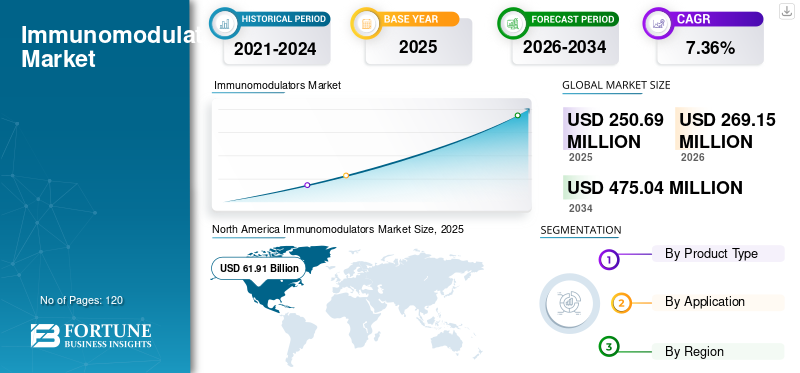
Download Free sample to learn more about this report.
IMMUNOMODULATORS MARKET KEY TAKEAWAYS
 Market Size & Forecast
- 2025 Market Size: USD 250.69 billion
- 2026 Market Size: USD 269.15 billion
- 2034 Forecast Market Size: USD 475.04 billion
- CAGR: 7.36% from 2026–2034
 Market Share
- North America dominated the market with a 38.32% share in 2025.
- The immunosuppressants segment held the largest market share.
- The respiratory segment is expected to account for a 37.9% share in 2025.
 Key Regional Highlights
North America
North America generated USD 61.91 billion in 2025, supported by high disease prevalence and strong product launches.
Europe
Europe is expected to grow at a CAGR of 6.2% during the forecast period, driven by R&D investments and immunosuppressant drug sales.
Asia Pacific
Asia Pacific is projected to record the highest growth rate due to increasing clinical studies and a growing geriatric population.
U.S.
The country remains the largest contributor in North America, supported by a high patient population and the presence of major market players.
Japan
The immunomodulators market is expected to reach USD 7.70 billion in 2025, driven by increasing demand for advanced therapies.
Read More

IMMUNOMODULATORS MARKET LATEST TRENDS
Robust R&D by Companies to Increase Market Potential
Cancer is one of the foremost causes of death globally and current research aims at the discovery of novel approaches to efficiently treat this disease. Lately, a considerable number of clinical trials have proven the success of immunomodulatory therapies for the treatment of cancer. Immune cells play a crucial role in tumor progression, and therefore companies are focusing on R&D of immunotherapy and targeted drug therapy to achieve a faster prognosis.
For example, in 2019, TG Therapeutics, Inc. presented the results from the Phase 2 clinical trials on ublituximab (TG-1101), an anti-CD20 monoclonal antibody being developed for MS treatment. Therefore, with the help of strategic collaborations among industry players, immunomodulators R&D has reached new heights, consequently contributing to the increasing market potential.
DRIVING FACTORS
Increasing Prevalence of Autoimmune Diseases to Propel Product Demand
Globally, the rising incidence of multiple sclerosis has been marked as the second leading cause of death after cardiovascular disorders. Factors such as the surging number of ongoing clinical trials for the development of immunotherapeutic agents, such as ponesimod, ozanimod, and laquinimod, in the treatment of multiple sclerosis, are expected to propel the demand for immunomodulators products.
Moreover, the high unmet clinical needs concerning the treatment for autoimmune disorders, such as rheumatoid arthritis, are likely to propel the market growth. In addition, immunotherapies are expected to gain acceptance in the upcoming years as these portray a lower risk of adverse effects when compared to other existing drugs. Thus, a higher prevalence, coupled with the surging demand for effective drugs, is anticipated to drive the market growth during the forecast period.
Strong Drug Pipeline to Aid in Providing More Growth Opportunities
Research and development with an aim to provide advanced patient care is accelerating year by year. Innovative experiments are leading to combination therapy with new or existing drug molecules. It has led to a rise in the pipeline candidates for several disease treatment options, including rheumatoid arthritis, multiple sclerosis, Crohn's disease, and others. For instance, Plegridy & Daclizumab by Biogen, Ocrelizumab by Roche, and Receptors' RPC-1063 & Nerventra by Teva Pharmaceuticals are anticipated to be made commercially available during the projected timeline. These immunomodulators are expected to capture a substantial market share in the upcoming years.
Download Free sample to learn more about this report.
RESTRAINING FACTORS
Adverse Effects of Drugs and Stringent Regulations to Restrict Market Growth
There is a greater risk of infection, comprising both primary infection and recurrence of latent infections. Such infections may include hepatitis B and hepatitis C viruses, fungal infections, tuberculosis (TB), and HIV. There is also a high risk of progressive multifocal leukoencephalopathy (PML). Accordingly, before the initiation of immunomodulatory treatment, patients must be screened for these threats or historical exposure to viruses associated with these diseases.
Furthermore, treating autoimmune diseases with a high dose of these drugs often leads to the destruction of tumor cells but also damages the normal cells of the body to a greater extent. This results in various side-effects such as gastrointestinal disorders, hair loss, fatigue, skin disorders, and others in many patients. Therefore, these adverse effects pertaining to autoimmune drugs are set to negatively influence the growth of the global immunomodulators market. Additionally, strict regulations with respect to clinical studies by regulatory bodies are also expected to cause hindrance in market growth.
SEGMENTATION ANALYSIS
By Product Type Analysis
To know how our report can help streamline your business, Speak to Analyst
Increased Sales of Products to Drive the Immunosuppressants Segment
Based on the product type, the market segment includes immunosuppressants and immunostimulants.
The immunosuppressants segment is further classified into antimetabolites, calcineurin inhibitors, glucocorticoids, and others. Besides, the Immunostimulants segment is categorized into vaccines, antibodies, and others.
The immunosuppressants segment accounted for the majority of the market share in 2019. Factors such as the existence of wide-ranging products in this segment with the capability to treat several autoimmune diseases are expected to propel its growth. In addition, these drugs suppress the strength of the body's immune system. They are used for autoimmune disorders such as multiple sclerosis (MS), alopecia areata, rheumatoid arthritis, and lupus to reduce the undesirable immune response of the body.
On the other hand, the immunostimulants segment is expected to grow as the fastest-growing segment during the forecast period owing to the rising incidence of several autoimmune diseases. The immunostimulants segment is projected to generate USD 119.00 billion in revenue by 2025.
By Application Analysis
Rising Prevalence of Cancer to Bolster Growth of the Oncology Segment
In terms of application, the market is segmented into oncology, respiratory, HIV, and others. The other segment, which includes rheumatoid arthritis, multiple sclerosis, Crohn’s disease, and others, holds the lion’s share in the global market owing to the wide adoption of these products for their treatment. This, coupled with new drug development activities in response to unmet needs and expected product launches for several indications, are anticipated to show future growth opportunities.
Besides, the rising awareness regarding cancer among the population is anticipated to favor the oncology segment in the upcoming years. Globally, the cancer incidence rate has increased to make it the second leading cause of death after cardiovascular disorders. Thus, the growing prevalence of cancer is expected to boost the global market during the projected time frame. The respiratory segment is expected to hold a 37.9% share in 2025.
REGIONAL ANALYSIS
North America Immunomodulators Market Size, 2025 (USD Billion)
To get more information on the regional analysis of this market, Download Free sample
North America and Europe
The market size in North America stood at USD 61.91 billion in 2025. The dominance of this region is attributable to the rising incidence of diseases among the U.S population. Also, another major factor contributing to the growth of the region is the presence of major players, coupled with the launch of new products. Europe holds the second position in the market owing to its investments in R&D for the development of effective drugs. This, coupled with the higher sales of immunosuppressant products, is expected to drive growth during the forecast period.
- Europe is anticipated to grow at a CAGR of 6.2% during the forecast period.
Asia Pacific
Moreover, Asia Pacific is anticipated to exhibit the highest CAGR owing to the growing number of clinical studies pertaining to immunomodulators and the increasing geriatric population in the region.
- The immunomodulators market in Japan is expected to reach USD 7.70 billion by 2025.
- China is projected to witness a strong CAGR of 7.00% during the forecast period.
Middle East & Africa
On the other hand, Latin America and the Middle East & Africa are likely to show comparatively slower growth owing to the lower adoption of expensive drugs coupled with the lack of product approvals in the majority of underdeveloped countries.
KEY INDUSTRY PLAYERS
Key Players Focus on Research and Development Activities to Intensify Competition
F. Hoffmann-La Roche Ltd., Abbott Laboratories, Bristol-Myers Squibb Company, Amgen Inc., and Novartis AG ruled the global market in 2019 and will continue to dominate in the upcoming years. Their dominance is driven by robust product portfolios, key strategic business acquisitions, and strong product pipelines. These companies have a wider geographic presence and are actively involved in research and development, thereby resulting in robust regulatory approvals. For Instance, in October 2019, Amgen announced the launch of AMGEVITATM, an adalimumab biosimilar approved by the EC, across Europe.
LIST OF TOP IMMUNOMODULATORS COMPANIES:
- F. Hoffmann-La Roche Ltd (Basel, Switzerland)
- Novartis AG (Basel, Switzerland)
- Biogen (Massachusetts, U.S.)
- Teva Pharmaceutical Industries Ltd. (Petah Tikva, Israel)
- Amgen, Inc (California, U.S.)
- Bristol-Myers & Squibb Company (New York, U.S)
- Merck Sharp & Dohme Corp. (New jersey, U.S)
- Eli Lilly and Company (Indiana, U.S)
- Other Players
KEY INDUSTRY DEVELOPMENTS:
- July 2021, Prograf has been licenced by the FDA for use in combination with other immunosuppressive medications to prevent organ rejection in adult and pediatric lung transplant recipients. Prograf was first licensed to prevent organ rejection in patients getting liver transplants, but it was later expanded to include kidney and heart transplants.
- February 2021, As a part of a larger development plan, PFIZER and BIONTECH have started a study to eliminate COVID-19 booster and new vaccine variations.
- January 2021, Aurinia Pharmaceuticals Inc. announced that the U.S. Food and Drug Administration (FDA) has approved LUPKYNIS (voclosporin) in combination with a background immunosuppressive therapy regimen to treat adult patients with active lupus nephritis (LN). LUPKYNIS is the first LN oral medication to be authorised by the FDA. LN damages the kidneys irreversibly, increasing the risk of renal failure, cardiac events, and death. It's one of the most dangerous and prevalent side effects of systemic lupus erythematosus.
- February 2021, Horizon Therapeutics plc announced that they will acquire Viela Bio, Inc. in order to significantly expand its development pipeline and grow its rare disease medicine portfolio. UPLIZNA is the first and only FDA-approved humanized monoclonal antibody to deplete B cells in patients with neuromyelitis optica spectrum illness (NMOSD) The optic nerve, spinal cord, and brain stem are all attacked by this rare, severe autoimmune disease. Adults with anti-aquaporin-4 (AQP4) antibody positivity have visual loss and paralysis.
REPORT COVERAGE
The global market research report provides a detailed analysis of the market and focuses on key aspects such as leading companies, product types, and leading applications of the product. Besides this, it offers insights into market developments and highlights key industry trends. In addition to the aforementioned factors, the report encompasses several factors that have contributed to the growth of the advanced market in recent years.
Request for Customization to gain extensive market insights.
Report Scope & Segmentation
|
ATTRIBUTE |
DETAILS |
|
Study Period |
2021-2034 |
|
Base Year |
2025 |
|
Forecast Period |
2026-2034 |
|
Historical Period |
2021-2024 |
|
Unit |
Value (USD Billion) |
|
Segmentation |
Product Type; Application; and Region |
|
By Product Type
|
|
|
By Application
|
|
|
By Geography
|
|
Frequently Asked Questions
According to Fortune Business Insights, the global immunomodulators market was valued at USD 250.69 billion in 2025 and is projected to grow from USD 269.15 billion in 2026 to USD 475.04 billion by 2034.
North America dominated the immunomodulators market with a market share of 38.32% in 2025, attributed to the rising incidence of diseases and the presence of major players in the region.
Registering a CAGR of 7.36%, the market will exhibit strong growth in the forecast period (2026-2034).
The oncology segment is anticipated to grow at the fastest rate during the forecast period, driven by the increasing prevalence of cancer and the development of novel therapies.
The increasing prevalence of autoimmune diseases, rising awareness about immunotherapies, and advancements in drug development are key factors propelling the growth of the immunomodulators market.
Leading companies in the immunomodulators market include F. Hoffmann-La Roche Ltd, Novartis AG, Biogen, Teva Pharmaceutical Industries Ltd., Amgen Inc., Bristol-Myers Squibb Company, Merck & Co., Inc., and Eli Lilly and Company.
The immunomodulators market is segmented into immunosuppressants and immunostimulants, with immunosuppressants expected to lead the market during the forecast period.
Recent trends in the immunomodulators market include robust research and development activities, strategic collaborations among industry players, and the introduction of novel drugs targeting various diseases such as multiple sclerosis, rheumatoid arthritis, and Crohns disease.



- 2021-2034
- 2025
- 2021-2024
- 120
Get 30-60 hrs Free Customization
Expand Regional and Country Coverage, Segments Analysis, Company Profiles, Competitive Benchmarking, and End-user Insights.













.webp)






Related Reports
-
US +1 833 909 2966 ( Toll Free )
-
Get In Touch With Us