Implantable Tibial Neuromodulation Systems Market Size, Share & Industry Analysis By Product Type (Battery Powered and Externally Powered), By Application (Urge Urinary Incontinence, Overactive Bladder, and Others), By End-user (Hospitals, Specialty Clinics, and Others), and Regional Forecast, 2026-2034
 Download Free Sample
Implantable Tibial Neuromodulation Systems Market Size and Future Outlook
 Listen to Audio Version
The implantable tibial neuromodulation systems market size was valued at USD 53.17 million in 2025. The market is projected to grow from USD 72.33 million in 2026 to USD 395.60 million by 2034, exhibiting a CAGR of 23.7% during the forecast period.
Implantable tibial neuromodulation systems are minimally invasive treatment devices implanted near the ankle to stimulate the tibial nerve, which has neural influence over bladder-control pathways. These systems are mainly used for Urge Urinary Incontinence (UUI), a common symptom of Overactive Bladder (OAB), particularly in patients who do not achieve adequate relief from behavioral therapy or medications. The market growth is driven by the high untreated urge urinary incontinence and overactive bladder population, increasing acceptance of non-pharmacologic therapies, and the shift toward outpatient, low-maintenance implants.
Furthermore, BlueWind Medical Ltd, Medtronic, and Valencia Technologies are key players highly focused on innovations and obtaining approvals for their implants across the globe.
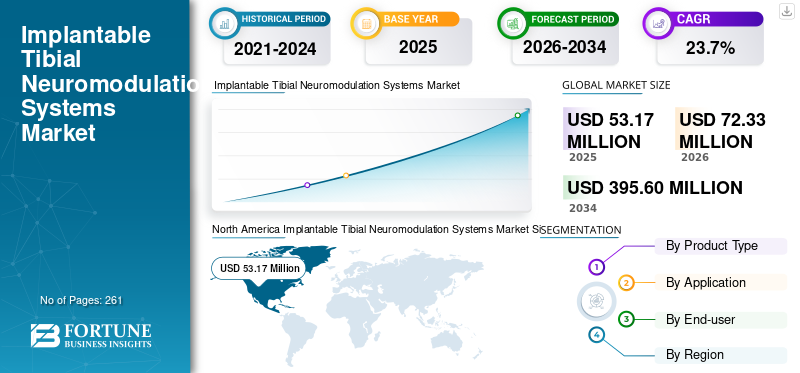
Download Free sample to learn more about this report.
Implantable Tibial Neuromodulation Systems Market Trends
Shift Toward Miniaturized, Patient-friendly, and Low-maintenance Implant Designs is an Emerging Market Trend
There is an increasing shift toward smaller, more patient-friendly systems that minimize patient management burden. For instance, eCoin is a coin-sized, primary-battery implant that automatically delivers intermittent tibial stimulation without ongoing patient handling of a power source. Similarly, Medtronic’s Altaviva is designed with a 15-year battery lifespan, MRI compatibility, and automatic therapy delivery.
Moreover, key players are focusing on receiving approvals for a battery-free implant powered by a lightweight external wearable. Also, these players are focusing on strategic initiatives such as facility expansions, conducting research studies for their products, and involving in collaborations.
Market Dynamics
Market Drivers
Download Free sample to learn more about this report.
Rising Burden of UUI/OAB and Demand for Durable Non-drug Therapy to Drive Market Growth
In recent years, there has been a rising prevalence of OAB and UUI across the globe. This is creating a strong clinical and commercial need for therapies that fill the gap between drugs, office-based PTNS, botulinum toxin injections, and sacral neuromodulation. Implantable tibial systems address this gap by offering long-term stimulation through a small ankle-area implant, often under local anesthesia, with fewer ongoing clinic visits.
Such a scenario, is expanding its adoption worldwide, which is anticipated to drive the global implantable tibial neuromodulation systems market growth.
- In September 2025, Medtronic estimated that bladder-control problems affect about 43.0 million U.S. adults, with nearly 16.0 million experiencing urge urinary incontinence.
|
Rank |
Market Driver |
Overall Impact Rank |
CAGR Contribution (2026-2034) |
Impact: 2026-2028 |
Impact: 2029-2031 |
Impact: 2032-2034 |
|
1 |
Rising Burden of UUI/OAB and Demand for Durable Non-drug Therapy |
High |
+8.0% |
High |
High |
High |
|
2 |
Recent FDA Approvals and Commercial Launches of Implantable Tibial Neuromodulation Systems |
Medium-High |
+6.2% |
High |
High |
Medium |
|
3 |
Improving Reimbursement, Coding, Hospital Outpatient, and ASC Payment Support |
Medium-High |
+5.4% |
Medium |
High |
High |
|
4 |
Growing Preference for Minimally Invasive Implant Systems, Low-maintenance Alternatives to Drugs, PTNS, and More Invasive Neuromodulation |
Medium-High |
+4.7% |
Medium |
High |
High |
|
5 |
Entry of Large MedTech Players and Increasing Commercial Investment |
Medium |
+4.0% |
Medium |
Medium |
Medium |
|
6 |
Others (includes physician training, clinical evidence expansion, guideline support, awareness programs, and aging population) |
Low |
+2.6% |
Low |
Low |
Low |
|
|
Total Positive Growth Contribution |
|
+30.9% |
|
|
|
Market Restraints
Reimbursement, Coverage, and Limited Procedure Adoption to Hamper the Market Growth
Reimbursement and payer coverage are still evolving, especially as implantable tibial neuromodulation is newer than sacral neuromodulation and botulinum toxin. As a result, hospitals & ASCs, and physicians need clear coding, payment, and payer-policy support before routine adoption.
Moreover, this becomes more challenging in the countries, where regulatory approvals, procedure reimbursement, clinical guideline recognition, and specialist training may lag. Henceforth, even though there are several developments ongoing, hospitals and other healthcare facilities are still cautious about adopting these implants, which is anticipated to hinder the market growth.
|
Rank |
Market Restraint |
Overall Impact Rank |
Negative CAGR Contribution (2026-2034) |
Impact: 2026-2028 |
Impact: 2029-2031 |
Impact: 2032-2034 |
|
1 |
Reimbursement, Coverage, and Limited Procedure Adoption |
High |
-2.7% |
High |
High |
High |
|
2 |
High Implant and Procedure Cost Compared with Drugs and Non-implantable Tibial Nerve Stimulation |
Medium-High |
-2.1% |
High |
Medium |
Medium |
|
3 |
Limited Physician Training, Patient Selection Complexity, and Competition from Established OAB Therapies |
Medium-Low |
-1.6% |
Medium |
Medium |
Low |
|
4 |
Others (including regulatory delays outside the U.S., patient awareness gaps, device follow-up needs, and adoption barriers in emerging markets) |
Low |
-0.8% |
Low |
Low |
Low |
|
|
Total Negative Growth Impact |
|
-7.2% |
|
|
|
Market Opportunities
Expansion of Healthcare Infrastructure in Emerging Countries to Create Lucrative Market Opportunities
In recent years, there has been an increasing expansion of healthcare infrastructure in emerging countries, which is expected to create lucrative opportunities for newer products. The developing countries, including Brazil, China, and several other countries are emphasizing investment in tertiary hospitals and specialist care networks.
Such investments are increasing access to implantable tibial neuromodulation systems, thereby offering lucrative opportunities for key companies to introduce novel products.
- For instance, according to 2025 statistics published by the Organization for Economic Co-operation and Development (OECD), the healthcare spending was around USD 1,588 per capita in Mexico.
Market Challenges
Limited Healthcare Access in Developing Nations to Challenge Market Expansion
Over the past few years, the limited number of specialists has been challenging the adoption of advanced products in developing countries. Additionally, limited healthcare spending and insufficient insurance coverage are further anticipated to hinder the adoption of these implants.
Therefore, despite the growing burden of OAB and UUI, several patients in developing countries are not able to access advanced treatments, which is expected to limit the market growth over the forecast period.
- For instance, the World Bank Group statistics published in 2023 indicated that nearly 4.5 billion people worldwide lack full access to essential health services.
SEGMENTATION ANALYSIS
By Product Type
Higher Emphasis on Battery Powered Implants by Leading Players Led to Segment’s Dominance
Based on the product type, the market is classified into battery powered and externally powered.
The battery powered segment held the largest global implantable tibial neuromodulation systems market share in 2025. Leading commercial products have emphasized self-contained or automatically delivered stimulation models that reduce ongoing patient effort. Moreover, battery-powered systems also benefit from regulatory-backed clinical evidence and commercial expansion by key players.
The externally powered segment is expected to grow at a CAGR of 24.2% over the forecast period.
To know how our report can help streamline your business, Speak to Analyst
By Application
Growing Prevalence of Urge Urinary Incontinence Led to Segment’s Dominance
Based on application, the market is segmented into urge urinary incontinence, overactive bladder, and others.
The urge urinary incontinence segment dominated the global market in 2025 and is estimated to hold a share of 81.8% in 2026. The growth is due to the growing prevalence of urge urinary incontinence, resulting in a growing adoption rate of implantable tibial neuromodulation systems primarily indicated for UUI.
- For instance, according to the European Association of Urology in November 2025, the global prevalence of urinary incontinence (UI) is projected at over 20.0% of the adult population.
The overactive bladder segment is set to grow with a CAGR of 26.6% during the forecast period.
By End-user
Increasing Number of Hospitals & ASCs to Drive the Segment’s Growth
Based on end-user, the market is divided into hospitals & ASCs, specialty clinics, and others.
The hospitals & ASCs segment dominated the market in 2025. The increasing prevalence of OAB and UUI along with a rise in the number of hospitals are some of the key factors contributing to the segment’s dominance worldwide. Furthermore, the segment is set to hold a share of 54.2% in 2026.
- For instance, 2026 data published by the Australian Private Hospitals Association (APHA) reported that Australia has 637 private hospitals.
On the other hand, the specialty clinics segment is projected to grow at a CAGR of 24.9% during the forecast period.
Implantable Tibial Neuromodulation Systems Market Regional Outlook
Based on region, the market has been studied across North America, Europe, Asia Pacific, Latin America, and the Middle East & Africa.
North America
North America Implantable Tibial Neuromodulation Systems Market Size, 2025 (USD Million)
To get more information on the regional analysis of this market, Download Free sample
North America accounted for the largest share of revenues in 2024, valued at USD 31.90 million, and further reached USD 53.17 million in 2025. The growth is primarily due to early FDA approvals, stronger reimbursement progress, higher awareness of overactive bladder therapies, and the presence of leading commercial players in the region.
Europe
Europe is projected to record a growth rate of 72.9% in the coming years, which is the second highest among all regions, and is set to reach a valuation of USD 1.79 million by 2027. The region’s growth is due to established urology infrastructure and high prevalence of urinary incontinence and overactive bladder symptoms across countries such as Germany, the U.K., and Italy.
U.K. Implantable Tibial Neuromodulation Systems Market
The U.K. market value in 2027 is estimated at around USD 0.56 million, representing roughly 0.6% of global revenues.
Germany Implantable Tibial Neuromodulation Systems Market
Germany market size is projected to reach approximately USD 9.2 million by 2027, equivalent to around 0.8% of global sales.
Asia Pacific
Asia Pacific is estimated to reach USD 0.16 million in 2028 and secure the position of the third-largest region in the market. The region’s growth is driven by increasing healthcare facilities and expanding access to urology and urogynecology care in Japan, Australia, and India.
Japan Implantable Tibial Neuromodulation Systems Market
The Japan market value in 2029 is estimated at around USD 1.22 million, accounting for roughly 0.7% of global revenues. Japan has historically reported a relatively increasing prevalence of neurological diseases, with a rising awareness about implantable tibial neuromodulation systems.
China Implantable Tibial Neuromodulation Systems Market
China’s market is projected to be at around USD 0.97 million by 2031, representing roughly 0.4% of global sales.
India Implantable Tibial Neuromodulation Systems Market
The Indian market size in 2030 is estimated at around USD 0.22 million, accounting for roughly 0.1% of global revenues.
Latin America and Middle East & Africa
Latin America and the Middle East & Africa regions are expected to witness moderate growth during the forecast period. The Latin America market is currently in the research and early-development phase, with commercial growth anticipated to gain momentum from 2029. Similarly, the market is projected to reach a valuation of USD 0.05 million in 2029. The growth is due to growing urology procedure volumes and increasing awareness of urinary incontinence treatment. In the Middle East & Africa, the GCC market is projected to reach a value of USD 0.05 million in 2028.
Competitive Landscape
Key Industry Players
Higher Focus of Key Players on Regulatory Approvals and Commercial Execution to Expand their Market Share
The global implantable tibial neuromodulation systems market is currently highly concentrated, with competition mainly led by BlueWind Medical Ltd, Medtronic, and Valencia Technologies. The market is still in an early commercialization phase, so competition is more about regulatory approvals, clinical evidence, reimbursement access, physician training, and commercial execution.
Moreover, other strategic initiatives such as the acquisitions, partnerships, and publishing clinical data are also expected to help the key companies expand their market share.
List of Key Implantable Tibial Neuromodulation Systems Companies Profiled
- Medtronic (Ireland)
- BlueWind Medical Ltd (U.S.)
- Valencia Technologies (Boston Scientific Corporation) (U.S.)
KEY INDUSTRY DEVELOPMENTS
- May 2026: BlueWind Medical Ltd secured USD 47.8 million in financing to accelerate commercialization of the Revi System.
- January 2026: Boston Scientific Corporation announced a definitive agreement to acquire Valencia Technologies, developer of the eCoin ITNS system.
- December 2025: BlueWind Medical Ltd received FDA 510(k) clearance for the enhanced Revi wearable to support long-term UUI treatment.
- September 2025: Medtronic received FDA approval for Altaviva, an implantable tibial neuromodulation device for urge urinary incontinence.
- August 2023: BlueWind Medical Ltd secured the U.S. FDA De Novo classification for the Revi System for urgency incontinence.
- March 2022: Valencia Technologies announced FDA PMA approval of the eCoin leadless tibial neurostimulator for urinary urge incontinence.
- April 2021: Medtronic received FDA approval to proceed with an IDE trial for its internally developed implantable tibial neuromodulation therapy for bladder incontinence.
REPORT COVERAGE
The report presents an in-depth analysis of the implantable tibial neuromodulation systems market, with a focus on key areas such as leading companies and market segmentation by product type, application, and end-user. It also provides insights into market trends and highlights major industry developments. In addition, the report covers various factors that have supported the growth and advancement of the market in recent years.
Request for Customization to gain extensive market insights.
Report Scope & Segmentation
| ATTRIBUTE | DETAILS |
| Study Period | 2021-2034 |
| Base Year | 2025 |
| Estimated Year | 2026 |
| Forecast Period | 2026-2034 |
| Historical Period | 2021-2024 |
| Growth Rate | CAGR of 23.7% from 2026-2034 |
| Unit | Value (USD Million) |
| Segmentation | By Product Type, Application, End-user, and Region |
| By Product Type |
|
| By Application |
|
| By End-user |
|
| By Region |
|
Frequently Asked Questions
Fortune Business Insights says that the global market size was USD 53.17 million in 2025 and is projected to reach USD 395.60 million by 2034.
In 2025, the market value stood at USD 53.17 million.
Growing at a CAGR of 23.7%, the market will exhibit steady growth over the forecast period.
By product type, the battery powered segment is leading the market.
The rising burden of UUI/OAB and demand for durable non-drug therapy is a key factor driving the market's growth.
BlueWind Medical Ltd, Medtronic, and Valencia Technologies are the major players in the global market.
North America held the highest share of the market.



- 2021-2034
- 2025
- 2021-2024
- 261
Get 30-60 hrs Free Customization
Expand Regional and Country Coverage, Segments Analysis, Company Profiles, Competitive Benchmarking, and End-user Insights.













.webp)






-
US +1 833 909 2966 ( Toll Free )
-
Get In Touch With Us