India Foodservice Market Size, Share & Analysis, By Type (Full Service Restaurants, Quick Service Restaurants, Institutes, and Others), By Service Type (Dine-In, Takeout, and Delivery), By Restaurant Type (Chained and Independent), and Country Forecast, 2026-2034
 Download Free Sample
(Offer valid till 15th Oct 2026)

KEY MARKET INSIGHTS
 Listen to Audio Version
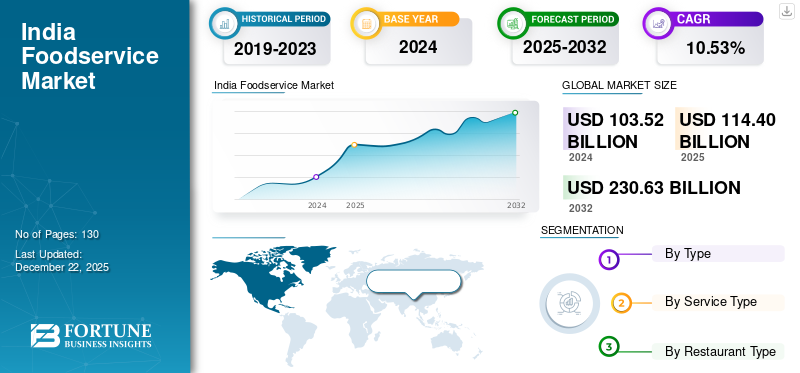
The India foodservice market size was worth USD 114.40 billion in 2025 and is estimated to grow from USD 126.43 billion in 2026 to USD 282.04 billion by 2034. The market is projected to grow at a CAGR of 10.55% during the forecast period.
The foodservice market in India has witnessed exponential growth, driven by the rise of cloud kitchens and growing disposable income. Over the past few years, Indians have experienced a spike in disposable income, which has been a key factor in the expansion and transformation of the country’s foodservice industry. Moreover, the surging demand for prepared meals to save cooking efforts and the rising popularity of dine-out culture are further fueling the growth of the India food service market.
Download Free sample to learn more about this report.
According to the above figure, the increasing women’s employment rate is also a notable factor responsible for the market’s potential.
Download Free sample to learn more about this report.
Global India Foodservice Industry Key Takeaways
Market Size & Forecast:
- 2025 Market Size: USD 114.40 billion
- 2026 Market Size: USD 126.43 billion
- 2034 Forecast Market Size: USD 282.04 billion
- CAGR: 10.55% from 2026–2034
Market Share:
- Full-service restaurants dominated the India foodservice market in 2024, accounting for around 59.04% of the total share due to their extensive menus, personalized dining experience, and higher revenue from beverages and multi-course meals.
- The dine-in segment led by service type and is projected to grow at a CAGR of 9.85% during the forecast period, supported by India’s social dining culture and preference for in-person experiences. Independent restaurants captured approximately 72.20% of the market in 2024, driven by their ability to adapt to local tastes, experiment with fusion cuisine, and offer customized dishes that resonate with diverse regional and urban consumers.
Key Country Highlights:
- India: Market growth is primarily driven by rising disposable income, expanding urbanization, and the growing popularity of online food delivery and cloud kitchens. Increasing employment, especially among women, and changing lifestyles are fueling demand for convenient, ready-to-eat options. Technological advancements such as AI, robotics, and mobile-based ordering are enhancing operational efficiency. However, infrastructural challenges—such as poor cold-chain logistics and inconsistent power supply—pose hurdles to growth. Key market players include Café Coffee Day, Jubilant FoodWorks, Barbeque Nation Hospitality, and Rebel Foods, all focusing on menu innovation, outlet expansion, and digital integration to meet the evolving needs of Indian consumers.
India Foodservice Market Trends
Rising Consumer Inclination towards Cloud Kitchen is the Current Trend
Cloud kitchens are an emerging and crucial trend in India’s foodservice industry, augmented by the growth of online ordering and changing consumer preferences. In comparison to traditional dine-in cafes/restaurants, virtual kitchens operate with reduced overhead costs by eliminating the requirement for physical outlets. The popularity of cloud kitchens has improved since the COVID-19 pandemic, which pushed foodservice providers to adopt delivery-focused models. Additionally, such kitchens provide operational efficiency and a streamlined supply chain, allowing faster deliveries and improved profitability. Moreover, the use of robotics and artificial intelligence in operations management further enhances scalability and efficiency.
Key Takeaways
- By Type: Full service restaurants accounted for around 58.78% of the India foodservice market in 2026.
- By Service Type: The dine-in segment is projected to grow at a CAGR of 9.85% during the forecast period.
- By Restaurant Type: Independent restaurants represented around 71.46% of the India foodservice market in 2026.
India Food Service Market Growth Factors
Surging Disposable Income Boosts the Market’s Potential
Growing disposable income is a pivotal factor fueling the India foodservice market growth. With more disposable income, consumers are spending more on out-of-home food at cafes, fast food outlets, and restaurants. Higher personal income supports a hectic lifestyle that prioritizes convenience, resulting in increased demand for ready-to-eat and prepared meal options. Moreover, improved earning power contributes to greater utilization of online food delivery services, which makes it convenient and easier for individuals to access a vast range of food products from their home/workplace.
Download Free sample to learn more about this report.
India Foodservice Market Restraints
Lack of Adequate Infrastructure Hinders Industry’s Potential
One of the major difficulties faced by foodservice operators in India is inadequate infrastructure. The sector struggles with inadequate availability of storage and cold chain facilities, which often leads to significant food loss and spoilage of perishable items. Moreover, unreliable transportation networks and poor quality roads further challenge the efficient transport of finished food items, adding to logistics costs and delivery timelines. Additionally, a few foodservice sectors face hurdles with inconsistent power supply, further forcing them to sustain high costs for electricity backup.
India Foodservice Market Segmentation Analysis
By Type
Based on type, the market is segmented into full service restaurants, quick service restaurants, institutes, and others.
In 2026, the Full service restaurants segment is projected to lead the market with a 58.78% share. Compared to institutional catering and QSRs, full-time restaurants offer more personalized and complex dishes, appealing to a large consumer base. These restaurants often generate higher revenue, particularly from beverage/alcohol sales and multi-course meals. Moreover, the physical presence of a full-time restaurant aids in building a strong brand identity by offering a flexible and diverse menu to consumers. The quick service restaurant segment is expected to grow at a faster pace, driven by a surge in demand for fast, convenient meals.
By Service Type
Based on service type, the market is trifurcated into dine-in, takeout, and delivery.
The dine-in segment is projected to dominate the market with a share of 70.03% in 2026 and holds numerous advantages over takeaway/delivery services. Dining out is often viewed as a social activity that needs a physical space. Moreover, the dine-in sector assures control over food quality, whereas delivery and packaging can hamper food presentation and quality. Additionally, diners can easily interact with staff, allowing instant feedback and enhancing customer retention.
The delivery segment is expected to witness the highest growth rate during the forecast period, owing to discounts and offers.
By Restaurant Type
Based on restaurant type, the market is divided into chained and independent.
Independent restaurants lead the India food service market. In 2026, the Independent segment is projected to lead the market with a 71.46% share. In comparison to chained restaurants, the independent sector experiments with seasonal specials and local ingredients to create unique fusion dishes. They can easily adapt menus as per market trends and consumer feedback. Moreover, the managers and owners are actively involved on-site, assuring improved attention to consumers’ requirements. Additionally, it provides the option of tailored dishes, whereas a chained restaurant focuses on mass appeal.
The chained restaurants are expected to witness the highest growth rate, due to growing brand recognition.
By Country Type Analysis
India is recognized as one of the fastest-growing markets in the foodservice sector. Urbanisation and globalization have influenced the eating habits of Indians, resulting in a diverse culinary landscape that caters to varied lifestyles and flavors. The emergence of bar and cafe culture has captivated the attention of millennials and Gen Z, looking for high-quality food in social settings. Moreover, the surging work-from-home trend boosts the growth of online food ordering services and co-working spaces, which offer accessible food options. Additionally, the growing demand for fast food meals provides convenient access to meals. The growing number of food courts is further propelling the food industry in India.
List of Key Companies in the India Foodservice Market
Café Coffee Day, Jubilant FoodWorks, and Barbeque Nation Hospitality Limited are the active players in the Indian market. Jubilant FoodWorks is one of the largest foodservice companies in India, which offers a wide range of beverages and food products through its portfolio of brands, including Popeye’s, Dunkin', Domino’s, and others.
Other companies with a moderate presence in the market include Rebel Foods, Wow! Momo and Bikanervala, and other small & medium-sized market players. These enterprises are undertaking strategic moves, such as expanding their market presence by opening new outlets and enhancing their menus with innovative items to attract customers.
LIST OF KEY COMPANIES PROFILED
- Barbeque Nation Hospitality Limited (India)
- Café Coffee Day (India)
- Haldirams Snacks Food Pvt Ltd. (India)
- Jubilant FoodWorks (India)
- Rebel Foods (India)
- Bikanervala (India)
- Wow! Momo (India)
KEY INDUSTRY DEVELOPMENTS
- August 2025: Bayroute, a popular Middle-Eastern foodservice chain, announced the news of opening its new outlet in Ghatkopar, Mumbai.
- August 2025: Pizza Express Limited, a pizza restaurant chain based in the U.K., opened a new foodservice branch at Oberoi Sky City Mall in Mumbai.
REPORT COVERAGE
The report provides a detailed India foodservice market analysis. It focuses on market dynamics and key industry developments, such as mergers and acquisitions. Additionally, it includes information about the growth in food chain outlets and an increase in consumer spending. Besides this, the report also offers insights into the latest India foodservice market trends and the impact of various factors on the food service market.
Request for Customization to gain extensive market insights.
Report Scope & Segmentation
|
ATTRIBUTE |
DETAILS |
|
Study Period |
2021-2034 |
|
Base Year |
2025 |
|
Estimated Year |
2026 |
|
Forecast Period |
2026-2034 |
|
Historical Period |
2021-2024 |
|
Growth Rate |
CAGR of 10.55% from 2026 to 2034 |
|
Unit |
Value (USD Billion) |
|
Segmentation |
By Type
|
|
By Service Type
|
|
|
By Restaurant Type
|
Frequently Asked Questions
Fortune Business Insights says that the India market was valued at USD 126.43 billion in 2026.
The market is expected to exhibit a CAGR of 10.55% during the India foodservice market forecast period (2026-2034).
By type, the full service restaurants segment led the market.
Cafe Coffee Day, Jubilant FoodWorks, and Barbeque Nation Hospitality Limited are the leading players in the market.



- 2021-2034
- 2025
- 2021-2024
- 130
-
(Offer valid till 15th Oct 2026)
Get 30-60 hrs Free Customization
Expand Regional and Country Coverage, Segments Analysis, Company Profiles, Competitive Benchmarking, and End-user Insights.




















Related Reports
-
US +1 833 909 2966 ( Toll Free )
-
Get In Touch With Us