Indoor Air Quality Monitoring System Market Size, Share & Industry Analysis, By Pollutant (Chemical, Physical, and Biological), By End-User (Commercial & Residential, Public Infrastructure, Power Generation Plants, Pharmaceutical Industry, and Others), and Regional Forecast, 2026-2034
 Download Free Sample
KEY MARKET INSIGHTS
 Listen to Audio Version
The global indoor air quality monitoring system market size was valued at USD 2.33 billion in 2025. The market is projected to grow from USD 2.47 billion in 2026 to USD 4.32 billion by 2034, exhibiting a CAGR of 7.27% during the forecast period. North America dominated the global market with a share of 41.08% in 2025.
An indoor air quality (IAQ) monitoring system is a device or set of devices that measures and tracks the levels of pollutants and environmental factors within an indoor space. These systems help assess the air quality and alert users to potential health risks or inefficiencies in ventilation systems.
Honeywell is a global conglomerate offering technologies and solutions to the aerospace, industrial, building, and energy sectors. The company’s Indoor Air Quality IAQ solutions, such as the Indoor Air Quality Monitor and the VESDA Air solution, are designed to help building owners and operators identify potential issues and improve indoor air quality. These systems measure various parameters, including temperature, humidity, and indoor air pollutants, offering insights to enhance building safety and occupant well-being.
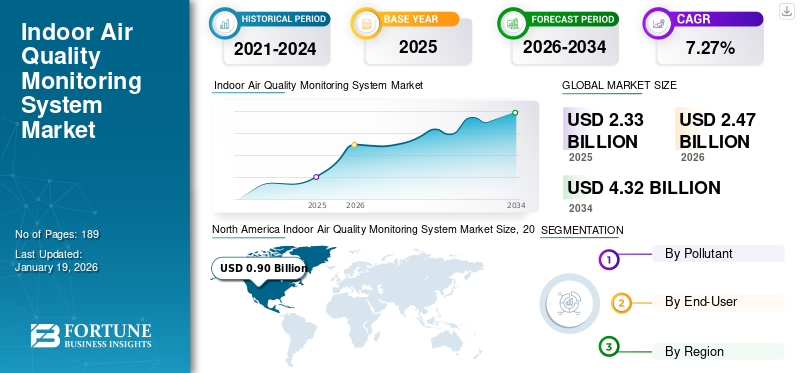
Download Free sample to learn more about this report.
INDOOR AIR QUALITY MONITORING SYSTEM MARKET KEY TAKEAWAYS
 Market Size & Forecast
- 2025 Market Size: USD 2.33 billion
- 2026 Market Size: USD 2.47 billion
- 2034 Forecast Market Size: USD 4.32 billion
- CAGR: 7.27% from 2026–2034
 Market Share
- North America dominated the market with a 41.08% share in 2025.
- Chemical pollutants monitoring was the leading pollutant type segment.
- Commercial & residential applications held the largest market share.
 Key Regional Highlights
North America
North America generated USD 0.96 billion in 2025, held a 41.08% share, and is projected to reach USD 1.02 billion in 2026.
Europe
Europe accounted for USD 0.72 billion and 31.13% of the market in 2025 and is expected to reach USD 0.76 billion in 2026.
Asia Pacific
Asia Pacific recorded USD 0.29 billion with a 12.65% share in 2025 and is projected to reach USD 0.32 billion in 2026.
U.S.
The market is driven by strict IAQ regulations, high health awareness, and growing adoption of smart-home and smart-building technologies.
Japan
The market is supported by rising health awareness, smart building adoption, and increasing focus on indoor environmental quality.
Read More

MARKET DYNAMICS
MARKET DRIVERS
Increasing Adoption in Commercial Setups such as Healthcare and Education to Support Market Growth
The demand for air quality monitoring systems is experiencing significant growth in facilities such as healthcare, education, and others, driven by the critical need for safe, healthy, and comfortable indoor environments. Hospitals, clinics, and other facilities are required to maintain strict air quality standards to prevent the spread of airborne infections.
Contaminants such as volatile organic compounds, carbon dioxide, dust, chemical residue, etc., can significantly compromise air quality. Education institutes often have high occupancy levels; thus, indoor air quality monitoring systems are crucial in such areas, as they help ensure a healthy learning environment by detecting and alerting to harmful pollutants. By providing real-time data and alerts, these systems enable timely interventions such as adjusting ventilation or triggering air purification, ultimately promoting better student health, focus, and academic performance.
MARKET RESTRAINTS
Integration Challenges with Existing Building Systems Could Hinder Market Expansion
Integrating an indoor air quality monitoring system into existing building infrastructure is one of the significant challenges associated with the market. As buildings age, their heating, ventilation, and air conditioning (HVAC) systems, electrical layouts, and automation platforms often become outdated or incompatible with modern technologies. This presents technical and economic challenges to building owners and facility managers, particularly in residential and commercial sectors. Many of the existing/old infrastructure are equipped with outmoded systems that are not compatible with dynamic, real-time monitoring or sensor integration. Thus, these aspects are anticipated to hinder the global indoor air quality monitoring system market growth.
MARKET OPPORTUNITIES
Growing Health Awareness and Air Quality Concerns to Encourage Market Growth
As global pollution levels rise, there is a growing focus on enhancing indoor air quality to mitigate various health issues, including asthma, allergies, and respiratory diseases. Indoor air quality monitoring systems can detect harmful substances, such as VOCs, CO2, and particulate matter. The awareness around air quality has increased due to COVID-19, highlighting the need for sophisticated indoor air quality monitoring systems in residential and commercial properties.
INDOOR AIR QUALITY MONITORING SYSTEM MARKET TRENDS
Increasing Focus on Sustainability is a Major Market Trend
Various industries' sustainability efforts and the necessity to lower energy expenses have led to the implementation of indoor air quality monitoring systems. In energy-efficient structures, effective ventilation and air filtration systems must be in place to reduce power usage and foster healthier spaces. It has been observed that indoor air quality monitoring systems enhance the efficiency of heating, ventilation, and air conditioning methods, reducing energy use while maintaining a safe indoor environment for health.
Download Free sample to learn more about this report.
Segmentation Analysis
By Pollutant
Chemical Segment to Dominate Market Due to Widespread Presence of Harmful Gases in Indoor Air
Based on the pollutant, the market is classified into chemical, physical, and biological.
The chemical segment is anticipated to dominate the global indoor air quality monitoring system market share. Indoor air quality monitoring involves assessing the levels of various pollutants, including chemical substances, to determine the air quality within buildings and its impact on occupants. Common chemical pollutants include volatile organic compounds (VOCs), formaldehyde, carbon monoxide (CO), and nitrogen dioxide (NO2).
Biological pollutants, such as bacteria, viruses, mold, and allergens, can significantly impact indoor air quality and human health. Indoor air quality (IAQ) monitoring focuses on assessing the levels of various pollutants, including biological contaminants, to ensure a healthy indoor environment. Managing the humidity level in a house can help reduce the growth of certain biological sources. It is typically advised to maintain a relative humidity between 30 and 50 percent in residential spaces.
By End-User
Commercial & Residential End-User Dominates Market due to Increasing Pollution Level in Indoor Environments
Based on end-user, the market is divided into commercial & residential, public infrastructure, power generation plants, pharmaceutical industry, and others.
The commercial & residential segment dominates the market, as indoor air quality (IAQ) monitoring is crucial for commercial and residential buildings to ensure occupants' healthy and safe environment. It involves using sensors and specialized equipment to detect and track pollutants and conditions, allowing for proactive mitigation of potential health risks and compliance with regulations.
Indoor air quality (IAQ) monitoring is crucial in the pharmaceutical industry to ensure product safety, employee health, and regulatory compliance. It involves assessing and controlling the environment within manufacturing facilities, particularly cleanrooms, to minimize contamination from airborne particles, microorganisms, and other pollutants.
Indoor Air Quality Monitoring System Market Regional Outlook
By region, the market is categorized into North America, Europe, Asia Pacific, Latin America, and the Middle East & Africa.
North America
North America Indoor Air Quality Monitoring System Market Size, 2025 (USD Billion)
To get more information on the regional analysis of this market, Download Free sample
The North America region captured 41.08% of the global market in 2025, generating USD 0.96 billion in revenue, and is projected to reach USD 1.02 billion in 2026, driven by growing concerns about indoor pollutants and their impact on health, coupled with increasing adoption of smart homes and IoT-enabled systems. Stringent regulations, such as those enforced by the EPA and OSHA, also play a significant role in driving the indoor air quality monitoring system market growth, particularly in the residential, commercial, and industrial sectors.
The U.S. dominates the market in North America, driven by high health concerns, strict IAQ regulations, and the increasing adoption of smart-home and smart-building infrastructure. Moreover, the commercial and residential sectors in the region are increasingly emphasizing healthy buildings.
Europe
Europe maintained a strong presence in the global market, reaching USD 0.72 billion in 2025, accounting for 31.13% share, and is expected to reach USD 0.76 billion in 2026. Europe's indoor air quality monitoring market is growing due to rising health awareness, increasing respiratory diseases, stricter government regulations, and the adoption of smart home technologies. The COVID-19 pandemic has also significantly increased the demand for Indoor Air Quality monitoring solutions. The region also enforces strict air quality standards under directives, including the Ambient Air Quality Directive (2008/50/EC). Indoor air quality is increasingly being integrated into building codes, further driving market growth.
Asia Pacific
In 2025, Asia Pacific generated USD 0.29 billion, contributing 12.65% to global market revenue, and is projected to grow to USD 0.32 billion in 2026. The Asia Pacific region is experiencing significant growth, owing to rising air pollution levels, increasing health concerns related to indoor air quality, and growing awareness of the impact of IAQ on health and productivity. Furthermore, supportive government initiatives, increased funding, and integrating IAQ monitoring with building automation and energy management systems also contribute to the market expansion.
Latin America
The Latin America market generated USD 0.16 billion in 2025, representing 6.84% of the global market landscape, and is expected to reach USD 0.17 billion in 2026. In Latin America, the market is driven by increasing air pollution in urban areas, owing to vehicular emissions and industrial activity, which fuels the demand for monitoring solutions. Increased urbanization, heightened awareness of health risks associated with poor air quality, and the integration of smart technologies encourage market expansion. This growth is further fueled by industrial expansion, particularly in countries such as Brazil, and by government initiatives promoting healthier indoor environments.
Middle East & Africa
Middle East & Africa recorded a market size of USD 0.19 billion in 2025, capturing 8.30% of the global market share, and is projected to reach USD 0.2 billion in 2026. The Middle East & Africa market is expected to grow steadily over the forecast period, owing to increased demand for air quality monitoring solutions in public and commercial infrastructure. The Middle East is experiencing rapid urbanization, leading to increased density of residential and commercial buildings, which in turn creates a greater need for IAQ monitoring. Moreover, the ongoing construction boom in the region necessitates the installation of IAQ monitoring systems in new buildings to ensure a healthy indoor environment.
COMPETITIVE LANDSCAPE
Key Industry Players
Awareness Programs and Initiatives to Highlight Need for Air Quality Systems
The market players are acquiring companies to fortify and expand their offerings. For instance, in December 2024, CogneSense acquired Sonitus Systems, a provider of environmental noise, air quality, and vibration monitoring solutions from Hidden Brain, a leading developer of a powerful open IOT platform from sensor to cloud and user application. The acquisition aims at developing cutting-edge tools that enhance safety, efficiency, and sustainability.
LIST OF KEY INDOOR AIR QUALITY MONITORING SYSTEM COMPANIES PROFILED
- Thermo Fisher Scientific (U.S.)
- Emerson Electric (U.S.)
- 3M Company (U.S.)
- Horiba, Ltd. (Japan)
- Siemens AG (Germany)
- RXI Instruments (U.S.)
- Testo (Germany)
- Innovaer Technologies (U.S.)
- Chemtrols (India)
- Honeywell (U.S.)
- Aeroqual (New Zealand)
- TSI Incorporated (U.S.)
KEY INDUSTRY DEVELOPMENTS
- October 2024: Union Minister of State for Science and Technology unveiled Pavana Chitra, India's first airport-based self-powered indoor air quality monitoring facility at Thiruvananthapuram International Airport. The off-grid air quality monitor is powered by indigenous indoor solar cells developed by CSIR-NIIST.
- May 2024: Thermo Fisher Scientific announced the commencement of manufacturing of Air Quality Monitoring System (AQMS) analyzers in India. The analyzers will be engineered, manufactured, and validated at Thermo Fisher’s facility in Nashik, India.
- February 2023: IKEA introduced VINDSTYRKA, a Matter-controlled indoor air quality monitor that enables measuring and monitoring indoor air pollutant levels.
- September 2022: Honeywell introduced a first-of-its-kind solution integrating early warning smoke detection with advanced indoor air quality (IAQ) monitoring. VESDA Air actively samples air to identify trace amounts of smoke and enable early intervention before it disrupts operations.
- March 2022: India-based environment monitoring technology solutions provider, Oizom, introduced AQBot, an industrial-grade, single-parameter air quality monitoring device.
REPORT COVERAGE
The global indoor air quality monitoring system market report delivers a detailed insight into the market. It focuses on key aspects, such as leading companies in the global market. Besides, it offers insights into the market trends & technology and highlights key industry developments. In addition to the factors above, it encompasses several factors and challenges that contributed to the growth and downfall of the market in recent years.
Request for Customization to gain extensive market insights.
Report Scope & Segmentation
|
ATTRIBUTE |
DETAILS |
|
Study Period |
2021-2034 |
|
Base Year |
2025 |
|
Estimated Year |
2026 |
|
Forecast Period |
2026-2034 |
|
Historical Period |
2021-2024 |
|
Growth Rate |
CAGR of 7.27% from 2026-2034 |
|
Unit |
Value (USD Billion) |
|
Segmentation |
By Pollutant
|
|
By End-User
|
|
|
By Region
|
Frequently Asked Questions
Fortune Business Insights says that the global market value stood at USD 2.33 billion in 2025 and is projected to record a valuation of USD 4.32 billion by 2034.
In 2025, the North America market value stood at USD 0.96 billion.
The market is expected to exhibit a CAGR of 7.27% during the forecast period.
The commercial & residential segment led the market by end-user.
Increasing adoption in commercial setups such as healthcare and education to support market growth.
Thermo Fisher Scientific, Emerson Electric, and Honeywell are some of the key players in the market.
North America dominated the market in 2025.
Growing health awareness and air quality concerns to encourage market growth.



- 2021-2034
- 2025
- 2021-2024
- 189
Get 30-60 hrs Free Customization
Expand Regional and Country Coverage, Segments Analysis, Company Profiles, Competitive Benchmarking, and End-user Insights.



















Related Reports
-
US +1 833 909 2966 ( Toll Free )
-
Get In Touch With Us