Agricultural Microbials Market Size, Share & Industry Analysis by Type (Bacteria, Fungi, Virus, and Others), By Formulation (Dry and Liquid), By Function (Soil Amendment [Biofertilizers and Biostimulants] and Crop Protection [Biofungicides, Bioinsecticides, Bionematicides, and Others]), By Application Method (Foliar Spray, Soil Treatment, Seed Treatment, and Others), By Crop (Cereals, Oilseed & Pulses, Fruits & Vegetables, and Others), and Regional Forecast, 2026–2034
 Download Free Sample
(Offer valid till 30th Sep 2026)

KEY MARKET INSIGHTS
 Listen to Audio Version
The global agricultural microbials market size was valued at USD 9.53 billion in 2025. The market is projected to grow from USD 10.96 billion in 2026 to USD 35.63 million by 2034, exhibiting a CAGR of 16.11% during the forecast period. North America dominated the agricultural microbials market with a market share of 41.47% in 2025.
The microbial products that are made for agricultural purposes are based on the principle that the live microbes are equivalent to probiotics and applied by different methods, such as foliar, soil treatment, seed treatment, and others, with an aim to achieve significant benefits in terms of crop health and growth. The global market growth is driven by the increasing pest proliferation. The agricultural microbial products are of several types, including fungi, bacteria, viruses, and others. The product form can be dry or liquid and is designed for soil amendment or crop protection of crops, such as cereals, oilseeds & pulses, fruits & vegetables, and others.
Leading manufacturers such as BASF SE, Bayer AG, Syngenta AG, Novozymes, and Certis Biologicals continue to strengthen their global presence through new product innovations, advanced fermentation capacities, microbial strain development, and strategic collaborations.
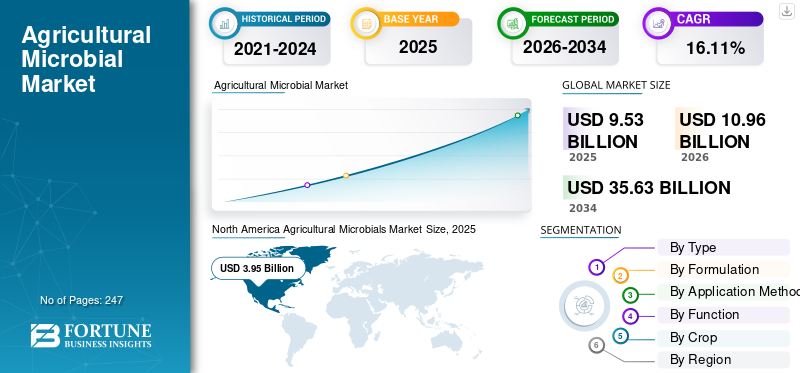
Download Free sample to learn more about this report.
AGRICULTURAL MICROBIALS MARKET KEY TAKEAWAYS
 Global Market Size & Forecast
- 2025 Market Size: USD 9.53 billion
- 2026 Market Size: USD 10.96 billion
- 2034 Forecast Market Size: USD 35.63 billion
- CAGR: 16.11% from 2026–2034
 Market Share
- North America dominated the market with a 41.47% share in 2025.
- The Bacteria segment is expected to hold the largest market share of 69.34% in 2026.
- The Liquid segment is expected to dominate the market with a 59.12% share in 2026.
 Key Regional Highlights
North America
The market reached USD 3.95 billion in 2025 and is projected to grow to USD 4.56 billion in 2026.
Europe
The market reached USD 2.03 billion in 2025 and is projected to grow to USD 2.31 billion in 2026.
Asia Pacific
The market reached USD 1.68 billion in 2025 and is projected to grow to USD 1.95 billion in 2026.
U.S.
The market is projected to reach USD 3.57 billion by 2026.
Japan
The market is projected to reach USD 0.13 billion by 2026.
Read More

MARKET DYNAMICS
Market Drivers
Increasing Pest Proliferation to Drive Global Market Growth
The changing climatic conditions, such as increasing average global temperature, declining rainfall, groundwater level, and arable land, have fueled the resurgence of pests in the environment. The rapid proliferation of pests and diseases has fueled the demand for high-quality pest control or pesticides at a global scale. In addition, the increasing demand for agricultural produce with the rapidly growing population resulting in increased food consumption has further fueled the requirement for agricultural input products, such as fertilizers, pesticides, and stimulants globally, improving soil health and crop yield. Moreover, there has been a rising awareness of the negative impact caused by chemical or synthetic agricultural input products, which further contributes to the increasing demand for microbial-based agriculture products.
- According to the Bulletin of Biological and Allied Sciences Research report 2024, insect pests account for approximately 38% of global agricultural losses, while weeds cause about 34% of losses on their own. Abiotic factors, such as drought, salinity, climate change, and resource mismanagement, are responsible for more than 50% of agricultural losses globally.
Market Restraints
Limited Shelf Life, Delivery Challenges, and Environmental Sensitivity to Impede Market Growth
Agricultural microbials often face challenges such as shorter shelf life, sensitivity to temperature fluctuations, and reduced field performance under inconsistent environmental conditions. Unlike chemical inputs that remain stable across climates, microbial viability is highly dependent on storage, transport, and formulation robustness.
These constraints increase adoption barriers, especially in low-infrastructure markets across Africa, Southeast Asia, and parts of Latin America.
Market Opportunities
Rising Integration with Integrated Pest Management (IPM) and Precision Agriculture to Provide New Growth Potential
Agricultural microbials are increasingly being incorporated into IPM programs as both standalone preventive tools and complementary solutions alongside chemical inputs. Their compatibility with precision agriculture, such as variable-rate technology, microbial seed coatings, and AI-driven soil microbiome analytics, is expanding their commercial scope. Moreover, microbial seed coatings are becoming one of the fastest-growing categories due to high demand for early root colonization and protection against soil pathogens.
- For instance, in November 2025, ProGro BIO announced the launch of its Rhizol sales program for the 2026 planting season. Rhizol is the company’s flagship microbial soil inoculant, OMRI-certified organic, containing 35 natural microbial isolates that enhance soil microbiome diversity, nutrient availability, and plant resilience in stressed soils.
Agricultural Microbials Market Trends
Rapid Advancement in Organic Agriculture Sector to Fuel Market Growth
The adoption of organic farming has recorded significant growth in recent times. This significant growth rate is owing to the increasing awareness related to the higher negative impacts caused by the excessive use of chemical fertilizers and other chemical products. In addition, the increasing awareness toward declining arable land due to excess use of pesticides and fertilizers, and, thus, the higher contribution of agriculture to climate change, is further influencing the demand for organic agriculture input products, such as microbial stimulants, microbial pesticides, and microbial fertilizers.
- For instance, as per the survey published by the Organic Trade Association, the U.S. organic farming sector experienced accelerated growth in 2024, with total organic food sales reaching an estimated USD 65.4 billion and non-food sales adding another USD 6.2 billion.
Download Free sample to learn more about this report.
SEGMENTATION ANALYSIS
By Type
Widespread Use in Biofertilizers, Biopesticides, and Biostimulants to Lead Bacteria Segment’s High Market Proportion
Based on type, the market for agricultural microbials is classified into bacteria, fungi, viruses, and others.
The bacteria segment is projected to dominate the market with a share of 69.34% in 2026, and a projected CAGR of 16.23% through 2025-2032. The bacteria segment holds the highest share in the global market owing to its wide utilization in the industry in the formulation of biofertilizers, biopesticides, and biostimulants. The higher adoption rate of bacteria is owing to their growth-promoting characteristics, as bacteria are known for having a higher contribution in growth-promoting functions in plants and are also characterized as protective in subduing root-fungus disease. In addition, the high availability of several bacterial strains in the environment further contributes to market growth.
The fungi segment is expected to grow significantly during the forecast period with a CAGR of 15.48% in 2025.
To know how our report can help streamline your business, Speak to Analyst
By Formulation
Easy Application and Handling, and Faster Plant Absorption to Lead Liquid Segment Growth
On the basis of the formulation, the market is segmented into dry and liquid.
The liquid segment is projected to dominate the market with a share of 59.12% in 2026, valued at approximately USD 4,890.83 million in 2024 and is projected to grow to USD 16,076.13 million by 2032, reflecting a CAGR of 16.19%. Liquid microbials are easier to handle, store, and apply using modern irrigation and spraying systems. This convenience drives adoption among farmers, especially those with mechanized agriculture. Liquids allow quicker absorption by crops, resulting in faster microbial action, which is critical for crops needing immediate nutrient and pest resistance benefits.
The dry segment is expected to grow significantly at a CAGR of 15.43% during the forecast period.
By Application Method
Higher Effectiveness of Foliar Spray to Drive Segment Growth
By application method, the market is categorized into foliar spray, soil treatment, seed treatment, and others.
The foliar spray segment is projected to dominate the market with a share of 60.49% in 2026. The dominance is due to its higher benefits than other application methods. Additionally, the foliar method provides faster nutritional uptake as the foliage rapidly absorbs the nutrients. The ease of application of foliar spray also assists in the prompt treatment of deficiencies and diseases in plants.
The seed treatment segment is anticipated to grow at the fastest CAGR of 15.59% during the forecast period.
By Function
Increasing Demand for Sustainable and Effective Crop Protection Solutions to Fuel Growth of Crop Protection Segment
Based on function, the market is classified into soil amendment and crop protection.
The crop protection segment accounted for 62.45% of the global agricultural microbials market share in 2024 and is expected to maintain this majority share through the coming years. This dominance is driven by the increasing demand for sustainable and effective crop protection solutions against pests, diseases, and weeds. Microbial crop protection products such as biopesticides, biofungicides, and bioherbicides are gaining acceptance due to their targeted action, lower environmental toxicity, and compatibility with integrated pest management programs.
The soil amendments segment is anticipated to grow at the fastest CAGR of 12.40% during the global agricultural microbials market forecast period.
By Crop
Increasing Demand for Fruits & Vegetables to Drive Growth of Agricultural Microbials
Based on the crop channel, the market is segmented into cereals, oilseeds & pulses, fruits & vegetables, and others.
The fruits and vegetables segment dominated the global market, valuing USD 4,601.56 million in 2024. The segment has shown a gradual rise in demand across the globe owing to its higher return on investment (ROI). Microbes are known for providing higher nutrition for soil improvement and crop protection. Further increasing demand for these high-value crops contributes to the higher demand for agricultural microbial products. Furthermore, the rising demand for organic fruits and vegetables and microbial products is economical in terms of high-value crop cultivation, thus further contributing to higher global agricultural microbials market demand during the forecast period.
The cereals segment is expected to grow significantly during the forecast period at a CAGR of 15.54% from 2025 to 2032. The cereals segment is projected to dominate the market with a share of 20.53% in 2026.
Agricultural Microbials Market Regional Outlook
Regionally, the report covers the global market analysis across North America, Europe, Asia Pacific, South America, the Middle East, and Africa.
NORTH AMERICA
North America Agricultural Microbials Market Size, 2025 (USD Billion) To get more information on the regional analysis of this market, Download Free sample
North America
The North America market was valued at USD 3.95 billion in 2025, capturing 41.47% of global revenue, and is estimated to reach USD 4.56 billion in 2026. The region is the largest region in the market and is said to hold a significant agricultural microbials market share during the forecast period. This higher share is due to the rising awareness related to the environmental benefits provided by these microbes and the increasing adoption of organic farming practices. Countries such as the U.S. are known for promoting higher utilization of microbials and further enabling several policies and regulations to increase awareness and provide assistance to farmers. For instance, the U.S. Department of Agriculture (USDA) and the National Science Foundation (NSF) are known for promoting and encouraging activities such as research and development in the diversity of microbes and providing plant-associated microbials with long-term availability. The U.S. market is projected to reach USD 3.57 billion by 2026.
EUROPE
In 2025, Europe held 21.24% of the global market, reaching a valuation of USD 2.03 billion, and is projected to grow to USD 2.31 billion in 2026. This high share is owing to the stringent regulations in the region related to the use of chemically induced or synthetic agricultural input products. The region has a significant awareness of sustainable agriculture practices and has shifted toward the use of microbial and organic practices, which is driving the growth of the European market. The growing demand for sustainable farming practices is driving the adoption of eco-friendly alternatives to chemicals in the Europe agricultural microbials market. The UK market is projected to reach USD 0.21 billion by 2026, while the Germany market is projected to reach USD 0.33 billion by 2026.
ASIA PACIFIC
The market in Asia Pacific reached USD 1.68 billion in 2025, representing 17.67% of total market revenue, and is projected to reach USD 1.95 billion in 2026. The rising awareness regarding the harmful impact on the environment caused by chemical fertilizers, the benefits of microbial-based crop protection products, and their ability to improve soil fertility in the Asia Pacific market support the overall growth. The region is expected to register a CAGR of 16.71% during the forecast period. India and China are majorly agriculture-dependent, and they contribute a significant share of their GDPs. Furthermore, these countries have started prioritizing environmental protection and restoration, which has led to the adoption of agricultural microbials. Thus, it is expected to open untapped opportunities for the Asia Pacific agricultural microbials market growth. The Japan market is projected to reach USD 0.13 billion by 2026, the China market is projected to reach USD 0.93 billion by 2026, and the India market is projected to reach USD 0.39 billion by 2026.
SOUTH AMERICA
Over the forecast period, South America is expected to be the fastest-growing region with a CAGR of 15.40%. The South American market in 2025 is set to record USD 1,535.43 million as its valuation. The higher profitability of microbial products and increasing awareness of farmers in the South American region have fueled the adoption rate of microbial products in countries such as Brazil, Argentina, and others, which has contributed to making the South American region the fastest-growing region.
MIDDLE EAST & AFRICA
In 2025, the Middle East & Africa market stood at USD 0.33 billion, representing 3.51% of global demand, and is projected to grow to USD 0.37 billion in 2026. The Middle East & Africa are experiencing significant traction toward these microbes to reduce and even replace synthetic chemicals. The region is expected to have moderate growth having CAGR of 11.99%. The farmers and producers have started to adopt agri-microbes as safe agricultural inputs. This factor is expected to contribute to the regional market growth during the forecast period.
COMPETITIVE LANDSCAPE
Key Industry Players
Growing Key Players Focus on New Product Launch and Geographical Expansion to Drive Market Expansion
The global market is consolidated with the presence of prominent players globally. Companies, such as Certis USA LLC, Marrone Bio Innovations, Inc., Koppert Biological Systems, BASF SE, and Valent Biosciences, LLC, are focusing on research and development of new products to widen their portfolio and maintain their strong foothold in the global market. Moreover, leading players also focus on expanding their presence in high-growth regions such as North America, Europe, Latin America, and Asia Pacific. Asia Pacific is emerging rapidly due to agrarian economies such as India and China prioritizing environmental protection and adopting bio-based inputs. Companies leverage broad distribution networks and adapt formulations to local agronomic needs.
Key Players in the Agricultural Microbials Market
|
Rank |
Company Name |
|
1 |
BASF SE |
|
2 |
Bayer AG |
|
3 |
Syngenta AG |
|
4 |
Novozymes |
|
5 |
Certis Biologicals |
List of Key Agricultural Microbials Companies Profiled
- Certis USA LLC (U.S.)
- ChemChina (China)
- Marrone Bio Innovations, Inc. (U.S.)
- Koppert Biological Systems (Netherlands)
- Varsha Bioscience and Technology Pvt. Ltd. (India)
- Andermatt Biocontrol AG (Switzerland)
- BASF SE (Germany)
- Sumitomo Chemical Co., Ltd. (Japan)
- Novozymes (Denmark)
- Bioceres S.A. (Argentina)
KEY INDUSTRY DEVELOPMENTS
- November 2025: Corteva AG announced two groundbreaking, nature-inspired insect control solutions designed to help farmers protect crop yields more effectively. The first is Goltrevo, Corteva’s first bioinsecticide, which is a microbial-based product developed from a novel strain of the entomopathogenic fungus Beauveria bassiana 203. The second product is Varpelgo active, a next-generation, nature-inspired synthetic insecticide. It controls chewing pests such as diamondback moths, armyworms, loopers, and others.
- November 2025: Pivot Bio, one of the world's leading innovative agtech companies, launched a new product, PROVEN G3. Pivot Bio's new product, PROVEN G3, is a third-generation nitrogen solution for corn that uses a proprietary gene-edited microbe blend to enhance nitrogen fixation, nutrient uptake, and nitrogen use efficiency.
- October 2024: MAFA Bioscience launched a new microbial biofertilizer called ASPERBIO, which contains the beneficial fungus Aspergillus niger EEZ-93. This fungus colonizes plant roots, promoting improved growth, development, and increased tolerance to stress conditions such as drought.
- April 2022: Bayer CropScience signed an agreement with Ginkgo Bioworks wherein Ginkgo Bioworks would acquire Bayer's West Sacramento Biologics Research & Development site and internal discovery and lead optimization platform. This agreement is likely to accelerate the expansion of Bayer's diversified portfolio of high-quality microbial-based solutions for growers globally.
- March 2022: The Mosaic Company and BioConsortia, Inc. signed a new agreement to develop and distribute nitrogen-fixing microbial products for rice, corn, wheat, fruit, and vegetables in India, China, Vietnam, and Thailand.
REPORT COVERAGE
The global agricultural microbials market industry report analyzes the market in depth and highlights crucial aspects such as global market trends, market dynamics, prominent companies, investment in research and development, and end-use. Besides this, the report also provides insights into the global market analysis and highlights significant industry developments.
Request for Customization to gain extensive market insights.
Report Scope & Segmentation
| ATTRIBUTE | DETAILS |
| Study Period | 2021-2034 |
| Base Year | 2025 |
| Estimated Year | 2026 |
| Forecast Period | 2026-2034 |
| Historical Period | 2021-2024 |
| Growth Rate | CAGR of 16.11% from 2026 to 2034 |
| Unit | Value (USD Million) |
| Segmentation | By Type
By Formulation
By Application Method
By Function
By Crop
By Region
|
Frequently Asked Questions
Fortune Business Insights says that the global market was USD 9.53 billion in 2025 and is anticipated to reach USD 35.63 million by 2034.
At a CAGR of 16.11%, the global market will exhibit steady growth over the forecast period.
By type, the bacteria segment leads the market.
North America held the largest market share in 2025.
Increasing pest proliferation drives the market growth.
BASF SE, Bayer AG, Syngenta AG, Novozymes, and Certis Biologicals are the leading companies in the market.
Rapid advancement in the organic agriculture sector is shaping the industry.



- 2021-2034
- 2025
- 2021-2024
- 247
-
(Offer valid till 30th Sep 2026)
Get 30-60 hrs Free Customization
Expand Regional and Country Coverage, Segments Analysis, Company Profiles, Competitive Benchmarking, and End-user Insights.














-
US +1 833 909 2966 ( Toll Free )
-
Get In Touch With Us