Stainless Steel Buffer Tank Market Size, Share & Industry Analysis, By Type (Hot Water Buffer Tanks and Chilled Water Buffer Tanks), By Tank Configuration (Vertical Buffer Tanks and Horizontal Buffer Tanks), By Tank Capacity (Up to 100 Liters, 101–300 Liters, 301–500 Liters, 501–1,000 Liters, and Above 1,000 Liters), By End User (Residential, Commercial, and Industrial), and Regional Forecast, 2026 – 2034
 Download Free Sample
Stainless Steel Buffer Tank Market Size and Future Outlook
 Listen to Audio Version
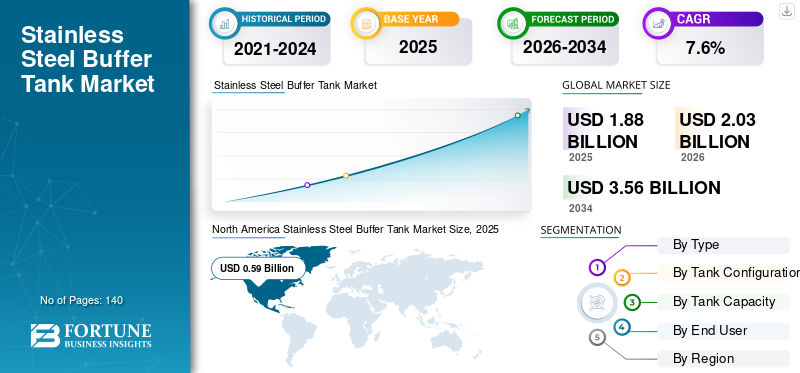
The global stainless steel buffer tank market size was valued at USD 1.88 billion in 2025 and is projected to grow from USD 2.03 billion in 2026 to USD 3.56 billion by 2034, exhibiting a CAGR of 7.6% during the forecast period. North America dominated the stainless steel buffer tank market with a market share of 31.38% in 2025.
The market comprises the manufacturing and commercial sale of corrosion-resistant storage tanks designed to temporarily store hot or chilled water, provide hydraulic separation, stabilize system flow, and maintain the minimum water volume required in heating and cooling installations. Hydronic buffer tanks are commonly manufactured using AISI 304, 304L, 316, or 316L stainless steel and are supplied in vertical or horizontal, atmospheric or pressure-rated, insulated or non-insulated configurations. Depending on system requirements, manufacturers offer ASME buffer tanks and non-ASME buffer tanks incorporating two-port or four-port connections, internal heat-exchange coils, flow-distribution baffles, electric heating elements, pressure-relief devices, smart temperature sensors, air vents, and factory-integrated controls.
Advanced designs increasingly feature automated laser welding, high-performance polyurethane insulation, anti-condensation protection, optimized thermal stratification, building management system connectivity, digital monitoring, and digital tank-sizing tools to improve energy efficiency, installation flexibility, corrosion resistance, and operating life. The market’s growth is supported by rising deployment of air-to-water heat pumps, low-water-volume condensing boilers, chilled-water systems, district heating expansion, and energy-efficient hydronic system installations. Buffer tanks reduce compressor, boiler, and chiller short cycling by balancing differences between equipment output and variable building loads. They also improve hydraulic stability across residential properties, commercial buildings, hospitals, hotels, data centers, manufacturing plants, institutional facilities, and LEED-certified buildings, where compliance with stringent energy efficiency regulations is increasingly important.
- For instance, in March 2025, Caleffi announced the presentation of its complete range of water management products and heat-pump components at ISH 2025. The company’s portfolio includes the Series 5485 stainless steel wall-mounted buffer tank-hydraulic separator, designed to maintain minimum system water volume and support efficient heat-pump operation.
AERCO International, Niles Steel Tank, HTP Comfort Solutions, Caleffi S.p.A., Cordivari S.r.l., and Cemline Corporation are among the major companies. AERCO offers ASME-certified buffer tanks for low-volume boiler systems, while Niles provides vertical and horizontal chilled-water buffer tanks with optional 316L and duplex stainless steel construction.
Download Free sample to learn more about this report.
STAINLESS STEEL BUFFER TANK MARKET TRENDS
Increasing Adoption of Heat-Pump-Optimized and Multi-Functional Tank Designs is Reshaping Product Development
The market is witnessing a shift from conventional standalone storage vessels toward compact, multi-functional stainless steel buffer tanks engineered specifically for heat pumps, hybrid heating systems, and reversible heating-and-cooling applications. Manufacturers are integrating hydraulic separation, thermal buffering, multiple flow connections, internal heat-exchange coils, electric heating provisions, sensor ports, and advanced insulation within a single tank assembly. These configurations help maintain minimum system water volume, reduce frequent compressor cycling, balance mismatched primary and secondary flow rates, and improve heat-pump operation under partial-load conditions. Space-saving wall-mounted and slim vertical models are also gaining prominence in residential retrofits and commercial plant rooms where installation space is limited. Stainless steel grades such as AISI 304 and 316L offer additional advantages in applications requiring corrosion resistance, hygienic water handling, and extended equipment life. Product development is further moving toward hot-and-cold compatible tanks that can support year-round operation without requiring separate heating and cooling vessels. The availability of factory-fitted insulation, hydraulic connections, monitoring ports, and modular accessories is simplifying installation while reducing onsite piping complexity. This trend is strengthening the role of buffer tanks as integrated energy-management components rather than passive water-storage equipment.
- For instance, in February 2025, Cordivari announced that it would showcase its latest heat-pump-based home comfort systems at ISH 2025, including dedicated thermal accumulators designed to support heating, cooling, and domestic hot-water production.
MARKET DYNAMICS
MARKET DRIVERS
Download Free sample to learn more about this report.
Expansion of Data Centers and High-Capacity Chilled-Water Infrastructure Drive Market Growth
The market is benefiting from the rapid expansion of data centers, hospitals, industrial facilities, hotels, laboratories, and large commercial buildings that depend on reliable chilled-water cooling infrastructure. These facilities experience fluctuating thermal loads and require stable water flow between chillers, cooling equipment, and downstream distribution systems. Stainless steel buffer tanks provide temporary chilled-water storage, hydraulic separation, and flow stabilization, helping reduce chiller short cycling and maintain cooling continuity during sudden load changes. Their corrosion resistance and long operating life make them suitable for mission-critical facilities where equipment failure or cooling interruption can result in substantial operational losses. Demand is also being supported by the development of high-density computing facilities, which require increasingly sophisticated cooling and thermal-management systems. Expansion of district cooling and centralized chilled-water plants is further increasing demand for medium- and large-capacity buffer tanks across commercial and industrial applications.
- For instance, in April 2025, the International Energy Agency projected that global data-center electricity consumption would more than double to approximately 945 TWh by 2030, reflecting the rapid development of data-center infrastructure and the associated requirement for advanced cooling systems.
Market Drivers - Impact & CAGR Contribution (2026–2034)
| Rank | Market Drivers | Expected impact on market growth | Estimated CAGR contribution | Impact: 2026-2028 | Impact: 2029-2031 | Impact: 2032-2034 |
|---|---|---|---|---|---|---|
| 1 | Rapid adoption of heat pumps and hydronic HVAC systems to drive demand for buffer tanks | High | 0.77% | High | High | High |
| 2 | Expansion of commercial buildings, district heating & cooling, and industrial infrastructure | High | 0.61% | Medium | High | High |
| 3 | Increasing focus on energy-efficient thermal storage and HVAC system optimization | Medium-High | 0.49% | Medium | High | High |
| 4 | Rising demand for corrosion-resistant stainless steel tanks across industrial applications | Medium-High | 0.29% | Medium | High | High |
| 5 | Expansion of data centers and high-capacity chilled-water infrastructure to drive market growth | Medium | 0.19% | Medium | Medium | High |
| 6 | Others (water treatment projects, renewable energy integration, replacement demand, smart building adoption, etc.) | Low | 0.14% | Low | Medium | Medium |
| Total Positive Growth Contribution | 2.49% | |||||
Source: Fortune Business Insights
MARKET RESTRAINTS
Higher Material, Fabrication, and Certification Costs Restrict Market Growth
The stainless steel buffer tank market growth is constrained by the higher acquisition cost of stainless steel tanks compared with mild-steel, carbon-steel, coated-steel, and polymer alternatives. Manufacturing pressure-rated stainless steel tanks requires certified raw materials, precision forming, automated or qualified welding, weld inspection, passivation, hydrostatic testing, pressure-relief validation, and detailed material traceability. Costs increase further when buyers specify AISI 316L construction, custom dimensions, horizontal configurations, internal coils, sanitary surface finishes, high-performance insulation, or factory-integrated instrumentation. Large-capacity tanks can also generate substantial transportation, lifting, foundation, piping, and commissioning expenses. These factors may discourage adoption among cost-sensitive residential and small commercial customers, particularly in closed-loop systems where treated mild-steel tanks can provide acceptable performance. Manufacturers must also manage stainless steel price volatility, customized low-volume production, and different pressure-vessel certification requirements across countries, which can extend delivery schedules and reduce pricing flexibility.
Market Restraints - Impact & Negative CAGR Contribution (2026–2034)
| Rank | Market Restraints | Overall Impact Rank | Negative CAGR contribution (2026–2034) (2026-2034) |
Impact: 2026-2028 | Impact: 2029-2031 | Impact: 2032-2034 |
|---|---|---|---|---|---|---|
| 1 | High Deployment Cost and Infrastructure Gaps to Restrain Market Growth | High | 1.4% | High | High | Medium |
| 2 | Safety validation, regulatory approval and liability challenges | Medium-High | 1.2% | High | High | Medium |
| 3 | Cybersecurity, system reliability and public acceptance concerns | High | 0.8% | Medium | Medium | Medium |
| 4 | Others | Low | 0.3% | Low | Low | Low |
| Negative Impact | 3.70% | |||||
Source: Fortune Business Insights
MARKET OPPORTUNITIES
Expanding Industrial Water Reuse and High-Purity Processing Applications to Create New Growth Opportunities
Increasing investment in water conservation, industrial water reuse, and high-purity liquid-management systems is creating new opportunities for stainless steel buffer tank manufacturers beyond conventional HVAC applications. Food and beverage plants, pharmaceutical facilities, semiconductor factories, biotechnology laboratories, cosmetics manufacturers, and water-treatment facilities require intermediate vessels to balance fluctuating process flows, maintain continuous downstream supply, and temporarily store treated, purified, or reverse-osmosis water. Stainless steel tanks are well suited to these applications due to their corrosion resistance, cleanable surfaces, material traceability, and compatibility with hygienic processing requirements. Manufacturers can capture higher-value demand by offering AISI 316L construction, electropolished surfaces, drainable tank geometries, sanitary connections, clean-in-place compatibility, integrated level monitoring, and application-specific pressure ratings. Expansion of decentralized water-treatment and reuse systems could also generate demand for compact buffer tanks installed between filtration, purification, dosing, and production stages.
- For instance, in June 2025, the European Commission adopted its Water Resilience Strategy, which seeks to improve water efficiency in the European Union by 10% by 2030 and promote investment in modern, water-smart infrastructure.
MARKET CHALLENGES
Application-Specific Sizing and Fragmented Certification Requirements to Challenge Market Expansion
Commercial adoption of stainless steel buffer tanks is challenged by the absence of a single standardized design suitable for every heating, cooling, potable-water, and industrial process application. Tank capacity must be calculated according to system flow, thermal output, minimum operating volume, temperature differential, equipment cycling limits, and peak-load behavior. Incorrect sizing can reduce thermal efficiency, occupy unnecessary installation space, or fail to prevent boiler, chiller, and heat-pump cycling. Manufacturers must also modify connection arrangements, pressure ratings, insulation systems, internal coils, stainless steel grades, instrumentation, and support structures according to site-specific specifications. Cross-border commercialization is further complicated by different pressure-vessel codes, potable-water approvals, welding qualifications, material-traceability rules, and inspection requirements.
Segmentation Analysis
By Type
Hot Water Buffer Tanks Dominate Owing to Broad Hydronic Heating Base and High Thermal-Storage Demand
By type, the market is segmented into hot water buffer tanks and chilled water buffer tanks.
Hot water buffer tanks accounted for the largest market share in 2025, supported by their extensive use across heat-pump systems, condensing boilers, biomass heating, solar thermal installations, district heating substations, and hybrid hydronic systems. These tanks store excess thermal energy, maintain minimum system water volume, balance differences between heat generation and consumption, and reduce frequent generator cycling during partial-load operation. Their broad applicability across residential buildings, hotels, hospitals, apartment complexes, educational facilities, and industrial heating networks creates a considerably larger installed base than chilled-water systems. Stainless steel construction further supports adoption in projects requiring corrosion resistance, high operating temperatures, hygienic performance, and longer service life.
- For instance, in May 2025, Automatic Heating Global acquired Simons Boilers to broaden its heating-product portfolio, strengthen manufacturing capabilities, and expand its service and export reach across commercial heating applications.
Chilled water buffer tanks are projected to register a high CAGR of 8.2% during the forecast period, driven by expanding data centers, commercial cooling facilities, hospitals, industrial process-cooling systems, and district cooling networks. These tanks help stabilize chilled-water temperatures, maintain required flow volumes, reduce compressor short cycling, and improve chiller performance under fluctuating cooling loads.
To know how our report can help streamline your business, Speak to Analyst
By Tank Configuration
Vertical Buffer Tanks Segment Leads Owing to Compact Footprint and Broad Installation Suitability
By tank configuration, the market is segmented into vertical buffer tanks and horizontal buffer tanks.
Vertical buffer tanks accounted for the largest market share in 2025, driven by their widespread use across residential heat-pump installations, commercial boiler rooms, chilled-water plants, and industrial hydronic systems. Their upright structure requires comparatively limited floor space, making them suitable for mechanical rooms where equipment density is high. Vertical designs also support natural thermal stratification by maintaining temperature layers along the tank height, thereby improving the effective utilization of stored heating or cooling energy. Manufacturers commonly offer vertical tanks as standardized, readily configurable models with multiple connection ports, insulation options, internal baffles, and pressure-rated construction. Their simpler support arrangement, easier piping integration, and availability across small-to-large capacity ranges further strengthen adoption across new installations and HVAC retrofit projects.
Horizontal buffer tanks are projected to register the highest CAGR of 8.7% during the forecast period, supported by increasing demand in facilities with restricted ceiling height, rooftop mechanical spaces, modular equipment skids, and retrofit sites where vertical clearance is insufficient.
By Tank Capacity
101–300 Liter Tanks are Highly Preferred Owing to Broad Residential and Light-Commercial Compatibility
By tank capacity, the market is segmented into up to 100 liters, 101–300 liters, 301–500 liters, 501–1,000 liters, and above 1,000 liters.
The 101–300 liters segment held the largest stainless steel buffer tank market share in 2025, owing to its broad suitability for residential heat pumps, multi-family buildings, small commercial facilities, hybrid boiler systems, and medium-capacity hydronic installations. Tanks within this range provide sufficient thermal mass to reduce generator cycling and stabilize system flow without requiring the substantial floor space, structural support, and installation expenditure associated with larger vessels. The segment also benefits from extensive availability of standardized vertical models, factory-applied insulation, multiple connection arrangements, temperature-sensor ports, and optional internal heat exchangers. Its balance between storage volume, equipment compatibility, installation flexibility, and acquisition cost supports widespread adoption across both new HVAC installations and building retrofit projects.
The up to 100 liters segment is projected to register the highest CAGR of 8.5% during the forecast period, supported by growing demand for compact buffer tanks in residential heat-pump retrofits, apartments, small mechanical rooms, and space-constrained commercial properties.
By End Usee
Commercial Segment Dominance is Led by Extensive HVAC Deployment across Large Buildings
By end user, the market is segmented into residential, commercial, and industrial.
The commercial segment held the largest market share in 2025, supported by extensive deployment of stainless steel buffer tanks across hospitals, hotels, educational institutions, office buildings, shopping centers, data centers, sports facilities, and multi-family properties. These facilities operate centralized heating and chilled-water systems with variable thermal loads, multiple distribution circuits, and frequent fluctuations in water-flow requirements. Buffer tanks help maintain minimum system volume, provide hydraulic separation, stabilize supply temperatures, and reduce excessive cycling of boilers, chillers, and commercial heat pumps. Commercial projects also typically use larger-capacity, pressure-rated, insulated, and multi-port tanks, resulting in higher average selling prices than residential installations.
The residential segment is projected to register the highest CAGR of 8.5% during the forecast period, driven by increasing installations of compact heat pumps, hybrid heating systems, and low-water-volume hydronic networks in individual houses and apartments.
Stainless Steel Buffer Tank Market Regional Outlook
By geography, the market is categorized into Europe, North America, Asia Pacific, South America, and the Middle East & Africa.
North America
North America Stainless Steel Buffer Tank Market Size, 2025 (USD Billion)
To get more information on the regional analysis of this market, Download Free sample
North America was valued at USD 0.59 billion in 2025, supported by the region’s established commercial HVAC, industrial cooling, hydronic heating, data-center, healthcare, hospitality, and institutional infrastructure. Demand is particularly strong for pressure-rated stainless steel buffer tanks used to maintain minimum system water volume, stabilize flow, and reduce cycling in boilers, chillers, and heat pumps. The region also benefits from high replacement activity across aging commercial buildings and mechanical plants, where corrosion resistance and extended equipment life support the adoption of 304 and 316L stainless steel tanks. Strict pressure-vessel requirements, widespread ASME certification, established engineering channels, and strong domestic fabrication capabilities further strengthen regional market value. Large commercial and industrial projects also generate demand for customized tanks with high pressure ratings, factory-applied insulation, seismic supports, and application-specific connections.
U.S. Stainless Steel Buffer Tank Market
The U.S. is expected to dominate the market with an estimated revenue of about USD 0.50 billion in 2026, owing to its large installed base of commercial HVAC systems, chilled-water plants, hydronic boilers, heat pumps, and industrial process-cooling infrastructure. Hospitals, universities, hotels, office complexes, manufacturing facilities, and rapidly expanding data centers require stable thermal distribution and continuous cooling performance, supporting demand for medium- and large-capacity buffer tanks. U.S. buyers also demonstrate strong preference for ASME-certified pressure vessels, domestic manufacturing, short delivery schedules, and customized engineering support.
Europe
Europe is expected to witness steady growth during the forecast period, supported by widespread hydronic heating, building renovation, district-energy infrastructure, and the transition toward low-temperature heating systems. Demand is influenced by Germany’s heat-pump and building-efficiency ecosystem, the U.K.’s commercial retrofit activity, France’s district heating and institutional infrastructure, Italy’s established thermal-storage manufacturing base, and the Nordics’ strong adoption of hydronic and renewable heating technologies. European projects increasingly require compact, highly insulated, and reversible hot-and-chilled-water buffer tanks that can integrate with heat pumps, solar thermal systems, and hybrid heating equipment. Stringent pressure-equipment, material-traceability, energy-efficiency, and sustainability requirements also support demand for durable stainless steel designs.
U.K. Stainless Steel Buffer Tank Market
The U.K. is estimated at around USD 0.07 billion in 2026, representing roughly 3.4% of the global market.
Germany Stainless Steel Buffer Tank Market
Germany is projected to reach approximately USD 0.14 billion in 2026, equivalent to around 6.3% of the global market.
Asia Pacific
Asia Pacific accounted for more than USD 0.52 billion in 2025 globally, supported by increasing heat-pump installations, commercial building development, industrial cooling requirements, district-energy projects, and replacement of conventional heating infrastructure. China represents the largest market in the region due to its extensive manufacturing base, expanding commercial construction sector, and growing adoption of centralized heating and chilled-water systems. Japan and South Korea remain high-value markets, supported by advanced hydronic technologies, stringent product-quality requirements, and demand for compact, energy-efficient thermal systems. India and Southeast Asia are gaining momentum as hospitals, hotels, data centers, manufacturing plants, and institutional facilities invest in modern HVAC infrastructure. Australia and New Zealand also contribute to growth through building-electrification programs and rising deployment of commercial heat-pump systems requiring thermal storage and hydraulic balancing.
China Stainless Steel Buffer Tank Market
China’s market is projected to remain dominant in Asia Pacific, with 2026 revenues estimated at around USD 0.23 billion, representing roughly 11.6% of the global market.
Japan Stainless Steel Buffer Tank Market
In 2026, Japan is estimated at around USD 0.10 billion, accounting for 4.9% of the global market.
India Stainless Steel Buffer Tank Market
The Indian market in 2026 is estimated at around USD 0.07 billion, accounting for roughly 3.3% of the global market.
Middle East & Africa
The Middle East & Africa is supported by expanding district cooling, commercial construction, hospitality, healthcare, and industrial HVAC infrastructure. GCC countries lead regional demand due to extensive centralized chilled-water systems across airports, hotels, shopping centers, residential towers, and mixed-use developments. Stainless steel buffer tanks help stabilize water flow, reduce chiller cycling, and withstand corrosive coastal conditions. South Africa contributes through commercial HVAC upgrades, hospitals, mining facilities, and industrial plants, while North Africa gains demand from tourism, food processing, water treatment, and urban development.
GCC Stainless Steel Buffer Tank Market
The GCC market is projected to reach around USD 0.04 billion in 2026, representing 2.0% of the global market.
South America
South America is supported by expanding commercial refrigeration, industrial cooling, food processing, healthcare, hospitality, and water-treatment infrastructure. Brazil leads regional demand due to its large commercial-building and manufacturing base, while Argentina contributes through industrial HVAC modernization and energy projects. Chile and Peru generate additional demand from mining facilities, hospitals, hotels, and process plants requiring corrosion-resistant thermal storage and hydraulic balancing. Stainless steel tanks are preferred where water quality, humidity, durability, and reduced maintenance are critical.
Brazil Stainless Steel Buffer Tank Market
Brazil is projected to reach approximately USD 0.07 billion in 2026, representing 3.5% of the global market.
COMPETITIVE LANDSCAPE
Key Industry Players
Product Breadth, Custom Engineering, and Certification Capabilities Drive Competitive Advantage
The stainless steel buffer tank market is moderately fragmented, with competition shaped by tank capacity, stainless steel grade, pressure rating, thermal insulation, connection configuration, customization capability, geographic coverage, and after-sales engineering support. Leading manufacturers compete across standardized residential and commercial models, large-capacity industrial vessels, ASME-certified pressure tanks, heat-pump buffer systems, and customized hot- and chilled-water storage solutions.
Competitive differentiation increasingly depends on the ability to offer AISI 304, 316L, and duplex stainless steel construction, vertical and horizontal configurations, two-port and four-port hydraulic connections, internal coils, factory insulation, and application-specific instrumentation. AERCO offers ASME-certified buffer tanks in various capacities and connection configurations, while Niles Steel Tank emphasizes customized stainless steel fabrication, non-destructive testing, passivation, and electropolishing. Automatic Heating Global supplies 316 stainless steel buffer tanks for heating and chilled-water circuits, whereas Cordivari provides compact and floor-standing buffer systems designed for heat-pump integration.
- For instance, in October 2025, Caleffi inaugurated its new German headquarters in Mülheim to strengthen collaboration with customers, partners, and technical specialists and expand its regional hydronic-market presence.
LIST OF KEY STAINLESS STEEL BUFFER TANK COMPANIES
- AERCO International, Inc. (U.S.)
- Automatic Heating Global Pty Ltd. (Australia)
- Cemline Corporation (U.S.)
- Wessels Company (U.S.)
- Niles Steel Tank (U.S.)
- Worthington Enterprises, Inc. (U.S.)
- Chiltrix Inc. (U.S.)
- Hamilton Engineering Company, Inc. (U.S.)
- Flexcon Industries (U.S.)
- HTP Comfort Solutions LLC (U.S.)
KEY INDUSTRY DEVELOPMENTS
- April 2026: Cordivari reconfirmed its EcoVadis Silver rating, placing it among the top 15% of assessed companies and reinforcing its sustainability positioning across thermal-storage and hydronic-product manufacturing.
- January 2026: Bradford White Corporation, the parent company of Niles Steel Tank, launched the eF Series Turbo commercial water heater to expand its high-efficiency commercial hot-water portfolio and strengthen its position in integrated water-heating and storage systems.
- January 2026: Worthington Enterprises completed the acquisition of LSI Group, strengthening its Building Products segment and expanding its manufacturing capabilities across commercial building and HVAC-related components.
- July 2025: Bradford White Corporation launched the AeroTherm Series G2 hybrid electric heat-pump water heater, expanding its energy-efficient residential water-heating portfolio and supporting demand for heat-pump-compatible thermal-storage solutions.
- June 2025: Worthington Enterprises acquired Elgen Manufacturing for approximately USD 93 million, expanding its commercial HVAC component portfolio, domestic manufacturing footprint, and contractor-distribution capabilities across North America.
REPORT COVERAGE
The global stainless steel buffer tank market research report provides a comprehensive analysis of market size and forecasts across all segments. It offers detailed insights into market trends, drivers, restraints, opportunities, challenges, technology advancements, regulatory landscape, and competitive developments expected to influence market growth during the forecast period. The report evaluates market segments, analyzes regional and country-level market performance, shipment trends, pricing, and competitive positioning. In addition, the report includes a detailed competitive landscape covering market share analysis, product benchmarking, strategic initiatives, company profiles, recent developments, and manufacturer expansion strategies of leading suppliers operating in the global market.
Request for Customization to gain extensive market insights.
Report Scope & Segmentation
| ATTRIBUTE | DETAILS |
| Study Period | 2021-2034 |
| Base Year | 2025 |
| Estimated Year | 2026 |
| Forecast Period | 2026-2034 |
| Historical Period | 2021-2024 |
| Growth Rate | CAGR of 7.6% from 2026-2034 |
| Unit | Value (USD Billion) |
| Segmentation | By Type, Tank Configuration, Tank Capacity, End User, and Region |
| By Type |
|
| By Tank Configuration |
|
| By Tank Capacity |
|
| By End User |
|
| By Region |
|
Frequently Asked Questions
According to Fortune Business Insights, the global market value stood at USD 2.03 billion in 2026 and is projected to reach USD 3.56 billion by 2034.
In 2025, North America’s market value stood at USD 0.59 billion.
The market is expected to exhibit a CAGR of 7.6% during the forecast period.
By end user, the commercial segment leads the market.
Heat-pump adoption, HVAC expansion, thermal storage demand, and corrosion resistance are some of the key factors driving market growth.
AERCO International, Automatic Heating Global, Cemline Corporation, Wessels Company, and Caleffi S.p.A. are among the leading players in the market.
North America held the largest market share in 2025.



- 2021-2034
- 2025
- 2021-2024
- 140
Get 30-60 hrs Free Customization
Expand Regional and Country Coverage, Segments Analysis, Company Profiles, Competitive Benchmarking, and End-user Insights.















-
US +1 833 909 2966 ( Toll Free )
-
Get In Touch With Us