Nitrocellulose Market Size, Share & Industry Analysis, By Product Form (Pre-wet Nitrocellulose, Solvent-based Nitrocellulose, and Others), By Application ((Military and Non-Military (Flexible, Packaging Inks, Other Printing Inks, Wood Coatings & Lacquers, General Industrial Coatings, Automotive Refinishing Coatings, and Others)), and Regional Forecast, 2026-2034
 Download Free Sample
(Offer valid till 15th Oct 2026)

Nitrocellulose Market Size & Future Outlook
 Listen to Audio Version
The global nitrocellulose market size was valued at USD 1,058.3 million in 2025. The market is projected to grow from USD 1,105.9 million in 2026 to USD 1,553.6 million by 2034, exhibiting a CAGR of 4.3% during the forecast period. Asia Pacific dominated the nitrocellulose market with a market share of 46.45% in 2025.
Nitrocellulose, also known as cellulose nitrate, is a highly functional cellulose derivative produced through the controlled nitration of purified cellulose using nitric and sulfuric acids. It is supplied in water-wet, alcohol-wet, solvent-based, or specialized processed forms and is used as a fast-drying film-forming binder, energetic material, and microporous membrane substrate. Nitrocellulose is widely used in wood coatings, furniture lacquers, automotive refinishing products, leather finishes, adhesives, cosmetics, packaging inks, and printing industries. In military applications, higher-nitrogen grades are used in propellants, smokeless powders, ammunition charges, and combustible components.
Rising demand for printed flexible packaging, high-speed gravure and flexographic printing, furniture coatings, industrial finishes, and ammunition production is supporting the global market. Packaging converters require binders with rapid solvent release, strong pigment binding, high gloss, and reliable press performance. At the same time, furniture manufacturers value nitrocellulose for its quick drying, clarity, smooth finish, and easy repairability. Therefore, market growth is increasingly being supported by a combination of expanding industrial consumption and rising strategic demand for energetic-grade nitrocellulose.
The global market is shaped by a specialized group of established manufacturers with capabilities in cellulose purification, nitration, stabilization, viscosity control, wetting, solvent blending, safe packaging, and energetic-material processing. Key participants include Rheinmetall AG, Nitro Química, Synthesia Nitrocellulose, The Nitrocellulose Group, and TNC Chemicals Philippines Inc. Competitive positioning is influenced by product consistency, nitrogen content, viscosity range, purity, safety performance, regulatory compliance, and the ability to supply both industrial and energetic grades.
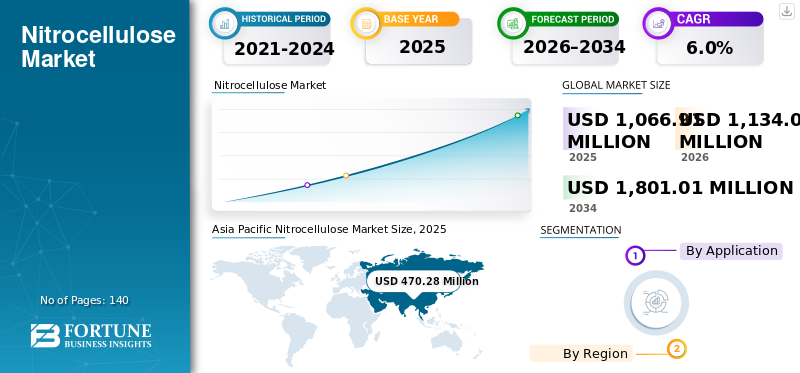
Download Free sample to learn more about this report.
NITROCELLULOSE MARKET KEY TAKEAWAYS
 Global Market Size & Forecast
- 2025 Market Size: USD 1,058.3 million
- 2026 Market Size: USD 1,105.9 million
- 2034 Forecast Market Size: USD 1,553.6 million
- CAGR: 4.3% from 2026–2034
 Market Share
- Asia Pacific dominated the nitrocellulose market with a 46.45% share in 2025.
- Solvent-based nitrocellulose is projected to grow at a 4.0% CAGR during 2026–2034.
- Military applications are projected to grow at the fastest 5.8% CAGR during 2026–2034.
 Key Regional Highlights
Asia Pacific
Asia Pacific led the market with USD 491.6 million in 2025 and is projected to grow at a 4.7% CAGR.
North America
North America generated USD 174.6 million in 2025 and is expected to grow at a 3.7% CAGR.
Europe
Europe reached USD 262.1 million in 2025 and is projected to grow at a 4.1% CAGR.
U.S.
The market is estimated to reach USD 156.3 million in 2026, accounting for approximately 14.1% of global revenues.
Japan
Demand is supported by applications across specialty coatings, printing inks, and industrial manufacturing.
Read More

NITROCELLULOSE MARKET TRENDS
Rising Adoption of Cleaner and Resource-Efficient Nitrocellulose Production Technologies to Fuel Product Demand
Increasing regulatory pressure, higher waste-treatment costs, and growing customer emphasis on sustainable sourcing are encouraging nitrocellulose manufacturers to adopt cleaner and more resource-efficient production technologies. As a result, producers are integrating acid-recovery systems, solvent recycling, closed-loop water management, improved nitration control, and advanced wastewater-treatment processes into manufacturing operations. These technologies reduce fresh chemical consumption, lower effluent generation, improve raw-material utilization, and enhance consistency in nitrogen content, viscosity, and product stability. Improved process efficiency also supports safer operations and more reliable supply across industrial and energetic grades. Consequently, cleaner production practices are strengthening the environmental acceptability of nitrocellulose and supporting its continued adoption in printing inks, coatings, propellants, membranes, and other specialized applications.
MARKET DYNAMICS
MARKET DRIVERS
Download Free sample to learn more about this report.
Rising Demand for Ammunition and Propellant Production to Accelerate Market Growth
Increasing ammunition and propellant production is driving the nitrocellulose market growth. Energetic-grade nitrocellulose is an essential raw material in smokeless powders, single-base and multi-base propellants, combustible components, and ammunition charges. Rising defense expenditure, replenishment of depleted ammunition inventories, military modernization, and the localization of strategic material supply are supporting new investments in propellant and ammunition manufacturing. Demand is particularly strengthening across Europe, North America, and selected Asia Pacific and Middle Eastern countries, where governments are expanding domestic defense-production capacity. Civil explosives and sporting ammunition also support nitrocellulose consumption. As military procurement programs require reliable long-term supply, demand for qualified high-nitrogen grades is expected to rise steadily. Therefore, expanding propellant and ammunition output is set to fuel market growth during the forecast period.
Market Drivers - Impact & CAGR Contribution (2026–2034)
| Rank | Market Drivers | Overall Impact Rank | CAGR Contribution (2026-2034) | Impact: 2026-2028 | Impact: 2029-2031 | Impact: 2032-2034 |
|---|---|---|---|---|---|---|
| 1 | Rising demand for flexible packaging and high-speed printing inks | High | 1.80% | High | High | High |
| 2 | Increasing ammunition and propellant production | High | 1.60% | High | High | High |
| 3 | Expansion of furniture manufacturing and wood-coating consumption | Medium-High | 1.10% | Medium | Medium | Medium |
| 4 | Growing use in general industrial and automotive-refinishing coatings | Medium | 0.90% | Medium | Medium | Medium |
| 5 | Increasing adoption in diagnostic membranes, cosmetics, leather finishes, and specialty applications | Medium-Low | 0.80% | Low | Medium | Medium |
| 6 | Others | Low | 0.60% | Low | Low | Low |
| Total Positive Growth Contribution | 6.80% | |||||
Source: Fortune Business Insights
Download Free sample For In-Depth Market Drivers & Impact Forecasts
MARKET RESTRAINTS
Growing Adoption of Nitrocellulose-Free Ink and Coating Technologies to Restrain Market Growth
Stricter recyclability targets, volatile organic compound controls, and demand for higher heat and chemical resistance are encouraging ink and coating manufacturers to adopt nitrocellulose-free formulations. Consequently, polyurethane-based, acrylic, water-based, and ultraviolet-curable systems are gaining acceptance in flexible packaging and selected industrial coating applications. In mechanically recycled polyethylene and polypropylene packaging, the limited thermal stability of some nitrocellulose-based ink layers may affect recyclate quality, thereby encouraging converters to evaluate alternative binder systems. Continued improvements in alternative resin chemistry are also expanding their suitability for surface printing, lamination, and high-performance coatings. As these technologies achieve better printability, adhesion, and durability, they may gradually displace nitrocellulose in sustainability-focused applications, thereby restraining demand growth in selected ink and coating segments.
Market Restraints - Impact & Negative CAGR Contribution (2026–2034)
| Rank | Market Restraints | Overall Impact Rank | Negative CAGR Contribution (2026-2034) | Impact: 2026-2028 | Impact: 2029-2031 | Impact: 2032-2034 |
|---|---|---|---|---|---|---|
| 1 | Growing adoption of nitrocellulose-free ink and coating technologies | High | -1.00% | High | Medium | High |
| 2 | Strict safety, storage, transportation, and regulatory requirements | Medium-High | -0.70% | High | High | High |
| 3 | Volatility in cellulose, acids, solvents, energy, and logistics costs | Medium | -0.50% | Medium | Medium | Medium |
| 4 | Others | Low | -0.30% | Low | Low | Low |
| Total Negative Growth Impact | -2.50% | |||||
Source: Fortune Business Insights
Download Free sample For In-Depth Market Restraints & Risk Analysis
MARKET OPPORTUNITIES
Expanding Use of Nitrocellulose in Wood and Furniture Coatings to Create Growth Opportunities
Growth in furniture manufacturing, residential renovation, hospitality, and commercial interior development is increasing demand for nitrocellulose-based wood finished materials. This expansion is creating additional opportunities for nitrocellulose-based lacquers, sanding sealers, cabinetry finishes, decorative panels, and interior joinery coatings. Nitrocellulose provides rapid drying, high gloss, good transparency, smooth film formation, and easy repairability, enabling furniture producers to shorten finishing cycles and maintain consistent surface quality. The opportunity is particularly strong across Asia Pacific and Latin America, where export-oriented furniture production and domestic consumption are expanding. Due to its fast drying and being cost-effective, its demand is expected to rise in woodworking activity and for aesthetically appealing furniture products. Therefore, continued growth in furniture and interior-finishing industries will create favorable opportunities for the market in the coming years.
Segmentation Analysis
By Product Form
Pre-wet Nitrocellulose Dominates Market Owing to Safer Handling and Broad Industrial Utilization
Based on product form, the market is segmented into pre-wet nitrocellulose, solvent-based nitrocellulose, and others.
The pre-wet nitrocellulose segment accounts for the largest market share due to its widespread use in printing inks, wood coatings, industrial lacquers, propellants, and other downstream formulations. The material is generally wetted with water or alcohol to reduce ignition risk during transportation, storage, and processing. Its suitability for bulk industrial consumption, comparatively economical pricing, and compatibility with established dissolution and blending systems strengthen its market position. Large printing-ink, coating, and energetic-material manufacturers commonly prefer pre-wet grades where internal formulation capabilities are available. Consequently, its strong presence across both civilian and military applications continues to support segment dominance.
The solvent-based nitrocellulose segment is witnessing steady adoption among printing-ink, coating, adhesive, and specialty-formulation manufacturers seeking ready-to-process materials. These products are supplied in dissolved or semi-formulated form, reducing the need for dedicated dissolution equipment and shortening batch-preparation time. Their controlled viscosity, consistent solvent balance, and compatibility with polyamide, polyurethane, acrylic, and alkyd resins support use in flexible-packaging inks, wood lacquers, leather finishes, and automotive refinishing products. Therefore, growing preference for formulation-ready solutions is projected to expand the segment at a CAGR of 4.0% during 2026–2034.
The others segment includes nitrocellulose chips, plasticized preparations, specialty solutions, membrane grades, cosmetic grades, and customized forms developed for technical applications. These products are consumed in relatively smaller quantities but frequently command higher prices due to their enhanced purity, controlled viscosity, specialized particle form, or application-specific performance. Demand arises from diagnostic membranes, nail varnishes, leather coatings, adhesives, coated fabrics, sealants, and specialty industrial finishes. Hence, expanding specialty and healthcare-related applications are expected to drive the segment at a CAGR of 4.3% during 2026-2034.
By Application
To know how our report can help streamline your business, Speak to Analyst
Non-Military Segment Dominated Market Due to Extensive Nitrocellulose Consumption across Inks and Coatings
Based on application, the market is segmented into military and non-military. The non-military segment is further classified into flexible packaging inks, other printing inks, wood coatings & lacquers, general industrial coatings, automotive refinishing coatings, and others.
The non-military segment accounted for the largest global nitrocellulose market share in 2025. The segment growth is supported by extensive nitrocellulose consumption in flexible-packaging inks, commercial printing inks, wood coatings, furniture lacquers, industrial finishes, automotive refinishing, leather coatings, and adhesives. Nitrocellulose provides rapid drying, strong pigment binding, high gloss, good transparency, and broad compatibility with solvents and complementary resins. These properties make it suitable for high-speed printing and efficient coating operations across consumer-goods and industrial manufacturing sectors. Continued expansion of packaged-product consumption, furniture production, construction-related finishing, and vehicle repair activities reinforces demand. Therefore, the broad and diversified industrial application base continues to sustain the segment’s dominance.
Military applications are expected to register the fastest growth, as governments increase defense expenditure, replenish ammunition inventories, and strengthen domestic propellant-manufacturing capabilities. Energetic-grade nitrocellulose is a critical raw material used in smokeless powders, single-base and multi-base propellants, combustible cartridge components, ammunition charges, and selected military explosives. Rising geopolitical tensions and concerns regarding strategic material availability are encouraging capacity additions across Europe, North America, Asia Pacific, and the Middle East. Higher utilization of existing ammunition facilities is also increasing demand for qualified high-nitrogen grades. As a result, sustained defense procurement and supply-chain localization are projected to expand the segment at a CAGR of 5.8% during 2026–2034.
Flexible packaging inks represent the largest non-military application due to the extensive use of nitrocellulose in solvent-based gravure and flexographic printing systems. Characteristics such as rapid solvent release, strong pigment binding, and excellent print definition support its use in printed films, laminates, pouches, labels, and foils for food, beverages, pharmaceuticals, personal care, and household products. Thus, the growing installed base of high-speed printing equipment and expanding packaging conversion will support the segment at a CAGR of 4.3% during 2026–2034.
Wood coatings and lacquers constitute a significant nitrocellulose application due to their extensive use in furniture, cabinetry, interior joinery, decorative panels, sanding sealers, and musical-instrument finishes. Nitrocellulose-based coatings provide rapid drying, good clarity, smooth film formation, high gloss, and easy repairability, making them suitable for high-throughput furniture-finishing operations. Therefore, the segment is projected to grow at a CAGR of 3.4% during 2026–2034.
Nitrocellulose Market Regional Outlook
By geography, the market is segmented into North America, Europe, Asia Pacific, Latin America, and the Middle East & Africa.
Asia Pacific
Asia Pacific Nitrocellulose Market Size, 2025 (USD Million)
To get more information on the regional analysis of this market, Download Free sample
Asia Pacific dominated the global market in 2025, when the regional market reached USD 491.6 million. It is projected to expand at a CAGR of 4.7% during 2026-2034. The region benefits from a strong concentration of flexible-packaging converters, gravure and flexographic ink producers, furniture manufacturers, wood-coating formulators, and ammunition facilities. China and India remain the principal demand centers, supported by packaged-consumer-goods production, industrial coatings consumption, furniture manufacturing, and defense localization. Continued investment in packaging conversion, high-speed printing infrastructure, and energetic-material production is expected to preserve Asia Pacific’s leading position in the coming years.
China Nitrocellulose Market
The market in China is estimated to reach USD 250.8 million in 2026, representing around 22.7% of global revenues. Demand is supported by the country’s large printing-ink, flexible-packaging, furniture, wood-coating, industrial-finishing, and ammunition industries. Its broad manufacturing base and established domestic nitrocellulose production make China the largest national market globally.
To know how our report can help streamline your business, Speak to Analyst
India Nitrocellulose Market
The market in India is estimated at USD 75.2 million in 2026, accounting for nearly 6.8% of global revenues. The presence of domestic producers strengthens supply availability across multiple industrial grades.
North America
North America generated USD 174.6 million in 2025 and is expected to grow at a CAGR of 3.7% during 2026-2034. Specialty printing, wood coatings, industrial lacquers, sporting ammunition, military propellants and in the automotive industry drive regional demand. Although the civilian market is relatively mature, renewed defense procurement and efforts to strengthen ammunition supply chains are supporting energetic-grade consumption. Import dependence also increases the importance of supplier qualification, hazardous-material logistics, and inventory security.
U.S. Nitrocellulose Market
The U.S. market is estimated to reach USD 156.3 million in 2026, equivalent to approximately 14.1% of global revenues. Limited domestic commercial production also keeps the market dependent on qualified imports.
Europe
Europe reached USD 262.1 million in 2025 and is projected to expand at a CAGR of 4.1% during 2026-2034. The region represents a mature but strategically important market supported by military propellants, automotive refinishing, specialty lacquers, and diagnostic applications. Rising defense expenditure and ammunition-stock replenishment are accelerating energetic-grade demand, while civilian consumption remains supported by packaging, furniture, and industrial-coating industries.
Germany Nitrocellulose Market
The market in Germany is estimated at USD 49.6 million in 2026, representing around 4.5% of global demand. Growing European defense preparedness is expected to strengthen high-value military consumption.
U.K. Nitrocellulose Market
The U.K. market is projected to reach USD 30.6 million in 2026, accounting for approximately 2.8% of global revenues. Defense procurement, specialty printing inks, industrial coatings, automotive repair products, and wood finishing support demand.
Latin America
Latin America generated USD 82.3 million in 2025 and is projected to grow at a CAGR of 3.9% during 2026-2034. Brazil and Mexico represent the largest demand centers due to their broader manufacturing, packaging, automotive, and consumer-goods industries. Expanding packaged-food consumption, modern retail, and export-oriented furniture manufacturing are expected to support regional growth.
Brazil Nitrocellulose Market
The market in Brazil is estimated to reach USD 36.7 million in 2026, representing approximately 3.3% of global revenues. Domestic nitrocellulose production positions Brazil as an important regional supply hub.
Middle East & Africa
The Middle East & Africa market reached USD 47.7 million in 2025 and is expected to expand at a CAGR of 4.4% during 2026-2034. The GCC market growth contributes through packaging conversion and defense localization, while South Africa maintains a comparatively strong ammunition and manufacturing base. Future growth will be supported by defense production and rising packaged-consumer-goods consumption.
COMPETITIVE LANDSCAPE
Key Industry Players
Established Producers Strengthen Market Positions through Product Specialization and Capacity Expansion
The global nitrocellulose market is moderately consolidated, with competition shaped by production capability, product consistency, safety compliance, and access to qualified industrial and energetic-grade customers. Leading participants include Nitro Química, The Nitrocellulose Group, Synthesia Nitrocellulose, Rheinmetall AG, and TNC Chemicals Philippines Inc. Companies compete through viscosity control, nitrogen-content customization, solvent and wetting-agent options, and dependable supply to printing inks, coatings, propellants, and specialty applications.
Market positioning is also influenced by hazardous-material handling expertise, regulatory approvals, and the ability to maintain stable product quality across batches. Recent competitive activity has focused on capacity expansion, defense-grade supply security, acid recovery, solvent recycling, closed-loop processing, and regional production development. Consequently, producers with integrated manufacturing, specialized grades, and strong customer qualification capabilities are expected to retain a competitive advantage.
LIST OF KEY NITROCELLULOSE COMPANIES PROFILED
- The Nitrocellulose Group (Thailand)
- Nitro Química (Brazil)
- Synthesia Nitrocellulose, a.s. (Czech Republic)
- Rheinmetall AG (Germany)
- TNC Chemicals Philippines Inc. (Philippines)
- MSM Walsrode GmbH & Co. KG (Germany)
- Nitrex Chemicals India Ltd. (India)
- Nitrochemie (Switzerland)
- Nobel Chemicals Co. (Egypt)
- Nantong Tailida Chemical Co., Ltd. (China)
- IVM Chemicals srl (Italy)
KEY INDUSTRY DEVELOPMENTS
- July 2026: Nitrochemie began expanding the Aschau propellant powder facility under Project Firepower, with an investment of about USD 395 million. Capacity is planned to rise from 1,700 tons to 4,200 tons by 2028, alongside higher propellant-module output and stronger integration with the Wimmis nitrocellulose supply site.
- August 2025: MSM Walsrode announced that it would expand its established Walsroder Nitrocellulose operations beyond civilian grades used in printing inks, packaging, and coatings to include energetic nitrocellulose for ammunition propellants. The expansion supports MSM GROUP and CSG’s strategy of establishing a more vertically integrated ammunition-production chain.
- August 2025: Synthesia Nitrocellulose reported an ongoing expansion of its energetic nitrocellulose production capacity from approximately 6,000 tons per year to more than 7,000 tons per year to address the growing demand from various application areas in coatings & lacquers.
- July 2025: Nitrex Chemicals India disclosed a capacity-expansion program at its Jhagadia, Gujarat manufacturing facility. The company plans to add 10,000 metric tons of annual nitrocellulose capacity by FY2027, supported by capital expenditure of approximately USD 11 million.
- May 2025: MSM GROUP completed the acquisition of IFF’s nitrocellulose business, the Walsroder Nitrocellulose production plant, and the Walsrode Industrial Park in Bomlitz, Germany. The transaction was completed on May 2, 2025, with MSM GROUP retaining the existing industrial nitrocellulose business serving coatings and printing inks while planning further investment and facility expansion for energetic-grade production.
REPORT COVERAGE
The global nitrocellulose market analysis provides an in-depth study of market size & forecast across all market segments included in the report. It includes details on the market dynamics and market trends expected to drive the market over the forecast period. It offers information on technological advancements, new product launches, key industry developments, and partnerships, mergers & acquisitions. The market research report also encompasses a detailed competitive landscape, including market share and profiles of key operating players.
Request for Customization to gain extensive market insights.
Report Scope and Segmentation
| ATTRIBUTE | DETAILS |
| Study Period | 2021-2034 |
| Base Year | 2025 |
| Estimated Year | 2026 |
| Forecast Period | 2026-2034 |
| Historical Period | 2021-2024 |
| Growth Rate | CAGR of 4.3% from 2026 to 2034 |
| Unit | Value (USD Million) Volume (Kiloton) |
| Segmentation | By Product Form, Application, and Region |
| By Product Form |
|
| By Application |
|
| By Region |
|
Frequently Asked Questions
Fortune Business Insights says that the global market size was valued at USD 1,058.3 million in 2025 and is projected to reach USD 1,553.6 million by 2034.
In 2025, the market value in Asia Pacific stood at USD 491.6 million.
Recording a CAGR of 4.3%, the market is slated to exhibit steady growth during the forecast period of 2026-2034.
The non-military application segment led the market in 2025.
Rising demand for ammunition and propellant production is driving market growth.
The Nitrocellulose Group, Nitro Química, Synthesia Nitrocellulose, Rheinmetall AG, and TNC Chemicals Philippines Inc. are some of the prominent players in the market.
Asia Pacific held the highest market share in 2025.
Rising adoption of cleaner and resource-efficient nitrocellulose production technologies is expected to fuel product adoption.



- 2021-2034
- 2025
- 2021-2024
- 250
-
(Offer valid till 15th Oct 2026)
Get 30-60 hrs Free Customization
Expand Regional and Country Coverage, Segments Analysis, Company Profiles, Competitive Benchmarking, and End-user Insights.


















Related Reports
-
US +1 833 909 2966 ( Toll Free )
-
Get In Touch With Us