Cardiac Pacemaker Market Size, Share and Industry Analysis By Product (Single Chamber Pacemakers, Dual Chamber Pacemakers, Cardiac Resynchronization Therapy-Pacemakers (CRT-P)), By End User (Hospitals & Clinics, Ambulatory Surgery Centers and Others), and Regional Forecast 2026-2034
 Download Free Sample
Cardiac Pacemaker Market Size and Industry Overview
 Listen to Audio Version
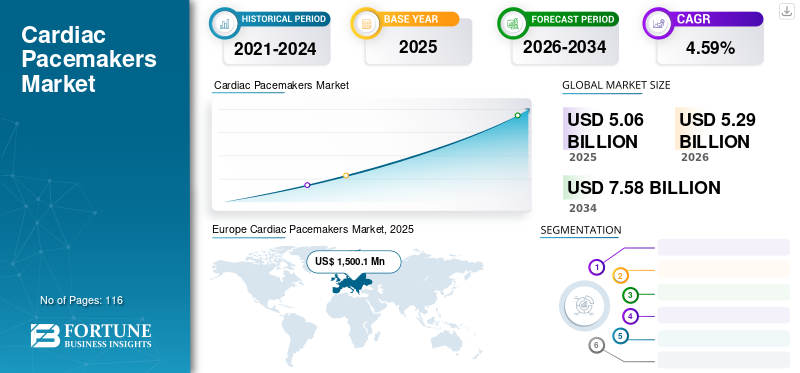
The global cardiac pacemakers market size was valued at USD 5.06 billion in 2025. The market is projected to grow from USD 5.29 billion in 2026 to USD 7.58 billion by 2034, exhibiting a CAGR of 4.59% during the forecast period. Europe dominated the global pacemaker market with a market share of 37.07% in 2025.
The increasing prevalence of arrhythmia and bradycardia is projected to boost the global cardiac pacemaker market growth by 2026. According to data published in the American Heart Association journal in 2015, an estimated 15.0% of global sudden cardiac deaths occur in China.
A pacemaker is an implantable electronic device widely used to regulate and monitor a patient's heartbeat with the help of small electric stimulation. Depending upon the heart's requirements, pacemakers are utilized for a short or long time. Combined with this, pacemakers play a major role in monitoring and analyzing the patient's heartbeat, providing physiologic heart rate, and providing diagnostic information about a heart condition.
Download Free sample to learn more about this report.
Global Cardiac Pacemaker Market Key Takeaways
 Market Size & Forecast
- 2025 Market Size: USD 5.06 billion
- 2026 Market Size: USD 5.29 billion
- 2034 Forecast Market Size: USD 7.58 billion
- CAGR: 4.59% from 2026–2034
 Market Share
- Europe dominated the global cardiac pacemakers market with a 37.07% share in 2025.
- Dual-chamber pacemakers led the product segment, accounting for approximately 71.2% of the global market.
- Clinics & hospitals represented the leading end-user segment, supported by the high volume of pacemaker implantation procedures.
 Key Regional Highlights
Europe
Europe dominated the global market with a 37.07% share in 2025, driven by advanced healthcare infrastructure, greater patient awareness, and favorable reimbursement frameworks.
Asia Pacific
Asia Pacific is expected to witness the highest CAGR due to a growing patient pool suffering from cardiac disorders and improving healthcare access.
North America
Favorable reimbursement policies are creating a lucrative opportunity for the pacemakers market growth in North America by 2026.
U.S.
Favorable reimbursement policies are supporting the growth of the pacemakers market in the U.S. by 2026.
Japan
Japan is expected to benefit from the growing patient pool suffering from cardiac disorders and improving healthcare access in Asia Pacific.
Read More

Cardiac Pacemakers Market Trends
Download Free sample to learn more about this report.
"Cardiac Resynchronization Therapy Device Pacemaker (CRT-P) is expected to register significant growth over the forecast period"
Cardiac Resynchronization Therapy Device Pacemaker (CRT-P) is an advanced type of pacemaker that provides certain added benefits, such as sensing heart rate and delivering shock in accurate time. Moreover, one of the prime functions of the CRT-P device is to reduce the future chances of heart failure. The adoption of CRT-P devices is growing extensively due to their added benefits and proven efficiency in treating heart rhythm disorders.
Additionally, favorable reimbursement policies served by governments across the globe are projected to boost the adoption of CRT-P devices, resulting in the pacemaker market growth. Other types of cardiac pacemakers include single-chamber pacemakers and dual-chamber pacemakers. The dual-chamber pacemaker accounted for an estimated 71.2% of the cardiac pacemaker market share.
Segmentation Analysis
To know how our report can help streamline your business, Speak to Analyst
In terms of products, the global cardiac pacemakers market segments are categorized into single-chamber pacemakers, dual-chamber pacemakers, and CRT-Pacemakers. On the basis of end-users, the cardiac pacemaker market segments include clinics & hospitals and ASCs (Ambulatory Surgery Centers) & others.
Regional Analysis
"Higher Adoption Pacemakers due to Advanced Healthcare Facilities and Awareness Amongst Patients"
Europe generated revenue of US$ 1,500.1 Mn in 2018 and is expected to dominate the pacemaker market throughout the forecast period. Developed healthcare infrastructure and awareness amongst the general population are fueling the adoption of pacemakers to cope up with the rapidly increasing pacemaker market in Europe. Moreover, favorable regulatory in reimbursement policies are creating a lucrative opportunity for the pacemakers market growth in Europe and countries of North America by 2026.
Europe Cardiac Pacemakers Market, 2025
To get more information on the regional analysis of this market, Download Free sample
The emerging countries of Asia Pacific hold a lower share in the global market, although the pacemaker market in Asia Pacific is anticipated to register a higher CAGR owing to increasing patient pool suffering from cardiac disorders. The rest of the world holds a smaller share in the global market owing to the lower awareness of the treatment and lack of trained healthcare professionals.
Pacemaker Market Drivers
"Medtronic and Boston Scientific Corporation to Account for More Than Half of the Market Share in Terms of Revenue"
Medtronic holds a considerable share of the cardiac pacemaker market. The company is anticipated to retain its leading position in the forecast duration owing to its wide range of product offerings, the introduction of advanced and innovative and strong brand presence. This company, together with Boston Scientific Corporation currently holds over half of the global cardiac pacemakers market share in terms of revenue. Other players operating in the pacemaker market are Abbott, LivaNova PLC, MicroPort, BIOTRONIK, and others.
List of Top Companies in Pacemaker Market:
- Medtronic Plc
- Boston Scientific Corporation
- Biotronik
- LivaNova Plc
- Abbott
- Microport
- Other prominent players
Key Industry Developments
- January 5, 2024: Medtronic received CE Mark approval for its next-generation Micra™ AV2 and Micra™ VR2 leadless pacemakers. These devices offer approximately 40% more battery life compared to previous generations, with projected longevity of nearly 16 and 17 years, respectively. They also feature remote monitoring capabilities, allowing clinicians to check on a patient's heart device without the need for in-person visits.
- November 21, 2024: Abbott launched the AVEIR™ VR leadless pacemaker system in India, approved by the Central Drugs Standard Control Organization (CDSCO). The device features a unique mapping capability to assess correct positioning prior to placement and has a longer projected battery life compared to other commercially available leadless pacemakers.
- December 17, 2024: Abbott announced the successful completion of the world's first in-human leadless left bundle branch area pacing (LBBAP) procedures using its investigational AVEIR™ Conduction System Pacing (CSP) leadless pacemaker system. This system is designed to deliver pacing to the left bundle branch area, activating the heart's natural conduction system.
- March 25, 2024: MicroPort CRM announced the first implantation of its ALIZEA™ Bluetooth® pacemaker system in the United States. The system offers advanced heart rhythm management features and is equipped with Bluetooth® technology for comprehensive remote monitoring equivalent to an in-person follow-up.
- March 6, 2025: MicroPort CRM launched the localized TEN pacemaker family in China. The TEN pacemaker range includes six models across three categories: T, E, and N, offering both single-chamber and dual-chamber frequency-responsive pacemakers. These devices feature AutoMRI™ technology and the advanced SAM™ function for monitoring nighttime sleep breathing patterns and associated arrhythmias.
- March 14, 2024: Biotronik introduced the world's first and only system CE approved for Left Bundle Branch Area Pacing (LBBAP). The system comprises the Selectra 3D catheters, Solia S leads, and the Amvia pacemaker family, providing a complete solution for LBBAP.
- September 16, 2024: Biotronik received FDA approval for its Selectra 3D catheter in conjunction with its Solia S lead for use in LBBAP. This represents the first and only FDA-approved stylet-driven lead and dedicated delivery catheter system approved for LBBAP.
- January 13, 2025: Biotronik enrolled the first patient with its next-generation Solia CSP S pacing lead in the BIO-CONDUCT IDE Trial, studying the use of stylet-driven leads for conduction system pacing.
- September 2024: Boston Scientific presented new data on the pacing performance of the EMPOWER leadless pacemaker from the MODULAR ATP Trial. The study demonstrated safety and efficacy in the pacing performance of the first Boston Scientific leadless pacemaker.
Report Coverage
Cardiac pacemakers are widely used to treat the heart, which is beating irregularly or too slowly. Generally, pacemakers contain two parts: a lead, which transports electric impulses to regularize heartbeat, and a generator to control the pacemaker and store information. The exponentially increasing prevalence of cardiac conditions is anticipated to offer huge potential for the cardiac pacemaker market growth by 2026.
The report provides qualitative and quantitative insights into cardiac pacemaker industry trends and a detailed analysis of the market size and growth rate for all possible segments. The market is segmented by product, end-user, and region.
The pacemaker market is segmented by product into single-chamber pacemakers, dual-chamber pacemakers, and cardiac resynchronization therapy pacemakers (CRT-P). The report covers various end-users, including hospitals and clinics, ambulatory surgery centers, and others. Geographically, the market is segmented into four major regions: North America, Europe, Asia Pacific, and the rest of the World. The regions are further categorized into countries.
The report also analyzes pacemaker market dynamics and the competitive landscape. Various key insights provided in the report include the prevalence of sudden cardiac arrests in key countries, technological advancements in cardiac pacemakers, recent industry developments such as mergers and acquisitions, the regulatory scenario in key countries, new product launches, the reimbursement scenario, and key industry trends.
REPORT SCOPE & SEGMENTATION
|
ATTRIBUTE |
DETAILS |
|
Study Period |
2021-2034 |
|
Base Year |
2025 |
|
Estimated Year |
2026 |
|
Forecast Period |
2026-2034 |
|
Historical Period |
2021-2024 |
|
Unit |
Value (USD Billion) |
|
Growth Rate |
CAGR of 4.59 |
|
SEGMENTATION |
By Product Single Chamber Pacemakers · Dual Chamber Pacemakers · Cardiac Resynchronization Therapy-Pacemakers (CRT-P) By End User · Hospitals & Clinics · Ambulatory Surgery Centers and Others By Geography · North America (USA and Canada) · Europe (UK, Germany, France, Italy, Spain, Scandinavia and Rest of Europe) · Asia Pacific (Japan, China, India, Australia, Southeast Asia and Rest of Asia Pacific) |
"
Frequently Asked Questions
According to Fortune Business Insights, the global cardiac pacemakers market was valued at USD 4,046.9 million in 2018 and is projected to reach USD 6,296.6 million by 2032, growing at a steady pace driven by increasing prevalence of cardiac arrhythmias and advancements in pacing technology.
Europe currently holds the largest share of the global cardiac pacemakers market, attributed to well-established healthcare infrastructure, high adoption of advanced medical devices, and supportive government reimbursement frameworks.
The cardiac pacemakers market is expected to grow at a compound annual growth rate (CAGR) of approximately 3.2% from 2018 to 2032, fueled by the rising global burden of cardiovascular diseases and the introduction of innovative, MRI-safe, and leadless pacemaker devices.
The dual Chamber Pacemakers segment is expected to be the leading segment in the market during the forecast period.
Superior treatment outcomes for cardiac sudden arrests are the key driving factor in the cardiac pacemakers market.
Medtronic and Boston Scientific Corporation are the leading market players in this market.
Dual-chamber pacemakers account for the largest share in the cardiac pacemakers market due to their ability to regulate both atrial and ventricular rhythms, offering improved synchronization and better treatment outcomes.



- 2021-2034
- 2025
- 2021-2024
- 116
Get 30-60 hrs Free Customization
Expand Regional and Country Coverage, Segments Analysis, Company Profiles, Competitive Benchmarking, and End-user Insights.













.webp)






Related Reports
-
US +1 833 909 2966 ( Toll Free )
-
Get In Touch With Us