Cardiac Rhythm Management (CRM) Devices Market Size, Share, Trends and Industry Analysis Product By (Cardiac Pacemakers, Defibrillators, Cardiac Resynchronization Therapy Devices) By End User (Hospitals & Clinics, Ambulatory Surgery Centers), and Regional Forecast, 2026-2034
 Download Free Sample
Cardiac Rhythm Management (CRM) Devices Market Size and Industry Overview
 Listen to Audio Version
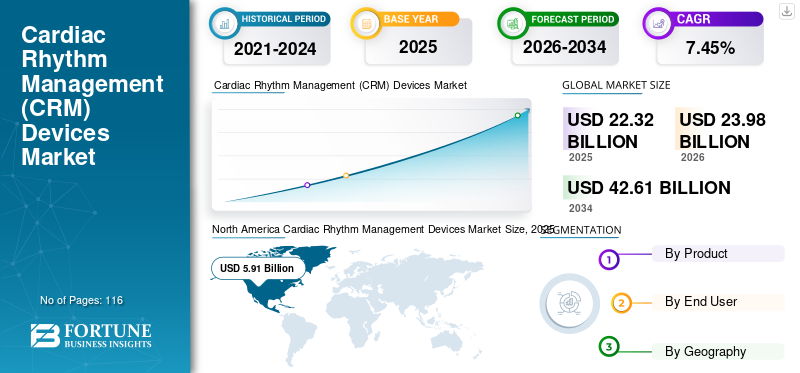
The global cardiac rhythm management devices market size was valued at USD 22.32 billion in 2025. The market is projected to grow from USD 23.98 billion in 2026 to USD 42.61 billion by 2034, exhibiting a CAGR of 7.45% during the forecast period. North America dominated the global market with a share of 42.58% in 2025.
Cardiac rhythm management (CRM) devices are extensively used to treat arrhythmia, bradycardia, tachycardia, and sudden cardiac arrests. Since the prevalence of cardiac rhythm conditions is increasing, the adoption of cardiac management devices has been increased significantly during the past decade. Additionally, emerging nations are witnessing a huge demand for these devices due to a higher prevalence of cardiac conditions, increasing awareness about products amongst the population, and increasing per capita income. According to the European Cardiac Society, in 2017, certain countries in Western Europe were having implant rate of more than 1000 units/million population. This higher rate of implants in developed nations represents higher adoption and patient preference for cardiac rhythm management devices.
Download Free sample to learn more about this report.
Cardiac Rhythm Management (CRM) Devices Market Key Takeaways
 Market Size & Forecast
- 2025 Market Size: USD 22.32 Billion
- 2026 Market Size: USD 23.98 Billion
- 2034 Forecast Market Size: USD 42.61 Billion
- CAGR: 7.45% from 2026–2034
 Market Share
- North America dominated the cardiac rhythm management devices market with a 42.58% share in 2025.
- The cardiac pacemakers segment accounted for the largest market share in 2025.
- The clinics & hospitals segment held the leading end-user share in 2025.
 Key Regional Highlights
Asia Pacific
Asia Pacific is expected to experience strong growth owing to increasing awareness and adoption of cardiac rhythm management devices.
North America
North America led the global market due to the high adoption of pacemakers and implantable cardiac devices.
Europe
Europe is witnessing steady market growth driven by the rising prevalence of sudden cardiac arrests.
U.S.
High prevalence of cardiac disorders and widespread adoption of advanced cardiac rhythm management devices continue to support market growth.
Japan
Growing awareness of cardiac care and increasing adoption of advanced cardiac rhythm management devices are driving market expansion.
Read More

Key Market Drivers
Defibrillator segmented is projected to drive global market
Defibrillators are generally used to treat arrhythmia and out-of-hospital cardiac arrests. Implantable cardioverter defibrillator (ICD) is highly recommended by physicians to treat irregular heartbeat, also it delivers electric shocks with the aim to restore the heartbeat. External defibrillators are widely being installed in developed as well as emerging nations in order to deal with the increasing prevalence of out-of-hospital cardiac arrests. Moreover, in certain countries, it is mandatory to install external defibrillators at public places with the aim to offer easy access to the cardiac patient. Defibrillators accounted for an estimated 49.0% of the share in this market in 2018.
Download Free sample to learn more about this report.
CARDIAC RHYTHM MANAGEMENT (CRM) DEVICES MARKET SEGMENTATION ANALYSIS
To know how our report can help streamline your business, Speak to Analyst
In terms of products, the global cardiac rhythm management devices market is categorized into cardiac pacemakers, defibrillators, and cardiac resynchronization therapy (CRT) devices. Cardiac pacemakers are further categorized into single chamber pacemakers and dual chamber pacemakers. Defibrillators are further categorized into external defibrillators and implantable defibrillators. Cardiac resynchronization therapy devices are categorized into CRT-P and CRT-D. On the basis of end users, this market is categorized into clinics& hospitals and ASCs (Ambulatory Surgery Centers) & others.
Regional Analysis
North America Cardiac Rhythm Management Devices Market Size, 2025
To get more information on the regional analysis of this market, Download Free sample
North America
Higher Adoption of Cardiac Rhythm Management Devices to Cope up with Higher Prevalence of Cardiac Conditions Enables Market to Hold Considerable Share in North America
North America is expected to dominate the cardiac rhythm management devices market share throughout the forecast period. Higher adoption of pacemakers and ICD implants owing to the gradual shift of patient preference towards preventive care and increasing prevalence of cardiac conditions is expected to drive the market in North America. Moreover, strict implementation of government regulations with respect to installations of external defibrillators in public places is projected to result in increased adoption of external defibrillators, which will eventually boost the market.
Europe
In Europe, higher prevalence of sudden cardiac arrests is expected to drive the market in Europe during the forecast period.
Asia Pacific
In Asia Pacific, increasing awareness about thesecrm devices is projected to increase the adoption of cardiac management devices market, which will eventually accelerate the market in the Asia Pacific.
Key Market Players
Medtronic and Boston Scientific Corporation to Account for More Than Half of the Market Share in Terms of Revenue
Medtronic is a leading player in the global implantable cardioverter defibrillator market. Combined with this, Medtronic also holds a considerable share of the global pacemaker market. Medtronic is anticipated to retain its leading position in the forecast duration owing to its wide range of product offerings, availability of products across the globe and strong customer base. This company, together with Boston Scientific Corporation, currently holds over half of the market share in terms of revenue. Other players operating in the global market are Cardiac Science, Physio Control, Stryker, Defibtech, LLC., CU Medical Systems Inc., Abbott, Boston Scientific Corporation, LivaNova PLC, MicroPort, BIOTRONIK, and others.
List of Top Cardiac Rhythm Management (CRM) Devices Companies:
- Medtronic
- Boston Scientific Corporation
- Biotronik
- Asahi Kasei Corporation
- Philips Healthcare
- Defibtech, LLC.
- Cardiac Science
- Stryker
- CU Medical System Inc.
- LivaNova Plc
- Abbott
- Microport
- Other prominent players
Key Industry Developments
- In March 2019, Biotronik launched MRI compatible ICD and CRT-D system in Europe market.
- In November 2017, Medtronic got FDA approval for their Azure pacemakers. These newly developed pacemakers are equipped with BlueSync technology which enables device longevity and improved patient monitoring.
- In July 2017, Biotronik launched Evity cardiac resynchronization therapy pacemaker (CRT-P) in Japan market. According to company estimates, it is the highest performing CRT-P with battery life of 10 years.
Report Coverage
Cardiac rhythm management devices are widely used to treat heart disease and heart rhythm disorders across the globe. Implantable cardioverter defibrillators and pacemakers play a major role in managing heart rhythm. Combined with this, these devices perform other important functions such as bradycardia pacing, defibrillation, and anti-tachycardia pacing. Dramatically increasing prevalence of cardiac conditions and proven efficiency of these devices to treat such conditions is anticipated to offer huge potential for growth of the global market by 2026.
The cardiac rhythm management devices market report provides qualitative and quantitative insights on the industry trends and detailed analysis of market size and growth rate for all possible segments in the market. The market is segmented by product, by the end user, and by region. On the basis of the product, the CRM devices market is segmented into cardiac pacemakers, defibrillators, and cardiac resynchronization devices. Cardiac pacemakers are further segmented into single chamber pacemakers and dual chamber pacemakers. Defibrillators are further segmented into external defibrillators and implantable defibrillators. Cardiac resynchronization therapy devices are categorized into CRT-P and CRT-D. Various end users covered under the report are hospitals & clinics and ambulatory surgery centers and others. Geographically, the market is segmented into four major regions, which are North America, Europe, Asia Pacific, and the rest of the World. The regions are further categorized into countries.
Along with this, the report analysis includes market dynamics and competitive landscape. Various key insights provided in the report are the prevalence of sudden cardiac arrests in key countries, technological advancements in cardiac rhythm management devices, recent industry developments such as mergers & acquisitions, the regulatory scenario in key countries, new products launches, reimbursement scenario, and key industry trends.
Request for Customization to gain extensive market insights.
Report Scope & Segmentation
|
ATTRIBUTE |
DETAILS |
|
Study Period |
2021-2034 |
|
Base Year |
2025 |
|
Estimated Year |
2026 |
|
Forecast Period |
2026-2034 |
|
Historical Period |
2021-2024 |
|
Unit |
Value (USD Billion) |
|
Growth Rate |
CAGR of 7.45% from 2026 to 2034 |
|
By Product |
|
|
By End User |
|
|
By Geography |
|
Frequently Asked Questions
Fortune Business Insights says that the market was valued at USD 23.98 Bn in 2026 and is projected to reach USD 42.61 Bn by 2034.
In 2025, the market was valued at USD 22.32 Bn.
Growing at a CAGR of 7.45%, the market will exhibit steady growth in the forecast period (2026-2034)
Defibrillator segment is expected to be the leading segment in this market during the forecast period.
Increasing prevalence of cardiac sudden arrests is the key driving factor of the market.
Medtronic and Boston Scientific Corporation are the leading market players in the global market.
North America is expected to hold the highest market share in this market.
Increasing demand for wearable technology in defibrillators is one of the trends in this market.



- 2021-2034
- 2025
- 2021-2024
- 116
Get 30-60 hrs Free Customization
Expand Regional and Country Coverage, Segments Analysis, Company Profiles, Competitive Benchmarking, and End-user Insights.













.webp)






Related Reports
-
US +1 833 909 2966 ( Toll Free )
-
Get In Touch With Us