Clinical Laboratory Services Market Size, Share & & Industry Analysis, By Test Type (Clinical Chemistry, Hematology, Genetic Testing, Microbiology & Cytology, and Others), By Age (Pediatric and Adult), By Source of Payment (Public, Private, and Out of Pocket), By Service Provider (Hospital-based Laboratories, Stand-alone Laboratories, Clinic-based Laboratories, and Others), and Regional Forecast, 2026-2034
 Download Free Sample
Clinical Laboratory Services Market Size and Future Outlook
 Listen to Audio Version
The global clinical laboratory services market size was valued at USD 291.07 billion in 2025 and is projected to grow from USD 306.91 billion in 2026 to USD 461.89 billion by 2034, exhibiting a CAGR of 5.2% during the forecast period. North America dominated the clinical laboratory services market with a market share of 36.46% in 2025.
Clinical laboratories are healthcare facilities where tests are conducted on clinical specimens to derive information regarding patients’ health for diagnosis, treatment, and disease prevention. These labs also offer emergency response assistance, research support, and training for new lab staff. The prevalence of chronic conditions and growing geriatric population are promoting the use of lab-based solutions.
- For instance, according to 2023 data published by the Government of China, about 297 million people were aged 60 and above in China.
Furthermore, growing focus on providing novel services by key companies, including Labcorp, Quest Diagnostics Incorporated, among others, is further contributing to the demand for these services in the market.
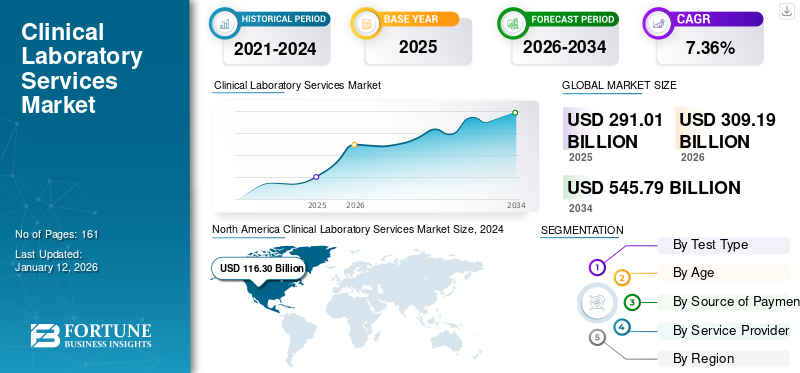
Download Free sample to learn more about this report.
Clinical Laboratory Services Market Trends
Advancements in Lab Automation to Boost Services Adoption
There is a growing focus on the development of automated clinical laboratories among the key companies in the global market. The benefits associated with automated labs, including increasing throughput, enhanced results quality, and replacement of manual and repetitive tasks, among others are anticipated to augment the demand for lab automation and propel the market growth in coming years. Clinical laboratories are focusing on developing automatic machinery to maintain profitability amidst the increasing healthcare costs globally.
- For instance, in April 2023, Flow Robotics announced the launch of a new sample-traceable device, ScanID, that offers both 1D and 2D scanning on one device and can scan an entire row of sample tubes in one go. The device optimizes sample traceability and reduces pre-analytical phase errors, further enhancing the patient’s clinical diagnosis and treatment.
Market Dynamics
Market Drivers
Download Free sample to learn more about this report.
Growing Ageing Population and Preventive Care Awareness to Promote the Services Adoption
The rising geriatric population is expected to surge the number of patient visits to the clinical laboratory tests for diagnosis of several chronic recurring conditions such as osteoarthritis, diabetes, osteoporosis, and heart diseases, which is expected to propel the global clinical laboratory services market growth during the forecast period.
- For instance, according to an article published by the American Diabetes Association (ADA) in January 2022, over one-quarter of people over the age of 65 years have diabetes, and one-half of older adults have prediabetes. Also, number of older adults living with these conditions is expected to increase rapidly in the coming decades, which is further expected to increase the demand for clinical laboratory tests.
This, along with growing healthcare expenditure, expansion of clinical laboratories, among others, growing focus of key laboratories on providing novel services are also some of the contributing growth factors in the market.
Total Positive Growth Contribution
| Rank | Market Drivers | Overall Impact Rank | CAGR Contribution | Impact: 2026-2028 | Impact: 2029-2031 | Impact: 2032-2034 |
|---|---|---|---|---|---|---|
| 1 | Rising burden of chronic and infectious diseases requiring recurring diagnostic testing | High | 1.7% | High | High | High |
| 2 | Aging population and increasing adoption of preventive and routine health screening | High | 1.3% | Medium | High | High |
| 3 | Growing adoption of molecular, genetic, oncology, and other specialized laboratory tests | High | 1.2% | Medium | High | High |
| 4 | Expansion of healthcare coverage and diagnostic access in emerging markets | Medium | 1.1% | Medium | High | High |
| 5 | Laboratory consolidation, hospital outsourcing, automation, and expansion of organized laboratory networks | Low | 1.1% | Medium | Medium | High |
| 6 | Others (Increasing adoption of home specimen collection and mobile phlebotomy, growth of direct-to-consumer and employer-sponsored laboratory testing, etc.) | Low | 0.6% | Low | Low | Low |
| Total Positive Growth Contribution | 7.00% | |||||
Source: Fortune Business Insights
Market Restraints
Pricing Pressure for Clinical Lab Testing Services to Hinder the Market Expansion
There is an increasing demand for clinical laboratory tests among the patient population. However, the increasing pricing pressure is one of the factors that is anticipated to hinder the growth of the market. The diagnostic industry is witnessing immense pricing pressure, mainly due to increased discounts and unacceptable pricing practices.
Moreover, the increasing demand for cost-effective healthcare solutions among patients is driving payers and healthcare providers to negotiate for lower prices for lab testing services. This pricing pressure is resulting in lower reimbursement rates and reduced profit margins for laboratories, thereby hindering the adoption of services.
- For instance, according to 2021 data published by Medline Plus, the cost of genetic testing ranges from under USD 100 to more than USD 2,000.
Market Restraints - Impact & Negative CAGR Contribution (2026–2034)
| Rank | Market Restraints | Overall Impact Rank | Negative CAGR Contribution (2026-2034) |
Impact: 2026-2028 | Impact: 2029-2031 | Impact: 2032-2034 |
|---|---|---|---|---|---|---|
| 1 | Reimbursement pressure, laboratory tariff reductions, and healthcare cost-containment measures | High | -0.7% | High | High | High |
| 2 | Shortage of skilled laboratory professionals and rising labor costs | Medium-High | -0.5% | Medium | High | High |
| 3 | Complex regulatory, accreditation, quality-control, data-privacy, and compliance requirements | Medium | -0.4% | Medium | Medium | High |
| 4 | Others (high cost, limited diagnostic infrastructure, supply-chain disruptions, reimbursement delays, etc.) | Low | -0.2% | Low | Low | Low |
| Total Negative Growth Impact | -1.80% | |||||
Source: Fortune Business Insights
Market Opportunities
Virtual and At-Home Testing Services are Expected to Offer Potential Growth Opportunities
The demand for virtual and at-home clinical lab testing is increasing. As a result, there is an increasing focus on the development of easily available tests with greater efficacy among laboratory clinics. At-home clinical lab testing clinics offer the convenience of conducting necessary medical tests from the comfort of one's own home, reducing the need for travel and wait times.
Additionally, these services provide a safe and private environment, minimizing exposure to potential infections in public settings. The benefits associated with the virtual and at-home clinics are expected to create an opportunity for the market to expand and fulfill the unmet needs.
- For instance, in May 2023, Getlabs, Inc. and Nice Healthcare announced a partnership to expand access to in-home healthcare services and lab testing. The partnership will transform the at-home healthcare industry by providing patients with more personalized and affordable services.
Market Challenges
Non-Standardized Regulatory Framework to Hamper the Market Growth
Increasing awareness about early disease diagnosis, among others are resulting in growing adoption of clinical tests globally. However, limited focus on regulatory framework and licensing for clinical laboratories among the key companies is anticipated to limit the market growth. Without clear guidelines and standards, there is a risk of unreliable and inaccurate test results, compromising patient safety and clinical decision-making.
- For instance, according to an article published by Lablogatory, majority of clinical laboratories in Africa are not accredited, and laboratories are not enrolled in external assurance programs.
Segmentation Analysis
By Test Type
Growing Prevalence of Chronic Diseases Led to the Clinical Chemistry Segmental Dominance
On the basis of test type, the market is divided into hematology, clinical chemistry, genetic testing, microbiology & cytology, and others.
The clinical chemistry segment accounted for the largest clinical laboratory services market share in 2025. The segment growth is attributed to the increasing prevalence of diabetes, thyroid, and hormonal disorders coupled with the availability of at-home clinical lab testing services, providing easy access to diagnostic procedures.
- For instance, according to 2024 data published by the International Diabetes Federation (IDF), about 589 million adults aged 20-79 years are living with diabetes globally.
The genetic testing segment is expected to grow at a CAGR of 8.4% over the forecast period.
To know how our report can help streamline your business, Speak to Analyst
By Age
Increasing Prevalence of Conditions Among Adults Propelled the Segment’s Leadership
Based on age, the market is segmented into pediatric and adult.
The adult segment dominated the global market in 2025 with a share 82.8%. The growth is due to the increasing prevalence of chronic diseases among the adult population, thereby boosting adoption and contributing to the segmental growth.
- For instance, according to 2023 data published by Medical News Today, about 15,000 adults were living with cystic fibrosis in the U.S.
The pediatric segment is set to flourish with a growth rate of 4.1% over the forecast period.
By Source of Payment
Increasing Public Health Expenditure Led to the Dominance of the Segment
Based on source of payment, the market is segmented into public, private, and out-of-pocket.
The public segment dominated the global market in 2025 with a share of 62.2%. The growth is attributed to the increasing public healthcare expenditures in various countries, coupled with the increasing collaborations among different public healthcare companies.
- For instance, according to the report published by the Canadian Institute for Health Information (CIHI), in November 2022, the public healthcare expenditure share IN Canada is 75.0% as compared to the private healthcare expenditure share, which is 25.0%.
The private segment is set to expand with a growth rate of 5.9% during the forecast period.
By Service Provider
Increasing Number of Hospital-based Laboratories Led to the Segmental Dominance
Based on service provider, the market is divided into hospital-based laboratories, stand-alone laboratories, clinic-based laboratories, and others.
The hospital-based laboratories segment dominated the market in 2025 owing to growing establishment of hospital-based laboratories and increasing healthcare expenditure, among others, are some of the crucial factors contributing to the segment’s dominance. Furthermore, the segment is set to hold a 49.7% share in 2026.
- For instance, in January 2021, Clinisys launched a new laboratory information management system for genomic laboratories in the U.K., which was introduced at Poitiers University Hospital in France.
Clinic-based laboratories are projected to grow at a CAGR of 5.5% during the forecast period.
Clinical Laboratory Services Market Regional Outlook
Based on region, the market has been studied across North America, Europe, Asia Pacific, Latin America, and the Middle East & Africa.
North America
North America Clinical Laboratory Services Market Size, 2025 (USD Billion)
To get more information on the regional analysis of this market, Download Free sample
The North America market held the dominant share in 2024, valued at USD 101.09 billion, and also took the leading share in 2025 with USD 106.15 billion. Prevalance of chronic conditions, rising adoption rate of laboratories testing services and advanced diagnostics, growing healthcare expenditure, increasing number of clinical laboratories, among others, are some of the factors contributing to the North America market growth.
- For instance, according to 2024 data published by the Centers for Medicare & Medicaid Services (CMS), the healthcare expenditure is USD 15,474 per capita in the U.S.
U.S. Clinical Laboratory Services Market
Based on North America’s strong contribution and the U.S. dominance within the region, the market in the U.S. can be analytically approximated at around USD 103.79 billion in 2026, accounting for roughly 33.8% of global market sales.
Europe
Europe is projected to record a growth rate of 4.3% in the coming years, which is the second highest among all regions, and reach a valuation of USD 82.17 billion by 2026. The growing occurrence of chronic conditions and adoption of clinical tests including genetic tests and others are likely to support the market growth.
U.K. Clinical Laboratory Services Market
The market in U.K., in 2026 is estimated at around USD 14.59 billion, representing roughly 4.8% of global market revenues.
Germany Clinical Laboratory Services Market
The market in Germany is projected to reach approximately USD 18.28 billion in 2026, equivalent to around 6.0% of global market sales.
Asia Pacific
Asia Pacific is estimated to reach USD 79.55 billion in 2026 and secure the position of the third-largest region in the market. Growing number of clinical labs, awareness about early disease detection, and increasing healthcare expenditure are likely to support the market growth in Asia Pacific.
Japan Clinical Laboratory Services Market
The market in Japan in 2026 is estimated at around USD 17.30 billion, accounting for roughly 5.6% of global revenues. Japan is expected to grow due to the expansion of clinical laboratory services and investment in R&D activities among the major companies in the country’s market.
China Clinical Laboratory Services Market
The marke in China is projected to be one of the largest, with 2026 revenues estimated at around USD 24.71 billion, representing roughly 8.1% of global sales.
India Clinical Laboratory Services Market
The market size in India, in 2026 is estimated at around USD 11.65 billion, accounting for roughly 3.8% of global market revenues.
Latin America and Middle East & Africa
The Latin America and Middle East & Africa regions are expected to witness moderate growth over the forecast period. The Latin America market is set to reach a valuation of USD 19.32 billion in 2026. The growth is due to the increasing focus towards patient care and the rising demand for clinical laboratory services in the region. The Middle East & Africa are also anticipated to grow due to the growing number of key companies expanding their geographic presence. In the Middle East & Africa, the market in GCC is set to reach a value of USD 14.62 billion in 2026.
South Africa Clinical Laboratory Services Market
The market in South Africa is projected to reach around USD 4.63 billion in 2026, representing roughly 1.5% of global market revenues.
COMPETITIVE LANDSCAPE
Key Industry Players
Robust Services Portfolio and Expansion of Clinical Laboratories By Key Players to Support Their Dominance
A strong services portfolio, along with a major focus on strategic initiatives globally, is one of the key factors contributing to the dominance of prominent market players. Labcorp and Quest Diagnostics Incorporated held the major market in 2025. Furthermore, growing focus of key companies on the expansion of laboratory services is likely to strengthen their presence, further contributing to their market share.
- For instance, in December 2022, Labcorp opened a new, larger anatomic pathology and histology (APH) laboratory in Los Angeles. This new launch expanded the company’s global central laboratory capabilities.
Other key players, including NeoGenomics Laboratories, Inc. are also growing in the market, primarily due to their increasing focus on acquisitions among other companies to strengthen their presence in the market.
List of Key Clinical Laboratory Services Companies
- Labcorp (U.S.)
- Quest Diagnostics Incorporated (U.S.)
- Illumina, Inc. (U.S.)
- Eurofins Scientific (Luxembourg)
- DDRC SRL Diagnostics (SRL Diagnostics) (India)
- UNILABS (A.P. Moller Holding A/S) (Switzerland)
- NeoGenomics Laboratories, Inc. (U.S.)
- ARUP Laboratories (U.S.)
- Sonic Healthcare Limited (Australia)
- Bupa (Chile)
KEY INDUSTRY DEVELOPMENTS
- January 2026: Corewell Health and Quest Diagnostics completed the transaction to establish a laboratory services joint venture to expand access to innovative, quality, and affordable laboratory services in Michigan.
- September 2024: Labcorp, a global company of innovative and comprehensive laboratory services, acquired selective assets of BioReference Health, a wholly owned subsidiary of OPKO Health, with an aim to increase its brand presence.
- October 2023: Sonic Healthcare Limited acquired the Dr Risch laboratory group, a full-service medical laboratory group in Switzerland, with an aim to increase its geographic presence.
- August 2023: Redcliffe Labs partnered with Abbott India to launch Clinical Decision Support (CDS), also known as AlinIQ. It is powered by advanced technologies, such as Big Data Engines and Artificial Intelligence (AI).
- April 2023: SRL Diagnostics announced the acquisition of Lifeline Laboratories to expand its presence in the Indian pathology market.
- April 2023: Quest Diagnostics announced the acquisition of Haystack Oncology to enhance the focus on early-stage oncology testing to aid in the early and accurate detection of residual or recurring cancer.
REPORT COVERAGE
The report encompasses a complete global clinical laboratory services market analysis. It highlights vital aspects such as test type, age, source of payment, service provider, and geography. It also provides insights into market dynamics, the prevalence of chronic diseases, an overview of accreditation bodies for laboratories, and prominent players in the market. Besides this, the report offers insights into the market trends and highlights key industry developments. In addition to the aforementioned factors, the report encompasses several factors that have contributed to the growth of the market over recent years.
Request for Customization to gain extensive market insights.
Report Scope & Segmentation
| ATTRIBUTE | DETAILS |
| Study Period | 2021-2034 |
| Base Year | 2025 |
| Estimated Year | 2026 |
| Forecast Period | 2026-2034 |
| Historical Period | 2021-2024 |
| Growth Rate | CAGR of 5.2% from 2026-2034 |
| Unit | Value (USD Billion) |
| Segmentation | By Test Type, Age, Source of Payment, Service Provider, and Region |
| By Test Type |
|
| By Age |
|
| By Source of Payment |
|
| By Service Provider |
|
| By Region |
|
Frequently Asked Questions
Fortune Business Insights says that the global market value stood at USD 291.07 billion in 2025 and is estimated to reach USD 461.89 billion by 2034.
The market is projected to record a CAGR of 5.2% during the forecast period.
The market value of North America was USD 106.15 billion in 2025.
Based on test type, the clinical chemistry segment dominates the global market.
North America held a dominant share of the global market in 2025.
The rising prevalence of chronic disorders is driving the global market growth.
Labcorp, Quest Diagnostics Incorporated, and Eurofins Scientific are some of the top players in the market.
The major contributing factors are increasing disease prevalence and a surge in strategic initiatives by key players to offer advanced offerings.



- 2021-2034
- 2025
- 2021-2024
- 161
Get 30-60 hrs Free Customization
Expand Regional and Country Coverage, Segments Analysis, Company Profiles, Competitive Benchmarking, and End-user Insights.













.webp)






Related Reports
-
US +1 833 909 2966 ( Toll Free )
-
Get In Touch With Us