Industrial Waste Management Market Size, Share & Industry Analysis, By Waste Type (Construction & Demolition Waste, Manufacturing Waste, Chemical Waste, Mining Waste, Oil & Gas Waste, Agriculture Waste, Nuclear Waste, and Others), By Service (Landfill, Recycling, and Incineration), and Regional Forecast, 2026-2034
 Download Free Sample
 KEY MARKET INSIGHTS
 Listen to Audio Version
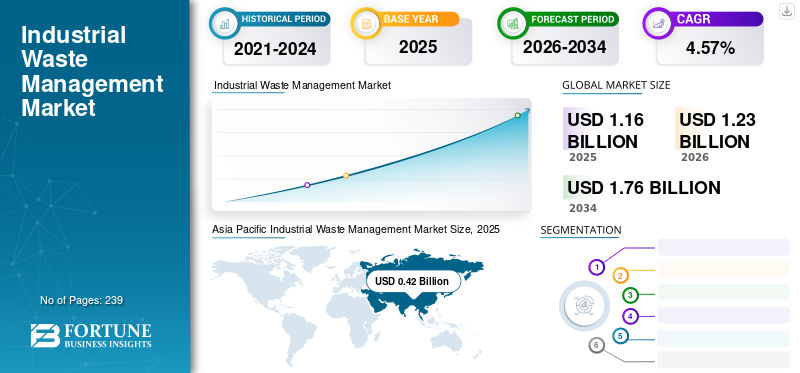
The global industrial waste management market size was valued at USD 1.16 billion in 2025 and is projected to grow from USD 1.23 billion in 2026 to USD 1.76 billion by 2034, exhibiting a CAGR of 4.57% during the forecast period. Asia Pacific dominated the global market with a share of 35.98% in 2025. The Industrial Waste Management market in the U.S. is projected to grow significantly, reaching an estimated value of USD 323.81 billion by 2032, driven by the stringent waste management solutions and emergence of advanced waste-to-energy plants.
Management of waste produced through industrial activities generally consists of separation, composting, landfill, and waste recycling. Industrial waste management through landfill includes waste burial which cannot be further composed or recycled. Subsequently, recycling of industrial waste is generally referred to reuse of waste materials and generally includes the utilization of multiple management of waste technologies.
Download Free sample to learn more about this report.
Download Free sample to learn more about this report.
Global Industrial Waste Management Market Overview
Market Size:
- 2025 Value: USD 1.16 billion
- 2026 Value: USD 1.23 billion
- 2034 Forecast Value: USD 1.76 billion
- CAGR: 4.57% from 2026 to 2034
Market Share:
- Regional Leader: Asia Pacific held approximately 35.98% of the global market in 2025
- Fastest‑Growing Region: Not explicitly specified
- End‑User Leader: The Construction & Demolition Waste segment led the market in 2023/2024
Industry Trends:
- Rising industrial activities worldwide are driving higher volumes of industrial waste requiring management solutions
- Increasing adoption of integrated recycling, landfill, and incineration methods to address diverse waste streams
- Growing emphasis on technological solutions and regulatory compliance to manage chemical, mining, oil & gas, agricultural, and other industrial waste types
Driving Factors:
- Accelerated growth in industrial production, resulting in higher waste generation and demand for treatment solutions
- Stringent environmental regulations enforcing better industrial waste disposal and treatment protocols
- Diversification of waste streams—ranging from construction and chemical to agricultural and nuclear waste—requiring varied management services
- Facility upgrades and technology adoption, including incineration and recycling infrastructure within industries
- COVID‑19 induced awareness, spotlighting the need for responsible handling of industrial and medical-related waste
Recycling is reusing or repurposing waste materials to reduce the amount of waste produced. All these processes also utilize various waste management technologies available within waste management facilities. Incineration is a waste treatment method that burns the organic substances contained in waste materials. Through this process, the solid waste’s mass is reduced approximately by 80 - 85%. However, incineration does not help replace landfill waste but significantly reduces the amount of disposed waste.
The global COVID-19 pandemic has been unprecedented and staggering, with industrial waste management experiencing lower-than-anticipated demand across all regions compared to pre-pandemic levels. Experts say the pandemic has highlighted the importance of managing waste to minimize long-term health risks to people and the environment. The COVID-19 pandemic has also resulted in a significant rise in medical waste, which mainly constitutes face masks, hand gloves, and protective gear.
Industrial Waste Management Market Trends
Increasing Global Industrial Activity Augments the Demand for Effective and Responsible Management Solutions
As industries diversify and new technologies emerge, the types of waste generated becomes more complex, requiring specialized treatment and disposal solutions. Certain sectors such as chemical manufacturing and electronics generate significant hazardous waste, demanding stringent safety protocols and specialized management expertise. Rapid urbanization and infrastructure development contribute to large volumes of construction and demolition waste, requiring efficient collection, processing, and recycling solutions.
Optimizing collection routes, utilizing alternative fuels for waste transportation vehicles, and exploring waste-to-energy solutions can improve efficiency and reduce environmental impact. Technologies such as anaerobic digestion, plasma gasification, and advanced recycling processes can effectively treat and recover valuable resources from complex waste streams. Minimizing landfill dependence and exploring alternative disposal options such as waste-to-landfill solutions or secure hazardous waste repositories are crucial for responsible waste management.
Increasing Focus on Developing Advanced Technologies to Spur Market Opportunities
Several developing and developed countries focus on developing innovative technologies and advancing collection solutions. Countries are developing new technologies for waste collection. Many advanced sensors notify waste management companies that bins are full and require maintenance.
The disposal of e-waste is also gaining popularity around the world. Kuwait ranks as the largest per capita producer of e-waste, using the same landfills for e-waste and conventional waste. Oman even has e-waste regulations. Various key technologies have been introduced in many regions worldwide, and different effective waste management techniques have been integrated into several countries around the globe.
For example, the Dubai Municipality is installing smart weighbridges and electronic gates at all landfill sites to make the landfill sites more sustainable. Moreover, this industry's increasing innovation and development will likely create tremendous market opportunities during the forecast period.
Industrial Waste Management Market Growth Factors
Increasing Number of Industries around the World to Boost Market Growth
The demand for industrial waste management solutions is increasing rapidly in industrialized countries. Urbanization and industrialization are increasing worldwide. Waste management awareness is rapidly increasing in the industry along with increasing technological advances in recycling facilities.
In India, approximately 60% of waste was processed in 2020 compared to 28.57% in 2018. The industrial verticals are growing with the increasing number of aerospace and defense, automotive, electronics, oil and gas, food and beverage, biotechnology, and others. With the growing number of industries, industrial waste generation is also increasing worldwide. This increasing waste is a significant problem for people and governments in many countries worldwide. This creates an enormous need for proper waste management worldwide. Therefore, the demand for industrial waste disposal will increase during the forecast period.
Increasing Application of Waste Management Technologies to Fuel Market Growth
Each year, various verticals, such as industrial sector, agricultural sector, municipalities, generate a billion tons of waste and management of such waste remains one of the most crucial challenges. Several industry verticals are trying to reduce their energy consumption by adopting waste to energy technologies such as thermochemical, biochemical, incineration, and gasification. The waste to energy helps various industry verticals to convert the waste into electricity and heat to be used for their application. Additionally, this helps them with generating a revenue stream from waste management.
This helps in possibly reducing heating and electricity consumption from the grid, which, in turn, fuels the growth of waste management in the energy sector.
RESTRAINING FACTORS
High Waste Disposal Cost is Hampering the Market Growth
The surplus products released by the industry can be recycled. Still, recycling such scrap is very costly, and small and medium-sized industries cannot invest such amounts for waste management. As of 2021, the Americas generated nearly 250 million tons of trash annually and recycled 34% of the total waste.
Many countries have presented small and medium-sized local industries that generate a lot of scraps. Still, they cannot spend a lot of money to dispose of such waste properly. Some regions of the world even lack the infrastructure to keep up the waste collection, hindering the industrial waste management market growth over the forecast period.
Industrial Waste Management Market Segmentation Analysis
By Waste Type Analysis
Construction & Demolition Waste to Hold Dominant Market Share Due to Growing Infrastructural Activities
Based on waste type, the market is segmented into construction & demolition waste, manufacturing waste, agricultural waste, chemical waste, mining waste, oil & gas waste, nuclear waste, and others.
Moreover, as per the United States Environmental Protection Agency (EPA), the U.S. alone generated over 600 million tons of construction-related waste and is likely to grow faster in the forthcoming years. Based on this factor, the construction & demolition waste segment is projected to dominate the market with a share of 30.49% in 2026.
In addition, waste from the manufacturing industry is expected to increase significantly over the forecast period owing to the growth of industrialization in many developing countries and production of the excess scrap. Disposal of such wastes into the environment may cause air and water pollution. In 2019, 5% of production-related waste from manufacturing was released into the atmosphere. However, the rest has been dealt with through treatment, recycling, and others.
In parallel to manufacturing waste, waste materials from industries such as metallurgy, non-metallurgy, and food processing industries are increasing significantly across the region, particularly in developing countries due to growing industrialization and population, which drives the mining industrial waste management market growth.
To know how our report can help streamline your business, Speak to Analyst
By Service Analysis
Landfill Segment Dominates the Market Due to Widespread Adoption
Based on service, the market is segmented into landfill, recycling, and incineration. Landfill segment is projected to dominate the market with a share of 53.80% in 2026. Landfilling is a high priority for state and local governments to manage waste as it is for state and local governments, thereby surging the demand for landfilling as waste management services across the region.
In addition, the industrial waste management hierarchy emphasizes reducing, reusing, and recycling as key to sustainable materials management. Based on this factor, the recycling industrial waste management service will likely experience significant growth during the forecast period.
In parallel to this, developing countries worldwide have increased their efforts to reduce the volume of waste through waste management techniques such as recycling and better better solid waste management. Moreover, many countries are exploring Waste-to-Energy (WtE) technologies, such as incineration, in which municipal solid waste is subjected to an environment-friendly process to produce steam and electricity. Based on these factors, incineration waste management services will likely experience significant growth during the forecast period.
REGIONAL INSIGHTS
Geographically, the market has been analyzed across North America, Europe, Asia Pacific, Middle East & Africa, and Latin America.
Asia Pacific Industrial Waste Management Market Size, 2025 (USD Billion)
To get more information on the regional analysis of this market, Download Free sample
North America
In 2025, the North America market stood at USD 0.28 billion, representing 24.06% of global demand, and is projected to grow to USD 0.3 billion in 2026. North America holds a well-established position in the industrial waste management market, supported by mature regulatory frameworks and high compliance requirements across manufacturing, chemicals, oil and gas, and energy sectors. Stringent environmental policies and enforcement mechanisms continue to shape the competitive landscape, with regulatory authorities strengthening landfill and disposal rules and imposing penalties for illegal dumping and burning of waste. Demand trends in the region are increasingly influenced by corporate sustainability targets, adoption of advanced treatment technologies, and growing investments in recycling, resource recovery, and waste-to-energy infrastructure, which collectively contribute to steady market expansion during the forecast period. The U.S. market is projected to reach USD 0.26 billion by 2026.
Europe
The Europe region captured 17.96% of the global market in 2025, generating USD 0.21 billion in revenue, and is projected to reach USD 0.22 billion in 2026. Europe represents a highly regulated and environmentally conscious market, characterized by strict waste handling directives, circular economy policies, and ambitious carbon reduction targets. Regulatory bodies across the region continue to promote waste minimization, recycling, and safe disposal practices, driving the adoption of advanced segregation, treatment, and recovery systems. Demand remains strong from industrial sectors such as automotive, chemicals, and construction, where compliance with environmental standards is a critical operational requirement. Increasing awareness of environmental impacts among industries and the public further accelerates the transition toward sustainable waste management solutions, supporting consistent market growth. The UK market is projected to reach USD 0.05 billion by 2026, and the Germany market is projected to reach USD 0.07 billion by 2026.
Asia Pacific
Asia Pacific maintained a strong presence in the global market, reaching USD 0.42 billion in 2025, accounting for 35.98% share, and is expected to reach USD 0 billion in 2026, primarily driven by rapid industrialization, rising economic activity, and the resulting increase in industrial waste generation. Expanding manufacturing bases in emerging economies continue to create substantial demand for efficient waste handling and disposal services. Governments across the region are actively supporting waste-to-energy projects and infrastructure development, strengthening the regulatory environment and encouraging private sector participation. Demand trends are also shaped by urbanization, growing environmental concerns, and the gradual implementation of stricter waste treatment standards, reinforcing the region’s leadership throughout the forecast period. The Japan market is projected to reach USD 0.06 billion by 2026, the China market is projected to reach USD 0.15 billion by 2026, and the India market is projected to reach USD 0.1 billion by 2026.
Latin America
In 2025, Latin America represented USD 0.15 billion, accounting for 12.96% of the worldwide market, and is projected to grow to USD 0.16 billion in 2026. Latin America is witnessing gradual but notable growth in industrial waste management, supported by evolving environmental regulations and increasing awareness of sustainable waste practices among industries. Governments and municipalities are investing in waste treatment infrastructure, including incineration facilities, to address rising industrial output and waste volumes. The growing adoption of circular economy principles is encouraging industries to focus on resource recovery and recycling, while public-private partnerships are playing an important role in modernizing waste management systems and improving compliance levels across key industrial sectors.
Middle East & Africa
The Middle East & Africa market accounted for USD 0.11 billion in 2025, representing 9.24% of the global industry, and is expected to reach USD 0.11 billion in 2026. The Middle East & Africa market is expanding steadily, driven by industrial diversification, infrastructure development, and growing environmental regulations aimed at improving waste handling practices. Increasing investments in waste incinerators and waste-to-energy facilities reflect a broader shift toward circular economy models and sustainable resource utilization. Regulatory frameworks in several countries are gradually strengthening, encouraging industries to adopt safer disposal and treatment methods. Demand trends are further supported by the expansion of petrochemical, mining, and construction industries, which generate significant volumes of industrial waste and require structured management solutions.
List of Key Companies in Industrial Waste Management Market
Key Participants Are Concentrating on Enhancing their Business Capacities through Business Collaboration with Governments and Domestic Bodies
The competitive landscape for the global market is fragmented due to the presence of many industrial waste management players. Several key players in the world are increasingly engaging in organic and inorganic developments to consolidate their market positions worldwide. Most companies focus on expanding their disposal capabilities by introducing or expanding existing facilities.
For example, In December 2021, Veolia signed an exclusive partnership with Saudi Aramco to treat 200,000 tons of industrial and non-hazardous waste. These amounts come in addition to managing hazardous waste with a volume of around 120,000 tons which will be treated at Jubail. At Jubail, Veolia is completing the construction of an incinerator plant for Sadara Chemical Company and other nearby industries.
Moreover, in June 2020, SIRC, the Saudi Investment Recycling Company opened its first construction and demolition waste recycling plant in Saudi Arabia. The facility recycles nearly 20 million tons of waste dumped on vacant lots.
List of Key Companies Profiled:
- Veolia (France)
- SUEZ (France)
- Covanta (U.S.)
- Waste Management Inc (U.S.)
- Stericycle (U.S.)
- Daiseki Co., Ltd. (Japan)
- CLEAN HARBORS INC. (U.S.)
- REMONDIS SE & Co. KG (Germany)
- Biffa (U.K.)
- SembCorp (Singapore)
- Republic Services, Inc. (U.S.)
KEY INDUSTRY DEVELOPMENTS:
- September 2022 – SUEZ, along with Royal Bafokeng Holdings (RBH) and African Infrastructure Investment Managers (AIIM) completed the accession of EnviroServ Proprietary Holdings Limited and its subsidiary. Through this accession, Suez will be able to integrate its position as a leading international municipal & industrial waste management company. This will also enable Suze to strengthen its market position across the African continent.
- June 2022 - Veolia proposed the sale of Suez's UK waste business and continues building the global champion of ecological transformation. The project aims to be an ecological transformation by bringing together Veolia and most of Suez's international activities. The merger has already proven helpful in adding new skills, technologies, and regions.
- April 2022 - Viridor announced the sale of its landfill and landfill gas business to Frank Solutions Limited. The deal was completed late March 31, 2022, and included the operation and management of 44 sites across the U.K. The sale will allow Viridor to continue growing its core energy recovery and polymer processing businesses while advancing its plans to be net zero by 2040.
- November 2021 – Waste Management Inc. announced that it expected to invest USD 200 million in recycling infrastructure in 2022, bringing the company’s investment in new and upgraded recycling facilities to over USD 700 million since 2018. With the demand for recycled content products continuing to rise, the investment will enable WM to capture more recycled materials and increase access to recycling for its customers.
- October 2021 – REMONDIS International GmbH took over all shares in Veolia Recycling Solutions Nordic AB. Through this acquisition, REMONDIS is strengthening its market position across the Northern Europe region and is significantly expanding its business activities in the Swedish market. The acquisition also marks the company’s entry into the Swedish industrial cleaning sector.
REPORT COVERAGE
The research report presents a comprehensive industry assessment by offering valuable insights, facts, industry-related information, and historical data. Several methodologies and approaches are adopted to make meaningful assumptions and views to formulate the report.
REPORT SCOPE & SEGMENTATION
|
ATTRIBUTE |
DETAILS |
|
Study Period |
2021-2034 |
|
Base Year |
2025 |
|
Estimated Year |
2026 |
|
Forecast Period |
2026-2034 |
|
Historical Period |
2021-2024 |
|
Growth Rate |
CAGR of 4.57% from 2026 to 2034 |
|
Unit |
Value (USD Billion) |
|
Segmentation |
By Waste Type
|
|
By Service
|
|
|
By Region
|
Frequently Asked Questions
A study by Fortune Business Insights shows that the global market size stood at USD 1.16 billion in 2025.
The global market is projected to grow at a CAGR of 4.57% over the forecast period.
The market size of Asia Pacific stood at USD 0.42 billion in 2025.
Based on waste type, the construction & demolition segment holds the dominating share in the global market.
The global market size is expected to reach USD 1.76 billion by 2034.
The key market drivers are rising industrial activities and growing waste management application.
The top players in the market are Veolia, Covanta, Waste Management Inc., Suez, and Biffa Plc.



- 2021-2034
- 2025
- 2021-2024
- 239
Get 20% Free Customization
Expand Regional and Country Coverage, Segments Analysis, Company Profiles, Competitive Benchmarking, and End-user Insights.









Related Reports
-
US +1 833 909 2966 ( Toll Free )
-
Get In Touch With Us