Diagnostic Antibodies Market Size, Share & Industry Analysis, By Type (Monoclonal Antibodies, Polyclonal Antibodies, Recombinant Antibodies, Conjugated Antibodies, and Others), By Technology (Flow Cytometry, ELISA, Immunohistochemistry, Western Blot, and Others), By Source (Mouse, Rabbit, Goat, Human, and Others), By Application (Oncology, Immunology, Infectious Diseases, and Others), By End User (Hospitals & Diagnostic Laboratories, Pharmaceutical and Diagnostic Companies, and Academic & Research Institutions), and Regional Forecast, 2026-2034
 Download Free Sample
Diagnostic Antibodies Market Size and Future Outlook
 Listen to Audio Version
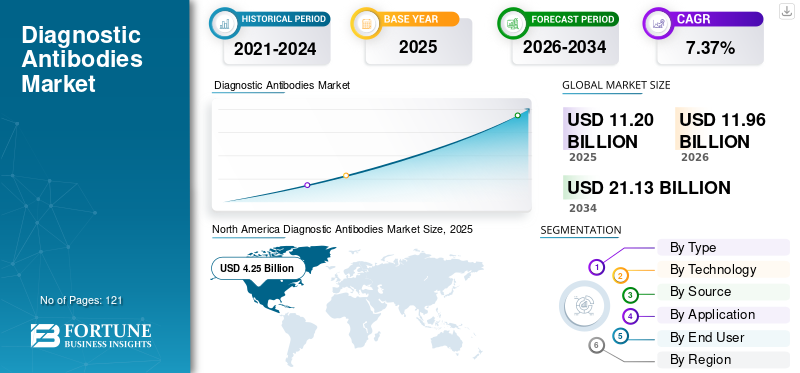
The global diagnostic antibodies market size was valued at USD 11.20 billion in 2025 & is projected to grow from USD 11.96 billion in 2026 to USD 21.13 billion by 2034, exhibiting a CAGR of 7.37% during the forecast period. North America dominated the diagnostic antibodies market with a market share of 37.95% in 2025.
Diagnostic antibodies are widely used in various techniques such as immunohistochemistry, flow cytometry, ELISA, and western blotting to detect disease-associated proteins in biological samples. Increased demand for biomarker-based disease detection is driving market expansion. The market is also witnessing shift toward recombinant and monoclonal antibodies that offer improved specificity, reproducibility, and compatibility with automated testing platforms. Growing adoption of companion diagnostics and precision medicine is further encouraging companies to develop validated antibody clones and disease-specific assays, thereby supporting market growth.
- For instance, in April 2025, Agilent Technologies collaborated with Abcam to develop immunohistochemistry companion diagnostics using the company’s portfolio of validated recombinant monoclonal antibodies. The collaboration accelerated custom assay development and supported the use of diagnostic assays in early-stage clinical trials.
Key players, such as F. Hoffmann-La Roche Ltd., Danaher Corporation, BD, and Thermo Fisher Scientific Inc., are actively participating in new technology launches, strategic collaborations, acquisitions, and investment initiatives to expand market presence.
Download Free sample to learn more about this report.
Diagnostic Antibodies Market KEY TAKEAWAYS
 Global Market Size & Forecast
- 2025 Market Size: USD 11.20 billion
- 2026 Market Size: USD 11.96 billion
- 2034 Forecast Market Size: USD 21.13 billion
- CAGR: 7.37% from 2026–2034
 Market Share
- North America dominated the diagnostic antibodies market with a 37.95% share in 2025.
- Recombinant antibodies is the fastest-growing segment, with an 11.41% CAGR.
- Flow cytometry is projected to grow at an 8.05% CAGR.
 Key Regional Highlights
North America
North America led the market with USD 4.25 billion in 2025, supported by strong cancer testing and precision medicine adoption.
Europe
Europe is projected to grow at a 6.09% CAGR, driven by cancer screening and advanced pathology infrastructure.
Asia Pacific
Asia Pacific held the third-largest share in 2025 and is estimated to reach USD 3.14 billion in 2026.
U.S.
U.S. The market is estimated at USD 4.18 billion in 2026, accounting for roughly 34.96% of global revenues.
Japan
Japan The market is estimated at USD 1.10 billion in 2026, representing approximately 9.22% of global revenues.
Read More

DIAGNOSTIC ANTIBODIES MARKET TRENDS
Growing Adoption of Recombinant Antibodies to Improve Diagnostic Accuracy and Reproducibility is a Prominent Trend
A shift toward recombinant antibodies across antibody-based testing applications is a key market trend. Recombinant antibodies are manufactured using defined genetic sequences, which helps reduce batch-to-batch variation and provides more consistent specificity and binding performance. These advantages are becoming increasingly important as diagnostic laboratories adopt standardized and automated testing workflows. These factors are encouraging diagnostic and life science companies to expand their recombinant antibody portfolios, thereby establishing recombinant antibodies as an important trend in the global market.
- For instance, in April 2026, Bio-Rad Laboratories expanded its recombinant monoclonal anti-idiotypic antibody portfolio by launching eight new antibodies against several biologic drugs, along with a recombinant antibody specific to dulaglutide. The antibodies are designed to support selective and reliable bioanalytical assays, including pharmacokinetic, anti-drug antibody, and therapeutic drug-monitoring applications.
MARKET DYNAMICS
MARKET DRIVERS
Download Free sample to learn more about this report.
Rising Cancer Burden and Biomarker-guided Treatment Selection to Drive Market Growth
The increasing global burden of cancer is creating strong demand for diagnostic antibodies used in disease detection, tumor classification, prognosis, and treatment selection. Global cancer incidence is expected to increase considerably over the coming decades, resulting in a higher number of tissue biopsies, diagnostic tests, and biomarker assessments. Also, the growing availability of targeted therapies and immunotherapies is making biomarker testing an important part of clinical decision-making. Antibodies targeting markers help clinicians identify eligible patients and avoid treatments that are unlikely to provide clinical benefit. As pharmaceutical companies expand biomarker-defined oncology pipelines, diagnostic laboratories are expected to adopt more validated immunohistochemistry and flow-cytometry antibodies, thereby driving market growth.
- For instance, in October 2024, F. Hoffmann-La Roche Ltd. received U.S. FDA approval for its VENTANA CLDN18 (43-14A) RxDx Assay, an antibody-based companion diagnostic used to identify patients with CLDN18-positive gastric or gastroesophageal junction cancer who may be eligible for treatment with VYLOY. The approval demonstrates the increasing importance of diagnostic antibodies in biomarker-guided oncology treatment selection.
|
Rank |
Market Drivers |
Overall Impact Rank |
CAGR Contribution (2026-2034) |
Impact: 2026-2028 |
Impact: 2029-2031 |
Impact: 2032-2034 |
|
1 |
Rising cancer burden and biomarker-guided treatment selection |
High |
3.10% |
High |
High |
High |
|
2 |
Expansion of diagnostic testing and clinical laboratory infrastructure. |
High |
2.45% |
Medium |
High |
High |
|
3 |
Growth of flow cytometry and high-parameter immunophenotyping |
High |
1.95% |
High |
High |
Medium |
|
4 |
Shift toward recombinant, sequence-defined, and engineered antibodies |
Medium-High |
1.55% |
Medium |
High |
High |
|
5 |
Growth of companion diagnostics and precision medicine |
Medium |
1.15% |
Medium |
Medium |
High |
|
6 |
Others |
Low |
0.75% |
Low |
Low |
Low |
|
Total Positive Growth Contribution |
10.95% |
MARKET RESTRAINTS
Lot-to-Lot Variability, Cross-reactivity, and Complex Validation Requirements to Restrain Market Growth
A key factor restricting the global diagnostic antibodies market growth is the variations in antibody performance across production. Changes in antibody affinity, conjugation, purity, or epitope recognition may alter assay sensitivity and produce different results even when laboratories use the same product and testing protocol. Cross-reactivity with structurally similar or unrelated antigens can further generate false-positive or false-negative findings, increasing the risk of incorrect disease classification. Therefore, manufacturers and diagnostic laboratories must conduct extensive specificity, sensitivity, interference, cross-reactivity, and lot-comparison studies before introducing or replacing an antibody reagent. These validation activities require additional samples, skilled personnel, documentation, and laboratory resources, increasing development costs and extending commercialization timelines. Such performance-related uncertainties may discourage laboratories from switching products and restrain the adoption of newly developed diagnostic antibodies.
- For instance, a 2024 laboratory evaluation published in the Harm Reduction Journal found that two manufacturing lots of an antibody-based nitazene test strip produced different detection limits of 2,000 ng/mL and 3,000 ng/mL. The study also reported variable cross-reactivity across the tested analogues. It stated that specificity, lot-to-lot variation, testing conditions, and sample characteristics must be considered before applying the assay in real-world settings. These findings highlight the additional validation burden required to ensure reliable antibody-based diagnostic performance.
|
Rank |
Market Restraints |
Overall Impact Rank |
Negative CAGR Contribution (2026-2034) |
Impact: 2026-2028 |
Impact: 2029-2031 |
Impact: 2032-2034 |
|
1 |
Lot variability, cross-reactivity, and validation burden |
High |
1.35% |
High |
High |
Medium |
|
2 |
Pricing pressure and centralized procurement |
Medium-High |
0.95% |
High |
Medium |
Medium |
|
3 |
Regulatory complexity and market-access fragmentation |
Medium |
0.78% |
Medium |
Medium |
Low |
|
4 |
Others |
Low |
0.50% |
Low |
Low |
Low |
|
Total Negative Growth Impact |
3.58% |
MARKET OPPORTUNITIES
Localization of Diagnostic Antibody Production and Expansion of Local OEM Networks to Create Growth Opportunities
The localization of diagnostic antibody production offers a significant growth opportunity in emerging markets. Establishing regional production and validation facilities can reduce import duties, currency-related costs, delivery delays, and the risk of supply disruptions. Local OEM suppliers can also customize antibody clones, conjugates, buffers, and assay formats according to the requirements of domestic diagnostic-kit manufacturers and laboratory platforms. Strategic partnerships between global antibody manufacturers and local OEM companies can therefore improve product affordability and market access while enabling suppliers to participate in government procurement and domestic-manufacturing programs. These factors are expected to create expansion opportunities for diagnostic antibody companies across China, India, Southeast Asia, Latin America, and other developing markets.
- For instance, in August 2025, a Reuters-based industry report highlighted that pharmaceutical and diagnostic companies in China were increasingly purchasing reagents from domestic suppliers to reduce costs, shorten delivery times, and limit uncertainty associated with international trade and supply chains. The shift toward local suppliers demonstrate the commercial opportunity for regional manufacturers to expand domestic production of diagnostic reagents and antibody-based assay components.
MARKET CHALLENGES
Maintaining Antibody Specificity Across Diagnostic Workflows Remains a Significant Challenge for Market
Maintaining consistent antibody performance across different diagnostic workflows remains a major challenge for market participants. An antibody that performs reliably in one application may generate weak, non-specific, or misleading signals when used with another technique, sample type, fixation method, antigen-retrieval process, or automated testing platform. Differences in laboratory protocols, tissue preparation, reagent concentrations, instrumentation, and interpretation criteria can further affect assay sensitivity and staining quality. This application-specific validation requires suitable controls, representative clinical samples, trained personnel, and continuous quality monitoring, increasing development time and operating costs. Failure to maintain specificity and reproducibility can produce false findings, delay diagnosis, and reduce laboratory confidence in newly introduced antibody products, thereby creating a continuing challenge for the global market.
- For instance, in December 2024, McGill University reported that many commercially available antibodies among an estimated 7.7 million products lacked adequate specificity, potentially resulting in off-target signals and poor reproducibility. The article accompanied the publication of a rigorous antibody-validation protocol in Nature Protocols and highlighted the scale of the performance problem facing laboratories and antibody suppliers.
Segmentation Analysis
By Type
High Specificity and Established Clinical Validation Supported Dominance of Monoclonal Antibodies
Based on the type, the market is categorized into monoclonal antibodies, polyclonal antibodies, recombinant antibodies, conjugated antibodies, and others.
The monoclonal antibodies segment dominated the market in 2025, owing to its high target specificity, consistent binding characteristics, and suitability for standardized diagnostic assays. These monoclonal antibodies recognize a defined epitope, which helps reduce background signals and improves the reproducibility of diagnostic results. Their established use in immunohistochemistry, flow cytometry, ELISA, and companion diagnostics has also resulted in a large portfolio of clinically validated antibody clones. These advantages have encouraged diagnostic companies and clinical laboratories to prefer monoclonal antibodies for routine and biomarker-guided testing, thereby supporting the segment’s dominant market position.
- For instance, in November 2024, Roche received U.S. FDA approval for the expanded use of its PATHWAY anti-HER2/neu (4B5) Rabbit Monoclonal Primary Antibody in biliary tract cancer. The antibody-based test identifies HER2-positive patients who may be eligible for ZIIHERA, demonstrating the established clinical role of monoclonal antibodies in standardized treatment-selection assays.
The recombinant antibodies segment is expected to grow at a CAGR of 11.41% over the forecast period.
To know how our report can help streamline your business, Speak to Analyst
By Technology
Extensive Use in Tissue Diagnosis and Companion Testing Supported Dominance of Immunohistochemistry
Based on technology, the market is segmented into flow cytometry, ELISA, immunohistochemistry, western blot, and others.
In 2025, the immunohistochemistry segment captured a leading share of the market in 2025. The technology enables pathologists to detect and localize disease-related proteins directly within preserved tissue architecture. This allows laboratories to assess not only whether a biomarker is present but also its location, staining intensity, and distribution across tumor cells. IHC is routinely used for tumor classification, determination of tissue origin, receptor-status assessment, prognosis, and selection of targeted or immune-based treatments. Additionally, the growing number of IHC-based companion diagnostics has increased the recurring consumption of primary antibodies and detection reagents, thereby strengthening the segment’s market dominance.
- For instance, in May 2025, Guardant Health added a comprehensive suite of IHC tests for solid tumors to its tissue-profiling portfolio. The expanded menu covered biomarkers including HER2, MMR, PD-L1, c-MET, ER, PR, Ki-67, CLDN18, and FOLR1, highlighting the broad clinical use of IHC in tumor characterization and treatment selection.
The flow cytometry segment is projected to grow at an 8.05% CAGR during the forecast period.
By Source
Large Availability of Established Hybridoma Clones Supported Dominance of Mouse Segment
Based on the source, the market is segmented into mouse, rabbit, goat, human, and others.
The mouse segment accounted for the largest diagnostic antibodies market share in 2025, attributed to its long-standing use of mice in hybridoma-based monoclonal antibody development and the extensive availability of validated murine clones. Mouse immune systems generate strong antibody responses against a broad range of human and non-human antigens, enabling manufacturers to develop antibodies for numerous diagnostic biomarkers. Furthermore, laboratories have access to a broad range of compatible anti-mouse secondary antibodies, conjugates, and detection systems, which simplifies assay development and routine implementation.
- For instance, in August 2024, Agilent received U.S. FDA approval for its MAGE-A4 IHC 1F9 pharmDx assay to identify patients with synovial sarcoma who may be eligible for TECELRA. The assay uses the monoclonal mouse anti-MAGE-A4 clone OTI1F9, demonstrating the continuing clinical importance of mouse-derived antibody clones in companion diagnostics.
The human segment is projected to grow at a CAGR of 11.01% during the forecast period.
By Application
High Requirement for Tumor Classification and Biomarker Testing Boosted Oncology Segment Growth
Based on the application, the market is segmented into oncology, immunology, infectious diseases, and others.
In 2025, the oncology segment dominated the market, owing to the extensive use of diagnostic antibodies throughout cancer diagnosis, classification, prognosis, and treatment selection. Cancer tissue frequently requires testing with multiple antibodies to determine tumor origin, histological subtype, receptor expression, proliferation status, and eligibility for targeted therapies. The expansion of precision oncology has further increased the number of therapies that require or benefit from companion diagnostic testing before treatment initiation. Consequently, the growing integration of biomarker testing into oncology pathways has generated greater demand for diagnostic antibodies than for applications requiring fewer markers or less frequent testing.
- For instance, in May 2025, F. Hoffmann-La Roche Ltd. received U.S. FDA approval for the VENTANA MET (SP44) RxDx Assay as the first companion diagnostic for identifying certain non-squamous non-small cell lung cancer patients eligible for Emrelis. The assay evaluates MET protein expression through antibody-based IHC staining, illustrating the growing requirement for diagnostic antibodies in precision oncology.
The immunology segment is projected to grow at a CAGR of 7.63% over the forecast period.
By End User
Hospitals & Diagnostic Laboratories Led Market Due to Centralized Procurement and Specialist-led Treatment
Based on the end user, the market is segmented into hospitals & diagnostic laboratories, pharmaceutical and diagnostic companies, and academic & research institutions.
Hospitals & diagnostic laboratories dominated the market in 2025. These institutions performed the majority of routine clinical testing on tissue, blood, bone marrow, and other patient samples. Hospitals also receive large volumes of biopsy and surgical specimens and frequently conduct multiple antibody tests for each complex cancer or immune-disease case. Diagnostic laboratories further support centralized testing for smaller hospitals, clinics, and physicians that lack advanced in-house pathology capabilities. Their high testing volumes, recurring reagent procurement, and ability to adopt newly approved companion diagnostics have therefore made hospitals & diagnostic laboratories the largest end-user segment.
- For instance, in April 2026, Labcorp announced nationwide availability of Agilent’s PD-L1 IHC 22C3 pharmDx companion diagnostic for identifying eligible patients with platinum-resistant ovarian cancer. Labcorp also completed early validation, standardized training, and laboratory-readiness activities to enable rapid access, demonstrating the central role of large diagnostic laboratories in commercializing antibody-based tests.
The pharmaceutical and diagnostic companies segment is projected to grow at a CAGR of 7.62% over the forecast period.
Diagnostic Antibodies Market Regional Outlook
By geography, the market is categorized into Europe, North America, Asia Pacific, Latin America, and the Middle East & Africa.
North America
North America Diagnostic Antibodies Market Size, 2025 (USD Billion)
To get more information on the regional analysis of this market, Download Free sample
North America led the market with USD 4.04 billion in 2024 and maintained its dominance in 2025 with USD 4.25 billion. Market growth is driven by high cancer-testing volumes, strong adoption of companion diagnostics, and well-established hospital and reference-laboratory networks. Continued investments in precision medicine and automated pathology are increasing the use of validated diagnostic antibodies.
U.S. Diagnostic Antibodies Market
Given North America's substantial contribution and the U.S. dominance in the region, the U.S. market is estimated at around USD 4.18 billion in 2026, accounting for roughly 34.96% of global revenues.
Europe
Europe is projected to grow at 6.09% CAGR in the coming years, with the second-largest growth among all regions, and reach a valuation of USD 3.18 billion in 2026. Growth is supported by expanding cancer-screening programs, advanced pathology infrastructure, and increasing use of biomarker-guided therapies. Regulatory emphasis on standardized and reproducible diagnostic testing is also strengthening demand for high-quality antibodies.
U.K. Diagnostic Antibodies Market
The U.K. market is estimated at USD 0.67 billion in 2026, accounting for roughly 5.61% of global revenues.
Germany Diagnostic Antibodies Market
Germany's market is projected to reach approximately USD 0.53 billion in 2026, equivalent to around 4.42% of global revenues.
Asia Pacific
Asia Pacific accounted for the third-largest share in the market in 2025 and is estimated to reach USD 3.14 billion in 2026. Market growth is driven by rising disease burden, improving diagnostic access, and rapid development of hospital and healthcare infrastructure. Local manufacturing, growing healthcare expenditure, and increasing adoption of advanced testing platforms are further supporting market growth.
Japan Diagnostic Antibodies Market
The Japanese market in 2026 is estimated at around USD 1.10 billion, accounting for approximately 9.22% of global revenues.
China's Diagnostic Antibodies Market
China's market is projected to be among the largest globally, with 2026 revenues estimated at around USD 0.78 billion, accounting for approximately 6.48% of global sales.
India Diagnostic Antibodies Market
The Indian market is estimated at around USD 0.39 billion in 2026, accounting for roughly 3.23% of global revenues.
Latin America and Middle East & Africa
Latin America is expected to witness moderate growth in this market during the forecast period and is estimated to reach a valuation of USD 0.64 billion in 2026. Market growth is driven by improving access to cancer and infectious-disease diagnostics, modernization of clinical laboratories, and expansion of private healthcare networks. Increasing availability of automated immunoassay and pathology systems is raising antibody consumption. In the Middle East & Africa, the GCC is set to reach USD 0.20 billion in 2026.
South Africa Diagnostic Antibodies Market
The South African market is projected to reach approximately USD 0.10 billion in 2026, accounting for roughly 0.82% of global revenues.
COMPETITIVE LANDSCAPE
Key Industry Players
Portfolio Expansion and Recombinant Antibody Innovation among Key Companies to Intensify Market Competition
The strong presence of diversified diagnostics companies and specialized antibody manufacturers characterizes the global diagnostic antibodies market. Companies are focusing on strengthening their portfolios through recombinant antibody development, application-specific validation, new conjugates, companion-diagnostic partnerships, and integration with automated immunohistochemistry and flow-cytometry platforms. Competition is increasing as laboratories demand antibodies that provide higher specificity, consistent lot performance, and compatibility with multiple diagnostic workflows. Large companies benefit from broad product portfolios, established instrument platforms, regulatory capabilities, and global distribution networks, while specialized suppliers compete through validated clones, emerging biomarker coverage, and customized antibody-development services.
- For instance, in April 2025, Cell Signaling Technology was named CiteAb’s Recombinant Antibody Supplier of the Year. The company stated that nearly 99% of its newly developed antibodies were produced using recombinant DNA technology and highlighted its application-specific validation approach. This development demonstrates how companies are competing through reproducible antibody production, extensive validation data, and differentiated product quality.
Major players such as F. Hoffmann-La Roche Ltd., Danaher Corporation, Becton, Dickinson and Company, Thermo Fisher Scientific Inc., and Agilent Technologies, Inc. compete through product innovation, regulatory approvals, strategic partnerships, portfolio expansion, and geographic reach. Companies with clinically validated antibodies, strong pathology and flow-cytometry platforms, reliable manufacturing systems, and established relationships with hospitals and diagnostic laboratories are expected to maintain a leading position in the market.
LIST OF KEY DIAGNOSTIC ANTIBODY COMPANIES PROFILED
- Hoffmann-La Roche Ltd. (Switzerland)
- Danaher Corporation (U.S.)
- BD (U.S.)
- Thermo Fisher Scientific Inc. (U.S.)
- Agilent Technologies, Inc. (U.S.)
- Merck KGaA (Germany)
- Revvity, Inc. (U.S.)
- Bio-Rad Laboratories, Inc. (U.S.)
- Bio-Techne Corporation (U.S.)
- Cell Signaling Technology, Inc. (U.S.)
KEY INDUSTRY DEVELOPMENTS
- April 2025: Cell Signaling Technology partnered with Visiopharm to advance spatial biology research. The collaboration enabled more streamlined analysis of images generated using the company’s IHC technology in Visiopharm’s Phenoplex software, helping researchers to more efficiently interrogate cellular interactions in the tumor microenvironment and streamline biomarker discovery and analysis.
- March 2025: Leica Biosystems partnered with CellCarta. The partnership combined Leica Biosystems' pathology technologies and local manufacturing expertise with CellCarta's superior testing methodologies and development capabilities.
- March 2025: Agilent Technologies Inc. received two new companion diagnostic indication approvals for PD-L1 IHC 28-8 from EU IVDR1, expanding the eligibility of treatment to early-stage non-small cell lung cancer (NSCLC) and previously untreated advanced melanoma patients.
- March 2025: Revvity, Inc. launched EUROIMMUN’s CE-marked Anti-Measles Virus ELISA 2.0 (IgG) to support the diagnosis of a measles virus infection or to determine the immune status against measles virus. EUROIMMUN’s Anti-Measles Virus ELISA 2.0 (IgG) is the first of several assays in development expanding EUROIMMUN’s serological infection diagnostics portfolio with validation for dried blood spots (DBS) as sample material in addition to serum and plasma.
- August 2024: Agilent Technologies Inc. received approval from the U.S. FDA for the use of MAGE-A4 IHC 1F9 pharmDx (SK032) as a diagnostic tool to aid in identifying patients with synovial sarcoma who may be eligible for treatment with TECELRA (afamitresgene autoleucel, also known as afami-cel or ADP-A2M4), a MAGE-A4-directed engineered TCR T-Cell therapy.
REPORT COVERAGE
The diagnostic antibodies market report provides a detailed assessment of all market segments, highlighting the key drivers, trends, opportunities, restraints, and challenges influencing industry growth. It also covers technological advancements in monoclonal, polyclonal, recombinant, and conjugated antibodies, major industry developments, market share analysis, and comprehensive profiles of leading companies. The report evaluates trends by type, technology, source, application, and end user across key regions. It includes a global market analysis covering immunohistochemistry, flow cytometry, ELISA, western blotting, biomarker development, companion diagnostic approvals, product launches, antibody validation, pricing trends, and competitive strategies adopted by leading diagnostic and life science companies. The study also highlights regional growth patterns across North America, Europe, Asia Pacific, Latin America, and the Middle East & Africa, along with the major factors supporting the adoption of diagnostic antibodies in each region.
Request for Customization to gain extensive market insights.
Report Scope and Segmentation
| ATTRIBUTE | DETAILS |
| Study Period | 2021-2034 |
| Base Year | 2025 |
| Estimated Year | 2026 |
| Forecast Period | 2026-2034 |
| Historical Period | 2021-2024 |
| Growth Rate | CAGR of 7.37% from 2026 to 2034 |
| Unit | Value (USD Billion) |
| Segmentation | By Type, Technology, Source, Application, End User, and Region |
| By Type |
|
| By Technology |
|
| By Source |
|
| By Application |
|
| By End User |
|
| By Region |
|
Research Methodology:
1. Bottom Up Approaches
Approach 1: Revenues and Market Share of Major Diagnostic Antibody Players
- Collection of diagnostic-antibody-related revenues from annual reports, SEC filings, investor presentations, earnings disclosures, company websites, product catalogs, and regulatory filings of key companies such as Roche, Danaher, Thermo Fisher Scientific, BD, Agilent Technologies, Merck KGaA, Bio-Rad, Revvity, and Bio-Techne.
- Assessment of company portfolios across monoclonal, polyclonal, recombinant, conjugated, and other diagnostic antibodies.
- Estimation of revenue exposure across flow cytometry, ELISA, immunohistochemistry, Western blot, and other diagnostic technologies.
- Separation of diagnostic antibody revenues from therapeutic antibodies, diagnostic instruments, laboratory services, software, and non-antibody reagents.
- Estimation of diagnostic antibody contribution within broader pathology, immunodiagnostics, life-science reagents, and biosciences business segments.
- Evaluation of product breadth, geographic coverage, OEM supply activity, hospital and laboratory penetration, distribution networks, and customer base.
- Consolidation of subsidiary revenues under parent companies, including Abcam under Danaher and BioLegend under Revvity, to prevent double counting.
- Triangulation of company-level revenues and estimated market shares to derive the global and regional market values.
Approach 2: End-user Procurement and Consumption Analysis
- Identification of hospitals and diagnostic laboratories, pharmaceutical and diagnostic companies, and academic and research institutions across the key countries covered in the study.
- Estimation of annual diagnostic antibody procurement volumes for each finalized end-user category.
- Assessment of antibody consumption by product type, diagnostic technology, source species, disease application, vial size, concentration, and conjugation format.
- Collection of procurement values, institutional tender quantities, distributor sales, OEM purchases, laboratory budgets, and reagent utilization information.
- Estimation of average annual antibody consumption per hospital, diagnostic laboratory, pharmaceutical company, diagnostic company, and research institution.
- Application of manufacturer-level average selling prices after removing distributor mark-ups, retail margins, taxes, freight, and laboratory service charges.
Approach 3: Diagnostic Test Volume and Technology Utilization Model
- Assessment of antibody-based diagnostic test volumes across oncology, immunology, infectious diseases, and other applications.
- Collection of testing volumes for flow cytometry, ELISA, immunohistochemistry, Western blot, and other antibody-based diagnostic procedures.
- Estimation of the number of antibodies, antibody panels, capture-detection pairs, or reagent quantities consumed per test, staining run, assay batch, or patient sample.
- Evaluation of laboratory throughput, installed analyzer base, test frequency, assay adoption, batch size, reagent-pack yield, wastage, quality-control consumption, and repeat testing.
- Mapping of oncology testing volumes to immunohistochemistry and flow cytometry demand, infectious-disease testing to ELISA and immunoblot demand, and immunology testing to ELISA and flow cytometry demand.
- Aggregation of country-level test-derived demand to determine regional and global market sizes.
- Cross-validation of the resulting market value with company revenues and end-user procurement estimates. Application of regional penetration and pricing factors to estimate North America, Europe, Asia Pacific, Latin America, and Middle East & Africa.
2. Top Down Approaches
Approach 1: Parent Market and Diagnostic Antibody Penetration Analysis
- Analysis of relevant parent markets, including immunodiagnostic reagents, clinical immunoassay reagents, pathology reagents, flow cytometry reagents, IVD raw materials, and life-science antibody reagents.
- Estimation of the portion of parent-market revenue attributable specifically to commercially sold diagnostic antibodies.
- Exclusion of diagnostic instruments, analyzers, software, laboratory services, non-antibody reagents, therapeutic antibodies, and complete kit revenues where the antibody component cannot be isolated.
- Allocation of the diagnostic antibody component by type, technology, source, application, end user, and geography.
- Assessment of country-level diagnostic testing intensity, healthcare expenditure, laboratory infrastructure, disease burden, reimbursement, technology adoption, and regulatory environment.
- Application of regional penetration and pricing factors to estimate North America, Europe, Asia Pacific, Latin America, and Middle East & Africa.
3. List of Key Sources
- FDA, EMA, PMDA, NMPA, CDSCO, TGA, CMS, WHO, OECD, World Bank, Eurostat, and IARC
- Annual reports, SEC filings, investor presentations, and earnings disclosures
- Company product catalogs, technical documents, and OEM antibody portfolios
- Regulatory approvals, product launches, partnerships, and acquisitions
- Hospital procurement, laboratory testing volumes, tenders, and reimbursement data
4. Primary Interviews
Supply Side Interviews: 60%
- Key respondents: Discussions with diagnostic antibody manufacturers, OEM suppliers, IVD companies, distributors, and laboratory-reagent suppliers.
- Key respondents include business heads, sales directors, product managers, market-access executives, application specialists, manufacturing managers, and regional distributors.
- Interviews validate diagnostic antibody revenues, product mix, manufacturer selling prices, geographic sales distribution, OEM contribution, demand trends, and competitive positioning.
Demand Side Interviews: 40%
- Key Respondents: Discussions with hospital laboratories, diagnostic laboratories, pathology laboratories, pharmaceutical and diagnostic companies, and academic and research institutions.
- Key respondents include laboratory directors, pathologists, procurement managers, clinical scientists, flow-cytometry specialists, research heads, and diagnostic assay-development teams.
- Interviews validate annual antibody consumption, preferred antibody formats, purchasing frequency, technology utilization, testing volumes, procurement prices, wastage, and unmet requirements.
Frequently Asked Questions
According to Fortune Business Insights, the global market value stood at USD 11.20 billion in 2025 and is projected to reach USD 21.13 billion by 2034.
In 2025, the market value in North America stood at USD 4.25 billion.
The market is expected to grow at a CAGR of 7.37% over the forecast period of 2026-2034.
By application, the oncology segment led the market.
Rising cancer burden and biomarker-guided treatment selection are driving market growth.
F. Hoffmann-La Roche Ltd., Danaher Corporation, BD, and Thermo Fisher Scientific Inc. are among the major players in the global market.
North America dominated the market in 2025.



- 2021-2034
- 2025
- 2021-2024
- 121
Get 30-60 hrs Free Customization
Expand Regional and Country Coverage, Segments Analysis, Company Profiles, Competitive Benchmarking, and End-user Insights.













.webp)






Related Reports
-
US +1 833 909 2966 ( Toll Free )
-
Get In Touch With Us