Floating Power Plant Market Size, Share & Industry Analysis, By Power Source (Non Renewable {Gas Turbines and IC Engines} and Renewable {Solar and Wind}), By Power Rating (Low, Medium, and High), and Regional Forecast, 2026-2034
 Download Free Sample
Floating Power Plant Market Size and Future Outlook
 Listen to Audio Version
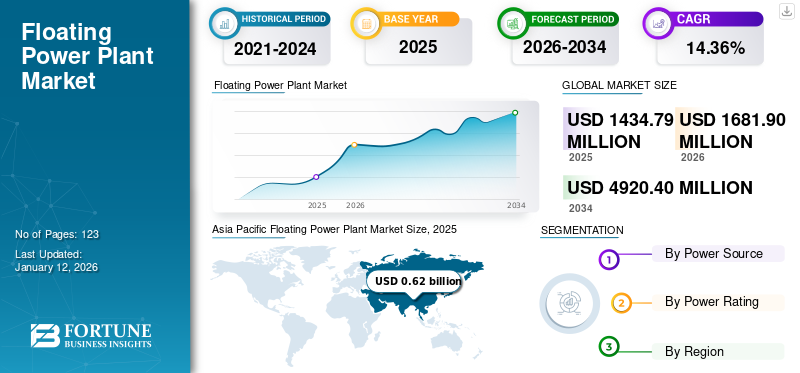
The floating power plant market market size was valued at USD 1,434.79 million in 2025. The market is projected to grow from USD 1,681.90 million in 2026 to USD 4,920.40 million by 2034, exhibiting a CAGR of 14.36 % during the forecast period. Asia Pacific dominated the floating power plant market with a market share of 42.97% in 2025.
Floating power plants are energy-generating units mounted on floating platforms such as ships and barges. These offer mobile or semi-permanent power stations that are increasingly being adopted due to their flexibility, space, efficiency, fast deployment, and growing energy demands. It can be deployed quickly and relocated as needed. It is ideal for meeting temporary or emergency power needs, including natural disasters or grid outages.
Moreover, the Asia Pacific market is driven by limited land, high energy demand, and aggressive renewable targets. Key growth factors include rapid coastal electrification, large-scale floating solar/wind projects in China, Japan, South Korea, and India, and the need for resilient, modular energy infrastructure.
Siemens Energy holds a leading market share, particularly for thermal-based (LNG/diesel/gas) and hybrid floating power sources. Furthermore, other prominent market players include Ciel & Terre, Kyocera Corporation, and Sungrow FPV. These companies dominate through expertise in floating solar systems, hybrid technologies, and specialized platforms.
Download Free sample to learn more about this report.
Floating Power Plant Market Key Takeaways
 Global Market Size & Forecast
- 2025 Market Size: USD 1,434.79 million
- 2026 Market Size: USD 1,681.90 million
- 2034 Forecast Market Size: USD 4,920.40 million
- CAGR: 14.36% from 2026–2034
 Market Share
- Asia Pacific dominated the floating power plant market with a 42.97% share in 2025.
- The renewable segment is projected to account for 73.43% of the market share in 2026.
- The low-capacity segment is projected to hold a 38.53% market share in 2026.
 Key Regional Highlights
Asia Pacific
Asia Pacific led the global market with a valuation of USD 616.62 million in 2025.
Europe
Europe reached USD 340.53 million in 2025 and is projected to grow at a CAGR of 23.73%.
North America
North America secured the second-largest market position, reaching USD 84.01 million in 2025.
U.S.
The market was valued at USD 82.03 million in 2025, accounting for approximately 5.72% of global revenue.
Japan
Growing investments in offshore renewable energy projects are expected to support market expansion.
Read More

FLOATING POWER PLANT MARKET TRENDS
Faster Deployment and Mobility has Emerged as a Trend in Market
Floating power plants can be built and deployed much faster than traditional onshore or offshore power plants. This decreases the demand for large-scale civil construction, land preparation, or long permitting processes, which shortens project timelines significantly. Floating units are ideal for disaster recovery or emergency power needs, where speed of deployment is critical. Mobile floating power plants can be relocated seasonally or when demand shifts to another region, offering flexible grid support or backup capacity. It is ideal for temporary industrial projects, including mining or construction in remote locations where permanent infrastructure is not viable.
MARKET DYNAMICS
MARKET DRIVERS
Rising Demand for Renewable Energy to Drive Market Growth
Solar farms and wind turbines need large land areas for energy generation, which are often scarce or costly, especially near urban centers or in densely populated countries. Floating solar and offshore floating wind projects allow the installation of renewable capacity on water surfaces, saving precious land for other uses. Many reservoirs, lakes, and coastal areas remain unused or underutilized. Floating solar and wind farms tap into these spaces, unlocking new renewable energy solutions without ecological or social disruption.
- In March 2025, Bharat Petroleum Corporation's floating solar power plant was built in the rainwater harvesting pond and covers eight acres of the waterbody, which has a complete area of about 19 acres. The plant has been built at a cost of USD 3.37 million.
MARKET RESTRAINTS
High Initial Capital Investments Hampers Market Development
Floating power plants, especially offshore wind or hybrid systems, require specialized floating platforms, mooring systems, corrosion-resistant materials, and marine construction. These components are costlier than their land-based counterparts. Deploying power plants on water involves marine transport, offshore cranes, and underwater anchoring, which remarkably raise project development and commissioning costs. Many floating power plants currently comprise batteries or hybrid systems to stabilize the energy supply. These systems add substantial upfront costs, hampering the market growth.
MARKET OPPORTUNITIES
Rising Need for Remote and Island Power to Create Growth Opportunities
The rising need for remote and island power is creating opportunities for floating power plants as they offer flexible, fast, and reliable solutions where conventional power infrastructure is unfeasible or limited. Remote regions and islands often lack access to national power grids, making it difficult and expensive to build traditional land-based infrastructure. Many isolated regions rely on diesel imports, which are expensive, polluting, and subject to supply disruptions. Floating renewable systems (solar, wind, or hybrid) replace or supplement diesel with clean, cost-effective alternatives.
- For instance, in January 2025, Solar Energy Corporation of India Limited declared its plan to choose project developers for grid-connected floating solar PV projects with battery energy storage systems in Lakshadweep. The choice will follow a tariff-based competitive bidding procedure under RESCO mode. The entire capacity of the projects is 2.7 MW and will require the construction of floating solar installations on the Lakshadweep island.
MARKET CHALLENGES
Technical and Engineering Complexity to Restrain Market Growth
Floating energy is a relatively a new domain. There is a shortage of specialized engineers and a lack of global standards for its design, safety, and performance. This adds to uncertainty for project developers and investors. All these factors increase cost, time, and risk, thereby restraining floating power plant market growth unless mitigated through innovation and experience building. Routine operations, inspections, and repairs are more difficult and expensive on water than on land. This requires specialized vessels, marine crews, and equipment, increasing O&M (Operations and Maintenance) costs.
Segmentation Analysis
By Power Source
Rising Demand for Clean Energy to Drive Renewable Energy Segment Growth
By power source, the market covers non renewable {gas turbines and IC engines} and renewable {solar and wind}.
In 2026, the renewable segment is projected to lead the market with a 73.43% share, driven by key factors such as government initiatives, increasing energy generation, and other developments that align with the global push for clean energy and innovative floating power solutions.
The non-renewable segment is the second dominating segment with CAGR of 12.19%. Many regions (especially in Asia, Africa, and island nations) face power shortages or grid limitations in remote or coastal locations. Non-renewable floating power plants typically powered by gas turbines, diesel, or heavy fuel oil offer a quick solution to add capacity where land-based power plants are difficult to build.
By Power Rating
To know how our report can help streamline your business, Speak to Analyst
Higher flexibility and ease of deployment to Drive Low Capacity Segment Growth
Based on power rating the market is segmented into low, medium, and high.
The low-capacity segment is projected to account for a 38.53% market share in 2026, driven by its flexibility, ease of deployment, and suitability for remote or island regions with limited grid infrastructure. These plants, often powered by solar or small-scale gas/diesel generators on barges or platforms, require lower capital investment and shorter installation times compared to medium or high-capacity units. This makes them a viable solution for countries seeking quick, modular, and mobile energy access without major infrastructure development.
Medium is the second dominating segment and is growing at the fastest rate in the market with CAGR of 11.46%. Medium-capacity floating plants provide enough power to meet the demands of small grids, island communities, and industrial sites without overloading the local infrastructure.
Floating Power Plant Market Regional Outlook
By geography, the market is categorized into North America, Europe, Asia Pacific, Latin America, and Middle East & Africa.
North America
Asia Pacific Floating Power Plant Market Size, 2025 (USD Million)
To get more information on the regional analysis of this market, Download Free sample
North America market reached USD 84.01 million in 2025, securing its position as the second largest market. The market in North America, especially in renewable floating segments such as floating solar PV and floating offshore wind, is growing remarkably due to a combination of energy, environmental, and economic factors.
U.S. Floating Power Plant Market
Given North America’s strong contribution, the U.S. market was valued at USD 82.03 million in 2025, accounting for roughly 5.72% of the global market. The U.S. and Canada have ambitious net zero targets and state/provincial mandates for renewable energy. Floating renewables (especially floating wind in deep waters) help meet these targets where land-based or fixed-bottom projects are less feasible.
Asia Pacific
Asia Pacific held the dominant share in 2025, at USD 616.62 million, and also will be leading in 2026, with USD 728.92 million. Asia Pacific holds the dominant share of the market as many Asian Pacific countries (e.g., Japan, South Korea, Singapore, India, and China) face land constraints, especially near major urban and industrial hubs. Floating solar wind plants allow these nations to utilize reservoirs, lakes, coastal waters, and offshore deep-sea areas without competing for land needed for agriculture or development. China, India, and Indonesia have ambitious net zero goals and aggressive renewable energy targets.
China Floating Power Plant Market
The China market in 2025 was at USD 302.25 million, accounting for roughly 21.07%% of the global market revenues. China has the world’s most cost-competitive solar PV manufacturing and floating system suppliers. Local production of components (modules, floats, mooring systems) helps keep project costs low and accelerate deployment. Coastal provinces (e.g, Guangdong, Fujian, Shandong) have deep sea wind resources inappropriate for fixed bottom turbines, driving interest in floating offshore wind technology.
India Floating Power Plant Market
India’s market is projected to be one of the largest worldwide, with 2025 revenue valued at USD 141.55 million, representing approximately 9.87% of the global market.
Europe
Europe is projected to grow at 23.73% over the coming years, the second-highest among all regions, and reached valuation of USD 340.53 million in 2025. Europe is the fastest-growing region in the market due to high efforts of the European countries to have deep offshore areas where fixed-bottom wind turbines are not feasible. Floating wind technology enables tapping into these stronger and steadier wind resources further offshore.
Latin America
Latin America reached a valuation of USD 94.12 million in 2025. The region is also showing positive growth in the market as Brazil, Colombia, Argentina, and Chile have vast hydropower reservoirs (e.g., Sobradinho, Balbina, Itumbiara). These reservoirs offer large, calm water surfaces ideal for installing floating solar PV without demanding new land or major environmental clearances.
Brazil Floating Power Plant Market
The German market in 2025 reached at USD 84.74 million. It is projected to reach USD 97.02 million by 2026, representing approximately 5.91% of the global market revenues.
Middle East & Africa
Middle East & Africa is the second dominant region in the market attributed by the growing deployment of power barges in the developing nations as well as rising focus of the countries toward offshore renewable energy sources. Floating solar helps optimize water bodies (reservoirs, desalination products, irrigation canals) without taking up valuable land. Middle East & Africa countries are under pressure to diversify their energy mix, reduce dependence on fossil fuels, and meet net-zero targets (e.g, UAE by 2050, Saudi Arabia by 2060, South Africa’s clean energy transition plants.) Floating power plants provide a flexible way to add renewable capacity near cities and industries.
COMPETITIVE LANDSCAPE
Key Industry Players
Technological Development in Solar & Wind Power to Amplify Market Competition
The global market is highly fragmented, with different key players operating in the floating power plant industry. Globally, Siemens is one of the key players in the market. In October 2024, Siemens Gamesa decided to contribute 15MW turbines to the 750MW Firefly floating wind project in South Korea under a treaty that would view the local assembly of nacelles.
In addition Karpowership, based in Turkey, is also among the global pioneers in barge-mounted power plants, operating a fleet of “Powerships” deployed in Africa, South Asia, and Latin America. The company focuses on rapid deployment of turnkey floating plants powered by dual-fuel engines (HFO and LNG) and has been expanding into South Africa and Mozambique.
Wärtsilä of Finland specializes in modular engine-based FPPs that can be installed on floating platforms. It emphasizes flexible, hybrid systems with energy storage, targeting island nations and regions with unstable grids, while also pursuing decarbonization through future fuels such as hydrogen and ammonia.
List of Key Floating Power Plant Companies Profiled
- China Energy International Group Co., Ltd. (China)
- Siemens (Germany)
- Ciel & Terre (France)
- Kyocera Corporation (Japan)
- Sungrow FPV (China)
- Ocean Sun (Norway)
- D3Energy (U.S.)
- Floating Power Plant (Denmark)
- Swimsol (Austria)
- Equinor (Norway)
- Principle Power (U.S.)
- Vikram Solar Pvt. Ltd. (India)
- Aker Solutions (Norway)
- Karpowership (Turkey)
- Power Barge Corporation (U.S.)
KEY INDUSTRY DEVELOPMENTS
- May 2025: Ciel & Terre completed a 120 MWp floating solar project in India, presenting various company firsts in engineering and design, comprising rock bolt mooring and a build-up fiberglass inverter barge. The system also labels the French PV specialist’s first usage of spin welding in its floating platform assembly.
- May 2025: Wärtsilä will provide power generation apparatus for a new 30 MW power plant being established on Victoria Island in Lagos by a Nigerian Independent Power Producer (IPP). Wärtsilä will also function and support the power plant for five years in place of the custom.
- November 2024: Uttar Pradesh government of India has partnered with NTPC to establish floating solar power plants and increase its renewable energy capacity. The state targets 14,000 MW of solar power generation by 2027.
- June 2024: Floating Power Plant obtained a wind turbine generator from Siemens Gamesa Renewable Energy for its radical project off the coast of Gran Canaria. The selected wind turbine is a 4.3 MW SWT-DD-120, which will be involved in the full-scale demonstrator project, displaying the amalgamation of wind power, wave power, and hydrogen storage technologies. Currently, the project gained a grant of USD 30,060 million from the European Union Innovation Fund.
- December 2023: Vikram Solar, one of India’s dominating module manufacturers, declared the registering of an order won with the National Thermal Power Corporation (NTPC) to supply 152 MW of streamlined Crystalline Bifacial Solar PV Modules at Nokh, Rajasthan.
REPORT COVERAGE
The global floating power plant market report delivers a detailed insight and focuses on key aspects such as leading companies and their operations offering floating power plant. Besides, the report offers insights into market trends and technology and highlights key industry developments. In addition to the factors above, the report encompasses several aspects and challenges that contributed to the growth of the market in recent years.
Request for Customization to gain extensive market insights.
Report Scope & Segmentation
| ATTRIBUTE | DETAILS |
| Study Period | 2021-2034 |
| Base Year | 2025 |
| Estimated Year | 2026 |
| Forecast Period | 2026-2034 |
| Historical Period | 2021-2024 |
| Growth Rate | CAGR of 14.36% from 2026 to 2034 |
| Unit | Value (USD Million) |
|
Segmentation |
By Power Source
|
|
By Power Rating
|
|
|
By Region
|
Frequently Asked Questions
Fortune Business Insights says that the global market value stood at USD 1,434.79 million in 2025 and is projected to reach USD 4,920.40 million by 2034.
In 2025, the Asia Pacific market value stood at USD 616.62 million.
The market is expected to exhibit a CAGR of 14.36% during the forecast period of 2026-2034.
The renewable led the power source segment.
Rising demand for renewable energy to drive market growth.
China Energy International Group Co., Ltd., Ciel & Terre, Kyocera Corporation, and Sungrow FPV are some of the prominent players in the Market.
Asia Pacific dominated the market in 2025.



- 2021-2034
- 2025
- 2021-2024
- 180
Get 30-60 hrs Free Customization
Expand Regional and Country Coverage, Segments Analysis, Company Profiles, Competitive Benchmarking, and End-user Insights.



















Related Reports
-
US +1 833 909 2966 ( Toll Free )
-
Get In Touch With Us