Advanced Biofuels Market Size, Share & Industry Analysis, By Fuel Type (Renewable Diesel (HVO), Sustainable Aviation Fuel (SAF), Cellulosic Ethanol, Biomethane/Renewable Natural Gas (RNG), and Others), By Production Technology (Biochemical Conversion, Thermochemical Conversion, and Catalytic Conversion), By End-Use Industry (Transportation Companies, Airlines, Shipping Companies, Utilities, Industrial Facilities, and Government & Defense Organizations), and Regional Forecast, 2026-2034
 Download Free Sample
 Advanced Biofuels Market Size & Future Outlook
 Listen to Audio Version
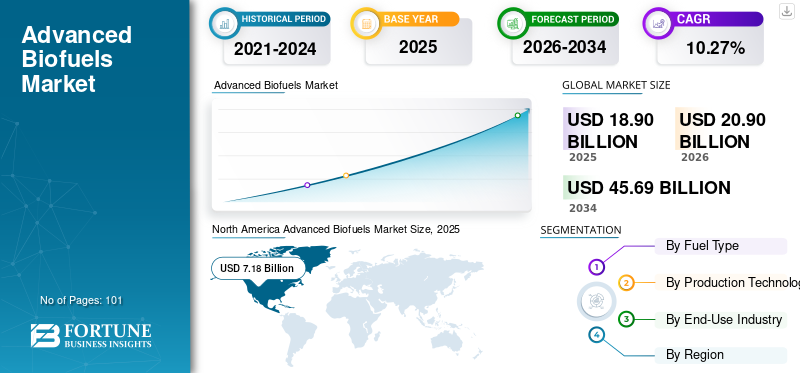
The global advanced biofuels market size was valued at USD 18.90 billion in 2025. The market is projected to grow from USD 20.90 billion in 2026 to USD 45.69 billion by 2034, exhibiting a CAGR of 10.27% over the forecast period. North America dominated the advanced biofuels market with a market share of 37.98% in 2025.
Advanced biofuels comprise the production, distribution, and commercialization of biofuels derived from non-food biomass feedstocks, waste materials, residues, algae, and other sustainable renewable resources that achieve significantly lower greenhouse gas (GHG) emissions compared to conventional fossil fuels and first-generation biofuels.
The market is experiencing significant growth due to increasing global efforts to reduce greenhouse gas emissions and transition toward sustainable energy sources. Governments globally are implementing stringent carbon reduction regulations, renewable fuel mandates, and incentives that encourage the adoption of low-carbon fuels across transportation, aviation, and marine sectors. Rising demand for Sustainable Aviation Fuel (SAF), renewable diesel, and Renewable Natural Gas (RNG) is further accelerating market expansion as these fuels offer substantial lifecycle emission reductions compared to conventional fossil fuels. Additionally, advancements in conversion technologies and the growing availability of waste-based and non-food feedstocks such as agricultural residues, forestry waste, used cooking oil, and municipal solid waste are improving production efficiency and scalability. Increasing corporate sustainability commitments and investments in decarbonization initiatives are also supporting the commercialization and deployment of advanced biofuel projects globally, driving sustained market growth.
The market consists of companies that produce advanced biofuels, develop conversion technologies, process renewable feedstocks, and supply low-carbon fuels to the transportation, aviation, marine, and industrial sectors. These vendors are investing in commercial-scale production facilities, expanding SAF capacity, developing renewable diesel and cellulosic ethanol technologies, and utilizing waste-based feedstocks such as used cooking oil, agricultural residues, forestry residues, municipal solid waste, and industrial waste gases to reduce carbon emissions.
Neste Oyj, Gevo Inc., and POET LLC are among the major vendors in the market due to their strong technological capabilities, commercial-scale production facilities, and strategic focus on low-carbon fuels. Neste is a global leader in renewable diesel and sustainable aviation fuel, with extensive production capacity and a strong international distribution network.
Download Free sample to learn more about this report.
ADVANCED BIOFUELS MARKET TRENDS
Growing Demand for Sustainable Aviation Fuel to Drive Market Growth
The increasing demand for sustainable aviation fuel is a major factor driving the advanced biofuels market growth. The aviation sector accounts for a significant share of global carbon emissions and faces mounting pressure from governments, regulators, airlines, and industry organizations to achieve net-zero emission targets. SAF, which is produced from renewable feedstocks such as used cooking oil, agricultural residues, municipal waste, and other non-food biomass sources, can reduce lifecycle greenhouse gas emissions by up to 80% compared to conventional jet fuel. As a result, airlines are increasingly entering long-term SAF procurement agreements and investing in sustainable fuel initiatives to meet decarbonization goals. Furthermore, supportive government policies, blending mandates, tax incentives, and funding programs aimed at accelerating SAF production are encouraging investments in advanced biofuel technologies and production capacity. This growing adoption of SAF is creating significant opportunities for advanced biofuel producers and contributing substantially to the expansion of the global market.
In June 2026, the International Civil Aviation Organization (ICAO) and the International Air Transport Association (IATA) announced greater collaboration to promote transparency in monitoring development and speeding up the creation and implementation of Sustainable Aviation Fuels (SAF). Underpinned by high-quality data and robust systems, close cooperation between industry and states will attempt to allow transparent and believable tracking of aviation clean energies and their contribution to net-zero carbon emissions by 2050, in accordance with the respective ICAO and IATA ambitions and commitments.
MARKET DYNAMICS
MARKET DRIVERS
Download Free sample to learn more about this report.
Government Decarbonization Policies, Blending Mandates, and Low-Carbon Fuel Regulations to Drive Market Growth
Government policies aimed at reducing greenhouse gas emissions are expected to remain the strongest driver of the global market during the 2026–2034 period. Countries across North America, Europe, Asia Pacific, and Latin America are strengthening renewable fuel mandates, implementing low-carbon fuel standards, and introducing stricter emissions regulations to decarbonize the transportation, aviation, and maritime sectors. Advanced biofuels produced from non-food feedstocks such as agricultural residues, municipal solid waste, used cooking oil, and lignocellulosic biomass offer significantly lower lifecycle carbon emissions, making them a preferred solution for meeting climate targets without competing with food production.
In March 2026, the U.S. Environmental Protection Agency improved the Renewable Fuel Standard program while proposing and then finalizing record Renewable Fuel Standard amounts for 2026 and 2027, including 9.02 billion RIN-equivalent gallons of advanced biofuels in 2026.
|
Rank |
Market Drivers |
CAGR Contribution 2026-2034 |
Overall Impact |
2026-2028 |
2029-2031 |
2032-2034 |
|
1 |
Supportive renewable-fuel policies, blending mandates, and decarbonization targets |
+3.69% |
High |
High |
High |
High |
|
2 |
Increasing demand for low-carbon and advanced transportation fuels |
+3.36% |
High |
High |
High |
High |
|
3 |
Technological advancements in biomass pretreatment, enzymes, and fermentation |
+2.76% |
Medium-High |
Medium |
High |
High |
|
4 |
Abundant availability and improved utilization of agricultural and forestry residues |
+1.65% |
Medium |
Medium |
Medium |
High |
|
5 |
Expansion of commercial-scale biorefineries and strategic industry investments |
+1.26% |
Medium-Low |
Medium |
Medium |
High |
|
6 |
Others |
+ 0.41% |
Low |
Low |
Low |
Low |
|
Total positive CAGR contribution |
+13.13% |
MARKET RESTRAINTS
High Production Costs Compared to Fossil Fuels to Restrain Market Growth
The high production costs of advanced biofuels compared to conventional fossil fuels are restraining market growth. Advanced biofuels are produced from sustainable feedstocks such as used cooking oil, agricultural residues, forestry waste, municipal solid waste, and algae through technologically complex conversion processes, including gasification, hydroprocessing, and cellulosic fermentation. These processes require substantial capital investment, specialized infrastructure, and advanced processing technologies, resulting in higher production costs than traditional petroleum-based fuels. In addition, feedstock collection, transportation, and preprocessing expenses further increase overall production costs. While government incentives and renewable fuel policies support market development, advanced biofuels often remain less cost-competitive than fossil fuels in the absence of subsidies or regulatory mandates. This cost disparity can limit adoption among fuel consumers and create challenges for large-scale commercialization, thereby restraining market growth.
|
Rank |
Market Restraints |
Negative CAGR Contribution 2026-2034 |
Overall Impact |
2026-2028 |
2029-2031 |
2032-2034 |
|
1 |
High capital investment and production costs compared with conventional ethanol |
-1.21% |
High |
High |
High |
Medium |
|
2 |
Technical challenges in achieving efficient and consistent commercial-scale conversion |
-0.86% |
Medium-High |
High |
Medium |
Medium |
|
3 |
Feedstock collection, transportation, storage, and seasonal supply constraints |
-0.54% |
Medium |
High |
Medium |
Medium |
|
4 |
Others |
-0.25% |
Low |
Low |
Low |
Low |
|
|
Total Negative CAGR contribution |
-2.86% |
MARKET OPPORTUNITIES
Technological Advancements in Biofuel Conversion Processes to Drive Market Growth
Technological advancements in biofuel conversion processes are significantly driving market growth by enhancing production efficiency, improving feedstock utilization, and reducing overall manufacturing costs. Continuous innovation in conversion technologies such as Hydroprocessed Esters and Fatty Acids (HEFA), cellulosic fermentation, gasification, pyrolysis, Fischer-Tropsch synthesis, and Alcohol-To-Jet (ATJ) is enabling producers to convert a broader range of renewable feedstocks, including agricultural residues, forestry waste, municipal solid waste, and industrial waste streams, into high-quality transportation fuels. These advancements are increasing fuel yields, improving process reliability, and supporting large-scale commercialization of SAF, renewable diesel, and advanced ethanol.
In November 2025, in Georgia, USA, LanzaJet opened the first Alcohol-to-Jet (ATJ) facility in the world that can produce around 10 million gallons of renewable diesel and SAF every year from ethanol-based feedstocks. Similarly, Clariant's Sunliquid technology has shown that it can turn agricultural wastes such as wheat straw and corn stover into cellulosic ethanol with greater yields and less enzyme usage than earlier-generation processes. Furthermore, a number of businesses, including Velocys, Fulcrum BioEnergy, and Gevo, are developing gasification, Fischer-Tropsch, and alcohol-to-jet technologies to turn municipal solid waste, biomass residues, and renewable alcohols into low-carbon transportation fuels. In addition to allowing for the large-scale deployment of renewable diesel, SAF, and sophisticated ethanol, these technical improvements are raising conversion efficiency, lowering production costs, and facilitating the utilization of a variety of waste-based feedstocks.
MARKET CHALLENGES
High Capital Investment Requirements to Restrain Market Growth
Market expansion is largely hampered by the substantial capital expenditure needed to create and grow facilities for advanced biofuel production. Sophisticated conversion technologies, such as hydroprocessed esters and fatty acids, gasification, Fischer-Tropsch synthesis, cellulosic fermentation, and alcohol-to-jet processes, are used in advanced biofuel facilities. These technologies necessitate considerable investments in specialized equipment, feedstock handling infrastructure, storage facilities, and distribution networks. Producers must invest in research and development, technology optimization, and regulatory compliance to become commercially viable, in addition to the high construction and commissioning costs. Large-scale sustainable aviation fuel, renewable diesel, and cellulosic ethanol projects often require hundreds of millions of dollars in upfront capital, creating financial barriers for new entrants and delaying project deployment. Furthermore, uncertainties related to feedstock availability, market demand, policy support, and return on investment can make financing more challenging.
Segmentation Analysis
By Fuel Type
Renewable Diesel (HVO) Dominated Market Due to Its Superior Fuel Properties
Based on the fuel type, the market is classified into renewable diesel (HVO), sustainable aviation fuel (SAF), cellulosic ethanol, biomethane/renewable natural gas (RNG), and others.
Renewable diesel (HVO) dominated the market, accounting for 37.23% in 2025. The renewable diesel, also known as Hydrotreated Vegetable Oil (HVO), led the market due to its superior fuel properties, compatibility with existing fuel infrastructure, and growing adoption across transportation sectors. HVO is a drop-in fuel that can be used in existing diesel engines, pipelines, storage facilities, and fueling stations without requiring modifications, making it highly attractive for fleet operators and fuel distributors. Additionally, renewable diesel offers significant lifecycle greenhouse gas emission reductions while delivering performance characteristics comparable to petroleum diesel, including high cetane numbers and improved cold-weather performance.
In March 2026, Neste increased its capacity for renewable products, including sustainable aviation fuel (SAF) and renewable diesel, to roughly 6.8 million tons per year. Neste is the biggest renewable diesel producer globally. Diamond Green Diesel, a joint partnership between Darling Ingredients and Valero, similarly increased the capacity of its Port Arthur facility, bringing the overall renewable diesel production capacity to around 1.2 billion gallons per year. Moreover, TotalEnergies and Enilive (Eni) have kept turning traditional refineries into biorefineries that focus on producing HVO to keep up with the increasing demand throughout Europe.
Cellulosic ethanol is the fastest-growing segment, projected to grow at a 11.26% CAGR during the forecast period and driven by increasing demand for low-carbon transportation fuels and growing utilization of abundant non-food biomass feedstocks. Cellulosic ethanol is derived from agricultural residues, forestry waste, energy crops, and other lignocellulosic materials, making it a more sustainable alternative with significantly lower lifecycle greenhouse gas emissions. Governments across North America, Europe, and Asia Pacific are supporting the development of cellulosic biofuels through renewable fuel mandates, carbon reduction policies, and financial incentives aimed at accelerating the adoption of advanced renewable fuels.
By Production Technology
Rising Demand for Sustainable Low-carbon Fuels Boosted Biochemical Conversion Segment Growth
By production technology, the market is categorized into biochemical conversion, thermochemical conversion, and catalytic conversion.
The biochemical conversion segment dominated the market share, accounting for 67.88% in 2025. The segment growth is attributed to rapid commercial adoption of biochemical conversion for producing cellulosic ethanol, biomethane, and other renewable fuels from agricultural residues, forestry waste, and organic waste feedstocks, supported by established fermentation technologies, favorable regulatory policies, and growing demand for sustainable low-carbon fuels.
In August 2022, the U.S. Department of Energy (DOE) awarded USD 29.5 million to 15 projects to improve the current science and infrastructure for utilizing waste streams, often disproportionately located in underserved communities, and support the development of improved organisms and inorganic catalysts for the production of valuable biofuels and bioproducts that can benefit the local energy economy. This effort will advance DOE goals to deliver a renewable energy future and put the U.S. on a path to achieve net-zero emissions, economy-wide, by no later than 2050.
The thermochemical conversion is expected to grow at a CAGR of 11.01% in the coming years. The segment growth is driven by thermochemical conversion’s ability to convert a wide range of feedstocks, including agricultural residues, forestry waste, municipal solid waste, and industrial by-products, into renewable fuels such as sustainable aviation fuel, renewable diesel, bio-oil, and synthetic fuels. Technologies such as gasification, pyrolysis, and Fischer-Tropsch synthesis offer greater feedstock flexibility and scalability compared to conventional biofuel production methods, making them increasingly attractive for large-scale fuel production. Growing demand for low-carbon transportation fuels, particularly SAF, is driving investments in thermochemical conversion facilities globally.
By End-Use Industry
To know how our report can help streamline your business, Speak to Analyst
Transportation Companies Segment Led Market Due to Increasing Regulatory Pressure to Reduce Emissions
By end-use industry, the market is categorized into transportation companies, airlines, shipping companies, utilities, industrial facilities, and government & defense organizations.
The transportation companies segment captured the largest advanced biofuels market share, accounting for 35.85% in 2025 due to the sector's substantial fuel consumption and increasing need to reduce greenhouse gas emissions while complying with stringent environmental regulations. Road freight operators, logistics companies, public transportation providers, shipping companies, and aviation operators are increasingly adopting advanced biofuels such as renewable diesel (HVO), sustainable aviation fuel (SAF), renewable natural gas (RNG), and cellulosic ethanol to achieve decarbonization targets without requiring major modifications to existing vehicles or fuel infrastructure.
In June 2026, Google and American Airlines revealed a significant SAF agreement to promote the use of lower-carbon aviation fuel made from renewable and waste-based resources. The agreement, which aims to decrease life cycle greenhouse gas emissions from air travel, demonstrates transportation firms' increased dedication to advanced biofuels as a component of their decarbonization plans. To satisfy sustainability objectives and adhere to increasingly strict emissions rules, major freight and logistics companies have likewise increased their usage of renewable diesel (HVO) and renewable natural gas (RNG) throughout their operations. Leading shipping companies are increasingly utilizing biofuel mixes in the marine industry to lower carbon emissions from ship operations.
Airlines are the fastest-growing segment, projected to grow at a 13.12% CAGR during the forecast period. The airline industry is increasingly adopting advanced biofuels, particularly SAF, to reduce carbon emissions and meet ambitious net-zero targets. Aviation accounts for approximately 2–3% of global CO₂ emissions, and with limited alternatives available for long-haul flights, SAF has emerged as one of the most viable decarbonization solutions.
ADVANCED BIOFUELS MARKET REGIONAL OUTLOOK
By geography, the market is categorized into Europe, North America, Asia Pacific, Latin America, and the Middle East & Africa.
North America
North America Advanced Biofuels Market Size, 2025 (USD Billion)
To get more information on the regional analysis of this market, Download Free sample
North America is the dominant region in the market. The region was valued at roughly USD 6.52 billion in 2024 and USD 7.18 billion in 2025. North America's market is growing due to the region's well-established biofuel production infrastructure, increasing commercialization of sustainable aviation fuel and renewable diesel, and strong availability of waste-based feedstocks such as used cooking oil, animal fats, agricultural residues, and municipal waste. The region is witnessing significant investments in advanced biofuel production facilities, refinery conversions, and next-generation conversion technologies that improve production efficiency and scalability. Additionally, growing demand from the aviation, transportation, and logistics sectors for low-carbon fuels is accelerating the adoption of advanced biofuels. Continuous innovation in cellulosic ethanol, renewable diesel (HVO), and waste-to-fuel technologies, combined with the presence of major biofuel producers and technology developers, is further supporting the expansion of the market across North America.
U.S. ADVANCED BIOFUELS MARKET
The U.S. market stood at around USD 6.41 billion in 2025. The U.S. market is growing due to increasing commercial-scale production of renewable diesel, SAF, renewable natural gas (RNG), and cellulosic ethanol, supported by abundant feedstock availability and continuous technological innovation. The country has a well-developed ecosystem for converting agricultural residues, corn stover, used cooking oil, animal fats, and municipal waste into low-carbon fuels. Additionally, growing demand from airlines, freight operators, and industrial consumers for sustainable fuel alternatives is accelerating investment in advanced biofuel production facilities and infrastructure.
Asia Pacific
The Asia Pacific market size was valued at USD 4.16 billion in 2025 and is expected to reach USD 4.71 billion in 2026. The market is growing due to increasing energy demand, supportive government policies promoting low-carbon fuels, rising investments in SAF and renewable diesel production, and growing efforts by countries such as China, India, Japan, Australia, and South Korea to reduce greenhouse gas emissions and strengthen energy security. Additionally, the region's abundant availability of agricultural residues, forestry waste, and other biomass resources is supporting the expansion of advanced biofuel production and commercialization.
CHINA ADVANCED BIOFUELS MARKET
In 2025, the China market reached USD 1.32 billion due to the country's strong focus on carbon neutrality, increasing demand for sustainable transportation fuels, and government initiatives aimed at reducing dependence on fossil fuels. China's commitment to achieving peak carbon emissions before 2030 and carbon neutrality by 2060 is driving investments in sustainable aviation fuel, cellulosic ethanol, renewable diesel, and other advanced biofuels. Additionally, the country's abundant agricultural residues, forestry waste, and municipal solid waste resources provide a substantial feedstock base for advanced biofuel production. Growing aviation activities, expanding biofuel research and development programs, and increasing investments in waste-to-fuel and biomass conversion technologies are further supporting market growth in China.
INDIA ADVANCED BIOFUELS MARKET
The India market reached around USD 0.79 billion in 2025, accounting for roughly 19.10% of global revenues. India's market is growing due to the country's abundant availability of biomass resources, increasing adoption of waste-based feedstocks, and rising demand for sustainable transportation fuels. India generates large quantities of agricultural residues, sugarcane bagasse, rice straw, used cooking oil, and municipal waste, providing a strong feedstock base for the production of advanced biofuels such as cellulosic ethanol, compressed biogas (CBG), SAF, and renewable diesel. Furthermore, increasing investments in second-generation (2G) ethanol plants, waste-to-fuel technologies, and integrated biorefineries are improving production capacity and commercialization.
Europe
The European market in 2025 was valued at USD 5.86 billion and is expected to reach USD 6.45 billion in 2026. Europe's market is growing due to increasing adoption of sustainable transportation fuels, strong investments in renewable fuel production capacity, and expanding utilization of waste-based feedstocks such as used cooking oil, animal fats, agricultural residues, and forestry waste. The region is witnessing significant growth in renewable diesel (HVO), SAF, and biomethane production as fuel suppliers and transportation operators seek low-carbon alternatives to conventional fossil fuels.
U.K. ADVANCED BIOFUELS MARKET
The U.K. market in 2025 stood at around USD 0.81 billion, representing roughly 13.90% of global revenues. The U.K. market is growing due to increasing investments in sustainable aviation fuel production, expanding waste-to-fuel projects, and rising utilization of renewable feedstocks such as used cooking oil, agricultural residues, municipal solid waste, and forestry by-products. The country is witnessing significant development of advanced biofuel facilities focused on producing low-carbon fuels for aviation, road transportation, and industrial applications.
GERMANY ADVANCED BIOFUELS MARKET
The German market in 2025 stood at around USD 1.22 billion, accounting for roughly 20.90% of global revenues. Germany's market is growing due to increasing investments in renewable fuel production, strong adoption of waste-based feedstocks, and expanding demand for low-carbon transportation fuels. The country has a well-established bioenergy and refining industry that is increasingly focused on producing renewable diesel (HVO), biomethane, sustainable aviation fuel, and advanced ethanol from feedstocks such as used cooking oil, agricultural residues, animal fats, and organic waste.
Latin America & Middle East Africa
Latin America and the Middle East & Africa stood at USD 0.95 billion and USD 0.75 billion, respectively, in 2025. The Latin America market is growing due to abundant biomass resources, expanding utilization of agricultural residues, and increasing investments in next-generation biofuel production technologies. The region benefits from large volumes of sugarcane bagasse, corn residues, forestry by-products, and other biomass feedstocks that can be converted into advanced ethanol, renewable diesel, SAF, and biomethane.
The Middle East & Africa market is growing due to increasing investments in sustainable fuel production, rising utilization of waste-based and biomass feedstocks, and growing development of bio-refining infrastructure. The region is witnessing increased interest in sustainable aviation fuel, renewable diesel, biomethane, and waste-to-fuel technologies as industries seek cleaner alternatives to conventional fuels.
GCC ADVANCED BIOFUELS MARKET
The GCC market in 2025 stood at around USD 0.29 billion, representing roughly 39.00% of global revenues. The GCC market is growing due to increasing investments in sustainable fuel technologies, expanding waste-to-fuel initiatives, and rising demand for low-carbon alternatives in transportation and aviation. The region is leveraging feedstocks such as municipal solid waste, used cooking oil, agricultural residues, and organic waste to produce advanced biofuels, including SAF, renewable diesel, and biomethane. In addition, ongoing development of biorefinery projects, growing collaboration between energy companies and technology providers, and advancements in biomass conversion technologies are improving the commercial viability of advanced biofuel production.
COMPETITIVE LANDSCAPE
Key Industry Players
Leading Companies are Expanding Production Capacity and Advancing Biofuel Technologies to Improve Fuel Yields
Advanced biofuels vendors are focused on developing, producing, and commercializing low-carbon fuels derived from renewable and waste-based feedstocks such as used cooking oil, agricultural residues, forestry waste, animal fats, and municipal solid waste. These companies are investing in advanced conversion technologies, including hydroprocessed esters and fatty acids (HEFA), cellulosic fermentation, gasification, Fischer-Tropsch synthesis, and alcohol-to-jet (ATJ) processes to improve fuel yields and production efficiency. Vendors are also expanding production capacity for renewable diesel, SAF, renewable natural gas (RNG), and advanced ethanol through new biorefineries, strategic partnerships, and long-term supply agreements with airlines, transportation companies, and industrial fuel consumers. Additionally, they are strengthening feedstock supply chains, advancing waste-to-fuel solutions, and investing in research and development to reduce production costs and support the global transition toward sustainable transportation fuel.
In February 2026, Shell and IAG, the parent company of British Airways, took part in a new funding round for LanzaJet, a major producer of alcohol-to-jet (ATJ) gasoline. Shell's ongoing backing of the development of sophisticated biofuel technology is shown by LanzaJet's commercial factory in Georgia, which can produce up to 10 million gallons of SAF and renewable diesel annually from sustainable ethanol feedstocks.
LIST OF KEY ADVANCED BIOFUEL COMPANIES PROFILED
- Neste Oyj (Finland)
- Renewable Energy Group (Chevron) (U.S.)
- Valero Energy (Diamond Green Diesel) (U.S.)
- Gevo, Inc. (U.S.)
- LanzaJet (U.S.)
- LanzaTech Global (U.S.)
- POET LLC (U.S.)
- Clariant AG (Switzerland)
- Raízen S.A. (Brazil)
- GranBio (Brazil)
- Verbio SE (Germany)
- UPM Biofuels (Finland)
- Shell plc (U.K.)
- TotalEnergies SE (France)
- BP plc (bp bioenergy) (U.K.)
KEY INDUSTRY DEVELOPMENTS
- June 2026: TruAlt Bioenergy Limited, the largest manufacturer of ethanol in India, secured USD 17.8 million under the Government of India’s PM JI-VAN Yojana to support its proposed SAF project in Bagalkot, Karnataka.
- May 2026: HASI and Ameresco announced the formation of Neogenyx Fuels, a joint venture focused on accelerating the development and marketing of cutting-edge biofuels. With the goal of increasing the output of renewable fuels derived from waste-based feedstocks, the new company integrates HASI's sustainable infrastructure investment capabilities with Ameresco's experience in waste-to-energy and renewable energy projects.
- February 2026: LanzaJet raised USD 47 million through the first close of its USD 135 million equity funding round. Existing investors such as Shell, International Airlines Group (IAG), Mitsui, Groupe ADP, and LanzaTech raised their investments to expedite the commercial implementation of Alcohol-to-Jet (ATJ) sustainable aviation fuel technology and worldwide project expansion.
- November 2025: Inpasa selected Sulzer as its primary provider of agitators and process pumps for a large industrial expansion project in Brazil. The project shows how much money is being invested in biofuel production capacity by building new facilities and improving existing ones. The objective of Inpasa's growth is to boost the output of bio-based items employed in the chemical, food, pharmaceutical, animal feed, and transportation sectors.
- August 2024: Raízen joined forces with Vertoro through a Joint Development Agreement (JDA) to unlock the value of lignin by turning it into sophisticated, environmentally friendly biofuels, chemicals, and materials.
REPORT COVERAGE
The global advanced biofuels market analysis provides an in-depth study of the market size & forecast across all market segments included in the report. It contains details on the market dynamics and market trends expected to drive the market over the forecast period. It offers information on technological advancements, new product launches, key industry developments, and partnerships, mergers & acquisitions. The market research report also includes a detailed competitive landscape, providing market share and profiles of key players.
Request for Customization to gain extensive market insights.
Report Scope & Segmentation
| ATTRIBUTE | DETAILS |
| Study Period | 2021-2034 |
| Base Year | 2025 |
| Estimated Year | 2026 |
| Forecast Period | 2026-2034 |
| Historical Period | 2021-2024 |
| Growth Rate | CAGR of 10.27% from 2026 to 2034 |
| Unit | Value (USD Billion) |
| Segmentation | By Fuel Type, By Production Technology, By End-Use Industry, and Region |
| By Fuel Type |
|
| By Production Technology |
|
| By End-Use Industry |
|
| By Region |
|
Frequently Asked Questions
Fortune Business Insights says that the global market value stood at USD 18.90 billion in 2025 and is projected to reach USD 45.69 billion by 2034.
The market is expected to exhibit a CAGR of 10.27% during the forecast period (2026-2034).
The transportation companies segment led the market.
Government decarbonization policies, blending mandates, and low-carbon fuel regulations are driving market growth.
Renewable Energy Group, Valero Energy, and Gevo, Inc. are among the top players in the market.
North America held the largest market share in 2025.
Technological advancements in biofuel conversion processes favor product adoption.



- 2021-2034
- 2025
- 2021-2024
- 101
Get 30-60 hrs Free Customization
Expand Regional and Country Coverage, Segments Analysis, Company Profiles, Competitive Benchmarking, and End-user Insights.



















Related Reports
-
US +1 833 909 2966 ( Toll Free )
-
Get In Touch With Us