Glycolic Acid Market Size, Share & Industry Analysis, By Purity (Glycolic Acid 99%, Glycolic Acid 70%, Glycolic Acid 30%, and Others), By Application (Personal Care & Cosmetics, Household, Textile, Food Processing, Pharmaceutical, and Others), and Regional Forecast, 2024-2032
 Download Free Sample
Glycolic Acid Market Size and Industry Overview
 Listen to Audio Version
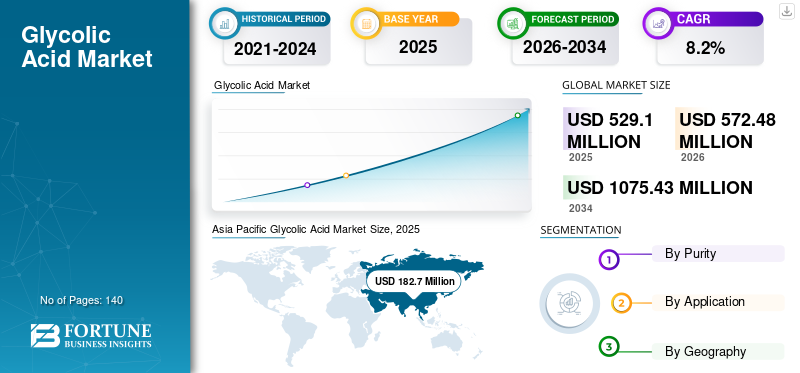
The global glycolic acid market size was valued at USD 529.10 million in 2025 and is projected to grow from USD 572.48 million in 2026 to USD 1075.43 million by 2034, exhibiting a CAGR of 8.20% during the forecast period. Asia Pacific dominated the glycolic acid market with a share of 39.02% in the year 2025. Moreover, the U.S. glycolic acid market is projected to reach USD 140.96 million by 2034, fueled by applications in cosmetics, skincare, and industrial cleaning.
C₂H₄O₃, also known as Hydroacetic acid is used in various applications such as dyeing and tanning agent in the textile industry, flavoring agent & preservative in the food & beverage industry, and the cosmetic industry for the manufacturing of anti-aging products. It is also used in plastics and adhesives manufacturing. The increasing use of hydroxyacetic acid in diverse applications owing to its properties, such as cell recovering and exfoliating, is expected to propel the market growth over the forecast period.
Hydroacetic acid is also a substitute for lactic acid and salicylic acid. Thus, glycolic acid is an intermediate in organic synthesis, where it is used as a monomer in the preparation of acid PGA (polyglycolic) and other copolymers.
COVID-19 Outbreak to Affect the Cosmetic Industry, Limiting Opportunities for the Market
Hydroxyacetic acid is used in the preparation of various skin care products. Since coronavirus attacks the respiratory system, the high risks associated with cosmetic products, if inhaled, can limit their adoption amid COVID-pandemic. However, the pandemic has resulted in the decline of the cosmetics market due to the imposition of lockdown. The cosmetic manufacturers have shut down the production units on account of labor shortage and mandated social distancing.
Moreover, cosmetic manufacturers are strengthening their personal care industrial products portfolio amid the COVID 19 outbreak. For example, in August 2020, Beiersdorf, a German-based cosmetic company is working to strengthen its skincare brands including La Prairie, Nivea, and Maestro, and expand its regional presence. These factors have negatively impacted this market and have limited its growth.
Download Free sample to learn more about this report.
Glycolic Acid Market Key Takeaways
 Global Market Size & Forecast
- 2025 Market Size: USD 529.10 million
- 2026 Market Size: USD 572.48 million
- 2034 Forecast Market Size: USD 1,075.43 million
- CAGR: 8.20% (2026–2034)
 Market Share
- Asia Pacific dominated the global market in 2025.
- The 99% purity segment accounted for the largest market share.
- The household segment held a 6.29% share of the market.
 Key Regional Highlights
Asia Pacific
Asia Pacific generated USD 171.0 million in 2025 and is projected to reach USD 182.7 million in 2026.
North America
North America is expected to witness significant growth during the forecast period.
Europe
Europe is projected to experience significant growth, driven by strong demand from the textile industry.
U.S.
U.S. market is projected to witness steady growth during the forecast period.
Japan
Japan market is projected to witness steady growth during the forecast period.
Read More

GLYCOLIC ACID MARKET TRENDS
Rising Product Demand in Oil and Refining Factories to Favor Growth
The rising global demand for glycolic acid in the oil and refining industry as an economical cleaning method poses lucrative opportunities for market growth. Hydroxyacetic acid ensures economical cleaning by providing low-cost metal complexing. It enhances cleaning and scraping processes in oil and refining applications. Also, provides metal complexing in a biodegradable form without any addition of undesirable chemical oxygen demand to the formulated products. It is readily biodegradable, non-volatile, and does not cause stress-cracking of stainless steel with hydrochloric acid. It is also an effective component in household cleaning products.
Download Free sample to learn more about this report.
GLYCOLIC ACID MARKET GROWTH FACTORS
Significant Demand for Alpha-hydroxy-acid in Cosmetic Industry to Aid Market Growth
As per L’Oréal’s statistics, the global cosmetics market witnessed a gain of around 5.5% in 2025. Skincare accounted for around 40% of the global glycolic acid market share in 2025. With the introduction of the e-commerce business, online companies, expansion of social networks, rise in per capita disposable income, and consumer interest in new, premium, and different products have emerged as prime factors for the overall cosmetics market growth. The rising demand for online shopping for cosmetic products has allowed most of the manufacturers or producers to establish a wide sales network, which in turn may accelerate the market growth of hydroacetic acid.
Continuous developments in the cosmetic industry will lead to an upsurge in the market. Glycolic acid is majorly used in the manufacturing of various skincare products such as creams, face masks, and peels, which will drive the demand. Growing consumer awareness, along with a rise in per capita disposable income with an improved standard of living mainly in India, Malaysia, and China, is the key contributing factor regarding the increasing product demand.
Cosmetic products include face and anti-aging cream, lipsticks, shampoo, hair care treatment sprays, moisturizers, cleanser, scrub, fragrance, body wash, and others. About 95% of these products contain hydroxyacetic acid as a raw material as it provides benefits to the skin such as removal of dark spots, irregular pigmentation, enlarged pores, dead skin, and improving overall skin health.
The demand for this product is gaining momentum in other industrial applications such as food preservatives, textile industry, household products, electronics, oil & gas, and pharmaceutical products. This will further propel the hydroxyacetic acid market growth.
RESTRAINING FACTORS
Hazardous Effects of Hydroxyacetic Acid on Health and Environment to Hinder Market
The increasing use of hydroxyacetic acid in cosmetic & personal care products may be harmful to the skin. In excess use, it irritates the eyes, causes irritation, itching, swelling, and inflammation to the skin. Additionally, regular chemical peeling can cause the skin to become more prominent to the UV radiation, and increase skin sensitivity in people to sunburn. Inhalation can cause respiratory problems, thymus, and liver damage if present at high levels over a longer period.
The product has some environmental effects, as phosgene gas is released during the manufacturing of hydroacetic acid. Stringent environmental regulations developed by various governments and associations over phosgene gas has been a restraining factor for the market growth. Also, lactic and salicylic acids are the major substitutes and can be used for various applications. The increasing shift towards more organic substances to produce cosmetics products and using these substitutes as preservatives are a restraining factor for market growth.
GLYCOLIC ACID MARKET SEGMENTATION ANALYSIS
By Purity Analysis
Glycolic Acid 99% to Generate Highest Revenue During the Forecast Period
Based on purity, the market is segmented into 99%, 70%, 30%, and others. Amongst these, 99% accounts for the largest market share owing to the increased use of this grade of hydroacetic acid in cosmetic products. Increasing usage of hydroacetic acid 99% purity in households, pharmaceuticals, textile, and food processing industries are the key factors expected to drive the market growth.
70% based purity is used in the pharmaceutical industry for the production of polymer for medical sutures and cream. Polymers with timed-release properties are used to manufacture products such as staples, sutures, implants, and meshes.
Hydroacetic acid 30% is also used as chemical peels for skin where it improves dry skin, age spots, decreases facial lines, reduces wrinkles, and rejuvenates the skin’s surface. It is an essential ingredient in making anti-aging products. It is also used for skin conditions such as hyperkeratosis, actinic keratosis, and seborrheic keratosis.
By Application Analysis
To know how our report can help streamline your business, Speak to Analyst
Personal Care & Cosmetics Segment to Exhibit a Significant CAGR during the Forecast Period
Based on application, the market is categorized into personal care & cosmetics, household, textile, food processing, pharmaceutical, and others. Amongst these applications, the personal care & cosmetics segment is expected to remain dominant in terms of market revenue and volume during the forecast period. In personal care & cosmetics application, hydroxyacetic acid is mainly used as a key ingredient for making anti-aging creams, lipsticks, shampoo, hair treatment sprays, moisturizers, cleanser, scrub, fragrance, and body wash products due to improving and healing skin, and anti-aging properties. Increasing demand for these products from the cosmetics industry will, in turn, lead to an increase in the demand for hydroxyacetic acid, further helping the market growth rate.
Hydroacetic acid has experienced high demand for household applications such as excellent cleaners for countertops, ceramic tiles, toilet bowls, shower doors & stalls, porcelain tubs, and sinks. It is used in food as a preservative, flavoring agent, and increases shelf life. The increasing population has created a high demand for packaged food which, in turn, has increased the food preservatives market growth.
In the textile industry, hydroxyacetic acid is used as a dye for cloth and tanning agents. The growing fashion industry and improving consumer lifestyle is supporting the growth of the textile market, which in turn, is driving the market. There is also an increase in hydroacetic acid demand from the electronics industry as it is used for cleaning copper substrates in electronics, which is expected to support market growth. The Household segment is expected to hold a 6.29% share in 2019.
REGIONAL GLYCOLIC ACID MARKET ANALYSIS
Asia Pacific
Asia Pacific Glycolic Acid Market Size, 2025 (USD Million)
To get more information on the regional analysis of this market, Download Free sample
Asia Pacific accounted for the highest market share in terms of revenue and volume in 2025 and is expected to remain the largest throughout the forecast period due to expanding cosmetics and textile industries in China and India. China is a major consumer due to the huge presence of the cosmetic industry to meet the increasing consumer demand. Changing lifestyles and increasing population with an inclination towards beauty and wellness products will drive the market in the region. This increasing demand for hydroxyacetic acid from the ever-growing cosmetic industry is responsible for the growth of this market.
- Asia Pacific witnessed a growth from USD 171.0 Million in 2025 to USD 182.7 Million in 2026.
Europe
Europe is projected to witness significant growth in the global market due to high demand from the textile industry. The fashion industry, which is dominant in the region, requires high-quality fabrics to convert them into different outfits. To achieve this, companies are undertaking innovative product development by incorporating advanced technologies, which is expected to foster the market growth in the region.
North America
On the other hand, North America is expected to witness significant growth in the global market. The pharmaceutical industry in the U.S. is one of the major consumers of hydroxyacetic acid, where it is used to make bio-absorbable suture material without any harm. Technological advancement in the medical field is helping in the production of better quality medical instruments, such as absorbable staples, screws, meshes, and stents, that will support market growth.
Latin America
In Latin America, increasing consumer awareness towards packaged food and beverages has given rise to the application of hydroacetic acid as a food preservative and flavoring agent, further helping the hydroacetic acid market growth.
Middle East & Africa
The Middle East & Africa is expected to observe considerable growth in the market. Saudi Arabia and the UAE are the major countries contributing to market growth. The increasing use of hydroxyacetic acid in numerous applications, including the production of cosmetics, household cleaning, and textile is responsible for the market growth in this region.
KEY INDUSTRY PLAYERS
Key Market Players to Strengthen Market Position through Novel Offerings to the Cosmetic Industry
Major producers are present in Europe and Asia Pacific. Some of the key market players include China Petroleum & Chemical Corporation (Sinopec Corp.), The Chemours Company, CABB Group, and Saanvi Corp. Key players in the market have developed a strong regional presence, distribution channels, and product offerings.
Chemours Company utilizes Polyglycolic acid (PGA) and its copolymers with lactic acid for applications in biomedical devices. The pharmaceutical industry produces polymers with the use of high purity acid having timed-release properties for synthetic bio-absorbable sutures. The company’s high purity 70% grade of hydroacetic acid is ideal for the production of PGA-based sutures and is also used in producing staples, meshes, and other implants.
Phibro Animal Health Corporation is a specialty chemical distribution and service company that caters to industries including personal care & pharmaceuticals such as skin, hair & oral, coatings, sealant, adhesives, metal plating, and industrial market. The company offers a 70% solution of AHA cosmetic products.
LIST OF KEY COMPANIES PROFILED IN GLYCOLIC ACID MARKET:
- China Petrochemical Corporation (Sinopec Corp.), (China)
- The Chemours Company (U.S.)
- CABB Group (Germany)
- Saanvi Corp (India)
- Parchem Fine & Specialty Chemicals (U.S.)
- Water Chemical Co., Ltd (China)
- Shandong Xinhua Pharmaceutical Co., Ltd. (China)
- Mehul Dye Chem Industries (India)
- Avid Organics (India)
- Zhonglan Industry Co., Ltd. (China)
- Eastman Chemical Company (U.S.)
- Corbion (Netherlands)
- CrossChem LP (U.S.)
- Other Key Players
KEY INDUSTRY DEVELOPMENTS:
- October 2018: CABB Group GmbH invested millions of Euros to increase the storage and production volume of monochloroacetic (MCA) acid & its derivatives at the Knapsack and Gersthofen facility. The expansion will be boosting the company’s production of glycolic acid at Gersthofen facility.
- January 2019 - Skinceuticals launched a new glycolic acid cream, Glycolic 10 Renew Overnight that improves skin glow by 36% while also maintaining tolerability. The cream effectively targets dullness, fine lines, and uneven texture of the skin. It stimulates cell regeneration for enriched tone, texture, and brighter complexion.
GLYCOLIC ACID MARKET REPORT COVERAGE
Request for Customization to gain extensive market insights.
The glycolic acid market report provides a detailed analysis of the market and focuses on crucial aspects such as leading companies, applications, and products. Also, the report offers insights into market trends and highlights vital industry developments. In addition to the factors mentioned above, the report encompasses various factors that have contributed to the growth of the market over recent years.
Glycolic Acid Market Report Scope & Segmentation
|
ATTRIBUTE |
DETAILS |
|
Study Period |
2021-2034 |
|
Base Year |
2025 |
|
Forecast Period |
2026-2034 |
|
Historical Period |
2021-2024 |
|
Unit |
Value (USD Million) |
|
Segmentation |
Purity; Application; and Geography |
|
By Purity
|
|
|
By Application
|
|
|
By Geography
|
|
Frequently Asked Questions
Fortune Business Insights says that the global market size was USD 572.48 million in 2026 and is projected to reach USD 1075.43 million by 2034.
In 2025, the market value stood at USD 529.1 million.
Growing at a CAGR of 8.2%, the market will exhibit steady growth in the forecast period (2026-2034).
Personal care & cosmetics is expected to be the leading segment in this market during the forecast period.
Rising demand for hydroacetic acid from the cosmetic industry will drive market growth.
Sinopec Corp., The Chemours Company, CABB Group, and Parchem Fine & Specialty Chemicals are a few of the leading players in the global market.
Asia Pacific dominated the global market in 2025.
The growing cosmetic industry is the key driving trend in the global market.



- 2021-2034
- 2025
- 2021-2024
- 140
Get 30-60 hrs Free Customization
Expand Regional and Country Coverage, Segments Analysis, Company Profiles, Competitive Benchmarking, and End-user Insights.


















Related Reports
-
US +1 833 909 2966 ( Toll Free )
-
Get In Touch With Us