Hemodialysis Services Market Size, Share & Industry Analysis, By Service Type (In-Center Maintenance Hemodialysis Services, Home Hemodialysis Services, Acute Inpatient Hemodialysis Services, and Non-Hospital Institutional Hemodialysis Services), By Application (End-Stage Kidney Disease Maintenance Therapy, Acute Kidney Injury, and Kidney Transplant-Related Dialysis Support), By Treatment Technique (Low-Flux Hemodialysis, High-Flux Hemodialysis, and Hemodiafiltration), By End User (Dialysis Centers, Hospitals, Home Settings, and Long-Term Care Facilities), and Regional Forecast, 2026-2034
 Download Free Sample
Hemodialysis Services Market Size and Future Outlook
 Listen to Audio Version
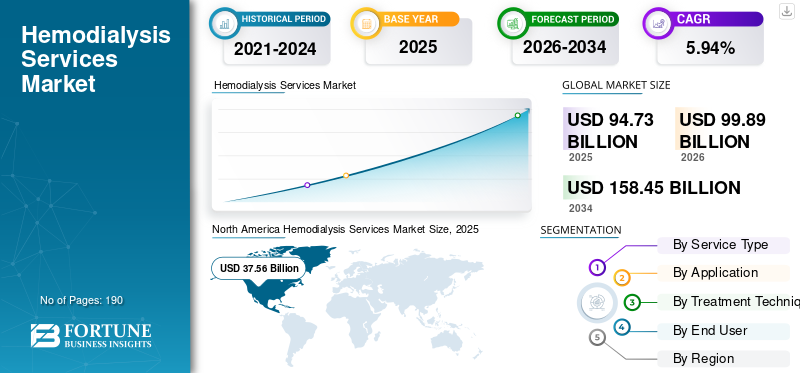
The global hemodialysis services market size was valued at USD 94.73 billion in 2025. The market is projected to grow from USD 99.89 billion in 2026 to USD 158.45 billion by 2034, exhibiting a CAGR of 5.94% during the forecast period. North America dominated the hemodialysis services market with a market share of 39.64% in 2025.
Hemodialysis services include patient monitoring, vascular-access management, laboratory testing, medication administration, and nutritional support delivered through hospitals. The market is expanding as the increasing prevalence of chronic kidney disease and the number of patients requiring regular renal replacement therapy are rising. Since most patients require multiple treatment sessions every week, the recurring nature of these therapies generates stable demand for dialysis service providers. Also, the expansion of dialysis-center networks, improving reimbursement coverage, and increasing investment in renal-care infrastructure are strengthening access to treatment.
- For instance, in June 2026, Fresenius Medical Care launched Kinexus, a unified digital platform designed to support home dialysis programs and strengthen connected, patient-centered care.
Key players such as Fresenius Medical Care AG, DaVita Inc., U.S. Renal Care, Inc., and Diaverum AB are actively participating in new product launches, strategic collaborations, acquisitions, and investment initiatives to expand market presence.
Download Free sample to learn more about this report.
Hemodialysis Services Market KEY TAKEAWAYS
 Global Market Size & Forecast
- 2025 Market Size: USD 94.73 billion
- 2026 Market Size: USD 99.89 billion
- 2034 Forecast Market Size: USD 158.45 billion
- CAGR: 5.94% from 2026–2034
 Market Share
- North America dominated the market with a 39.64% share in 2025.
- Home hemodialysis services are expected to grow at a CAGR of 9.41% during the forecast period.
- Kidney transplant-related dialysis is projected to grow at a CAGR of 8.28% during the forecast period.
 Key Regional Highlights
Asia Pacific
Asia Pacific is estimated to reach USD 28.96 billion in 2026, supported by a large patient population, improving kidney disease diagnosis, and expanding dialysis access.
North America
North America dominated the market with USD 37.56 billion in 2025, supported by a large treated ESKD population and strong dialysis reimbursement systems.
Europe
Europe is projected to grow at a CAGR of 5.01% during the forecast period and reach USD 22.61 billion in 2026, supported by an aging population and rising chronic kidney disease incidence.
U.S.
The U.S. market is estimated at around USD 37.02 billion in 2026, accounting for roughly 37.06% of global revenues.
Japan
The Japanese market is estimated at around USD 11.32 billion in 2026, accounting for approximately 11.33% of global revenues.
Read More

HEMODIALYSIS SERVICES MARKET TRENDS
Growing Shift Toward Home Hemodialysis to Improve Patient Convenience is a Prominent Trend Observed
One of the prominent global market trends is the growing popularity of home dialysis. Patients are increasingly seeking greater flexibility, independence, and control over their treatment schedules. Home hemodialysis enables eligible patients to receive treatment in a familiar environment and allows greater flexibility in treatment frequency and timing under clinical supervision. This trend is encouraging service providers to strengthen patient-training programs, remote monitoring capabilities, technical support, and home-delivery services for dialysis supplies. As a result, the growing preference for convenient and patient-centered treatment is expected to support the expansion of home hemodialysis services.
- For instance, in June 2025, Vantive announced results from a newly commissioned health economic study showing that use of home-based peritoneal dialysis (PD), compared with In-Center Hemodialysis (ICHD) as the initial dialysis modality, is linked to improved patient outcomes and lower overall health system costs. The study highlighted the potential for expanded access to home dialysis to support a more coordinated, patient-centric approach to kidney care while helping to relieve pressure on health systems and increase renal care capacity.
MARKET DYNAMICS
MARKET DRIVERS
Download Free sample to learn more about this report.
Rising Treated End-Stage Kidney Disease (ESKD) Population and Sustained Dialysis Dependence to Drive Market Growth
A key factor driving the global hemodialysis services market growth is the rising number of patients receiving treatment for end-stage kidney disease, which continues to increase. Patients with ESKD generally require dialysis throughout their lifetime unless they receive a successful kidney transplant, creating sustained demand for recurring treatment services. Hemodialysis is commonly performed three times per week and requires continuous clinical monitoring, vascular-access management, laboratory testing, and medication support. The limited availability of donor kidneys and long transplant waiting periods further extend patients’ dependence on dialysis. Such factors assist in generating stable patient volumes for hospitals and the dialysis-center network, driving overall market growth.
- For instance, in March 2026, DaVita served approximately 295,000 patients through 3,242 outpatient dialysis centers globally as of December, 2025. Such a large patient base results in the need for extensive treatment infrastructure.
|
Rank |
Market Drivers |
Overall Impact Rank |
CAGR Contribution (2026-2034) |
Impact: 2026-2028 |
Impact: 2029-2031 |
Impact: 2032-2034 |
|
1 |
Rising treated ESKD population and sustained dialysis dependence |
High |
2.45% |
High |
High |
High |
|
2 |
Expansion of reimbursement coverage and government-funded dialysis programs |
High |
1.85% |
Medium |
High |
High |
|
3 |
Dialysis infrastructure expansion in emerging markets |
High |
1.55% |
High |
High |
Medium |
|
4 |
Adoption of high-flux hemodialysis and online hemodiafiltration |
Medium-High |
1.05% |
Medium |
High |
High |
|
5 |
Home hemodialysis and remote-care enablement |
Medium |
0.75% |
Medium |
Medium |
High |
|
6 |
Others |
Low |
0.35% |
Low |
Low |
Low |
|
Total Gross Growth Contribution |
8.00% |
MARKET RESTRAINTS
High Operating Intensity to Restrict Service Capacity and Restrain Growth
Hemodialysis service delivery requires continuous investment in dialysis machines, water-treatment systems, consumables, facility maintenance, infection-control measures, and regular clinical monitoring. Also, inadequate reimbursement adjustments can prevent providers from fully recovering rising labor and input costs. These pressures may leave dialysis chairs underutilized, restrict additional treatment shifts, and delay the opening or expansion of dialysis centers. Therefore, the high operating intensity and limited availability of skilled personnel are expected to restrain market growth, particularly in rural and underserved areas.
|
Rank |
Market Restraints |
Expected Impact on Market Growth |
Negative CAGR Contribution (2026-2034) |
Impact: 2026-2028 |
Impact: 2029-2031 |
Impact: 2032-2034 |
|
1 |
High operating intensity and persistent workforce shortages |
High |
0.92% |
High |
High |
Medium |
|
2 |
Reimbursement pressure and payer-mix exposure |
Medium-High |
0.63% |
High |
Medium |
Medium |
|
3 |
Capital, water, power, and infection-control requirements |
Medium |
0.36% |
Medium |
Medium |
Low |
|
4 |
Others |
Low |
0.15% |
Low |
Low |
Low |
|
Total Market Reduction |
2.06% |
MARKET OPPORTUNITIES
Expansion of On-Site Dialysis in Institutional and Long-Term Care Settings to Create Growth Opportunities
The increasing number of elderly and medically complex ESKD patients residing in skilled nursing facilities, rehabilitation centers, and long-term care institutions offers a significant growth opportunity for hemodialysis service providers. These patients often require dialysis several times per week. Establishing on-site dialysis units enables institutions to coordinate renal therapy with broader patient-care plans and reduces the operational burden associated with arranging repeated transport. This model also allows dialysis providers to expand beyond conventional outpatient centers through partnerships with hospitals, nursing homes, and post-acute-care facilities.
- For instance, in August 2025, Lincolnwood Rehabilitation & Healthcare Center partnered with Innovative Renal Care to operate an on-site hemodialysis unit at its skilled nursing facility in Rhode Island. The six-chair dialysis den has the capacity to serve up to 36 patients and allows residents with ESKD to receive coordinated treatment within the facility.
MARKET CHALLENGES
Limited Skilled Workforce and Infrastructure in Long-Term Care Facilities Challenge Service Expansion
The expansion of hemodialysis services in long-term care facilities is challenged by the limited availability of trained dialysis nurses, nephrology professionals, and technical staff. Elderly and medically complex residents often have multiple chronic conditions, increasing the need for close coordination between dialysis providers, facility physicians, nurses, and caregivers. Inadequate staffing can result in treatment delays, underutilization of installed dialysis capacity, and greater dependence on external transportation to outpatient centers. These operational and infrastructure limitations may slow the adoption of institutional dialysis models, particularly among smaller and resource-constrained long-term care facilities.
- The American Health Care Association’s 2024 survey of 441 nursing-home providers found that 99% had open positions, 89% were actively recruiting registered nurses, and 46% had restricted new admissions due to workforce shortages. These staffing limitations can make it difficult for facilities to introduce complex services such as on-site hemodialysis, which require additional trained clinical personnel and continuous care coordination.
Segmentation Analysis
By Service Type
Established Clinical Infrastructure and Supervised Care Supported Dominance of In-Center Maintenance Hemodialysis Services
Based on the service type, the market is categorized into in-center maintenance hemodialysis services, home hemodialysis services, acute inpatient hemodialysis services, non-hospital institutional hemodialysis services, and others.
The in-center maintenance hemodialysis services segment dominated the market in 2025. Most patients initiating dialysis require trained staff, scheduled vascular-access care, laboratory monitoring, and immediate clinical support and management of treatment-related complications. The limited availability of caregivers, home modifications, and patient-training programs further maintains dependence on facility-based treatment. As patients generally visit centers several times per week, this model generates a large volume of recurring treatment sessions and service revenue.
- For instance, the 2025 U.S. Department of Health and Human Services (USRDS) Annual Data Report stated that in-center hemodialysis remained the most common initial ESKD treatment modality in the U.S., accounting for 81.7% of patients beginning ESKD treatment in 2023.
The home hemodialysis services segment is expected to grow at a CAGR of 9.41% over the forecast period.
To know how our report can help streamline your business, Speak to Analyst
By Application
End-Stage Kidney Disease Maintenance Therapy Led Market Due to Large Chronic Patient Pool and Lifelong Treatment Requirements
Based on application, the market is segmented into end-stage kidney disease maintenance therapy, acute kidney injury, acute-on-chronic kidney failure, toxicological and emergency blood clearance, kidney transplant-related dialysis, and others.
In 2025, the end-stage kidney disease maintenance therapy segment captured the largest market share, as patients generally require three or more treatments per week for as long as they remain on dialysis. Patients generally undergo repeated hemodialysis sessions and remain dependent on treatment unless they receive a successful kidney transplant. Moreover, the growing incidence of diabetes, hypertension, and age-related kidney damage continues to add new patients to the treated ESKD population.
- For instance, in March 2025, NephroPlus reported that its dialysis network was treating approximately 32,000 patients every month. The large volume of patients receiving recurring dialysis demonstrates the sustained service demand generated by ESKD, as most affected individuals require regular treatment over an extended period unless they undergo a successful kidney transplant.
The kidney transplant-related dialysis segment is projected to grow at an 8.28% CAGR during the forecast period.
By Treatment Technique
High-Flux Hemodialysis Dominated Market Due to Broad Infrastructure Compatibility
Based on the treatment technique, the market is segmented into low-flux hemodialysis, high-flux hemodialysis, hemodiafiltration, and others.
The high-flux hemodialysis segment held the largest market share in 2025. The treatment technique combines broad clinical acceptance with lower infrastructure complexity than online HDF. High-flux dialyzers offer higher membrane permeability while maintaining controlled albumin loss, making them suitable for routine treatment of a broad patient population. The technique is also widely supported by existing hemodialysis machines, clinical protocols, trained staff, and reimbursement systems. Factors such as new product launches and regulatory approvals collectively result in the dominance of the segment.
- For instance, in April 2025, Sanxin Medtec announced NMPA approval for its wet-membrane high-flux dialyzer, developed to provide more efficient hemodialysis and improve membrane integrity. The product approval highlights continued manufacturer investment in high-flux dialyzer technologies owing to their widespread use in routine hemodialysis delivery.
The hemodiafiltration segment is projected to grow at a CAGR of 10.82% during the forecast period.
By End User
Concentration of Specialized Infrastructure and Patient Volumes Supported Dominance of Dialysis Centers
Based on the end user, the market is segmented into dialysis centers, hospitals, home settings, long-term care facilities, and others.
In 2025, the dialysis centers segment dominated the hemodialysis services market share. These facilities are specifically designed to manage the high frequency and operational complexity of maintenance hemodialysis. Dedicated centers combine dialysis machines, water-purification systems, trained nurses, technicians, nephrologist oversight, laboratory coordination, and infection-control processes at a single location. Their ability to operate multiple treatment shifts enables providers to serve a large number of patients and distribute fixed infrastructure and staffing costs across recurring sessions. These operational advantages have made specialized dialysis centers the principal setting for regular hemodialysis delivery.
- For instance, in February 2025, NephroPlus acquired seven dialysis centers in the Philippines, increasing its network in the country to 36 clinics serving nearly 2,000 patients. The acquisition demonstrated how providers are expanding dedicated center networks to capture recurring patient volumes and improve access to scheduled dialysis services.
The home settings segment is projected to grow at a CAGR of 9.27% over the forecast period.
Hemodialysis Services Market Regional Outlook
By geography, the market is categorized into Europe, North America, Asia Pacific, Latin America, and the Middle East & Africa.
North America
North America Hemodialysis Services Market Size, 2025 (USD Billion)
To get more information on the regional analysis of this market, Download Free sample
North America held the dominant share in 2024 at USD 35.91 billion and maintained its leading position in 2025 at USD 37.56 billion. Market growth is attributed to the large treated ESKD population, high prevalence of diabetes and hypertension, and strong reimbursement support for recurring dialysis. Expansion of home hemodialysis and value-based kidney care is further supporting service demand.
U.S. Hemodialysis Services Market
Given North America's substantial contribution and the U.S. dominance in the region, the U.S. market is estimated at around USD 37.02 billion in 2026, accounting for roughly 37.06% of global revenues.
Europe
Europe is projected to grow at 5.01% CAGR in the coming years, the third-highest among all regions, and reach a valuation of USD 22.61 billion in 2026. Growth is supported by an aging population, rising chronic kidney disease incidence, and broad public healthcare coverage for dialysis treatment. Providers are also expanding high-flux dialysis, hemodiafiltration, and home-based renal care programs.
U.K. Hemodialysis Services Market
The U.K. market is estimated at USD 2.87 billion in 2026, accounting for roughly 2.87% of global revenues.
Germany Hemodialysis Services Market
Germany's market is projected to reach approximately USD 5.24 billion in 2026, equivalent to around 5.25% of global revenues.
Asia Pacific
Asia Pacific is estimated to reach USD 28.96 billion in 2026 and secure second place in the market. The region is expanding rapidly due to its large patient population, improving diagnosis of kidney disease, and rising dialysis access in China, India, and Southeast Asia. New dialysis centers and government-backed treatment programs are increasing service availability.
Japan Hemodialysis Services Market
The Japanese market in 2026 is estimated at around USD 11.32 billion, accounting for approximately 11.33% of global revenues.
China's Hemodialysis Services Market
China's market is projected to be among the largest globally, with 2026 revenues estimated at around USD 9.90 billion, accounting for approximately 9.92% of global sales.
India Hemodialysis Services Market
The Indian market is estimated at around USD 1.51 billion in 2026, accounting for roughly 1.51% of global revenues.
Latin America and Middle East & Africa
The Latin America and Middle East & Africa regions are expected to witness moderate growth in this market during the forecast period. They are estimated to reach a valuation of USD 4.74 billion in 2026. Market growth is driven by increasing diabetes-related kidney failure, limited transplant availability, and expansion of private dialysis networks. Public–private partnerships are also improving access to maintenance hemodialysis in underserved areas. In the Middle East & Africa, the GCC is set to reach USD 1.69 billion in 2026.
South Africa Hemodialysis Services Market
The South African market is projected to reach approximately USD 0.36 billion in 2026, accounting for roughly 0.36% of global revenues.
COMPETITIVE LANDSCAPE
Key Industry Players
Clinic Network Expansion and Strategic Partnerships among Key Providers to Strengthen Market Positions
The global hemodialysis services market is characterized by the strong presence of multinational dialysis chains, regional clinic networks, nonprofit providers, and specialized institutional dialysis companies. Service providers are focusing on expanding standalone dialysis centers, hospital-based treatment units, home hemodialysis programs, and long-term-care dialysis services through acquisitions, partnerships, and new facility openings. The market is also witnessing increasing investment in high-flux hemodialysis, hemodiafiltration, remote treatment monitoring, patient-training programs, and integrated kidney-care models. Companies with extensive clinic networks, trained nephrology workforces, standardized care protocols, and established payer relationships are better positioned to manage recurring patient volumes and maintain service quality across multiple locations.
- For instance, in September 2025, Diaverum secured a five-year contract to provide outpatient hemodialysis services to more than 360 patients in Córdoba, Spain. The agreement expanded the company’s partnership with the regional healthcare system. It strengthened its dialysis service presence in southern Spain, highlighting the use of long-term service contracts to expand treatment capacity and regional market reach.
Major players such as Fresenius Medical Care AG, DaVita Inc., U.S. Renal Care, Diaverum AB, and B. Braun Avitum AG compete through clinic expansion, service differentiation, clinical-quality improvement, workforce development, and partnerships with hospitals and long-term-care facilities. Large providers benefit from broad treatment networks and operating scale, while regional and specialized companies compete by offering localized care, home dialysis support, and on-site institutional services. Growing demand for accessible, flexible, and patient-centered dialysis is expected to encourage further consolidation and collaboration among service providers.
LIST OF KEY HEMODIALYSIS SERVICE COMPANIES PROFILED
- Fresenius Medical Care AG (Germany)
- DaVita Inc.(U.S.)
- S. Renal Care, Inc. (U.S.)
- Diaverum AB (Sweden)
- Braun Avitum AG (Germany)
- Innovative Renal Care (IRC) (U.S.)
- Dialysis Clinic, Inc. (U.S.)
- KfH Kuratorium für Dialyse und Nierentransplantation e.V. (Germany)
- Satellite Healthcare, Inc. (U.S.)
- PHV – Der Dialysepartner (Germany)
KEY INDUSTRY DEVELOPMENTS
- September 2025: Quanta Dialysis Technologies and Innovative Renal Care (IRC), a dialysis care provider for patients nationwide, signed a multi-year strategic agreement to broaden access to the Quanta Dialysis System within select IRC programs.
- September 2025: Northwest Kidney Centers collaborated with Outset Medical, Inc. to enable access to its offerings for patients in its network to expand access to home hemodialysis. The addition of Tablo to its home program marks a significant step forward in making dialysis more accessible, intuitive, and aligned with modern lifestyles.
- July 2025: Vantive, a vital organ therapy company, collaborated with Innovative Renal Care (IRC), a provider for patients across the U.S., to focus on expanding access to home dialysis, enhancing the therapy experience, and empowering patients and care teams through home dialysis care.
- June 2025: Fresenius Medical Care (FME) began the second phase to introduce high-volume hemodiafiltration (HVHDF) kidney replacement therapy across the U.S. The company received FDA 510(k) clearance for the updated version of its new, hemodiafiltration-capable 5008X CAREsystem with additional features.
- December 2022: The Asian Development Bank (ADB) signed a financing package of up to USD 8.39 million with Nephrocare Health Services Central Asia LLC (NephroPlus) to establish four dialysis centers as part of a public–private partnership (PPP) arrangement to enhance health care service delivery in Uzbekistan. The transaction represents ADB’s first financing of private health care in Uzbekistan and supports the country’s first international health care PPP.
REPORT COVERAGE
The hemodialysis services market report provides a detailed assessment of all market segments, highlighting key drivers, trends, opportunities, restraints, and challenges shaping industry growth. It also covers technological advancements in hemodialysis services, major industry developments, market share analysis, and comprehensive profiles of leading companies. The report also evaluates service type trends, treatment technique, branded and generic adoption, age group dynamics, and distribution channel performance across key regions. It includes global market analysis, including pipeline developments, regulatory approvals, product launches, pricing and reimbursement trends, and competitive strategies adopted by leading pharmaceutical companies. The study also highlights regional growth patterns across North America, Europe, Asia Pacific, Latin America, and the Middle East & Africa, along with key factors supporting adoption in each region.
Request for Customization to gain extensive market insights.
Report Scope & Segmentation
| ATTRIBUTE | DETAILS |
| Study Period | 2021-2034 |
| Base Year | 2025 |
| Estimated Year | 2026 |
| Forecast Period | 2026-2034 |
| Historical Period | 2021-2024 |
| Growth Rate | CAGR of 5.94% from 2026 to 2034 |
| Unit | Value (USD Billion) |
| Segmentation | By Service Type, Application, Treatment Technique, End User, and Region |
| By Service Type |
|
| By Application |
|
| By Treatment Technique |
|
| By End User |
|
| By Region |
|
Research Methodology
1. Bottom Up Approaches
Approach 1: Revenues and Market Share of Major Hemodialysis Service Providers
- Collection and estimation of hemodialysis service revenues from annual reports, SEC filings, investor presentations, earnings releases, and company websites of key providers such as Fresenius Medical Care, DaVita, Diaverum, U.S. Renal Care, B. Braun Avitum, Innovative Renal Care, Dialysis Clinic, Inc., NephroPlus, and other regional operators.
- Estimation of company-specific hemodialysis revenues based on service type, patient base, clinic network, geographic coverage, annual treatment volumes, reimbursement exposure, and care-delivery mix.
- Separation of hemodialysis service revenues from peritoneal dialysis, medical-device manufacturing, consumable sales, pharmacy services, vascular-access procedures, and unrelated healthcare operations.
- Estimation of undisclosed regional revenues using clinic counts, dialysis patient numbers, annual treatments per patient, country-level reimbursement rates, and average provider revenue per treatment.
- Triangulation of company-level revenues with regional hemodialysis patient populations, facility capacity, reimbursement indicators, and treatment volumes to derive the global market estimate.
- Inclusion of independent, nonprofit, government-operated, hospital-based, and smaller regional dialysis providers not represented among the major companies.
Approach 2: Patient-Treatment Volume and Revenue-per-Session Analysis
- Estimation of the diagnosed and treated hemodialysis patient population across key countries and regions, including maintenance, home, acute inpatient, and non-hospital institutional patients.
- Mapping of the treated patient population to annual treatment frequency based on conventional three-times-weekly hemodialysis, home hemodialysis, nocturnal dialysis, incremental dialysis, and temporary acute treatment schedules.
- Collection of country-level net provider reimbursement or realized revenue per treatment from government reimbursement schedules, public insurance programs, hospital payment systems, and provider disclosures.
- Summation of country-level estimates to arrive at regional and global market values.
- Assessment of expected patient growth, treatment intensity, reimbursement changes, home hemodialysis adoption, and service-setting shifts during the forecast period.
Approach 3: Dialysis Facility Capacity and Utilization Model
- Collection of the number of dialysis centers, hospital dialysis departments, dialysis stations, treatment chairs, home hemodialysis programs, and institutional dialysis facilities across key countries.
- Assessment of average dialysis stations per facility, operating shifts per day, operating days per year, treatments per shift, and facility utilization rates.
- Adjustment for staffing shortages, maintenance downtime, treatment cancellations, rural underutilization, facility saturation, and differences in operating models.
- Application of country-level net revenue or reimbursement per treatment to derive facility-level and national hemodialysis service revenues.
- Addition of home hemodialysis treatments, acute bedside dialysis, and long-term care dialysis services not fully captured through outpatient facility counts.
- Validation of calculated treatment volumes against provider-reported annual treatments, patient-to-station ratios, national renal registry data, and clinic revenues.
- Mapping of dialysis center openings, capacity expansions, acquisitions, public-private partnerships, and healthcare infrastructure development to forecast market growth.
2. Top Down Approaches
Approach 1: National Dialysis Expenditure and Reimbursement Analysis
- Analysis of national healthcare expenditure, renal replacement therapy spending, government dialysis budgets, public insurance payments, private insurance coverage, and patient out-of-pocket expenditure.
- Estimation of the proportion of kidney failure and renal replacement therapy expenditure attributable specifically to hemodialysis services.
- Separation of hemodialysis expenditure from peritoneal dialysis, kidney transplantation, vascular-access procedures, nephrology consultations, and standalone medical-device or pharmaceutical revenues.
- Assessment of country-level payment systems, including bundled reimbursement, prospective payment systems, fee-for-service models, hospital case payments, public tenders, and contracted dialysis programs.
- Evaluation of public versus private dialysis provision, insurance penetration, treatment accessibility, service utilization, and unmet dialysis demand.
- Application of the estimated hemodialysis share to national dialysis or renal replacement therapy expenditure to calculate country-level market values.
- Summation of country-level expenditure attributable to hemodialysis services across regional markets to estimate the global market.
3. List of Key Sources
- S. Renal Data System
- European Renal Association Registry
- K. Kidney Association and U.K. Renal Registry
- Australia and New Zealand Dialysis and Transplant Registry
- Japanese Society for Dialysis Therapy
- Centers for Medicare & Medicaid Services
- National health ministries and reimbursement authorities
- World Health Organization
- World Bank
- Company annual reports, SEC filings, investor presentations, and operational disclosures
4. Primary Interviews
Supply Side Interviews: 60%
- Key Respondents: Discussions with dialysis service providers, hospital dialysis operators, renal-care companies, equipment and consumable suppliers, distributors, and industry consultants to understand market size, service-provider revenues, facility utilization, reimbursement exposure, and competitive dynamics.
- Key respondents include senior executives, business-unit heads, dialysis clinic directors, operations managers, finance and reimbursement managers, procurement executives, regional sales managers, nephrologists, dialysis nurses, and technical managers.
Demand Side Interviews: 40%
- Key Respondents: Discussions with nephrologists, healthcare providers, hospital administrators, payers, patients, caregivers, long-term care facilities, and government renal-program representatives to analyze treatment frequency, service-setting preferences, affordability, reimbursement access, home hemodialysis adoption, and quality-of-care requirements.
- Demand-side interviews are used to validate patient access, treatment adherence, annual session frequency, care-delivery preferences, home-treatment barriers, and regional differences in hemodialysis utilization.
Frequently Asked Questions
According to Fortune Business Insights, the global market value stood at USD 94.73 billion in 2025 and is projected to reach USD 158.45 billion by 2034.
In 2025, the market value in North America stood at USD 37.56 billion.
The market is expected to grow at a CAGR of 5.94% over the forecast period of 2026-2034.
By service type, the in-center maintenance hemodialysis services segment led the market.
Rising treated ESKD population and sustained dialysis dependence drive market growth.
Fresenius Medical Care AG, DaVita Inc., U.S. Renal Care, Inc., and Diaverum AB are among the major players in the global market.
North America dominated the market in 2025.



- 2021-2034
- 2025
- 2021-2024
- 190
Get 30-60 hrs Free Customization
Expand Regional and Country Coverage, Segments Analysis, Company Profiles, Competitive Benchmarking, and End-user Insights.













.webp)






-
US +1 833 909 2966 ( Toll Free )
-
Get In Touch With Us