Perforating Gun Market Size, Share & Industry Analysis, By Gun Type (Wireline Conveyed Casing System, Through Tubing Exposed Gun System, Tubing Conveyed Perforation (TCP) System, and Through Tubing Hollow Carrier System), By Well Type (Horizontal Well and Vertical Well), By Application (Onshore and Offshore), and Regional Forecast, 2026-2034
 Download Free Sample
Perforating Gun Market Size and Future Outlook
 Listen to Audio Version
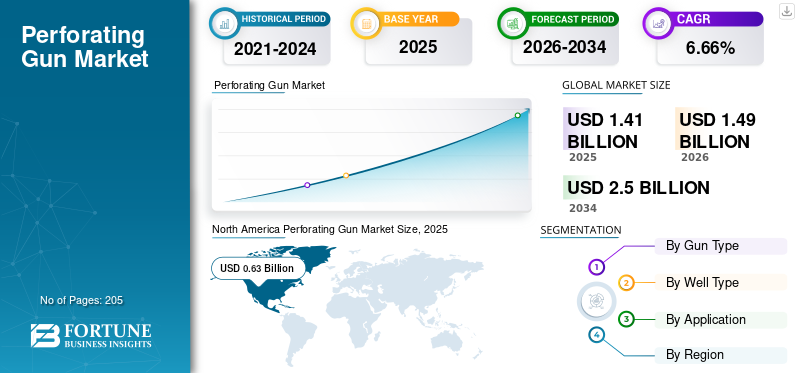
The global perforating gun market size was valued at USD 1.41 billion in 2025 and is projected to grow from USD 1.49 billion in 2026 to USD 2.50 billion by 2034, exhibiting a CAGR of 6.66% during the forecast period. North America dominated the perforating gun market with a market share of 44.68% in 2025.
The market is primarily driven by the need to maximize well productivity and recovery efficiency in oil and gas production operations. Effective perforation can improve initial production rates by 20–40% by creating cleaner, deeper flow paths between the reservoir and wellbore. According to the U.S. Energy Information Administration, as unconventional resources expand, horizontal wells now account for over 70% of new wells drilled globally, leading to increased use of high-shot-density guns (up to 20–40 shots per foot) to enhance reservoir contact. As stated by SLB, a leading perforating gun manufacturer, the advances in shaped-charge design have boosted penetration depths by 30–50% compared to legacy systems, directly supporting higher flow efficiency. Additionally, mature field redevelopment and workover activities contribute significantly as more than 60% of global production comes from aging fields that require re-perforation to sustain output. Wireline-conveyed casing gun systems are high-energy perforating guns deployed on wireline to create precise, deep-penetration holes through casing and cement, establishing efficient communication between the wellbore and the reservoir.
- For instance, in 2023, according to aggregated public industry data from public operator filings, the market growth is closely tied to rising well completion intensity, especially in complex reservoirs. This industry data indicated that over 85% of newly completed oil and gas wells worldwide used cased-hole perforation, underscoring the technology’s near-universal role in well productivity. As operators target tighter formations and longer laterals, precise, repeatable perforation has become essential to ensure consistent fracture initiation, efficient stimulation, and stable production performance throughout the life of the well.
Some of the leading companies in the industry include Baker Hughes, Schlumberger Limited, and Hunting PLC. Baker Hughes’ guns are designed to deliver high-penetration, consistent shot performance across conventional and unconventional wells. Their systems support precise phasing and shot density control, helping operators improve fracture initiation and overall well productivity while maintaining high safety and reliability standards.
Download Free sample to learn more about this report.
PERFORATING GUN MARKET Key Takeaways
 Market Size & Forecast
- 2025 Market Size: USD 1.41 billion
- 2026 Market Size: USD 1.49 billion
- 2034 Forecast Market Size: USD 2.50 billion
- CAGR: 6.66% from 2026–2034
 Market Share
- North America dominated the perforating gun market with a market share of 44.68% in 2025.
- The horizontal well segment held the largest share of the global market in 2025.
- The through-tubing exposed gun system segment is projected to grow at a CAGR of 6.72% during the forecast period.
 Key Regional Highlights
North America
North America led the global market in 2025, reaching USD 0.63 billion, supported by extensive oil and gas exploration and production activities.
Europe
Europe reached USD 0.80 billion in 2025 and is anticipated to expand steadily at a CAGR of 4.46% over the forecast period.
Asia Pacific
Asia Pacific secured the second-largest market position in 2025, with a valuation of USD 0.24 billion, driven by increasing energy demand and upstream investments.
U.S.
The U.S. market was valued at approximately USD 0.55 billion in 2025, accounting for around 39.03% of global market revenue due to its strong shale oil and gas production base.
Japan
The Japan market reached around USD 0.02 billion in 2025, representing approximately 1.06% of global revenues, supported by ongoing energy infrastructure and resource development activities.
Read More

PERFORATING GUN MARKET TRENDS
Digitalization and Real-Time Data Integration in Perforating Operations are Key Market Trends
A significant trend in the market is the increasing digitalization and integration of real-time downhole data to improve operational precision and decision-making. Modern perforating systems are equipped with sensors and telemetry that deliver pressure, temperature, and shot confirmation data to surface control systems in real time. This digital feedback allows operators to verify firing success, adjust phasing and shot density in situ, and reduce uncertainty in complex well trajectories. The adoption of these innovative perforating solutions has accelerated. In the exploration and production of unconventional oil, perforating guns are used to create engineered perforation tunnels through casing and cement, enabling effective reservoir access and optimized hydrocarbon flow from tight formations.
Download Free sample to learn more about this report.
MARKET DYNAMICS
MARKET DRIVERS
Increasing Deepwater and HPHT Well Developments to Drive the Market Expansion
A key factor driving perforating gun market growth is the steady increase in deepwater and high-pressure high-temperature (HPHT) well development worldwide. These wells require robust, high-performance perforating systems capable of operating at pressures exceeding 15,000 psi and temperatures exceeding 175°C. According to Global Energy Monitor, as of 2024, deepwater projects accounted for nearly 30% of global offshore oil production, a share that continues to rise as shallow-water reserves mature. HPHT environments demand advanced gun metallurgy, reliable detonating systems, and precise charge performance to ensure well integrity and safety. The technical complexity and high cost of these wells underscore the importance of reliable perforation, driving the demand for systems designed for extreme conditions.
MARKET RESTRAINTS
Rising Operational Costs and Regulatory Constraints on Explosives Handling to Hamper the Market Expansion
A key restraint for the market is the increasing regulatory scrutiny and operational complexity associated with handling explosives. Perforating guns rely on shaped charges and detonators that are subject to strict transportation, storage, and on-site handling regulations. According to the U.S. EPA’s New Source Performance Standards (NSPS), between 2019 and 2024, compliance-related costs for explosives management in oilfield operations surged by over 25% in several producing regions, driven by tighter safety and environmental rules. These requirements can extend permitting timelines, limit logistics flexibility, and raise operational expenses, particularly for offshore and remote locations.
MARKET OPPORTUNITIES
Growth in Carbon Capture and Geothermal Well Applications to Present Excellent Opportunities
A growing opportunity lies in carbon capture and storage (CCS) and geothermal well development. Injection wells for CO₂ storage and geothermal energy require precise perforation to ensure controlled fluid flow and long-term well integrity. According to CCS Institute, by 2024, the global CCS capacity would have exceeded 50 million metric tons of CO₂ injected annually, with multiple new projects under development across North America, Europe, and Asia Pacific. Similarly, geothermal wells often operate in abrasive, high-temperature environments, creating demand for durable, high-precision perforating systems. As governments and operators accelerate low-carbon energy investments, the expanding use of perforating guns beyond conventional oil and gas wells presents a strong diversification and growth opportunity.
MARKET CHALLENGES
Performance Reliability in Complex and Heterogeneous Reservoirs to Present Significant Challenges
A major challenge in product deployment is maintaining consistent performance in highly heterogeneous, complex reservoirs. Variations in rock strength, stress orientation, and fluid saturation can lead to uneven penetration and suboptimal perforation efficiency. In complex formations, studies have shown that up to 15–20% of perforation shots may underperform or fail to achieve target penetration, affecting fracture initiation and well productivity.
Segmentation Analysis
By Gun Type
Wireline Conveyed Casing System Led the Market Owing to its High Precision & Reliability
Based on gun type, the market is classified into wireline conveyed casing system, through tubing exposed gun system, Tubing Conveyed Perforation (TCP) system, and through tubing hollow carrier system.
In 2025, the wireline conveyed casing system segment dominated the global perforating gun market share. The segment dominated as these systems offer high precision, reliability, and operational efficiency during primary well completions. The system enables accurate depth control and shot placement, which is critical in long horizontal and multi-stage wells. Wireline deployment also allows faster run-in and retrieval, reducing rig time by 20–30% compared to tubing-conveyed methods.
The through-tubing exposed gun system segment is experiencing significant growth and is expected to grow at a CAGR of 6.72% over the analysis period.
To know how our report can help streamline your business, Speak to Analyst
By Well Type
Horizontal Well Segment Dominated the Market Owing to Longer Reservoir Contact and Higher Production Efficiency
Based on well type, the market is classified into horizontal wells and vertical wells.
In 2025, the horizontal well segment dominated the global market. Horizontal wells maximize contact with the reservoir, enabling higher production rates compared to vertical wells. By extending laterally through productive zones, they improve drainage efficiency and enhance recovery from tight and unconventional formations. Horizontal drilling also supports multi-stage fracturing and precise perforation, making it the preferred well type for modern oil and gas development.
The vertical well segment is expected to grow at a CAGR of 5.79% over the forecast period.
By Application
Onshore Segment Dominated the Market Due to Lower Drilling and Completion Costs
Based on application, the market is classified into onshore and offshore.
In 2025, the onshore segment held the largest market share. The segment dominated as the guns offer significantly lower drilling and completion costs compared to offshore projects, along with simpler logistics and faster project execution. Onshore fields allow easier access for intervention, workover, and re-perforation activities, supporting sustained production over time. Additionally, the large number of mature onshore fields worldwide and continuous unconventional development drive the consistent demand for perforating and completion services.
The offshore segment is expected to grow at a CAGR of 4.90% over the forecast period.
Perforating Gun Market Regional Outlook
By geography, the market is categorized into North America, Europe, Asia Pacific, Latin America, and the Middle East & Africa.
North America
North America Perforating Gun Market Size, 2025 (USD Billion)
To get more information on the regional analysis of this market, Download Free sample
North America held the highest share in 2025 with a value of USD 0.63 billion and is estimated to account for a significant share in 2026 with a valuation of USD 0.67 billion. North America is dominant in the global market due to its high concentration of drilling and completion activity, particularly in shale and tight oil formations. The region accounts for a large share of global horizontal wells and multi-stage fracturing operations, which require extensive perforating. Strong infrastructure, rapid technology adoption, and continuous well redevelopment in mature basins further sustain demand. In addition, stable investment levels and efficient regulatory processes support consistent onshore and offshore project execution. For unconventional oil and gas resources, perforating equipment help create precisely engineered perforations in cased wells to enable efficient stimulation and hydrocarbon flow from low-permeability formations.
U.S. Perforating Gun Market
Given North America’s strong contribution and the U.S. dominance in the region, the U.S. market reached a value of around USD 0.55 billion in 2025, accounting for roughly 39.03% of the global market.
Europe
Europe is projected to grow at a rate of 4.46% over the coming years and reached a valuation of USD 0.80 billion in 2025. Europe remains significant for oilfield activity, driven by extensive offshore drilling and well intervention, particularly in the North Sea and Norwegian Sea, which support substantial exploration and production efforts. According to European Union, Norway alone historically supplied 20–25% of EU gas demand, highlighting the region’s upstream importance. European operators continue to redevelop mature offshore fields and integrate advanced drilling/completion technologies, while sustaining the use of perforating and related equipment despite declining onshore output in some EU countries.
Germany Perforating Gun Market
The German market reached a value of around USD 0.006 billion in 2025 and is expected to reach USD 0.007 billion in 2026, representing roughly 0.47% of global revenues.
Asia Pacific
The Asia Pacific market reached USD 0.24 billion in 2025 and secured the second-largest position. In the region, India and China reached USD 0.03 billion and USD 0.12 billion, respectively, in 2025.
Asia Pacific is dominant due to rising upstream activity driven by growing energy demand and expanding domestic production. The region accounts for over 35% of the global energy consumption, prompting countries such as China, India, Indonesia, and Australia to intensify drilling and well-completion programs. The increasing development of onshore unconventional resources and offshore gas projects, along with government-backed investments in energy security, continues to support strong demand for perforating and well-completion systems across the region.
Japan Perforating Gun Market
The Japan market reached a value of around USD 0.02 billion in 2025, accounting for roughly 1.06% of global revenues. The market is mainly driven by offshore gas development and well intervention projects aimed at strengthening energy security and reducing import dependency.
China Perforating Gun Market
The China market touched a value of around USD 0.12 billion in 2025, representing roughly 8.43% of the global market. The market is projected to be significant worldwide.
India Perforating Gun Market
The Indian market reached a value of around USD 0.03 billion in 2025, accounting for roughly 2.04% of global revenues.
Latin America
Latin America is expected to witness moderate growth in perforation gun sales during the forecast period. The market reached a valuation of USD 0.14 billion in 2025. Latin America’s perforating activity is supported by offshore and onshore development in countries such as Brazil, Mexico, and Argentina. Deepwater projects and shale exploration, particularly in Brazil’s pre-salt fields and Argentina’s Vaca Muerta, sustain steady demand for advanced well completion technologies.
Brazil Perforating Gun Market
The Brazil market reached a valuation of USD 0.07 billion in 2025, accounting for roughly 4.66% of the global market.
Middle East & Africa
The Middle East & Africa market is expected to witness significant growth in this market during the forecast period. The regional market reached USD 0.32 billion in 2025. The market is driven by large-scale conventional oilfield development, high well counts, and ongoing field expansion and redevelopment activities.
GCC Perforating Gun Market
The GCC market reached a value of USD 0.20 billion in 2025, accounting for roughly 14.21% of the global market.
COMPETITIVE LANDSCAPE
Key Industry Players
Companies Adopt Partnerships, Business Expansion, and Technological Advancements to Expand their Market Share
The global market has a consolidated market structure, with prominent players including Baker Hughes, Schlumberger Limited, Hunting PLC, Weatherford International plc, and others. Companies operating in the industry are adopting targeted growth strategies centered on strengthening their technical capabilities, product portfolios, expanding their manufacturing presence, and other areas.
- For instance, in October 2025, Baker Hughes reported strong third-quarter results, highlighting continued performance in completions and intervention technologies, including perforating gun systems as part of its broader well-construction solutions, reflecting steady demand amid sustained drilling activity.
Other key players in the global market include DMC Global Inc., NOV Inc., Halliburton Company, and others. These players are expected to prioritize new partnerships and product launches to increase their global market share during the analysis period.
LIST OF KEY PERFORATING GUN COMPANIES PROFILED
- Baker Hughes (U.S.)
- Schlumberger Limited (SLB) (U.S.)
- Hunting PLC (U.K.)
- Weatherford International plc (U.S.)
- DMC Global Inc. (U.S.)
- NOV Inc. (U.S.)
- Halliburton Company (U.S.)
- Core Laboratories NV (Netherlands)
- DynaEnergetics (U.S.)
- China Shaanxi FYPE Rigid Machinery Co., Ltd (China)
KEY INDUSTRY DEVELOPMENTS
- November 2025: Schlumberger continued to engineer advanced perforating gun systems, including high-shot-density hollow-carrier systems designed to optimize perforation penetration and pattern phasing, enhancing completion outcomes across well types.
- October 2025: Halliburton announced the commercial release of its IntelliBurst® Smart Perforating System, featuring real-time downhole telemetry and adaptive firing control. The system integrates advanced sensor feedback to optimize charge detonation sequencing and improve reservoir access while reducing formation damage. Designed for use in horizontal and multistage completions, IntelliBurst enables operators to adjust perforating parameters based on real-time downhole conditions, enhancing overall completion efficiency and lowering non-productive time across unconventional and mature fields
- May 2024: Hunting PLC continued advancing perforating system technologies, including the roll-out of ControlFire® Perf+ and H-series perforating guns with embedded switch technologies that streamline downhole communications and automated firing control. These developments, showcased in industry demonstrations, aim to improve precision, safety, and operational efficiency across conventional and challenging wellbore conditions, reinforcing Hunting’s focus on integrated detonator and tool-string solutions.
- February 2024: Hunting Titan unveiled its latest perforating technology at the SPE Hydraulic Fracturing Technology Conference, launching the H-4 Oriented Perforating System along with the Perf+ shooting panel. This system features a self-orienting design for precise alignment of perforation tunnels and a fully integrated control panel that reduces human error during gun string configuration and deployment.
- June 2023: DynaEnergetics, a DMC Global business, introduced the DS Gravity 2.0 perforating gun, a compact, self-orienting system that uses an internal gravity-based design to ensure precise phasing and improve perforation efficiency without external orientation tools. The launch marked a notable advancement in perforating technology by enabling higher gun counts and smoother deployment, enhancing well completion outcomes and potentially reducing operational time and complexity.
REPORT COVERAGE
Request for Customization to gain extensive market insights.
Report Scope & Segmentation
| ATTRIBUTE | DETAILS |
| Study Period | 2021-2034 |
| Base Year | 2025 |
| Estimated Year | 2026 |
| Forecast Period | 2026-2034 |
| Historical Period | 2021-2024 |
| Growth Rate | CAGR of 6.66% from 2026-2034 |
| Unit | Value (USD Billion) |
| Segmentation | By Gun Type, Well Type, Application, and Region |
| By Gun Type |
|
| By Well Type |
|
| By Application |
|
| By Region |
|
Frequently Asked Questions
Fortune Business Insights says that the global market value stood at USD 1.41 billion in 2025 and is projected to reach USD 2.50 billion by 2034.
In 2025, the market value stood at USD 0.63 billion.
The market is expected to grow at a CAGR of 6.66% over the forecast period of 2026-2034.
The wireline conveyed casing system segment led the market by type in 2025.
Rising drilling and completion activity and growth in horizontal and unconventional wells are the key factors driving the market.
Baker Hughes, Schlumberger Limited, Hunting PLC, and others are some of the prominent players in the market.
North America dominated the market in 2025.
The product adoption is favored by increasing horizontal drilling, complex reservoir development, higher re-perforation activity in mature fields, and the need for precise, high-efficiency well completions.


- 2021-2034
- 2025
- 2021-2024
- 205
Get 30-60 hrs Free Customization
Expand Regional and Country Coverage, Segments Analysis, Company Profiles, Competitive Benchmarking, and End-user Insights.










Related Reports
-
US +1 833 909 2966 ( Toll Free )
-
Get In Touch With Us