Protein Bar Market Size, Share & Industry Analysis, By Source (Non-Dairy Animal, Dairy Animal, Single Source Plant, Plant Blends and Hybrid), By Product Type (Protein Sports Nutrition Bars, Protein Meal/Weight Management Bars , Protein Snack Bars, Protein Breakfast Bars, Protein Dessert-style Bars and Protein Clinical/Medical-style Bars), By Protein Content (Ultra-high, High, Moderate and Light), By Price (Economy, Premium and Luxury), By Distribution Channel (Mass Merchandisers, Specialty Stores, Convenience Stores, Online Channels and Others) and Regional Forecast, 2026-2034
 Download Free Sample
(Offer valid till 30th Sep 2026)

Protein Bar Market Size and Future Outlook
 Listen to Audio Version
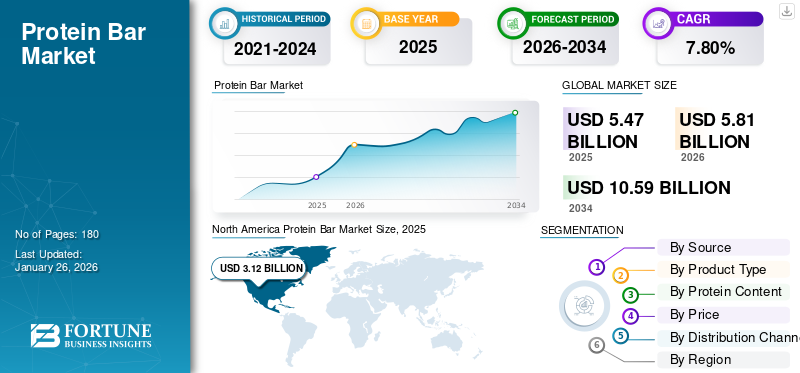
The global protein bar market size was valued at USD 5.47 billion in 2025. The market is projected to grow from USD 5.81 billion in 2026 to USD 10.59 billion by 2034, exhibiting a CAGR of 7.80% during the forecast period. North America dominated the protein bar market with a market share of 56.95% in 2025.
Protein bars are high concentration of protein dosage which is consumed as a nutritional snack options to meet the necessary protein requirement of the body. Apart from protein, these products also contain carbohydrates, fats, fiber, vitamins and minerals in small amounts. These products are packed in a convenient portable and shelf stable format that can be consumed on the go. Growing popularity of maintaining health and fitness and weight management products is expected to boost the consumption of these products.
Companies such as Nestle S.A., The Kellogg Company, General Mills, Mars Incorporated, Mondelez International are some of the well-known players operating to meet the growth in demand for protein bars. New product launch and premiumization of product are key strategies adopted by such companies to expand their market presence and sales among consumers.
Download Free sample to learn more about this report.
Protein Bar Market Key Takeaways
 Global Market Size & Forecast
- 2025 Market Size: USD 5.47 billion
- 2026 Market Size: USD 5.81 billion
- 2034 Forecast Market Size: USD 10.59 billion
- CAGR: 7.80% from 2026-2034
 Market Share
- North America dominated the protein bar market with a 56.95% share in 2025.
- The dairy animal segment is expected to account for the largest market share of 61.11% in 2026.
- The protein snack bars segment is anticipated to hold a dominant market share of 40.40% in 2026.
 Key Regional Highlights
North America
North America represented USD 3.12 billion in 2025 and is projected to reach USD 3.30 billion in 2026.
Asia Pacific
Asia Pacific was valued at USD 0.81 billion in 2025 and is expected to grow to USD 0.87 billion in 2026.
Europe
Europe generated USD 1.27 billion in 2025 and is projected to reach USD 1.35 billion in 2026.
U.S.
The U.S. market is expected to reach USD 2.51 billion in 2026.
Japan
The Japan market is expected to reach USD 0.11 billion in 2026.
Read More

MARKET DYNAMICS
MARKET DRIVERS
Growing Consumer Awareness About Importance of Protein Fuels Market Growth
Protein consumption pattern has evolved significantly in the last decade. This nutrient was mainly popular among bodybuilder and athletes who wanted nutrition for their health and growth but in recent years the occupation of such products have become more mainstream. As research shows that protein helps in managing weight, improving muscle building, recovery and strength and promote general wellness, such products have become popular among consumers of all age groups. Protein bars are a convenient way to boost daily protein intake for busy, health-conscious consumers. Therefore, protein rich packed foods, including protein bars have grown in popularity in recent years. This has led to significant rise in global protein bar market growth.
MARKET RESTRAINTS
High Production Cost Makes Product Expensive, Hindering Market Growth
Production of protein products such as whey isolate, casein, pea protein and others is expensive. Hence, products which have high protein content are comparatively expensive than other products types. Moreover, products with high protein content have chalky texture and requires specialized components that involved binders and fillers to provide a balanced taste and nutrition. Moreover, smaller production batches of such products in comparison to other nutritional snacks increases the overall production cost leading to smaller economies of scale.
MARKET OPPORTUNITIES
Positioning Products for Weight Management Create Opportunity to Expand Sales
As lifestyle related disease is increasing among consumers, obesity and other health ailments are on rise. Dietician often recommend to manage weight by reducing the consumption of bar based food and replacing it with protein rich products. Manufacturers are positioning their products in the market by launching protein rich snack which can help management weight and also provide nutrition. However, as the cost of high protein rich bars is high, manufacturers have the opportunity to launch affordable economy bars by reducing the production cost through souring protein from local sources or launching in smaller packaging formats and meet the market demand.
PROTEIN BAR MARKET TRENDS
Flavor and Ingredient Innovation are Key Trends Influencing Product Sales
Consumer demand for plant protein is increasing rapidly. This has enabled manufacturers to launch vegan and dairy free protein bars for such consumers. Brands are shifting from whey protein to plant based protein such as pea, soy, rice, hemp, and almond protein blends which are targeted specific consumers. Flavor innovation is another major trend impacting the market where taste is the key factor influencing consumer purchase decision. Thus, to satisfy such consumer segments, manufacturers are launching dessert based flavors such as chocolate fudge brownie flavor protein bars in the market.
Download Free sample to learn more about this report.
Segmentation Analysis
By Source
High Protein Content from Dairy Animal Sources Contribute To Its Popularity In Market
The market is divided by source into Non-dairy animal, dairy animal, single source plant, plant blends and hybrid.
The dairy animal segment is estimated to expected for the largest market share of 61.11% in 2026. Whey and casein are some of the primary protein component which are consumed widely and is used for the production of protein products. Moreover, such proteins are rich in amino acids which are critical for muscle repair and growth and hence preferred by gym goers and other health conscious consumers.
The plant blend segment is expected to grow at a CAGR of 6.17% over the forecast period. Growing adoption of vegan and vegetarian diets among consumer is one of the major factor expected to contribute to the segment’s growth.
By Product Type
Protein Snack Bars are Popular Owing to its Growing Demand by Consumer of All Age Groups
The market is segmented by product type into protein sports nutrition bars, protein meal/weight management bars, protein snack bars, protein breakfast bars, protein dessert-style bars and protein clinical/medical-style bars.
The Protein snack bars segment is anticipated to hold a dominant market share of 40.40% in 2026. Such bars are target all consumer segments and hence consumed by people who want healthy product alternatives to chips and other processed food. Such products are also preferred by consumers who eat snacks between meal or on-the-go. Moreover, compared to specialized products, these bars are marketed at an affordable price point making it popular among consumers. These nutritional bars offer a convenient way to support healthy snacking and balanced diets.
Sports nutrition bars is another major product type expected to grow by 5.99% during the forecast period. Booming fitness and active lifestyle with growing participation in gyms, fitness classes, HIIT and other sports categories contribute to the growth of the segments.
By Protein Content
Growing Popularity and Consumption of Moderate Protein Content Based Bars Contributes to its High Market Share
Based on protein content, the market is segmented into ultra-high, high, moderate and light.
Moderate protein content bar accounted for the highest market share in 2024. Such products provide a balance of nutrition/taste and are also affordable, contributing to the products popularity among all consumer segments. Such products are consumed as everyday snacks by office worker and people who seek healthy and balanced alternative to processed foods.
High protein bars are also growing in popularity in the market. These products are popular among fitness enthusiasts, active lifestyle consumers, and weight management users. As health consciousness is increasing, the popularity of such products is also expected to increase. This segment is expected to account for a CAGR of 6.08% during the forecast period.
To know how our report can help streamline your business, Speak to Analyst
By Price
Premium Products Accounts for Higher Market Share Owing to Better Quality Ingredients
On the basis of price, the market is segregated into economy, premium and luxury.
Premium products accounted for the largest market share in 2024. Premium products have comparatively higher protein content than products in the affordable prices and hence they command higher price among consumers. Such product also made of higher quality of ingredient and people prefer to pay more.
Economy segments are expected to grow with a CAGR of 5.28% during the forecast period, the second-fastest growth rate in this category. These products are positioned in the market as an everyday snacks and hence it is appealing to consumer of all segments. Such products are also available in supermarkets, hypermarkets, convenience stores, and even vending machines leading to strong sales.
By Distribution Channel
Mass Merchandizers Hold Significant Market Share Owing to Wide Reach and Strong Consumer Preference
The market is segregated into mass merchandisers, specialty stores, convenience stores, online channels and others, based on distribution channel.
The Mass merchandizers segment is expected to lead the market, contributing 35.31% globally in 2026. Consumers prefer such stores as they have wide product range which provide them a one shop stop to purchase all the necessary items. Moreover, bars are placed near checkout aisles, making them an easy add on the shopping list product. Established market players use such stores to sell their products and mainstream shoppers trust such stores to sell authentic products in the market.
Online sales accounts for the fastest growth and is projected to grow at a CAGR of 6.38% during the study period. Companies can provide customized product bundles to consumer, thus offering targeted solutions based on the diet goals of consumers.
Protein Bar Market Regional Outlook
North America Protein Bar Market Size, 2025 (USD Billion)
To get more information on the regional analysis of this market, Download Free sample
By geography, the market is categorized into Europe, North America, Asia Pacific, South America, and Middle East & Africa.
North America
In 2025, North America represented USD 3.12 billion, accounting for 56.95% of the worldwide market, and is projected to grow to USD 3.3 billion in 2026. The penetration rate of gyms, fitness clubs and sports participation in the region is high. As sport professional prefer protein-rich products including whey protein powder, content format of these products are popular. Products such as gluten free protein bar is the perfect snack for health-conscious consumers with dietary need. Moreover, several consumer skip meal and consume on-the-go products including quick protein snacks that also leads to high sales in the market. In 2025, the U.S. market is estimated to reach USD 5.34 billion. Therefore, the protein bar demand reveals a strong growth trajectory driven by demand among all consumer segments. The U.S. market is expected to reach USD 2.51 billion by 2026.
Asia Pacific
Asia Pacific contributed 14.84% to the global market in 2025, with a valuation of USD 0.81 billion, and is projected to reach USD 0.87 billion in 2026. Fitness centers such as gyms, yoga, crossfit and other are growing in this region and consumer are seeking portable protein products which can help to support the workouts. Moreover, protein is widely consumed in the region and protein product are already popular among consumer, majorly in China. As health literacy is evolving and western influence in growing in several Asian countries, acceptance of such products is one the rise. In this region, China and Japan are estimated to reach USD 1.16 billion and USD 0.90 billion, each, in 2025. The Japan market is expected to reach USD 0.11 billion by 2026, the China market is expected to reach USD 0.30 billion by 2026, and the India market is expected to reach USD 0.23 billion by 2026.
Europe
The Europe market generated USD 1.27 billion in 2025, representing 23.21% of the global market landscape, and is expected to reach USD 1.35 billion in 2026. Countries such as U.K., Germany and Nordic nations lead active lifestyle due to which health and wellness products are popular among consumers in these market. Clean label plant based products are widely popular among consumers in the regions and hence manufacturers launch high quality ingredient products. During the forecast period, the European region is projected to record a growth rate of 7.18%. Backed by these factors, countries including Germany are expected to record the valuation of USD 0.66 billion, France to record USD 0.41 billion, and the U.K. to record USD 0.95 billion in 2025. The UK market is expected to reach USD 0.48 billion by 2026, while the Germany market is expected to reach USD 0.31 billion by 2026.
South America and the Middle East & Africa
The Middle East & Africa market was valued at USD 0.06 billion in 2025, capturing 1.01% of global revenue, and is estimated to reach USD 0.06 billion in 2026. Over the forecast period, South America and the Middle East & Africa regions would witness a moderate growth in this market. Several ingredients including soybeans are manufactured in Brazil itself which also lead to lower production cost and manufacturing of affordable products. Protein bars are a key part of the sports nutritional segment, offering energy and recovery support for active lifestyles.
Latin America
The market in Latin America reached USD 0.22 billion in 2025, representing 3.99% of total market revenue, and is projected to reach USD 0.23 billion in 2026.
COMPETITIVE LANDSCAPE
Key Industry Players
New Product Launch and Expansion in Emerging Markets are Key Strategy Adopted by Manufacturers
The global market exhibits a consolidated structure as there are several well established multinational companies operating in the market with extensive product range in this category. Hover several smaller brands are also developing and launching new differentiated products which helps them compete with these established players. Apart from mature markets, companies are expanding their reach in developing economies by launching products for price sensitive consumer in the region. Clean label products are launched in European markets as they are preferred by the consumers. New advertising campaign are launched which include partnership with athletes and dieticians. This helps to ensure that they can push their products to young consumers who seek authentic products.
LIST OF KEY PROTEIN BAR COMPANIES PROFILED:
- Nestle S.A. (Switzerland)
- The Kellogg Company (U.S.)
- General Mills Inc. (U.S.)
- Mars, Incorporated (U.S.)
- Mondelez International (U.S.)
- GNC Corporation (U.S.)
- The Simply Good Foods Company (U.S.)
- Hormel Foods Corporation (U.S.)
- Abbott Laboratories (U.S.)
- Fulfil Nutrition (Ireland)
KEY INDUSTRY DEVELOPMENTS:
- April 2025: U.K. based protein bar brand Trek launched high protein low sugar protein bars in the market. This bar is positioned in the market for health conscious consumers.
- April 2025: U.S. based protein brand named Pure Protein launched protein bars in the market named Pure Protein AMMMAZE bars. These products are available across 7-Eleven and Speedway stores across the country.
- June 2020: Nestle S.A. launched plant based protein bars in the market. The new product named YES! Protein bars are made of nuts and peas and is high in fiber and contain no additional preservatives.
- August 2025: Indian protein bars Phab launched savory protein bar in the market named Bhel Bars which is made of clean plant protein. The product is available in three format namely The OG Bhel, Curry Leaf Podi and Peri Peri.
- January 2025: Once Upon a Farm launched Refrigerate protein bars in the U.S market. The product is available in two formats namely Oatmeal Chocolate and Cinnamon Roll. They ae made of apple puree cocoa butter, dates and others.
REPORT COVERAGE
Request for Customization to gain extensive market insights.
Report Scope & Segmentation
|
ATTRIBUTE |
DETAILS |
|
Study Period |
2021-2033 |
|
Base Year |
2025 |
|
Forecast Period |
2026-2034 |
|
Historical Period |
2021-2024 |
|
Growth Rate |
CAGR of 7.80% from 2026-2034 |
|
Unit |
Value (USD Billion) |
|
Segmentation |
By Source, Product Type, Protein Content, Price, Distribution Channel, and Region |
|
By Source |
· Non-Dairy Animal · Dairy Animal · Single Source Plant · Plant Blends · Hybrid |
|
By Product Type |
· Protein Sports Nutrition Bars · Protein Meal/Weight Management Bars · Protein Snack Bars · Protein Breakfast Bars · Protein Dessert-style Bars · Protein Clinical/Medical-style Bars |
|
By Protein Content |
· Ultra-high · High · Moderate · Light |
|
By Price |
· Economy · Premium · Luxury |
|
By Distribution Channel |
· Mass Merchandisers · Specialty Stores · Convenience Stores · Online Channels · Others |
|
By Geography |
North America (By Source, Product Type, Protein Content, Price, Distribution Channel, and Country)
Europe (By Source, Product Type, Protein Content, Price, Distribution Channel, and Country)
Asia Pacific (By Source, Product Type, Protein Content, Price, Distribution Channel, and Country)
South America (By Source, Product Type, Protein Content, Price, Distribution Channel, and Country)
Middle East & Africa (By Source, Product Type, Protein Content, Price, Distribution Channel, and Country)
· Rest of the Middle East & Africa (By Price) |
Frequently Asked Questions
Fortune Business Insights says that the global market value stood at USD 5.47 billion in 2025 and is projected to reach USD 10.59 billion by 2034.
In 2025, the market value stood at USD 3.12 billion.
The market is expected to exhibit a CAGR of 7.80% during the forecast period of 2026-2034.
By product type, the protein snack bars segment led the global market in 2025.
Growing consumer awareness about the importance of protein fuels the market growth.
Nestle S.A., The Kellogg Company, General Mills, Mars Incorporated, Mondelez International are a few of the key players in the market.
North America held the largest market share in 2025.
Flavor and ingredient innovation are key trends influencing product sales.



- 2021-2034
- 2025
- 2021-2024
- 180
-
(Offer valid till 30th Sep 2026)
Get 30-60 hrs Free Customization
Expand Regional and Country Coverage, Segments Analysis, Company Profiles, Competitive Benchmarking, and End-user Insights.



















Related Reports
-
US +1 833 909 2966 ( Toll Free )
-
Get In Touch With Us