Rocket and Missile Market Size, Share & Industry Analysis, By Type (Missile and Rocket), By Platform (Airborne, Naval, and Ground), By Launch Mode (Surface-to-Surface, Surface-to-Air, Air-to-Air, Air-to-Surface, Subsea-to-Surface, and Sea-to-Sea), By Propulsion (Solid, Liquid, Hybrid, Scramjet, Cryogenic, and Others), and Regional Forecasts, 2026-2034
 Download Free Sample
KEY MARKET INSIGHTS
 Listen to Audio Version
The global rocket and missiles market size was estimated at USD 70.87 billion in 2025 and is expected to rise from USD 74.11 billion in 2026 to USD 106.05 billion by 2034, expanding at a CAGR of 4.58% from 2026 to 2034. North America dominated the rocket and missiles market with a market share of 32.56% in 2025.
The ongoing war between Russia and Ukraine has been unprecedented and staggering, with rockets and missiles experiencing higher-than-anticipated demand across all regions. Based on our analysis, the global market exhibited a growth of 3.47% in 2020 as compared to 2019.
A rocket is a highly advanced reaction motor that can drive a launch vehicle by carrying its oxidant. A reaction motor is utilized as a propulsion mechanism to generate forward thrust by expelling the structure in a backward direction. An unmanned vehicle is known as a missile. It combines the guiding system with an explosive substance. A ground-based communication center guides a warhead.
Industry growth is projected by emerging economies, such as China and India, boosting defense spending. Furthermore, the industry is expected to benefit from the changing nature of military technology worldwide. Market potential includes initiatives for the development of superior autonomous systems. On the other hand, the exorbitant expense of constructing rockets and missiles is limiting industry expansion. The COVID-19 outbreak has presented the military sector with numerous hurdles. Though the sector was not badly harmed, it experienced numerous economic difficulties following the COVID-19 pandemic.
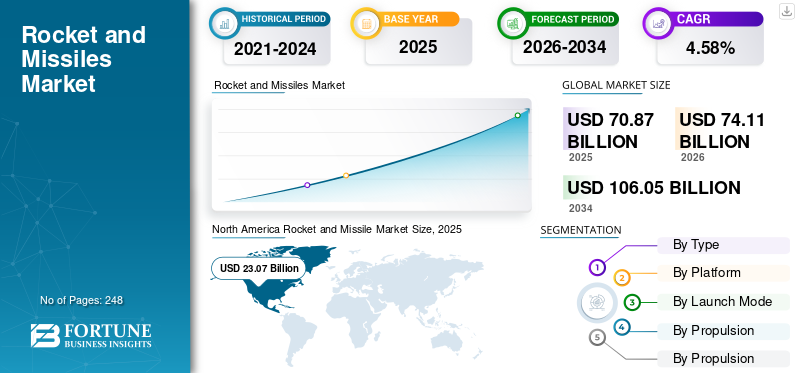
Download Free sample to learn more about this report.
Rocket and Missiles Market KEY TAKEAWAYS
 Global Market Size & Forecast
- 2025 Market Size: USD 70.87 billion
- 2026 Market Size: USD 74.11 billion
- CAGR: 4.58% from 2026–2034
 Market Share
- North America dominated the rocket and missiles market with a 32.56% share in 2025.
- The Missiles segment is projected to hold the largest market share during the forecast period.
- The Naval platform segment is projected to account for the largest market share with 23.12% in 2026.
 Key Regional Highlights
North America
The market was valued at USD 23.07 billion in 2025, driven by increasing defense modernization programs.
Asia Pacific
The region is expected to witness the fastest growth, supported by increasing defense budgets.
Europe
The market is expected to grow steadily, driven by rising investments in precision-guided missile systems.
U.S.
The market is expected to witness steady growth, supported by ongoing military modernization programs.
Japan
Japan is expected to witness steady market growth, driven by strengthening missile defense capabilities.
Read More

RUSSIA-UKRAINE WAR IMPACT
Russia-Ukraine Conflict is Reshaping the Defense Industry Owing to Increase in Arsenal Expenditures
The global market is bracing itself for a fresh wave of rapid defense spending as the Russia-Ukraine conflict continues. However, this form of conflict can impact more than one military budget; it can also trigger changes in procurement priorities. The effective deployment of new Russian electronic warfare equipment in Ukraine in 2014 and later in Syria encouraged to research and development and acceptance of communications solutions that work (if not flawlessly) in GPS-denied conditions. The Russia-Ukraine conflict will also disrupt the defense procurement landscape, and defense officials must be prepared.
Ukraine's successful deployment of the Turkish Bayraktar TB2 Unmanned Combat Aerial Vehicle (UCAV) against Russian forces may irritate Western market incumbents. This UCAV, which has already demonstrated its capacity to engage Russian platforms in Libya and Syria, has done so again. The TB2's tactical success and the ensuing media frenzy benefit Baykar, the TB2's maker, as several governments are actively looking to expand their UCAV fleets. Therefore, these factors will positively impact the defense industry, especially this market.
Rocket and Missiles Market Overview & Key Metrics
Market Size & Forecast:
- 2025 Market Size: USD 70.87 billion
- 2026 Market Size: USD 74.11 billion
- 2034 Forecast Market Size: USD 106.05 billion
- CAGR: 4.58% from 2026–2034
Market Share:
- North America dominated the rocket and missiles market with a 32.56% share in 2025, driven by high defense spending, modernization programs, and presence of leading manufacturers like Lockheed Martin, Raytheon Technologies, and General Dynamics.
- By type, guided missiles (ballistic and cruise) are expected to remain dominant due to increasing demand for precision strike capabilities.
- By platform, the ground segment leads the market, supported by growing land-attack cruise missile deployments.
Key Country Highlights:
- United States: Expansion driven by a USD 782 billion defense budget in 2022 and significant investments in hypersonic missile programs and fiber-optic guidance systems.
- China: Rapid military modernization and development of multiple independent re-entry vehicles (MIRVs) to enhance strike capabilities.
- India: Increasing defense spending and indigenous missile development programs like Agni and BrahMos boost market growth.
- Europe: Growth supported by advanced missile contracts in the U.K., France, and Russia’s focus on hypersonic systems like 3M22 Zircon.
- Middle East: Saudi Arabia and Turkey driving demand with expanding missile procurement and modernization initiatives.
ROCKET AND MISSILES MARKET TRENDS
Download Free sample to learn more about this report.
Growing Use of 3D-Printed Missile Components to Drive Market Growth
3D printing is an additive manufacturing technique for creating complex geometrical objects such as rocket and missile structures. Complex components and structures of missiles and rockets, such as warheads, outer skins, fuel tanks, and control vanes, are manufactured using technologically advanced 3D printers. The advantages of 3D printing technology include faster product creation, single-step manufacturing, low-cost production, and increased sustainability.
- North America witnessed rocket and missile market growth from USD 17.86 Billion in 2020 to USD 19.29 Billion in 2021.
- In May 2022, AgniKul Cosmos, a space tech business based out of the Indian Institute of Technology Madras, will file a patent application for its full-scale second-stage engine Agnilet, which is the world's first single-piece 3D-printed engine. This development implies that it was built in one piece rather than the thousands of parts required by a traditional engine. Using 3D printing technology by crucial companies in the defense manufacturing industry is likely to boost the rocket and missile market growth.
DRIVING FACTORS
Technological Advancements in Warfare Techniques to Propel the Market’s Progress
Guided weapons technology is a cutting-edge warfare technique employed by a variety of defense groups around the world. Among the technologically advanced guided missiles are short-range anti-air missiles, medium-range and long-range air-to-land and air-to-air missiles, and ballistic & cruise missiles. The U.S., China, and Russia are all working on hypersonic missiles that can reach Mach 5 speeds. The market is expanding due to growing countries such as India's greater adoption of Command, Control, Computers, Communications, Cyber, Intelligence, Surveillance and Reconnaissance (C5ISR) warfare techniques to reduce strike time during battlefield operations.
- In April 2022, North Korea successfully tested a new tactical guided weapon to improve its nuclear capability.
Automatic Target Recognition (ATR) Missile Systems Became More Prominent Due to Rising Demand
An automatic target-recognition system's primary goal is to detect enemy targets such as armored personnel carriers, military tanks, and howitzers. The target is identified using the information gathered such as several photographs of the enemy's location captured by laser radar sensors. Anti-ship missiles are the most common use of ATR architecture. This method combines multi-layered artificial neural networks with Imaging Infrared (IR). In 43 milliseconds, the ATR can recognize 90% of targets. The U.S. approved a defense budget of USD 782 billion for 2022. Military spending in the U.S. is expected to account for more than half of total federal defense spending. The market is growing due to the increased usage of the ATR missile system by the U.S. and Russian militaries to recognize targets.
- A cost-plus-fixed-fee contract worth USD 7 billion was awarded to BAE Systems Inc. of Burlington, Massachusetts for research and development to cultivate innovative machine learning and fusion algorithms to advance Automatic Target Recognition (ATR), machine learning, and multi-level multi-source fusion technology to improve algorithm performance.
RESTRAINING FACTORS
COVID-19 Impact Constrains Industry Expansion Since Rocket and Missile Development Costs are High
Manufacturing businesses' main concerns are successful distribution and connectivity coverage. Increased connectivity due to technological advancements and new product development is projected to surge the demand for wireless infrastructure. The design and development of wireless infrastructure, connectivity challenges, and a delay in standardization are all important factors limiting the market's growth. The fast spread of wireless networks on a global scale raises serious concerns about network security and data privacy, both of which hinder commercial progress. Furthermore, certain impediments, such as gates, walls, and people, interfere with the transmission of wireless signals. These barriers cause poor communication and, in certain cases, full loss of wireless connection. The range and position of the receiver determine the power of wireless transmissions.
SEGMENTATION ANALYSIS
By Type Analysis
Increased Use of Self-propelled Guided Missiles to Foster the Cruise Missile Market’s Progress
The market is divided into rockets and missiles based on type. Ballistic missiles and cruise missiles are two types of missiles. The segment is projected to grow significantly during the forecast period. A ballistic missile's flight path follows a ballistic trajectory. Numerous types of ballistic missiles are Short-Range Ballistic Missiles (SRBMs), Medium-Range Ballistic Missiles (MRBMs), Intermediate-Range Ballistic Missiles (IRBMs), and Intercontinental Ballistic Missiles (ICBMs). A cruise missile is a self-propelled guided missile that is used to kill predetermined targets. Subsonic cruise missiles, supersonic cruise missiles, and hypersonic cruise are three types of cruise missiles. The hypersonic cruise has a top speed of 5 Mach. Many growing economies, including China and India, have developed hypersonic cruise. Due to the rising usage of artillery and air-launched in Europe and Asia Pacific, the rocket segment is expected to grow at the highest throughout the projected period.
By Platform Analysis
To know how our report can help streamline your business, Speak to Analyst
Ground Segment to Dominate Propelled by Increasing Use of Land-Attack Cruise Missiles
By platform, the market is divided into airborne, naval, and ground. Airborne platforms employ missiles launched from combat fighter aircraft to destroy an opponent's base camp. The naval segment is projected to register the highest growth rate during the forecast period. The weapon launch system is installed on naval boats to boost their offensive capability. During maritime operations, arsenal are fired from the aircraft carrier, corvette, and several attacking naval vessels from the naval platform. Several multi-range rocket and missile are fired from earth-based control centers and combat military vehicles from the ground platform. Land-attack cruise missiles are sophisticated missiles launched from airborne, naval, or ground platforms. China's land-attack cruise’s are the YJ-63, CJ-10, and CJ-20 (LACM).
- The Naval segment is projected to dominate the market with a share of 23.12% in 2026.
By Launch Mode Analysis
Surface-to-Surface Segment to Dominate Owing to Increasing Use of Laser-Guided Missiles
The market is divided into surface-to-surface, surface-to-air, air-to-air, air-to-surface, subsea-to-surface, and sea-to-sea based on launch mode. During military operations, the armed services frequently employ surface-to-surface and the segment is dominating the market due to high demand. It has a rocket-powered guided projectile that may be fired from trailer-mounted platforms, hand-held platforms, vehicle-mounted platforms, and fixed installation platforms. This system destroys aerial targets such as military helicopters and airplanes from a ground-based platform. A military aircraft launches an air-to-air missile primarily employed to kill the opponent's aerial vehicles. The missile can reach a top speed of 4 Mach and is primarily employed in military aircraft to attack pre-determined ground targets, employing GPS-based laser guiding technology. On the other hand, the submarine-to-surface missile is designed to be launched from naval vessels at terrestrial targets
By Propulsion Analysis
Solid Segment to Dominate Supported by Growing Solid Fuel Use in Ballistic Missiles
The market is divided into solid, liquid, hybrid, scramjet, cryogenic, and others (ramjet, turbojet, and pulsejet) based on propulsion. Aluminum powder is used to make solid fuel, which is employed in solid propulsion. This increase is attributed to the increased use of solid fuel in ballistic systems due to the solid fuel's storage advantage. Solid fuel can generate a significant amount of thrust. Hydrocarbons make up liquid fuels. The procedure of loading liquid fuel into missiles is complicated. Liquid fuel can produce a high impulse rate regardless of the solid fuel used. Hybrid propulsion combines the benefits of both solid and liquid propulsion, giving it the best of both worlds.
REGIONAL Analysis
North America Rocket and Missile Market Size, 2025 (USD Billion)
To get more information on the regional analysis of this market, Download Free sample
The global market has been segmented into North America, Europe, Asia Pacific, the Middle East, and the Rest of the World based on region.
North America
North America dominated the rocket and missiles market with a valuation of USD 23.07 billion in 2025 and USD 24.13 billion in 2026. The increased usage of fiber optic guidance systems by the U.S. Army and various countries and increased investment in the military modernization program by the U.S. and Canada are driving the market expansion. The presence of important manufacturers, such as Lockheed Martin Corporation, General Dynamics Corporation, and Raytheon Technologies Corporation, comprises a higher rockets and missiles market share in North America. It is expected to strengthen the region's rocket and missile industry dominance.
Asia Pacific
uring the projection period, Asia Pacific is expected to register the highest CAGR during the forecast period. The People's Liberation Army Navy (CHINA) and the Japan Maritime Self-Defense Force (MIRV) use multiple independent re-entry vehicles more frequently, thereby facilitating the industry’s growth. In April 2022, Australia announced spending USD 2.6 billion to upgrade its defense system.
Europe
Increased private sector funding for the supply of ballistic missiles in Europe is expected to improve the industry. The U.K. market is expanding due to increased demand for precision-guided and automatic target recognition technology. In August 2021, The Russian Defense Ministry inked a contract with the Scientific and Production Association Mashinostroyenia to supply 3M22 Zircon hypersonic missiles.
During the projection period, the Middle East will also see significant growth. This increase is due to Saudi Arabia and Turkey's anticipated deployment of missile technology. Due to rising defense spending in Latin America and Africa, the Rest of the World is likely to expand significantly throughout the forecast period.
ROCKET AND MISSILES INDUSTRY KEY PLAYERS
Key Market Players Use Additive Manufacturing Technology to Drive Market Growth
In this industry, additive manufacturing technology is being used to manufacture complicated geometrical structures, Multiple Independent Re-entry Vehicles (MIRV), cruise, and ballistic & fiber optic guiding systems. The dominance of these key market players can be attributed to their diverse product portfolios, technologically advanced solutions, and Research & Development (R&D) efforts.
LIST OF KEY COMPANIES PROFILED:
- Denel Dynamics (South Africa)
- General Dynamics Corporation (U.S.)
- ROKETSAN A.S. (Turkey)
- KONGSBERG (Norway)
- Lockheed Martin Corporation (U.S.)
- MBDA (France)
- MESKO (Poland)
- Nammo AS (Norway)
- Rafael Advanced Defense Systems Ltd. (Israel)
- Raytheon Technologies Corporation (U.S.)
- Saab AB (Sweden)
- Thales Group (France)
KEY INDUSTRY DEVELOPMENTS:
- January 2022 - The U.S. Air Force has awarded SpaceX a contract for over USD 102 million to use a rocket to transport military supplies and humanitarian relief worldwide. It's the largest contract for cargo.
- February 2022 - The U.S. Missile Defense Agency (MDA) awarded Raytheon Co., Lockheed Martin Corp., and Northrop Grumman Corp. contracts worth approximately USD 20 million each to develop prototypes of a hypersonic designed to intercept and destroy an adversary's hypersonic projectile in the unpowered glide phase of its trajectory.
- May 2021 - General Dynamics Corporation and Raytheon Technologies signed a contract with a USD 43 million valuation to manufacture seeker components for two new variants of the Standard system. General Dynamics provides optical hardware to Raytheon's missiles and defense business to integrate into the SM-3 Block IB and IIA interceptors.
- November 2021 - The U.S. Army Contract Command has announced a contract with Lockheed Martin Missile and Fire Control Division to procure a long-range Precision Strike (PrSM) system.
- October 2020 - Boeing's Operation Huntsville received a treaty amendment to support the only operationally deployed missile defense system capable of protecting the entire U.S. from long-range ballistic attacks.
ROCKET AND MISSILES MARKET REPORT COVERAGE
The global rocket and missiles market research report provides qualitative and quantitative insights into this market and a complete analysis of the market size and growth rate for all segments. The report also includes an in-depth look at propulsion systems, launch modalities, market dynamics, emerging trends, and the competitive landscape. The adoption trends by individual segments, recent industry developments such as partnerships, mergers, and acquisitions, consolidated SWOT analysis of key players, Porter's five forces analysis, leading business strategies of market players, and key industry trends are among the key insights offered in the report.
Request for Customization to gain extensive market insights.
ROCKET AND MISSILES MARKET Report Scope & Segmentation
|
ATTRIBUTE |
DETAILS |
|
Study Period |
2021-2034 |
|
Base Year |
2025 |
|
Estimated Year |
2026 |
|
Forecast Period |
2026-2034 |
|
Historical Period |
2021-2024 |
|
Unit |
Value (USD Billion) |
|
Segmentation |
By Type, Platform, Launch Mode, Propulsion, and Geography |
|
By Type
|
|
|
By Platform
|
|
|
By Launch Mode
|
|
|
|
By Propulsion
|
|
|
By Geography
|
Frequently Asked Questions
According to Fortune Business Insights, the global rocket and missiles market size reached USD 74.11 billion in 2026 and is projected to reach USD 106.05 billion by 2034, exhibiting at a CAGR of 4.58% during the forecast period.
Registering a CAGR of 4.58%, the market will exhibit rapid growth during the forecast period (2026-2034).
The market is driven by rising defense budgets, technological advancements like hypersonic missiles, increasing geopolitical tensions (e.g., Russia-Ukraine war), and the growing demand for precision-guided weapon systems to enhance strike capabilities.
North America leads the global market, holding a 32.58% share in 2021, fueled by the U.S.’s significant defense spending, advanced missile programs, and strong presence of key players such as Lockheed Martin, Raytheon Technologies, and General Dynamics.
The market is categorized into rockets and missiles, with missiles further classified into ballistic and cruise missiles. Variants include short-range ballistic missiles (SRBMs), intercontinental ballistic missiles (ICBMs), supersonic and hypersonic cruise missiles, and advanced guided systems.
3D printing enables the production of complex missile components such as warheads, fuel tanks, and control vanes at lower costs and faster timelines. Innovations like Agnilet’s single-piece 3D-printed engine highlight the growing use of additive manufacturing in defense applications.
The Russia-Ukraine war has accelerated global defense spending and boosted demand for advanced rockets and missiles. It has also prompted NATO countries and other nations to modernize their arsenals and invest in GPS‑denied communication systems and anti-jamming technologies.
Guided missiles, especially land-attack cruise missiles and hypersonic systems, are expected to witness the fastest growth due to their precision strike capabilities and increasing adoption in modern warfare strategies by major defense forces.
Propulsion types include solid fuel, liquid fuel, hybrid propulsion, scramjet, cryogenic, and ramjet systems. Solid propulsion dominates due to its storage benefits and reliability, while scramjet and hypersonic propulsion are emerging for next-generation missiles.
Leading companies include Lockheed Martin (U.S.), Raytheon Technologies (U.S.), General Dynamics (U.S.), Rafael Advanced Defense Systems (Israel), MBDA (France), and Saab AB (Sweden), focusing on hypersonic missiles, precision-guided systems, and strategic partnerships.
The market outlook remains strong, driven by rising geopolitical conflicts, modernization of defense forces, and investments in advanced missile systems like hypersonics and autonomous targeting. Emerging economies such as China and India are expected to significantly contribute to market expansion.



- 2021-2034
- 2025
- 2021-2024
- 248
Get 30-60 hrs Free Customization
Expand Regional and Country Coverage, Segments Analysis, Company Profiles, Competitive Benchmarking, and End-user Insights.




















Related Reports
-
US +1 833 909 2966 ( Toll Free )
-
Get In Touch With Us