Weather Forecasting Services Market Size, Share & Industry Analysis By Forecasting Type (Nowcast, Short-Range, Medium-Range, and Long-Range), By Purpose (Safety, Operational Efficiency, and Others), By Organization Size (Small & Medium-Sized Enterprises and Large Enterprises), By Industry (Transportation, Defense, Agriculture & Forestry, Banking, Financial Services and Insurance (BFSI), Media, Energy & Utilities, Construction & Mining, Retail, and Others), and Regional Forecast, 2026-2034
 Download Free Sample
KEY MARKET INSIGHTS
 Listen to Audio Version
The global weather forecasting services market size was valued at USD 2.77 billion in 2025 and is projected to grow from USD 2.95 billion in 2026 to USD 5.23 billion by 2034, exhibiting a CAGR of 7.40% during the forecast period.North America dominated the weather forecasting services market with a market share of 30.90% in 2025.
The global market growth is driven by the increasing demand for accurate weather predictions across various sectors, including disaster management, aviation, energy, agriculture, and logistics. The frequency of climate-related disruptions and the economic implications of extreme weather events have emphasized the need for advanced forecasting technologies. Governments and enterprises are investing significantly in real-time meteorological services to mitigate weather-related risks and optimize operational efficiency.
The market expansion is further driven by the integration of cloud computing, big data analytics, IoT-enabled weather sensors, machine learning, and satellite data analytics, which enhances the granularity and reliability of forecasts. These solutions are increasingly embedded into mobile applications, enterprise software, and visual dashboards, providing clients with timely alerts and actionable insights.
Major service providers such as AccuWeather, The Weather Company, DTN, and StormGeo are investing in geospatial analysis with advanced real-time technology to improve forecast accuracy and reliability. By customizing these services for industry-specific needs, such as agricultural advisories, marine weather route optimization, and grid load forecasting in the energy sector, market players are effectively increasing their global market share.
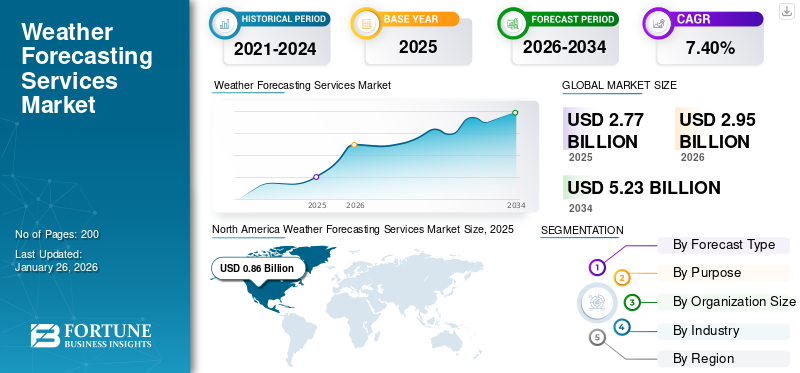
Download Free sample to learn more about this report.
Weather Forecasting Services Market Key Takeaways
 Market Size & Forecast
- 2025 Market Size: USD 2.77 Billion
- 2026 Market Size: USD 2.95 Billion
- 2034 Forecast Market Size: USD 5.23 Billion
- CAGR: 7.40% from 2026–2034
 Market Share
- North America dominated the weather forecasting services market with a 30.90% share in 2025.
- The short-range forecasting segment is projected to account for a 34.24% share in 2026.
- The safety segment is projected to hold a 53.56% share in 2026.
 Key Regional Highlights
Asia Pacific
Asia Pacific generated USD 0.66 billion in 2025 and is projected to reach USD 0.70 billion in 2026.
North America
North America generated USD 0.86 billion in 2025 and is projected to reach USD 0.91 billion in 2026.
Europe
Europe accounted for USD 0.77 billion in 2025 and is expected to reach USD 0.82 billion in 2026.
U.S.
The weather forecasting services market is projected to reach USD 0.70 billion in 2026.
Japan
The weather forecasting services market is projected to reach USD 0.05 billion in 2026.
Read More

IMPACT OF GENERATIVE AI
AI Integration Enhances Forecast Accuracy and Enables Real-Time Decision-Making
Generative AI is transforming the weather forecasting services sector by increasing the accuracy and responsiveness of climate forecasts. AI-powered models can currently process large sets of data from satellites, radars, sensors, and past climate records to create accurate weather scenarios in real time. Such advancements render the enormous human error involved with manual approaches obsolete while allowing for quicker and more credible responses to shifting atmospheric conditions.
Generative AI could be used to make visualizations from different types of forecast models to visualize what the weather may look like to help with planning and decision-making in different sectors, such as agriculture, transportation, and emergency management. Machine learning with generative AI can also provide dynamic simulations using environmental data about humidity levels, wind shear, temperature gradients, and ocean currents. AI-generated systems can help meteorologists ascertain hyperlocal and long-range forecasts. Hyperlocal, high-resolution predictive models using AI and other survey data can produce GIS or remote sensing applications such that authorities can redefine protocols for public safety, preparedness, and response functions concerning severe weather.
- For instance, in May 2025, the Aurora AI model developed by the University of Pennsylvania and Microsoft became a tool for forecasting extreme weather events better than traditional models, especially for ten-day weather forecasts. It is said to have reached a 92% accuracy rate for 10-day global forecasts, beating the established European Centre for Medium-Range Weather Forecasts (ECMWF), among others.
MARKET DYNAMICS
Weather Forecasting Services Market Trends
Digital Transformation and Use of AI-Driven Platforms to Accelerate Industry Expansion
The digitalization of climate systems monitoring and smart platforms is causing a major disruption to the weather forecasting ecosystem. The combination of Artificial Intelligence (AI), Big Data analytics, and cloud computing, which creates new information systems for meteorology, has radically improved the scaling capabilities of weather forecasting models and their speed and accuracy.
Organizations are focusing on transitioning from conventional static forecasting practices to automated, real-time prediction systems that can provide situational weather intelligence. This is also driven by the development of Nowcasting systems based on radar data and Artificial Intelligence (AI) for ultra-short-term predictions, which are imperative for aviation, renewable energy (particularly wind and solar), and public safety authorities.
- For instance, in March 2025, MyRadar secured a U.S. Navy contract to develop AI-driven 4D cloud nowcasting technology, replacing traditional numerical outputs with cloud and weather hazard predictions for operational decision-making.
Market Drivers
Climate Change and Increasing Economic Impact of Extreme Weather Events to Boost Market Growth
Climate-related disasters' rising frequency and severity drive the market. Hurricanes, floods, wildfires, droughts, and heatwaves are causing economic losses and global human lives. This has increased the need for advanced warning systems and real-time weather intelligence among public and private entities.
While governments approach weather preparedness at the national level, enterprises invest in climate risk mitigation instruments to safeguard installations and ensure business continuity. Industries such as aviation, maritime transport, agriculture, energy, and event management use precision weather forecasts to make optimum decisions, reduce downtime, and avert losses.
- For instance, according to the UN and WMO, Impact-Based, People-Centred Multi-Hazard Early Warning Systems (MHEWS) can reduce disaster damage by up to 30% with just 24 hours' notice. Investing USD 800 million in MHEWS in developing nations could prevent annual losses of USD 3 to 16 billion.
Market Restraints
High Cost of Advanced Technology and Infrastructure Deployment May Hinder the Market Growth
The weather forecasting services market growth is severely hampered by the high costs involved in deploying advanced weather forecasting infrastructure. Meteorological stations come with huge costs, such as purchasing satellite data, installing radar systems, and developing AI platforms.
This restraint is felt even more severely in underdeveloped and rural regions, where infrastructural gaps prevail in the lack of skilled personnel that hinders the uptake of modern forecasting technologies. In some geographies, independent variables might be unpredictable, and therefore, the lack of real-time data streams could uphold inconsistency in data accuracy and service reliability.
- For instance, as per the WMO State of the Climate in Africa 2024 report, Sub-Saharan Africa is experiencing severe constraints on real-time weather observation due to limited station coverage and underdeveloped infrastructure. Although AI and mobile technologies are increasing forecasting ability, the report highlights the need for greater climate-smart investments, enhanced data-sharing mechanisms, and inclusive early warning systems to improve regional resilience as a priority.
Market Opportunities
Rising Demand for Hyperlocal Forecasting in Emerging Economies to Bolster Market Growth
The increasing digital network in the developing world provides a huge opportunity for the expansion of weather forecasting services. The emerging economies of Asia Pacific, Africa, and Latin America are experiencing rising climate instability and increasing extreme weather conditions, which result in greater demand for localized, actionable meteorological information. Industries such as smart agriculture, urban planning, renewable energy, and insurance increasingly depend on hyperlocal forecasts to maximize planning and resource allocation.
Moreover, embedding weather APIs into mobile applications, e-commerce sites, and smart city networks is broadening the business use of forecasting services. Enterprises providing SaaS-based weather intelligence and real-time climate analysis can benefit from unexplored market niches, such as local governments, logistics companies, and SMEs in climate-sensitive businesses.
- For instance, in May 2024, IBM partnered with the India Meteorological Department (IMD) to use its AI-powered Weather Company platform for monsoon forecasting. Startups such as CropIn, SatSure, and Skymet are using AI and ML to give farmers local meteorological information. Microsoft and ICRISAT teamed up to create an AI-powered planting advice tool for Andhra Pradesh's groundnut growers.
SEGMENTATION ANALYSIS
By Forecast Type
Short-Range Forecasts Dominate the Market Owing to Real-Time Accuracy and Operational Agility
The market is segmented into nowcast, short-range, medium-range, and long-range, by forecast type.
The short-range forecasting segment is projected to dominate the market with a share of 34.24% in 2026 and is anticipated to depict the highest CAGR over the forecast period. This type of forecasting includes weather predictions generally between 1 and 3 days in duration. Short-range forecasts are widely used in industries from agriculture, transportation, aviation, energy, and logistics as they are trustworthy and can reliably eliminate risk when planning day-to-day operations. As the trends of climate change continue and the volatility of weather patterns rise, the frequencies of digital weather platforms usage and hyperlocal forecasts continue to grow.
Nowcasting provides weather updates from a few minutes up to a few hours ahead and real-time weather updates, which are crucial for air traffic, emergencies, and events. The technology is gaining traction with investments in satellite and monitoring tech.
Medium-range forecasting, looking ahead in the range of 4 to 10 days, is useful to agriculture and utilities by creating opportunities for proactive resource planning and with AI developments improving accuracy. Long-range (weeks to months) forecasts are valuable in insurance, retail, or construction planning decisions.
To know how our report can help streamline your business, Speak to Analyst
By Purpose
Safety-Driven Forecasting Leads the Market Owing to Growing Emphasis on Risk Mitigation and Disaster Planning
By purpose, the market is segmented into safety, operational efficiency, and others.
The safety segment is projected to dominate the market with a share of 53.56% in 2026 and is anticipated to grow at the highest rate over the prediction period. With the increasing uncertainty surrounding climate dynamics and the increase in extreme weather or natural disasters, accurate forecasting is critical for disaster management and emergency planning, ensuring aviation safety, maritime navigation, and protecting public infrastructure. The urgency to mitigate weather-related risks is at the forefront of the agenda for governmental offices, transportation agencies, and energy producers to safeguard human lives and physical assets, demonstrating stability in the segment.
The deployment of forecasting for operational efficiency is rising, particularly across the agriculture, energy, logistics, and utilities sectors. This allows businesses to improve workflows, reduce weather-related delays, and improve resource management.
Others, including insurance planning, tourism, event timing, and sports, to have a stable market presence.
By Organization Size
Large Enterprises Dominate the Market Owing to Higher Investment Capacity and Wide-Scale Operational Demand
The market is segmented by organization size into small & medium-sized enterprises (SMEs) and large enterprises.
The large enterprises segment is projected to dominate the market with a share of 68.14% in 2026 and is set to depict the highest growth rate during the forecast period. These enterprises have a global or regional presence and must provide real-time and location-appropriate weather information for informed decision-making. Industries such as aviation, energy, maritime, logistics, and defense are adopting tailored weather forecasting services to manage risks, optimize operations, and ensure people's safety. These enterprises have more capital to adopt the latest advanced forecasting methodologies and systems that are AI-integrated and satellite-based.
Small and medium-sized businesses (SMEs) are becoming an increasingly important segment, backed by the increasing availability of affordable, subscription-based weather information. Agriculture, retail, tourism, and local transportation SMEs embrace weather data to enhance planning, minimize operational disruption, and satisfy customer needs. The expanding digitalization of weather instruments and the provision of easy-to-use platforms is likely to drive product adoption by SMEs in subsequent years.
By Industry
Transportation Sector Leads the Market Owing to High Dependency on Real-Time Weather Data for Operational Continuity
The market is segmented by industry into transportation, defense, agriculture and forestry, BFSI, media, energy and utilities, construction and mining, retail, and others.
The transportation segment is projected to dominate the market with a share of 22.03% in 2026 due to its critical reliance on accurate and timely weather information. Aviation, shipping, railways, and road transport need real-time updates to schedule flights, ensure cargo safety, plan routes, and prevent accidents. The increased adoption of automated systems and IoT-based transport infrastructure further strengthens the demand for converged weather forecasting services to keep operations running smoothly with minimal disruption and ensure operating safety.
The energy & utilities segment is set to depict the highest growth rate during the forecast period. This expansion is driven by rising reliance on renewable energy (wind, solar, hydro) that requires precise weather forecasting services for grid stability and output optimization.
The defense industry stands out as a key customer, using advanced forecasting services for mission planning, surveillance tasks, and troop safety. Weather data is vital to ensure effective peacetime operations and strategic deployments, particularly in unpredictable climates or areas with high risks.
The agriculture and forestry segment is experiencing rapid growth owing to increasing adoption of weather services to boost crop output, optimize irrigation timing, and avoid losses from random climate occurrences. Combined with weather analytics, precision farming revolutionizes productivity for large and smallholder farms.
The BFSI industry uses weather data to check risk and make insurance products, while the media industry uses it to set up shows and run events. Construction and mining firms use weather updates to boost safety and plans at work sites. The retail industry uses weather data to guess what people want and fix their supply lines, mainly for weather-sensitive things such as clothes and drinks. New uses in tourism and sports show how weather forecasting data helps make operations smooth and decisions better for customers.
WEATHER MONITORING SERVICES MARKET REGIONAL OUTLOOK
North America
North America Weather Forecasting Services Market Size, 2025 (USD Billion)
To get more information on the regional analysis of this market, Download Free sample
In 2025, North America generated USD 0.86 billion, contributing 30.90% to global market revenue, and is projected to grow to USD 0.91 billion in 2026. driven by prominent aerospace and meteorological institutions, a strong digital structure, and sophisticated public-private collaborations. The U.S., as a technological hustler, heads the request due to sweats by NOAA (National Oceanic and Atmospheric Administration), NASA, and private companies such as The Weather Company (IBM) and AccuWeather. The U.S. market is projected to reach USD 0.7 billion by 2026.
The demand is fueled by high-stakes operations in aeronautics security, energy grid operation, agrarian forecasting, and natural disaster forecasting. Integrated machine learning algorithms with high-performance computing platforms enable accurate prognostications, critical during extreme events similar as hurricanes or backfires. Public mindfulness campaigns and mobile app predicted distribution further access throughout the U.S. and Canada.
Download Free sample to learn more about this report.
The weather forecasting services demand is growing significantly in the U.S. due to the increasing demand for accurate weather information within various industries such as energy and utilities, agriculture, and transport. The growth in demand is due to the increasing frequency and intensity of extreme weather events and the need to prepare for and mitigate them. New technologies, such as AI and systems based on satellites, are being applied in weather forecasting to increase the levels of precision and predictability. For instance,
- In September 2024, the U.S. Trade and Development Agency (USTDA) gave technical help to Vanuatu's Meteorology Department (VMGD) to improve weather forecasting and early warning systems. They will use Tomorrow.io's technology to boost disaster resilience and keep the public safer.
To know how our report can help streamline your business, Speak to Analyst
Asia Pacific
Asia Pacific recorded a market size of USD 0.66 billion in 2025, capturing 23.70% of the global market share, and is projected to reach USD 0.7 billion in 2026. The Asia Pacific market is expected to grow at the highest CAGR over the analysis period due to rising climate vulnerability, rapid urbanization, and increasing reliance on monsoon-sensitive sectors such as agriculture, fisheries, and transportation. Countries such as India, China, Japan, and Australia are investing in advanced meteorological systems to tackle climate-related risks and maintain strong disaster preparedness. The Japan market is projected to reach USD 0.05 billion by 2026, the China market is projected to reach USD 0.13 billion by 2026, and the India market is projected to reach USD 0.08 billion by 2026.
India’s IMD (India Meteorological Department) and China’s CMA (China Meteorological Administration) are upgrading to AI-powered forecasting systems and working with private tech firms to share real-time information. Japan’s focus on tsunami and earthquake forecasting propels the regional demand. Governments across Southeast Asia are also introducing weather-based crop insurance programs, which is escalating the demand for hyperlocal forecasts.
Europe
The Europe market accounted for USD 0.77 billion in 2025, representing 27.80% of the global industry, and is expected to reach USD 0.82 billion in 2026. Europe remains a strong market for weather forecasting services, underpinned by investments in sustainable infrastructure and climate resilience. The European Centre for Medium-Range Weather Forecasts (ECMWF) and initiatives under the EU’s Copernicus Programme provide comprehensive Earth observation data, essential for forecasting accuracy across sectors. The UK market is projected to reach USD 0.2 billion by 2026, while the Germany market is projected to reach USD 0.24 billion by 2026.
With increasing occurrences of floods, heatwaves, and seasonal variability, the demand for early warning systems and climate adaptation services is rising sharply. European nations are investing in green energy planning, where precise weather data supports wind and solar energy grid integration. Countries such as Germany, France, and the U.K. are leading the charge in deploying AI-based tools for long-range and real-time forecasting, particularly for transport, maritime operations, and insurance risk modeling.
Middle East and Africa
The Middle East & Africa market generated USD 0.29 billion in 2025, representing 10.50% of the global market landscape, and is expected to reach USD 0.31 billion in 2026. The Middle East and Africa weather forecasting services market is expanding steadily, driven by the need for climate resilience, water resource management, and agricultural risk mitigation. The region is prone to extreme weather conditions such as droughts, sandstorms, flash floods, and heat waves and the demand for tailored forecasting solutions is rising.
In the Middle East, Gulf Cooperation Council (GCC) nations such as the UAE and Saudi Arabia are investing in climate technology as part of their Vision 2030 strategies. The establishment of national weather authorities and satellite-based meteorological systems has been instrumental in supporting sectors such as aviation, oil and gas, and event management (e.g., during global expos or sports tournaments).
In Africa, weather forecasting services are critical for agriculture-dependent economies. However, infrastructure constraints and funding gaps pose challenges. International partnerships (e.g., WMO and African Development Bank) support the region through public-private collaboration models and early warning system deployments.
South America
The South America market is shaped by many environmental ups and downs, with a focus on agriculture, hydroelectric energy, mining, and disaster response. Countries such as Brazil, Argentina, and Chile are improving their forecasting systems to handle better risks linked to deforestation, El Niño effects, and irregular rainfall patterns.
Brazil’s INMET and Argentina’s SMN are important players in the region’s public forecasting scene. Both have started digitizing data collection and making regional models more accurate. One aspect gaining momentum is satellite monitoring of the Amazon rainforest and hydrological forecasting to help manage dams.
Private companies are slowly entering the market with agri-tech solutions that offer crop-level forecasts and irrigation alerts. At the same time, government-backed projects are working to reduce disaster risks through mobile-based early warning platforms.
COMPETITVE LANDSCAPE
KEY INDUSTRY PLAYERS
Market Players Emphasize Strategic Collaborations and AI-led Product Innovation
The global weather forecasting services market is highly dynamic and includes national meteorological agencies, private tech companies, defense departments, and data analytics startups. Industry leaders are investing more money in high-resolution modeling, AI-based analytics, and cloud platforms to provide solutions that meet their users’ needs.
Key players such as The Weather Company, DTN, AccuWeather, Fugro, and Vaisala are working on growing their service offerings through strategic acquisitions, AI-enhanced data pipelines, and expanding into emerging economies.
Long List of Companies Studied
- The Weather Company (U.S.)
- DTN (U.S.)
- Accuweather Inc. (U.S.)
- Fugro (Netherlands)
- Enav S.P.A (Italy)
- Met Office (U.K.)
- Vaisala Oyj (Finland)
- StormGeo (Alfa Laval AB)
- Pelmorex Corp. (Canada)
- BMT Group (U.K.)
- Saildrone Inc. (U.S.)
- UBIMET GmbH (Austria)
- Meteo-Logic (Israel)
- CAMPBELL SCIENTIFIC, INC. (U.S.)
- Climavision (U.S.)
- Precision Weather Services (U.S.)
- Custom Weather (U.S.)
- AerisWeather (U.S.)
- Skymet Weather Services Pvt Ltd. (India)
- MetraWeather (New Zealand)
KEY INDUSTRY DEVELOPMENTS
- January 2025: The Japan Meteorological Agency (JMA) began developing the Himawari-10 geostationary satellite equipped with an advanced imager and a hyperspectral infrared sounder for high-resolution, three-dimensional data of the atmosphere. The next generation satellite will provide detailed temperature and humidity readings throughout various atmospheric layers, significantly enhancing the forecasting of extreme weather incidents.
- December 2024: Vaisala Corporation acquired Maxar Intelligence's WeatherDesk for USD 70 million to enhance its artificial intelligence-driven weather offerings. WeatherDesk offers quick global forecast and weather observation access, with customers in commodity and energy trading and energy demand forecasting.
- November 2024: The India Meteorological Department established a specialized weather forecasting of the Sabarimala Pilgrimage. For the Sabarimala Pilgrimage, rain gauges were deployed at strategic locations and real-time weather updates will be provided soon to assist pilgrims with the area's volatile and often extreme weather.
- October 2024: The Telangana government joined IMD to offer a weather forecasting service at the village level to enhance agricultural planning and disaster preparedness. Farmers and rural communities receive real-time five-day weather forecasts and warnings about extreme weather through convenient digital services.
- October 2024: Vaisala purchased Speedwell Climate Ltd, which is a U.K.-based company that specializes in climate and environmental risk. This acquisition allows Vaisala to move into the insurance space with their subscription-based offering. Speedwell provides data and software applications to design and manage index-based climate risk contracts for sectors including insurance, finance, and renewable energy. The company had nearly GBP 4 million in revenue in 2023.
- October 2024: Vaisala expanded its offering for renewable energy customers by acquiring Nevis Technology Limited, a U.K.-based provider of weather and environmental monitoring systems for offshore facilities and the provision of maintenance for that monitoring equipment. The company services the offshore wind energy sector by supplying vessels and offshore platforms with tools to monitor operational and weather conditions.
- August 2024: The WMO Polar Coupled Analysis and Prediction for Services (PCAPS) project was initialized to improve weather forecasts in the Arctic and Antarctic regions. It aims to advance climate prediction and services for these regions vulnerable to extreme weather and global warming. This effort, lasting through 2028, will seek to improve observational networks and Earth system modelling to support safe living and travel in polar regions.
- May 2024: Tuvalu implemented a highly accurate artificial intelligence (AI) weather forecast system developed with Atmo and the Global Centre for Climate Mobility. The accurate localized updated weather forecasts every 15 minutes can assist in response to climate threats such as sea-level rise and weather incidents. They are also important for disaster preparedness and planning for long-term climate adaptation.
- May 2024: Tomorrow.io, a Boston-based provider of weather intelligence services, secured a USD 10.2 million contract with the U.S. Department of Defense to design and deliver two weather satellites. The satellites will carry microwave sounders engineered for military-grade applications to provide National Defense Authorities with environmental awareness for defense contexts.
- March 2024: Huawei Cloud and the Meteorological Bureau of Shenzhen Municipality launched the Zhiji Regional Model, using artificial intelligence to develop high-resolution five-day forecasts at a 3 km resolution. The predictions are superior to traditional models of this type at a global scale and will allow better local disaster prevention by tapping into the massive amount of data led by artificial intelligence.
- February 2024: Honeywell Aerospace Technologies and NOAA’s National Weather Service initiated a two-year agreement to deploy a ground-based HALAS (High-Altitude LiDAR Atmospheric Sensing) system. The purpose of this project is to assess whether the system can generate high-altitude atmospheric data for use in improving weather forecasts' accuracy and dependability.
- February 2024: The Indian Space Research Organization (ISRO) launched INSAT-3DS, a next-generation weather satellite for the Ministry of Earth Sciences. It was flown on the GSLV-F14 rocket. The satellite will improve India's ability to observe and forecast climate and weather, particularly rainfall and weather variability, helping communities better manage weather-related vulnerabilities.
REPORT COVERAGE
The report provides a detailed analysis of the market and focuses on key aspects such as leading companies, forecast type, purpose, organization size, and industry of the service. Besides, the report offers insights into the market trends and highlights key industry developments. In addition to the factors mentioned above, the report encompasses several factors that contributed to the growth of the market in recent years.
Request for Customization to gain extensive market insights.
REPORT SCOPE & SEGMENTATION
|
ATTRIBUTE |
DETAILS |
|
Study Period |
2021-2034 |
|
Base Year |
2025 |
|
Estimated Year |
2026 |
|
Forecast Period |
2026-2034 |
|
Historical Period |
2021-2024 |
|
Growth Rate |
CAGR of 7.40% from 2026 to 2034 |
|
Unit |
Value (USD Billion) |
|
Segmentation |
By Forecast Type
By Purpose
By Organization Size
By Industry
By Region
|
|
Companies Profiled in the Report |
The Weather Company (U.S.), DTN (U.S.), Accuweather Inc. (U.S.), Fugro (Netherlands), Enav S.P.A (Italy), Met Office (U.K.), Vaisala Oyj (Finland), StormGeo (Alfa Laval AB), Pelmorex Corp. (Canada), BMT Group (U.K.) |
Frequently Asked Questions
According to Fortune Business Insights, the market is projected to reach USD 5.23 billion by 2034.
In 2025, the market was valued at USD 2.77 billion.
The market is projected to grow at a CAGR of 7.40% during the forecast period.
On the basis of forecast type, the short-range segment is the leading segment in the market.
Climate change and increasing economic impact of extreme weather events is the key factor driving market growth.
The Weather Company, DTN, Accuweather Inc., Fugro, and Enav S.P.A are the top players in the market.
North America holds the highest market share.
By industry, the energy & utilities segment is expected to grow at the highest CAGR during the forecast period.


- 2021-2034
- 2025
- 2021-2024
- 200
Get 30-60 hrs Free Customization
Expand Regional and Country Coverage, Segments Analysis, Company Profiles, Competitive Benchmarking, and End-user Insights.


















Related Reports
-
US +1 833 909 2966 ( Toll Free )
-
Get In Touch With Us