Inflatable Toys Market Size, Share & Industry Analysis, By Type (Pools, Castles, Slides, Balls, and Others), By End-user (Residential and Commercial), By Distribution Channel (Specialty Stores, Supermarkets & Hypermarkets, Online Stores, and Others), and Regional Forecast, 2026-2034
 Download Free Sample
(Offer valid till 15th Oct 2026)

KEY MARKET INSIGHTS
 Listen to Audio Version
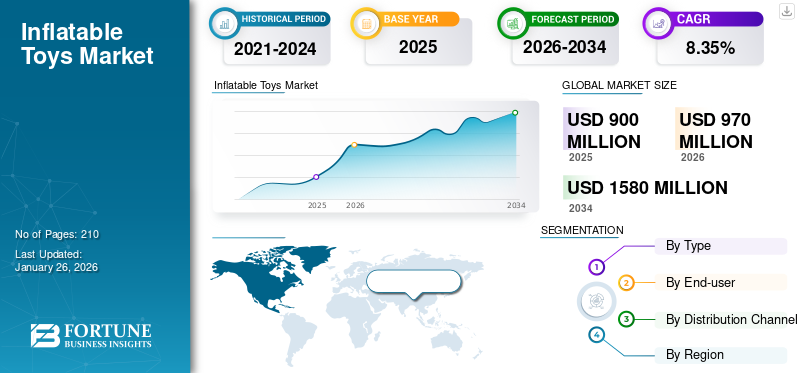
The global inflatable toys market size was valued at USD 900.00 million in 2025 and is projected to grow from USD 970.00 million in 2026 to USD 1,580.00 million by 2034, exhibiting a CAGR of 8.35% during the forecast period. North America dominated the inflatable toys market with a market share of 33.34% in 2025.
An inflatable toy is primarily made from materials, such as polyvinyl chloride, that can be inflated with air or gas for recreational and leisure purposes. These products include inflatable pools, animals, balls, castles, play homes, slides, bounce houses, and other similar items designed for children and adults. Inflatable-type toys are generally affordable and easy to install, maintain, and store, which attracts families and recreational venues with limited space, further propelling the global market share.
Leading firms including Intex Recreation Corp., JB Inflatables, Bestway Inflatables and material corp., are heavily investing in research and development to create inflatable-type toys that combine advanced materials with interactive and safety-enhancing features. This includes integrating smart materials and electronics to improve durability, portability, and user engagement, further contributing to market growth.
Download Free sample to learn more about this report.
Download Free sample to learn more about this report.
Inflatable Toys Market Key Takeaways
 Market Size & Forecast
- 2025 Market Size: USD 900.00 Million
- 2026 Market Size: USD 970.00 Million
- 2034 Forecast Market Size: USD 1,580.00 Million
- CAGR: 8.35% from 2026–2034
 Market Share
- North America dominated the inflatable toys market with a 33.34% share in 2025.
- The pools segment is projected to lead the market with a 30.93% share in 2026.
- The commercial segment is expected to account for 58.76% of the market in 2026.
 Key Regional Highlights
North America
North America generated USD 300 million, accounting for 33.34% of the global market in 2025.
Asia Pacific
Asia Pacific recorded a market size of USD 270 million in 2025 and is projected to grow at a 6.67% CAGR during the forecast period.
Europe
Europe reached USD 230 million, representing 25.90% of global market revenue in 2025.
U.S.
The market is projected to reach USD 260 million by 2026.
Japan
The market is projected to reach USD 23.64 million by 2026.
Read More

Market Dynamics
Market Drivers
Growing Popularity of Inflatable Toy Products Among Children and Parents to Support Market Growth
Inflatable toys are soft and less likely to cause injuries, making them a preferred choice for parents seeking safe play options for their children. This safety aspect has increased their demand, especially in kindergartens and playschools, where child safety is the top priority. Besides, with more dual-income households, parents seek innovative and engaging toys that keep children entertained safely at home. Growing focus on providing convenient recreational options without requiring constant supervision or expensive outings is fostering inflatable toys market growth. For instance, according to the Pew Research Center survey analysis, marriages where both spouses contribute nearly equally, each earning between 40% and 60% of the couple’s total income, have grown significantly. Currently, 29% of marriages are egalitarian in 2022, compared to just 11% in 1972.
Rising Demand for Inflatable Toys from Educational Institutions to Aid Market Growth
Educational institutions use inflatable playing toys to promote physical activity, coordination, and social interaction among children. These toys help in the physical and mental growth of children by encouraging active play, teamwork, and healthy competition, which aligns well with early childhood education goals. Moreover, the increasing number of kindergartens and playschools globally is driving demand for safe and engaging play equipment. Inflatable-type toys fit this need perfectly, thus expanding their market penetration in educational sectors. For instance, according to the British Council survey on Indian Educational Statistics, in 2021-22, almost 2,400 new higher education institutions were established, and student enrollment in higher education rose by nearly 2 million within a single year.
Market Restraints
Vulnerability to Damage and Limited Lifespan to Restrict Market Growth
Inflatable toys are prone to punctures, leaks, and damage from sharp objects or rough handling, which can cause sudden deflation of the products. This fragility leads to higher rates of product returns and customer dissatisfaction, negatively impacting product sales. Therefore, frequent repairs or replacements increase the total cost of ownership for consumers, discouraging repeat purchases and limiting market expansion.
Market Opportunities
Expansion of E-commerce and Online Retail to Surge Market Growth
E-commerce platforms enable inflatable toy manufacturers and retailers to reach a global audience beyond the limitations of physical stores to cater to growing consumer preferences. Consumers across regions can easily browse, compare, and purchase a wide variety of inflatable toy products, including niche and innovative products, without geographical constraints. Furthermore, online retail offers the convenience of shopping anytime from home, eliminating the need to visit multiple stores. This is particularly attractive to busy parents who prefer hassle-free purchasing experiences, further augmenting market expansion. For instance, according to the IBEF data, in FY 2024, Google, Meta, Amazon, and Flipkart collectively earned over USD 7.19 billion in advertising revenue, reflecting a 9% rise from USD 6.60 billion in FY 2023.
Market Challenges
High Initial and Maintenance Costs to Challenge Market Growth
Large or custom inflatable toy products, such as bounce houses, obstacle courses, or commercial-grade inflatables, require considerable initial capital for purchase and setup. This high entry cost can discourage small businesses, schools, and budget-conscious consumers from investing, restraining market penetration. Besides, high initial and recurring costs can reduce consumer willingness to buy or replace inflatable playing toys, hindering market growth.
Inflatable Toys Market Trends
Growing Trend of Outdoor Activities and Family Vacations to Foster Market Development
Outdoor and water-based activities peak during warmer months and holiday seasons, driving seasonal spikes in inflatable playing toy sales. This cyclical demand contributes to sustained market growth as families prepare for vacations and outdoor events. Therefore, inflatable toy products can be quickly set up and stored, making them suitable for various outdoor environments with limited space, such as parks or holiday rentals. This flexibility supports their growing adoption among families seeking convenient outdoor play solutions, boosting inflatable toy market trends. For instance, according to the Outdoor Industry Association, in 2022, the number of outdoor recreation participants increased by 2.3%, reaching a record of 168.10 million people, which represents 55% of the U.S. population aged six and above.
Impact of COVID-19
During the early stages of the COVID-19 pandemic, lockdowns, travel restrictions, and business shutdowns worldwide disrupted manufacturing operations and supply chains, leading to delays in product deliveries and reduced availability of inflatable-type toys. Also, consumer demand sharply declined due to economic uncertainty and reduced incomes, which made buyers more cautious, leading to a cutback on non-essential purchases, including inflatable playing toys.
Segmentation Analysis
By Type
Popularity and Affordability Features of Pools to Make Them Dominant
Based on type, the market is divided into pools, castles, slides, balls, and others.
The pools segment is anticipated to lead the market during the forecast period. Inflatable pools are surging in popularity due to their affordability compared to permanent pools. The high costs of building and maintaining traditional swimming pools make inflatables an attractive, budget-friendly alternative for families seeking recreational water activities at home. This segment is projected to dominate the market with a share of 30.93% in 2026.
The castles segment is expected to be the fastest-growing segment in the forecast period. Inflatable castles, or bouncy castles, have evolved from simple children's party attractions to versatile entertainment solutions for all ages. Their attractions now span birthday parties, festivals, corporate events, weddings, and even fitness classes, making them a staple at a wide range of gatherings.
To know how our report can help streamline your business, Speak to Analyst
By End-user
Increasing Demand for Inflatable Pools and Castles in Events and Amusement Parks Fosters Commercial Segment Growth
By end-user, the market is divided into residential and commercial.
The commercial segment is projected to dominate the market with a share of 58.76% in 2026. The commercial segment includes amusement parks, water parks, event rentals, shopping malls, and entertainment centers. These venues require large, durable, and often custom-designed inflatable castles and toys to attract and entertain large crowds, driving significant demand and higher-value sales. This segment is poised to grow with a CAGR of 6.02% during the forecast period (2025-2032).
The residential segment is predicted to be the fastest-growing segment in the market. Increasing parental spending on children's toys and a desire for convenient, safe, and affordable home entertainment are driving growth in the residential segment. Inflatable type toys for home use, such as pools, slides, balls, and playhouses, are especially popular for their ease of setup and storage. The segment is anticipated to capture a share of 40% in 2025.
By Distribution Channel
Increasing Visibility of Toys in Supermarkets & Hypermarkets Assisted Segment Growth
In terms of distribution channel, the market is subdivided into specialty stores, supermarkets & hypermarkets, online stores, and others.
The supermarkets & hypermarkets segment attained the dominant share of the global market. Supermarkets & hypermarkets attract significant daily footfall, increasing the visibility of inflatable toys and driving impulse purchases. Besides, consumers often trust established supermarket and hypermarket brands, feeling confident in product quality and safety standards. The segment is predicted to grow with a CAGR of 7.05% during the forecast period (2025-2032).
The online stores segment is projected to grasp a significant share in the near term. E-commerce platforms offer a vast range of inflatable-type toys, including niche and specialty products that may not be available in retail stores. Also, competitive pricing, frequent discounts, and bundled deals further attract price-sensitive shoppers to incline toward online platforms.
- The specialty stores are set to gain 36.08% of the market share in 2026.
Inflatable Toys Market Regional Outlook
By region, the market is studied across North America, Europe, Asia Pacific, South America, and the Middle East & Africa.
North America
North America Inflatable Toys Market Size, 2025 (USD Million)
To get more information on the regional analysis of this market, Download Free sample
North America contributed approximately USD 300 million to the global market in 2025, accounting for 33.34% share, and is expected to reach USD 320 million in 2026, due to the significant U.S. and Canadian consumers’ spending on toys for playful activities. In addition, increasing popularity of inflatable playing toys for outdoor recreational activities drive product sales across North America. Parents in the region extensively purchase inflatable slides, pools, playhouses, and inflatable animals for children, driven by a strong culture of outdoor family fun and active play. For instance, according to the Outdoor Industry Association data published in 2022, the number of outdoor recreation participants in the U.S. increased from 152.5 million in 2019 to 164.2 million in 2021.
The U.S. benefits from well-established distribution networks, including supermarkets, hypermarkets, specialty stores, and a rapidly growing online retail segment. Specialty stores hold a significant market share due to their wide product assortments and knowledgeable staff, enhancing customer satisfaction and sales. For instance, according to the U.S. Department of Commerce, retail trade sales increased by 1.4% in March 2025, compared to February 2025, and rose by 4.6% compared to the same period of 2024. The U.S. market is growing and is poised to be worth USD 260 million in 2026.
Asia Pacific
Asia Pacific is the second leading region, anticipated to be worth USD 270 million in 2025, exhibiting a CAGR of 6.67% during the forecast period (2025-2032). The region has witnessed significant urban growth and a rising middle-class population with increasing disposable incomes. This demographic shift fuels higher spending on leisure and home entertainment products, including inflatable pools, slides, animals, and others. China is expected to stand at USD 97.68 million in 2026. Besides, countries such as China, India, and Japan contribute substantially to the market size due to their large populations and increasing awareness of child safety and development, driving demand for inflatable-type toys. For instance, according to the Ministry of Statistics and Programme Implementation (MOSPI), the disposable personal income of India increased from USD 3.30 million in 2022 to USD 3.55 million in 2023. India is set to reach USD 88.84 million in 2026, Japan is estimated to hit USD 23.64 million in the same year.
Europe
In 2025, the Europe market stood at USD 230 million, representing 25.90% of global demand, and is projected to grow to USD 250 million in 2026. The region’s diverse cultural events, festivals, and seasonal outdoor activities generate temporary but significant spikes in demand for inflatable toys, contributing to overall market vitality. The U.K. market is expected to grow with a valuation of USD 40.52 million in 2026. Besides, the region hosts major global toy companies such as Hasbro, Mattel, LEGO Group, and Spin Master, which invest in expanding product portfolios and strategic alliances, further strengthening significant growth within the market. For instance, in March 2025, Moose Toys, an Australian toy manufacturer, accelerated its European growth strategy by expanding its direct-to-retail operations into Spain and Portugal. This expansion strengthens Moose’s position as a leading player in Europe, complementing its existing direct-to-retail presence in the U.K., France, and Germany. The market in Germany is set to be valued at USD 47.67 million in 2026, while France is anticipated to stand at USD 36.58 million in the same year.
South America and Middle East & Africa
In 2025, Middle East & Africa generated USD 36.31 million, contributing 4.03% to global market revenue, and is projected to grow to USD 37.6 million in 2026. South America is the fourth leading region, projected to reach USD 63.15 million in 2025. Rising disposable incomes and improving living standards in South American countries, such as Brazil, Argentina, and others, are driving consumer spending on recreational and outdoor toys, including inflatables. In the Middle East and Africa regions, mainly, there is rising awareness about the developmental benefits of sports and outdoor toys for children, which is encouraging purchases of inflatable-type toys by families and educational institutions, further surging product demand. The UAE market is expected to grow with a valuation of USD 5.44 million in 2025.
Competitive Landscape
Key Market Players
Increasing Investment toward R&D by Key Players to Boost Market Growth
Leading companies in the market invest heavily in research and development to create inflatable playing toys with enhanced durability, safety features, and interactive designs. They focus on integrating advanced materials that are lightweight, more resilient, and eco-friendly, which improves product quality and meets rising consumer expectations for safety and sustainability. Besides, toy manufacturers are offering personalized and themed inflatable playing toys to cater to diverse consumer preferences, including children’s entertainment, educational use, and promotional events, increasing market growth. For instance, in 2020, the Indian Government of India launched an updated version of India’s Production-Linked Incentive (PLI) scheme for the toy sector, which is in the advanced stages of finalization, with an expected outlay of around USD 421 million in March 2025.
List of Key Inflatable Toy Companies Profiled:
- Joyin Inc. (U.S.)
- Intex Recreation Corp. (U.S.)
- Bestway Inflatables & Material Corp (U.S.)
- JB Inflatables (U.K.)
- Bounceabouts Leisure Ltd (U.K.)
- Omega Inflatables (China)
- HearthSong (U.S.)
- Little Tikes (U.S.)
- ViPa Inflatables (Germany)
- Water Toys Canada (Canada)
Key Industry Developments
- April 2025 – White Castle launched a new spring merchandise collection featuring an 8-foot-tall bouncy castle designed to look like an actual White Castle building. This inflatable fun house is made to order and sized for all ages, allowing up to five kids or one adult and three children to bounce at a time.
- September 2024 – FunAir expanded its lineup of superyacht inflatables with the introduction of the Splash Dome and Splash Tower, two innovative products designed to enhance on-water entertainment for yacht owners, charter guests, and crew.
- May 2024 – FUNBOY launched its first major retail collection, ‘Float Life by FUNBOY,’ exclusively at Walmart. This new line aims to make the brand’s signature high-quality, stylish inflatables more accessible, with prices ranging from USD 12 to USD 30. The Float Life collection includes a variety of summer essentials, such as inflatable tube floats, sun loungers, and kiddie pools, all featuring FUNBOY’s iconic prints and durable construction.
- February 2024 – EyeCandy Inflatables introduced a new line of state-of-the-art inflatable slides. Their collection features innovative designs such as the dual-lane Cabin Slide Dual 21' Wet/Dry and other themed combos such as Beach Party, Donut Combo, and Ice Cream Shop Combo, all designed for both wet and dry use.
- March 2023 - Intex Recreation Corp. launched a new line of inflatable stand-up paddle boards (SUPs) in early 2023 under the AquaQuest brand. The launch included two models, the AquaQuest 240 and AquaQuest 320, for spring outdoor activities.
REPORT COVERAGE
The inflatable toys market research report provides a comprehensive analysis, focusing on key elements such as major companies, regional and market segmentation, regional analysis, competitive dynamics, product categories, and distribution channels. Additionally, it offers insights into market trends and highlights significant developments within the industry. Beyond these aspects, it also examines various factors that have contributed to market growth in recent years.
Request for Customization to gain extensive market insights.
Report Scope & Segmentation
|
ATTRIBUTE |
DETAILS |
|
Study Period |
2021-2034 |
|
Base Year |
2025 |
|
Estimated Year |
2026 |
|
Forecast Period |
2026-2034 |
|
Historical Period |
2021-2024 |
|
Growth Rate |
CAGR of 8.35% from 2026 to 2034 |
|
Unit |
Value (USD Million) |
|
Segmentation |
By Type
By End-user
By Distribution Channel
By Region
|
Frequently Asked Questions
Fortune Business Insights says that the global market size stood at USD 970 million in 2026 and is anticipated to record a valuation of USD 1,580.00 million by 2034.
Fortune Business Insights says that the global market value stood at USD 900 million in 2025.
The global market will exhibit a CAGR of 8.35% during the forecast period of 2026-2034.
By type, the pools segment is predicted to dominate the market during the forecast period of 2026-2034.
The growing popularity of inflatable toy products among children and parents is a key factor driving the global market.
Joyin Inc., Intex Recreation Corp., Bestway Inflatables & Material Corp, JB Inflatables, and Bounceabouts Leisure Ltd. are some of the leading players globally.
North America dominated the global market in 2025.



- 2021-2034
- 2025
- 2021-2024
- 210
-
(Offer valid till 15th Oct 2026)
Get 30-60 hrs Free Customization
Expand Regional and Country Coverage, Segments Analysis, Company Profiles, Competitive Benchmarking, and End-user Insights.



















Related Reports
-
US +1 833 909 2966 ( Toll Free )
-
Get In Touch With Us