 Download Free Sample



Get a Quote
Receive a tailored pricing based on your needs.
- Choose license type
- Multiple user options
- Custom scope & coverage
- Fast turnaround
"Designing Growth Strategies is in our DNA"
 Listen to Audio Version
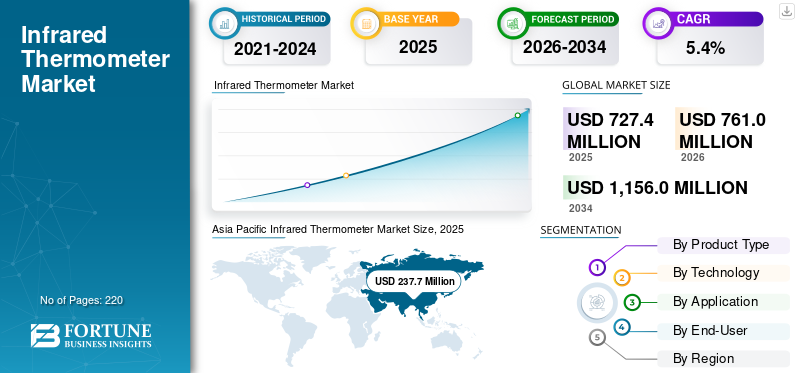
The global infrared thermometer market size was valued at USD 727.4 million in 2025 and is projected to grow from USD 761.0 million in 2026 to USD 1,156.0 million by 2034, exhibiting a CAGR of 5.4% during the forecast period. Asia Pacific dominated the infrared thermometer market with a market share of 32.67% in 2025.
Infrared thermometers are non-contact tools that read surface temperature by detecting infrared energy. They are used widely outside healthcare, especially in factories, electrical maintenance, utilities, food processing, and building inspection, as they deliver fast readings without touching hot, moving, or hard-to-reach parts. The market growth is attributed to rising emphasis on the implementation of safety guidelines, integration of smart technologies, and growing preference for safer work practices and more preventive maintenance, where technicians routinely scan motors, bearings, panels, and conveyors to spot overheating early and reduce unplanned downtime.
Many key industry players, such as Fluke Corporation, FLIR Systems, Inc., Optris GmbH, Testo SE & Co. KGaA, and AMETEK, Inc., operating in the market, are focusing on developing various innovative technologies to offer better products with improved accuracy and efficiency.
Download Free sample to learn more about this report.
 Global Market Size & Forecast
 Market Share
 Key Regional Highlights
Asia Pacific
Asia Pacific led the global market and is projected to reach USD 249.7 million in 2026.
North America
North America reached USD 202.9 million in 2025, maintaining a substantial market position.
Europe
Europe is projected to reach USD 197.4 million in 2026, with a growth rate of 4.7%.
U.S.
The market is estimated at USD 180.5 million in 2026, accounting for approximately 23.7% of global sales.
Japan
The market is estimated at USD 43.3 million in 2026, accounting for approximately 4.6% of global revenues.
Read More

Rising Demand for Smaller and Smarter Tools is a Significant Market Trend
There is a considerable demand for compact and smarter tools that allow efficient reporting. Nowadays, users want more than a single parameter, such as repeatable checks, simple records, and faster decisions. As a result, infrared thermometers are being paired with apps or software so teams can save readings, add notes, and compare results over time. This makes it easier to prove maintenance work, share findings, and train technicians. Moreover, manufacturers are also adding features that help with aiming and setup to reduce human error.
Download Free sample to learn more about this report.
Substantial Use in Rapid Patient Screening and Infection Control to Accelerate Market Growth
Healthcare facilities continue to use infrared thermometers for quick and non-contact temperature screening in outpatient departments, emergency rooms, and public entry points. Moreover, these devices help staff check patients and visitors without physical contact, which supports infection control practices and improves workflow speed. Even after the peak pandemic period, many hospitals and clinics have kept routine temperature screening as part of standard triage protocols. The product is also useful in pediatric and high-throughput settings where fast readings are important. Such factors are expected to drive the global infrared thermometer market growth during the forecast period.
Accuracy Concerns in Clinical Settings to Deter Market Growth
One key restraint in the market is concern about reading accuracy in clinical environments. Non-contact thermometers can be affected by factors such as distance, ambient temperature, sweat, and improper aiming, which may lead to inconsistent results. Due to this, some healthcare providers still prefer traditional contact thermometers for confirmatory measurements, especially in critical care situations.
Expansion of Home Healthcare and Remote Patient Monitoring to Offer Lucrative Growth Opportunities
The growing shift toward home healthcare and remote patient monitoring is creating new opportunities for infrared thermometers. Patients and caregivers increasingly prefer simple, non-contact devices that can be used safely at home, especially for children, elderly individuals, and chronically ill patients. In addition, healthcare providers are also encouraging home-based temperature monitoring to reduce unnecessary hospital visits and improve early detection of infections. Moreover, the product fits well into this trend as they are quick, easy to use, and requires minimal training.
Strong Competition and Price Pressure to Pose a Critical Challenge to Market Growth
The infrared thermometers market faces strong competition due to the presence of many global and regional manufacturers offering similar products. This has led to significant price pressure, especially in the handheld segment, where products are often compared mainly on cost. Hospitals, distributors, and industrial buyers frequently negotiate aggressively, which can reduce profit margins for suppliers. In addition, low-cost entrants make it harder for premium brands to differentiate purely on basic functionality.
Portable Segment to Dominate due to Prefer Handheld Tools
Based on the product type, the market is divided into fixed and portable.
The portable segment is anticipated to account for the largest infrared thermometer market share. The portable segment dominates as most temperature checks happen during walk-around inspections. In addition, maintenance teams prefer handheld tools that fit in a pocket, start quickly, and work without complex setup. They are also easier to share across shifts and contractors, which is common in factories and utilities. Moreover, portable models suit many day-to-day tasks such as checking motors, bearings, pumps, ovens, and electrical connections.
The fixed segment is anticipated to rise with a CAGR of 4.9% over the forecast period.
To know how our report can help streamline your business, Speak to Analyst
Single-Wavelength Infrared Thermometers due to Affordability
Based on technology, the market is segmented into single-wavelength infrared thermometers, dual-wavelength (ratio) infrared thermometers, and others.
In 2025, the single-wavelength infrared thermometers segment dominated the global market. Single-wavelength infrared thermometers remain the most common choice as they are simple, affordable, and good enough for many routine checks. In addition, they work well when users measure consistent surfaces and follow basic rules for distance and aiming. For many industrial tasks, such as screening for unusual heat on equipment teams, mainly need repeatable comparisons rather than laboratory-level precision. Single-wavelength devices also tend to be smaller and easier to maintain, which suits portable use.
The dual-wavelength (ratio) infrared thermometers segment is projected to grow at a CAGR of 5.5% during the study period.
Industries Use Infrared Thermometers for Quick Checks in Manufacturing, Boosting Non-Medical Application Segment Growth
Based on application, the market is segmented into medical and non-medical.
In 2025, the non-medical segment dominated the global market. Most demand comes from non-medical uses, as temperature is a universal indicator of risk in machines and facilities. Moreover, industries use infrared thermometers for quick checks in manufacturing, power generation, electrical maintenance, food processing, automotive, and building services. These tools help spot overheating parts, confirm process stability, and support quality checks without interrupting operations.
The medical segment is projected to grow at a CAGR of 5.1% during the study period.
Availability of Heat—Intensive Equipment in Industrial Factories to Boost Industrial Facilities Segment Growth
Based on end-user, the market is segmented into healthcare facilities, industrial facilities, homecare settings, and others.
In 2025, industrial facilities held the highest market share as they run heat-intensive equipment and cannot afford downtime. Infrared thermometers are used daily in maintenance rounds to check motors, conveyors, furnaces, compressors, and electrical cabinets. Moreover, these sites also have structured safety programs, making non-contact measurement attractive where surfaces are hot or moving. Industrial facilities typically buy multiple units for different zones and shifts, and they replace tools as they wear out. Furthermore, the segment is set to hold 37.0% share in 2026.
The homecare settings segment is projected to grow at a CAGR of 5.2% during the study period.
By geography, the market is categorized into Europe, North America, Asia Pacific, Latin America, and the Middle East & Africa.
Asia Pacific Infrared Thermometer Market Size, 2025 (USD Million)
To get more information on the regional analysis of this market, Download Free sample
North America held a substantial share in 2024, valued at USD 194.7 million, and also maintained its leading share in 2025, with USD 202.9 million. The market in the region is expected to increase due to the higher prevalence of infectious diseases and strict food and safety regulations.
Based on North America’s strong contribution and the U.S. dominance within the region, the U.S. market stood at around USD 180.5 million by 2026, accounting for roughly 23.7% of global sales.
Europe is projected to record a growth rate of 4.7% in the coming years and reach a valuation of USD 197.4 million by 2026. The region is estimated to witness considerable market growth due to rising investments for new product development and technological advancements in sensors and AI.
The U.K. market in 2026 reached around USD 32.0 million, representing roughly 4.2% of global revenues.
Germany’s market reached approximately USD 44.4 million in 2026, equivalent to around 5.8% of global sales.
Asia Pacific dominated the global market and reached USD 249.7 million by 2026 and secured the position of the largest region in the market.
The Japanese market in 2026 stood at around USD 43.3 million, accounting for roughly 4.6% of global revenues.
China’s market is projected to be one of the largest worldwide, with 2026 revenues estimated at around USD 82.9 million, representing roughly 10.9% of global sales.
The Indian market is estimated to touch around USD 55.4 million, accounting for roughly 7.3% of global revenues.
The Latin America and Middle East & Africa regions are expected to witness moderate growth in this market during the forecast period. The Latin America market is set to reach a valuation of USD 62.2 million by 2026. In the Middle East & Africa, the GCC is set to reach a value of USD 14.9 million by 2026.
The South African market is projected to reach around USD 6.1 million by 2026, representing roughly 0.80% of global revenues.
Rising Number of Collaborations and Technological Adoptions by Key Players to Boost Market Progress
The global market holds a fragmented market structure, constituting prominent players such as Fluke Corporation, FLIR Systems, Inc., Optris GmbH, Testo SE & Co. KGaA, and AMETEK, Inc. The significant global infrared thermometer market share of these companies is due to numerous strategic activities, including distribution collaborations and the implementation of new programs.
Other notable players in the global market include OMEGA Engineering Inc., Klein Tools, Inc., Exergen Corporation, and Omron Corporation. These companies are expected to prioritize collaborations to increase their global market share during the forecast period.
The global infrared thermometer market analysis includes a comprehensive study of the market size & forecast by all the market segments included in the report. It includes details on the market dynamics and market trends expected to drive the market over the forecast period. It provides information on key aspects, including an overview of technological advancements, the regulatory environment, and product launches. Additionally, it details partnerships, mergers & acquisitions, as well as key industry developments and investments by key regions. The global market research report also provides a detailed competitive landscape with information on the market share and profiles of key operating players.
Request for Customization to gain extensive market insights.
| ATTRIBUTE | DETAILS |
| Study Period | 2021-2034 |
| Base Year | 2025 |
| Estimated Year | 2026 |
| Forecast Period | 2026-2034 |
| Historical Period | 2021-2024 |
| Growth Rate | CAGR of 5.4% from 2026 to 2034 |
| Unit | Value (USD Million) |
| Segmentation | By Product Type, Technology, Application, End-User, and Region |
| By Product Type |
|
| By Technology |
|
| By Application |
|
| By End-User |
|
| By Region |
|
According to Fortune Business Insights, the global market value stood at USD 727.4 million in 2025 and is projected to reach USD 1,156.0 million by 2034.
In 2025, the market value stood at USD 202.9 million.
The market is expected to exhibit a CAGR of 5.4% during the forecast period.
By product type, the portable segment is expected to lead the market.
Rising prevalence of infectious diseases is driving market expansion.
Fluke Corporation, FLIR Systems, Inc., Optris GmbH, Testo SE & Co. KGaA, and AMETEK, Inc. are the major players in the global market.
Asia Pacific dominated the market in 2025.

Get 30-60 hrs Free Customization
Expand Regional and Country Coverage, Segments Analysis, Company Profiles, Competitive Benchmarking, and End-user Insights.













.webp)






Related Reports
Get In Touch With Us
US +1 833 909 2966 ( Toll Free )
Receive a tailored pricing based on your needs.
Discuss your questions with our industry experts.
Have questions? Get quick answers before you purchase.

